
Laser Cut Toys and 3D Puzzles: 12 Free SVG and DXF Files
Laser cut toys are flat parts that slot or fold into a model, a game or a puzzle. The 12 free files below range from a 142 mm chainsaw cutout that cuts in about 1.5 minutes on a 10 W diode to a three-level toy car garage of about 1187 × 606 mm that takes almost 3 hours. Some slots are drawn for 3 or 4 mm sheet; for the bus, race car and cable car you measure the slot width and match your material to it.
The bus is half built on the kitchen table, one seat is missing, and a seven-year-old is under the chair with a torch looking for it. That is the best kind of evening a laser can give you. Laser cut toys start as flat sheets and end as something you can hold, roll and play with, and the kid who helped press out the parts will defend that bus forever.
Below are 12 free toy and 3D puzzle files from the DXF World library: slot-together vehicles, a three-level parking garage, doll furniture, a checkers board, learning puzzles and a few quick cardboard and felt projects. Each one comes as SVG and DXF, and you will find them all in toys and games and 3D puzzles and models.
All 12 laser cut toys compared
| File | Layout size, mm | Material | 10 W diode | 40 W CO2 |
|---|---|---|---|---|
| City bus 3D puzzle | 381 × 414 | Measure the slots | about 45 min | about 19 min |
| Race car 3D puzzle | 353 × 434 | Measure the slots | about 43 min | about 18 min |
| Cable car gondola | 296 × 194 | Measure the slots | about 18 min | about 7 min |
| Tricycle planter | 299 × 261 | 3 mm sheet | about 34 min | about 14 min |
| Three-level toy garage | 1187 × 606 | 3 mm sheet | about 2 h 51 min | about 1 h 11 min |
| Doll rocking chair set | 283 × 289 | 4 mm sheet | about 20 min | about 8 min |
| Chainsaw cutout | 142 × 43 | Any sheet | about 1.5 min | under 1 min |
| Chinese checkers board | 457 × 457 | Board + backing disc | about 21 min | about 9 min |
| Jigsaw grids, 10 sizes | 1014 × 419 | 3 mm board + print | about 2 h 8 min | about 53 min |
| Cyrillic alphabet and numbers | 946 × 481 | 3–6 mm plywood | about 1 h 15 min | about 31 min |
| Fold-up elephant | 210 × 157 | Card or cardboard | about 6 min | about 2.5 min |
| Giant mouse cat mat | 584 × 249 | Felt or cardboard | about 6 min | about 2.5 min |
Times are estimates for the whole layout at the drawn size; your speed, power and passes change them. On the cards below, the parts figure counts every closed cut shape, windows and holes included, so you will hold fewer loose pieces.
Laser cut 3D puzzle models that slot together
A laser cut 3D puzzle is a set of flat parts with slots that lock into each other at right angles. No glue is needed when the fit is right, and getting the fit right is the whole trick (next section).
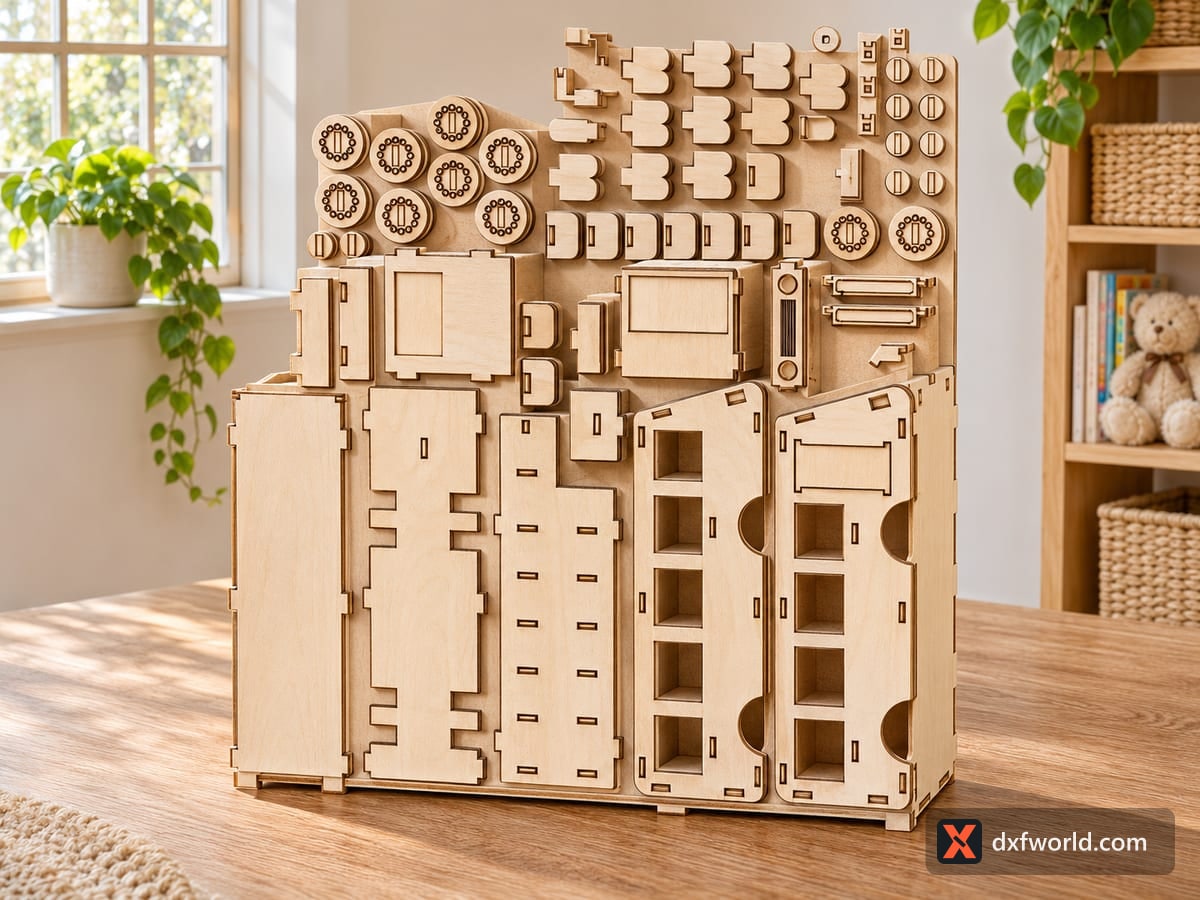 Slot-Together Bus ModelSize 381 × 414 mm (15.01 × 16.31 in)Est. time, 10 W diode (3 mm) 44 min 47 sEst. time, 40 W CO2 (3 mm) 18 min 40 sSVG · DXF →
Two tall side panels with five square windows each, a slotted floor that carries rows of seats, and a front grille with two lamp holes. With this many joints, a slot that is a little loose on every part adds up to a wobbly bus, so cut one side panel and one seat as a test first.
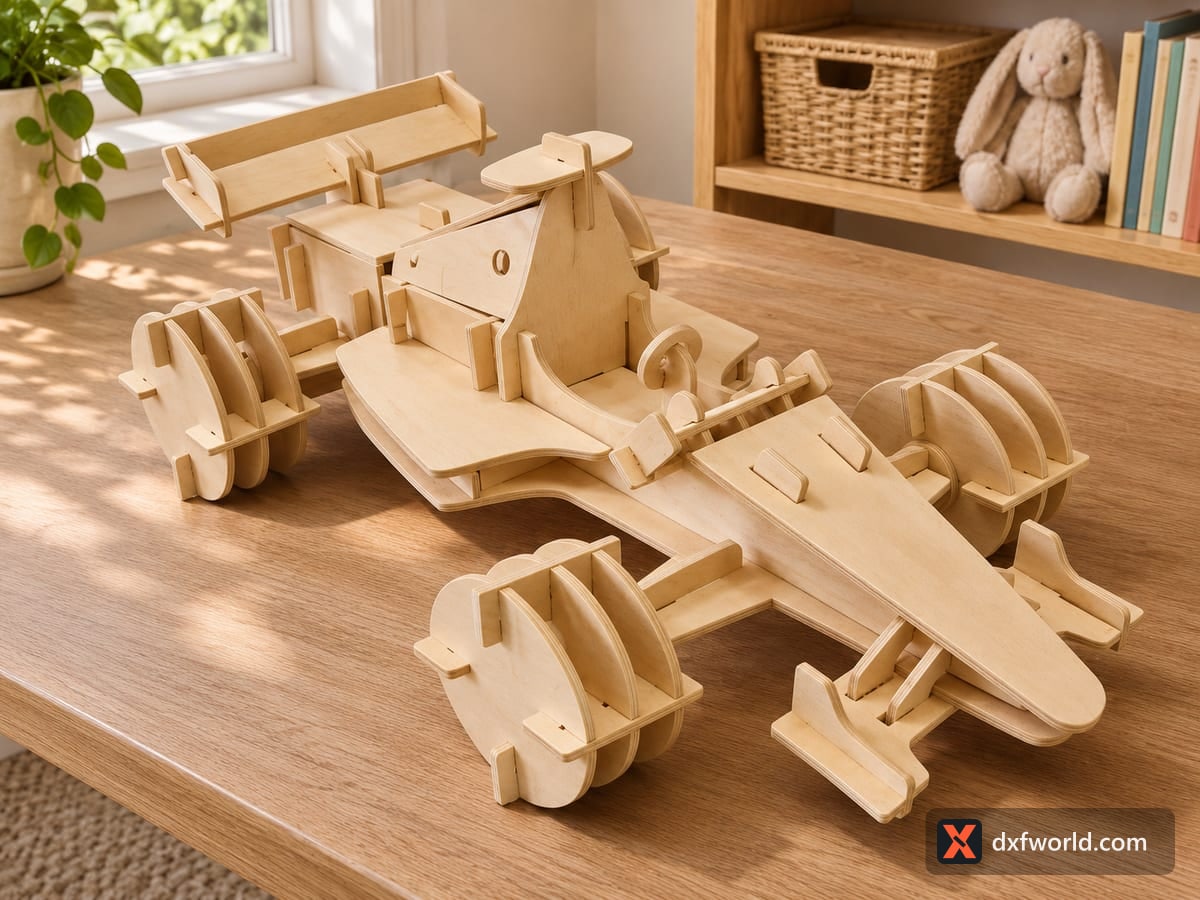 Open-Wheel Race Car 3D PuzzleSize 353 × 434 mm (13.89 × 17.07 in)Est. time, 10 W diode (3 mm) 43 min 01 sEst. time, 40 W CO2 (3 mm) 17 min 56 sSVG · DXF →
A single-seater with a long nose, front and rear wings and four wide drum wheels built from notched discs and ribbed spacers. Build the four wheels first: they are the repetitive part, and once they are done the chassis goes together quickly.
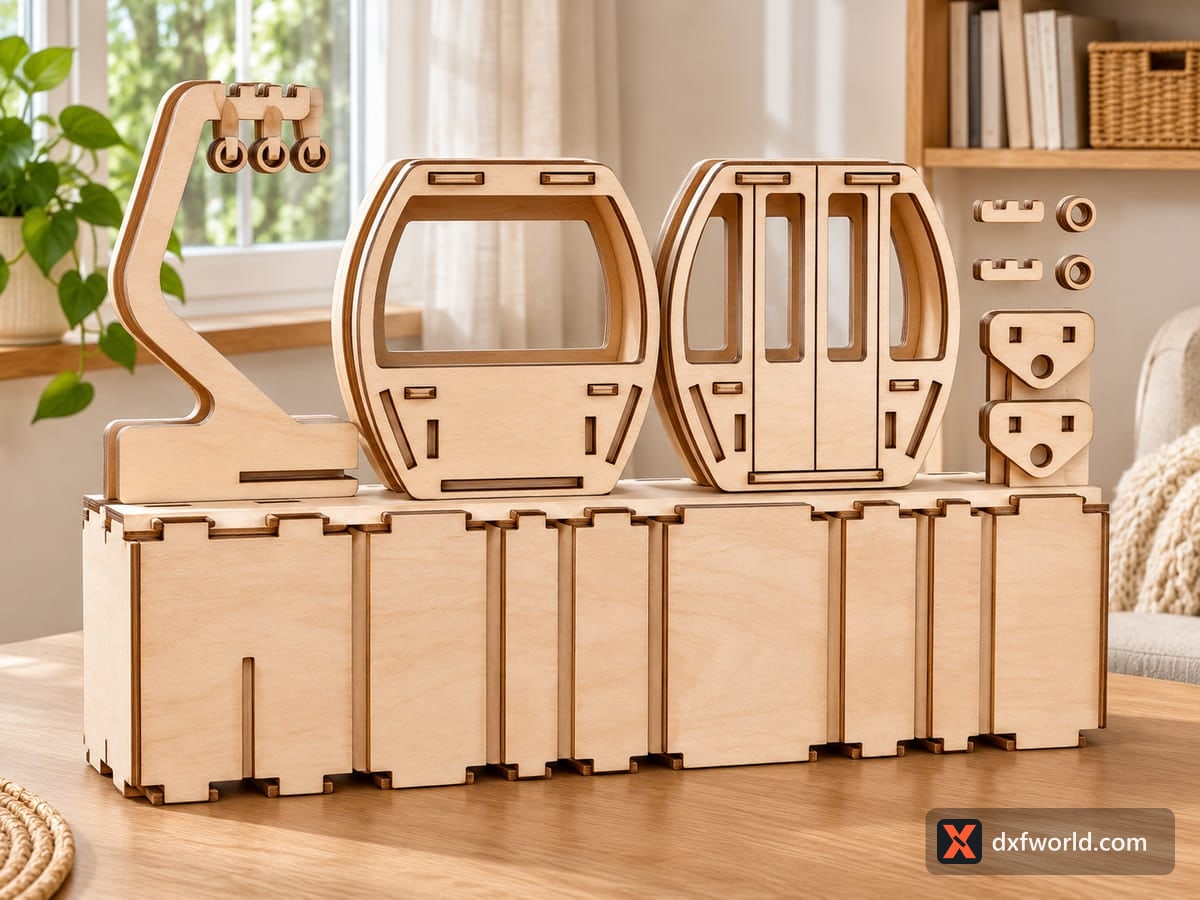 Cable Car Gondola ModelSize 296 × 194 mm (11.67 × 7.64 in)Est. time, 10 W diode (3 mm) 17 min 34 sEst. time, 40 W CO2 (3 mm) 7 min 19 sSVG · DXF →
The smallest model here, under 300 mm of layout and about 18 minutes on a 10 W diode: a rounded gondola with a window face and a door face, plus a curved hanger arm with three grip wheels. Hang it from a cord stretched across a mantel for a ski-lift display.
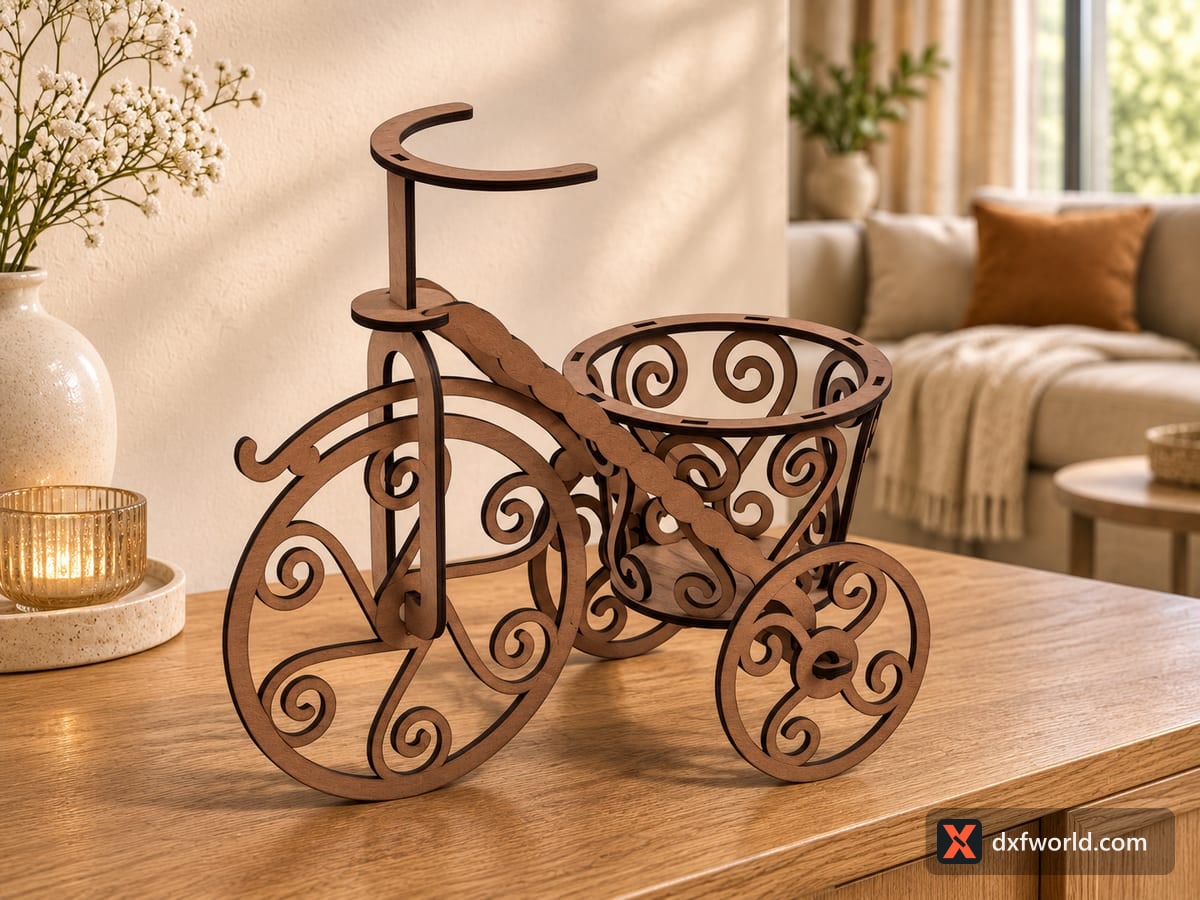 Scrollwork Tricycle PlanterSize 299 × 261 mm (11.76 × 10.26 in)Est. time, 10 W diode (3 mm) 34 min 07 sEst. time, 40 W CO2 (3 mm) 14 min 13 sSVG · DXF →
A vintage tricycle with a scroll-filled front wheel, two small rear wheels and a round basket walled with S-shaped scrolls. Unlike the three models above, its slots are drawn for 3 mm sheet, and with a drop of glue in each joint the basket carries a small potted succulent.
Slot width vs material thickness: measure before you cut
The bus, the race car and the cable car do not state their material thickness. It takes five minutes to sort out:
- Open the file in LightBurn, xTool Creative Space or Inkscape and measure the width of three slots in different places.
- Measure your sheet with calipers at several points. Plywood sold as 3 mm is often a few tenths thinner or thicker.
- If slot and sheet match within about 0.1 mm, cut one test pair of parts.
- If they do not, pick another sheet, or scale the whole file until the slot equals your sheet. A 3 mm slot scaled for 4 mm sheet means 133%, and the bus layout grows to about 508 × 552 mm.
- For small differences, adjust the kerf offset instead of scaling: see how to measure kerf.
Pro tip: ten minutes of test cuts beats an hour of wobbly parts.
| Test fit result | Likely cause | Fix |
|---|---|---|
| Tab drops out of the slot | Slot wider than the sheet, or a wide kerf | Thicker sheet, kerf offset, or a drop of wood glue |
| Tab will not go in | Sheet thicker than the slot | Thinner sheet, or sand the tab faces lightly |
| Tight at one end of the sheet, loose at the other | Thickness varies across the sheet | Measure in several places, cut joint-heavy parts from one area |
| Thin parts crack when pressed | Fit too tight for brittle plies | Ease the fit, never hammer the joint |
| Finished model leans | Warped sheet | Weigh the sheet flat, use flatter plywood |
Common mistake: scaling a model up to make it bigger and cutting it from the same 3 mm plywood. Every slot grows with the scale, so the parts rattle. The doll chairs below are a good example: doubled in size they need 8 mm board, not 4 mm.
There is a full guide to tab and slot joints, and how to scale laser files correctly covers the maths.
Laser cut toys kids actually play with
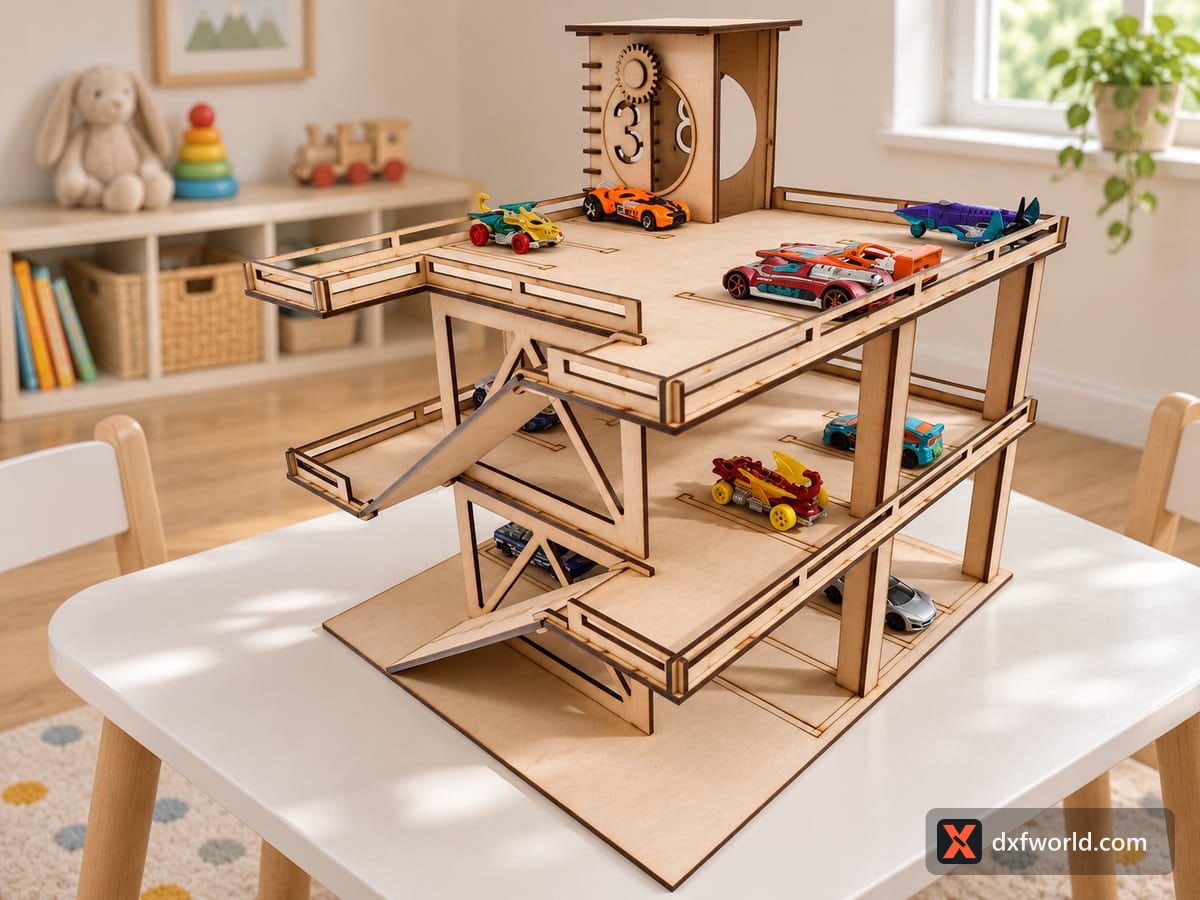 Three-Level Toy Car Parking GarageSize 1,187 × 606 mm (46.74 × 23.85 in)Est. time, 10 W diode (3 mm) 171 min 17 sEst. time, 40 W CO2 (3 mm) 71 min 22 sSVG · DXF →
The big one: three parking decks, ramps between them, railings, a corner tower numbered 1 to 3 and a round helipad on top, sized for small die-cast cars. The layout is about 1.19 m long with slots for 3 mm sheet, so plan three or four runs on a hobby bed. Birch plywood holds up better than MDF on the thin rail strips.
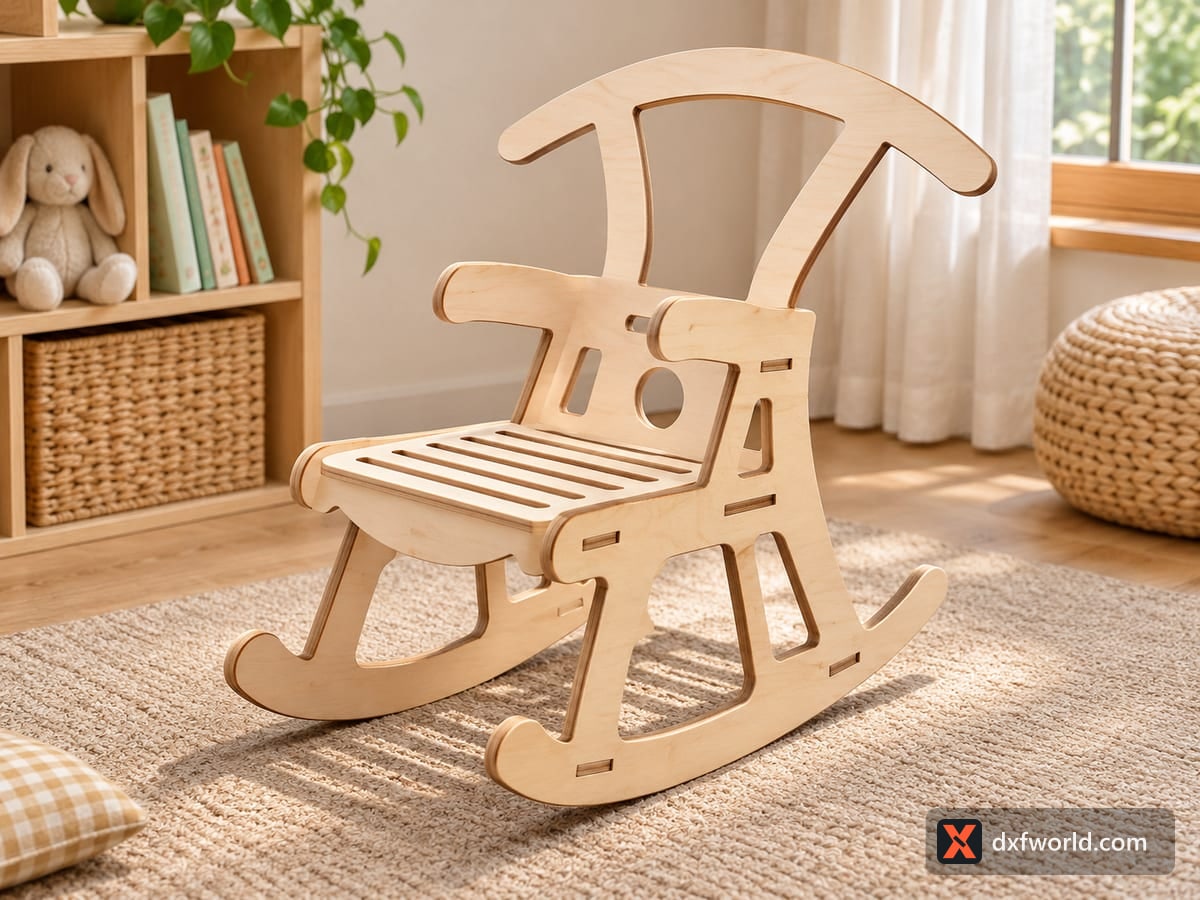 Doll Rocking Chair and Chair SetSize 283 × 289 mm (11.16 × 11.39 in)Est. time, 10 W diode (3 mm) 19 min 34 sEst. time, 40 W CO2 (3 mm) 8 min 09 sSVG · DXF →
A rocking chair and a straight chair with slatted seats, 12 flat pieces drawn for 4 mm wood, sized for dolls and teddy bears. Delete the small thickness label in the file before cutting, or the laser will cut it out as letters.
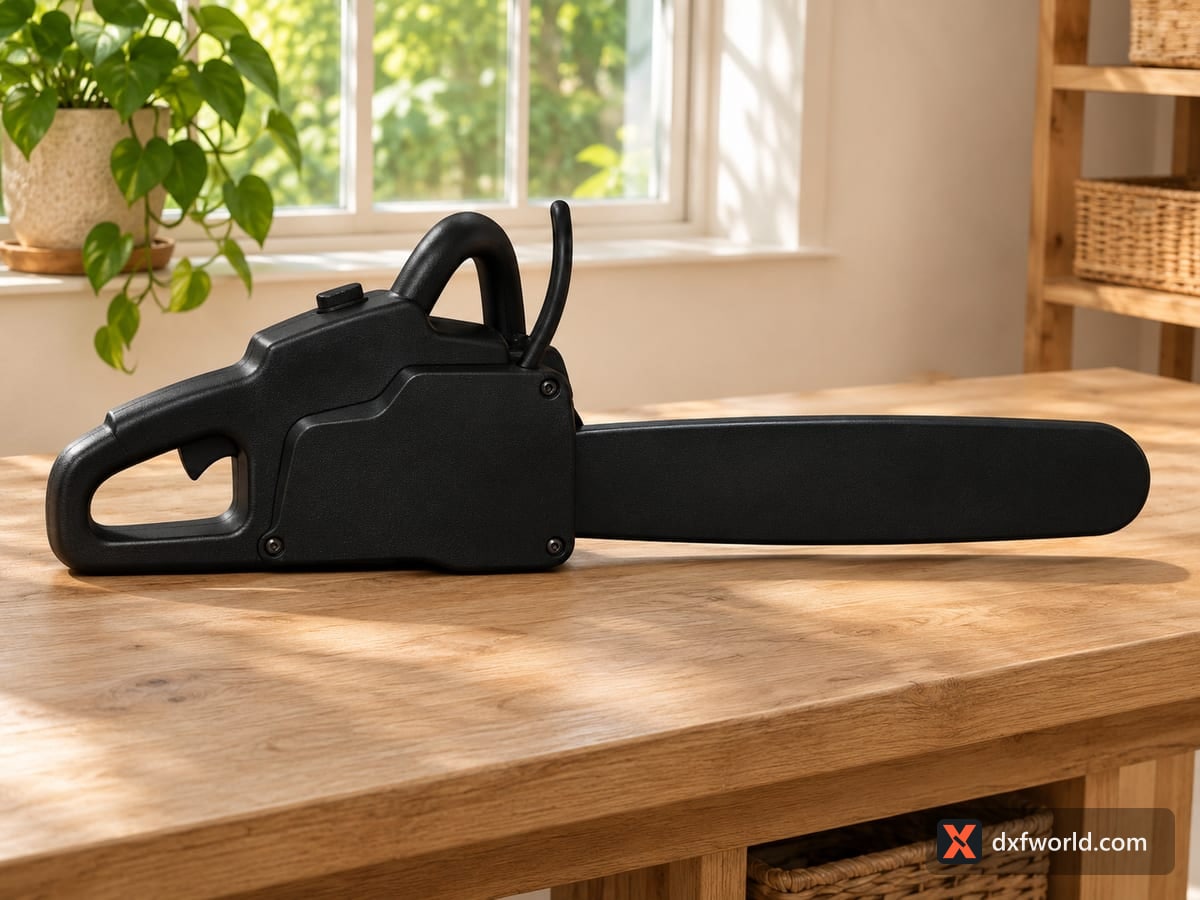 Chainsaw Silhouette CutoutSize 142 × 43 mm (5.59 × 1.71 in)Est. time, 10 W diode (3 mm) 1 min 29 sEst. time, 40 W CO2 (3 mm) 37 sSVG · DXF →
A 142 mm chainsaw silhouette that cuts in about a minute and a half. As drawn it is a cake topper; scale it up and glue two or three layers of 6 mm plywood together for a chunky pretend-play saw.
Pro tip: cut a long job like the garage sheet by sheet and label each stack in pencil. The guide to splitting a laser file across sheets shows how to rearrange the parts.
Board games and learning puzzles
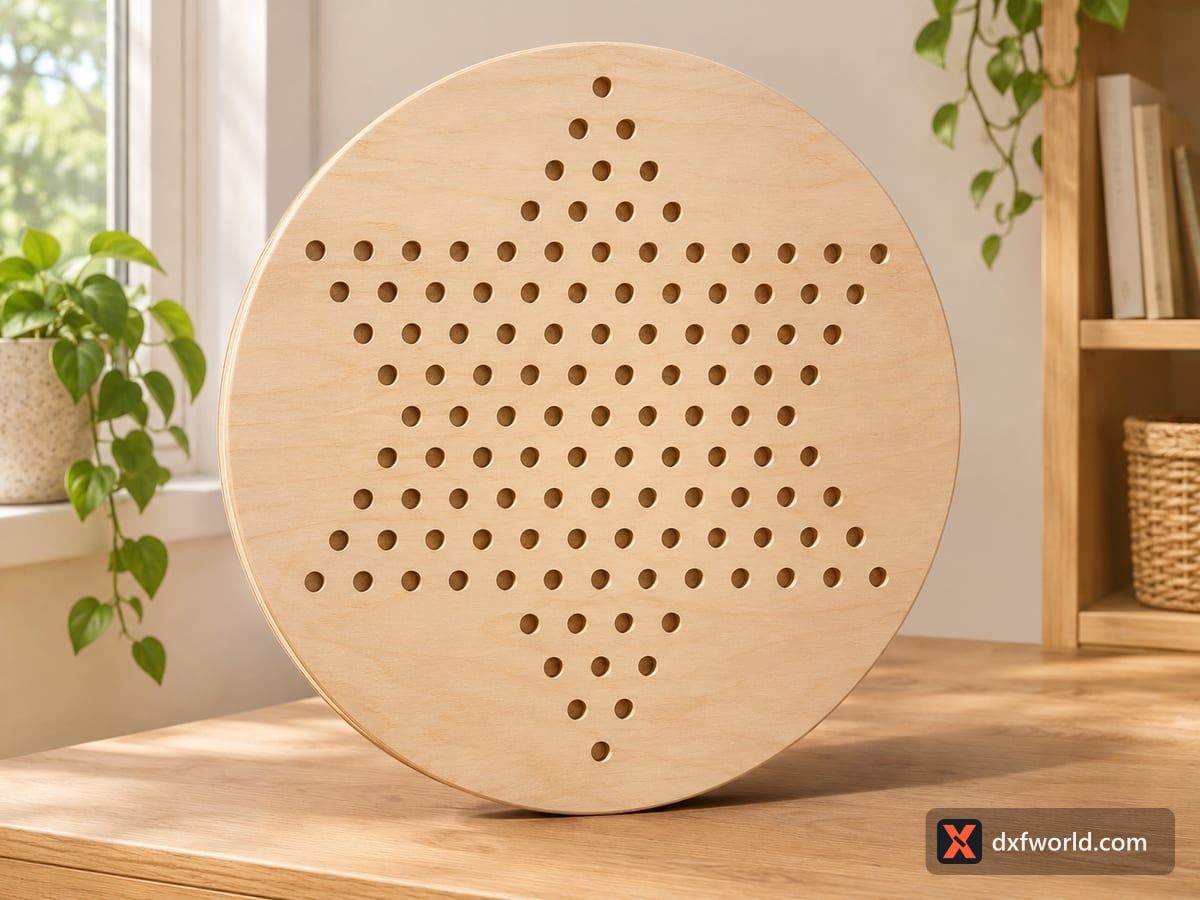 Round Chinese Checkers Board, 121 HolesSize 457 × 457 mm (18.00 × 18.00 in)Est. time, 10 W diode (3 mm) 20 min 39 sEst. time, 40 W CO2 (3 mm) 8 min 36 sSVG · DXF →
121 holes of 12.5 mm in the classic six-point star on a 457 mm round board. The holes go right through, so glue a plain 3 mm disc underneath to turn them into marble cups. At 457 mm it is bigger than a 400 × 400 mm bed; if you scale it down, the holes shrink too, so check your marbles or pegs in a test hole.
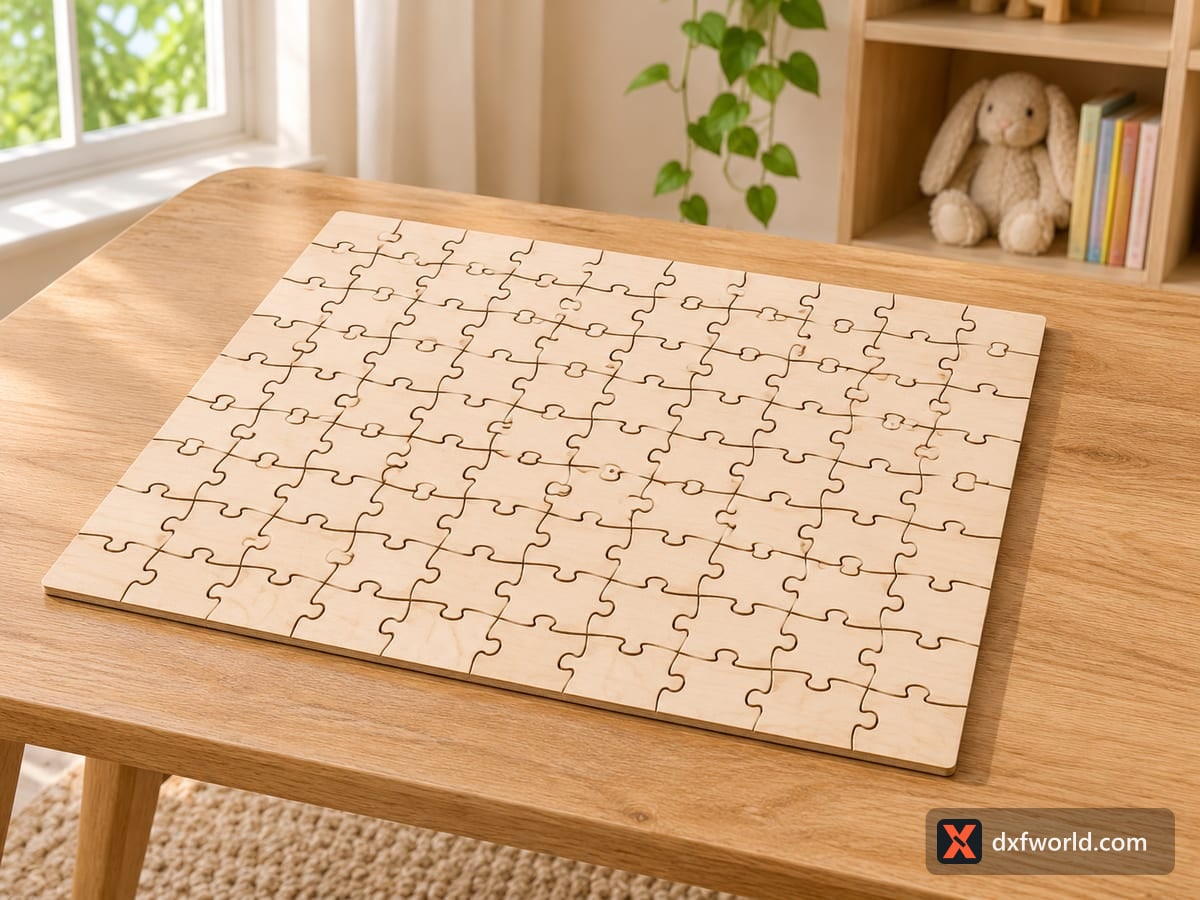 Jigsaw Puzzle Grids, Ten SizesSize 1,014 × 419 mm (39.90 × 16.51 in)Est. time, 10 W diode (3 mm) 127 min 58 sEst. time, 40 W CO2 (3 mm) 53 min 19 sSVG · DXF →
Ten ready grids on one sheet, from a 4-piece toddler square to dense grids of about a hundred pieces. Copy out the grid you need, glue a photo print to 3 mm plywood or MDF and cut from the printed side; keep pieces above about 15 mm or the knobs snap.
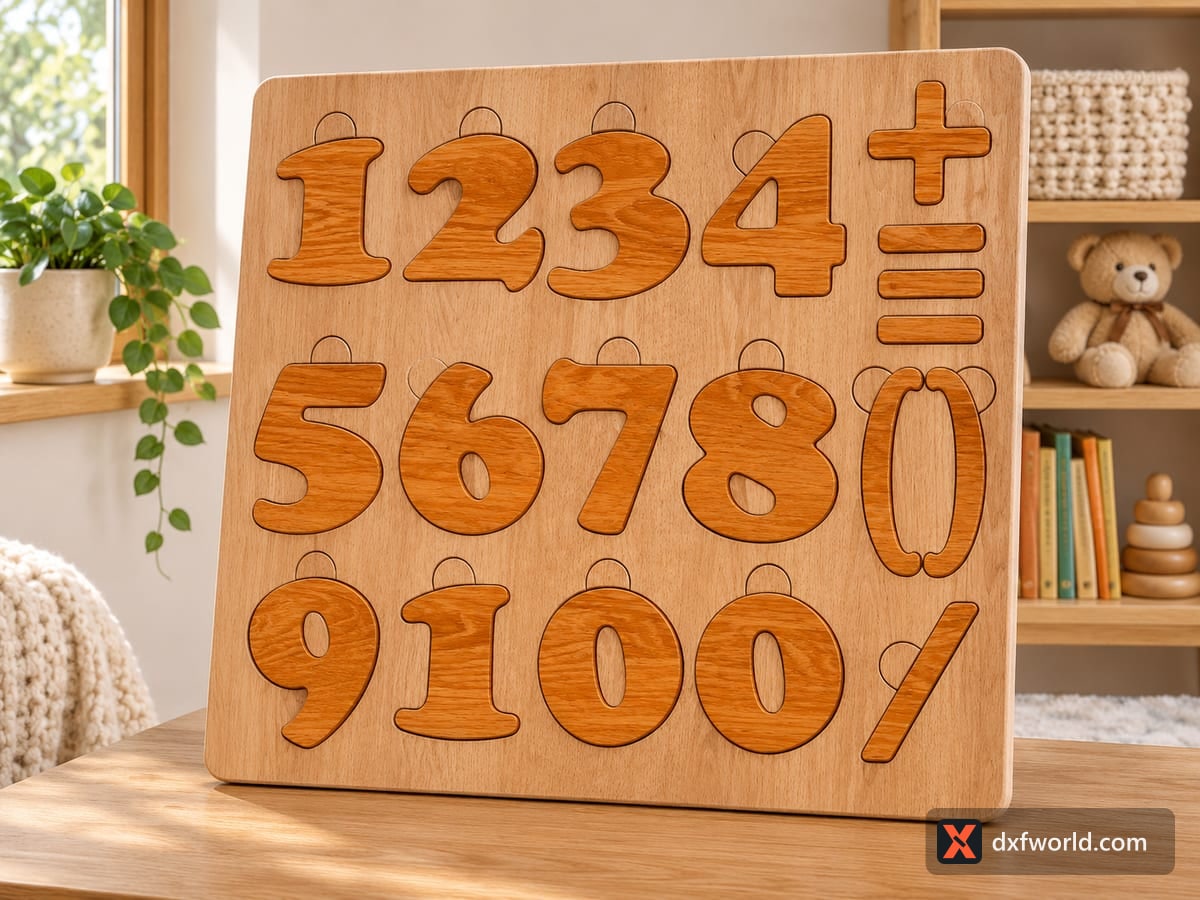 Cyrillic Alphabet and Number Puzzle BoardsSize 946 × 481 mm (37.23 × 18.92 in)Est. time, 10 W diode (3 mm) 75 min 15 sEst. time, 40 W CO2 (3 mm) 31 min 21 sSVG · DXF →
Two layered boards in one file: the 33 capitals of the Russian alphabet, and the digits 0 to 10 with plus, minus, equals, brackets and a slash. Each board is a back plate, a frame with letter-shaped holes and a separate set of loose letters with clean edges. The layout is about 946 × 481 mm, so cut one board at a time.
Paper, felt and cardboard toys
Not every toy needs plywood. These two cut in about six minutes each.
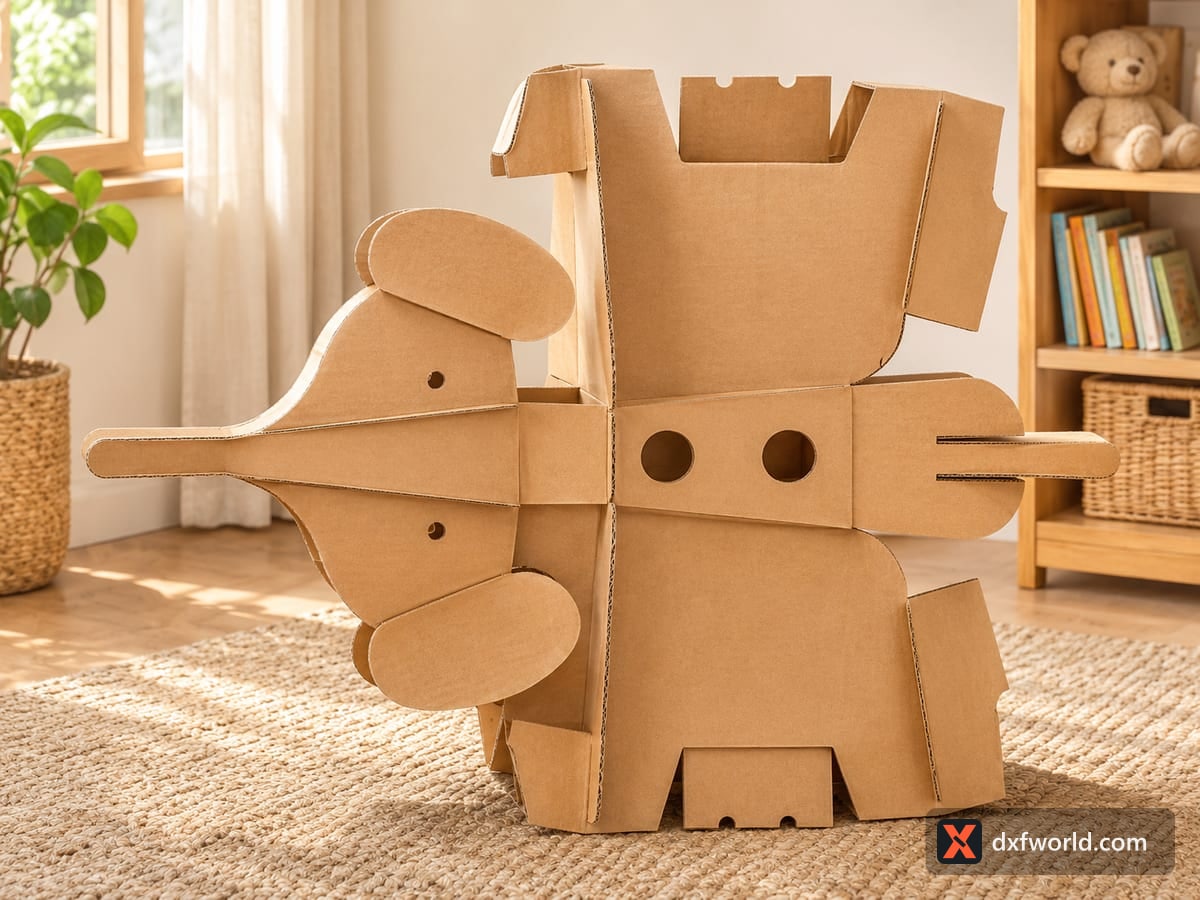 Fold-Up Cardboard ElephantSize 210 × 157 mm (8.27 × 6.18 in)Est. time, 10 W diode (3 mm) 5 min 57 sEst. time, 40 W CO2 (3 mm) 2 min 29 sSVG · DXF →
A one-piece net that folds into a standing elephant, 210 × 157 mm flat. All lines sit on one layer: move the straight fold lines to a second layer and run them as a light score, then cut the outline. Scale it up for corrugated cardboard and hand the kids a paint box.
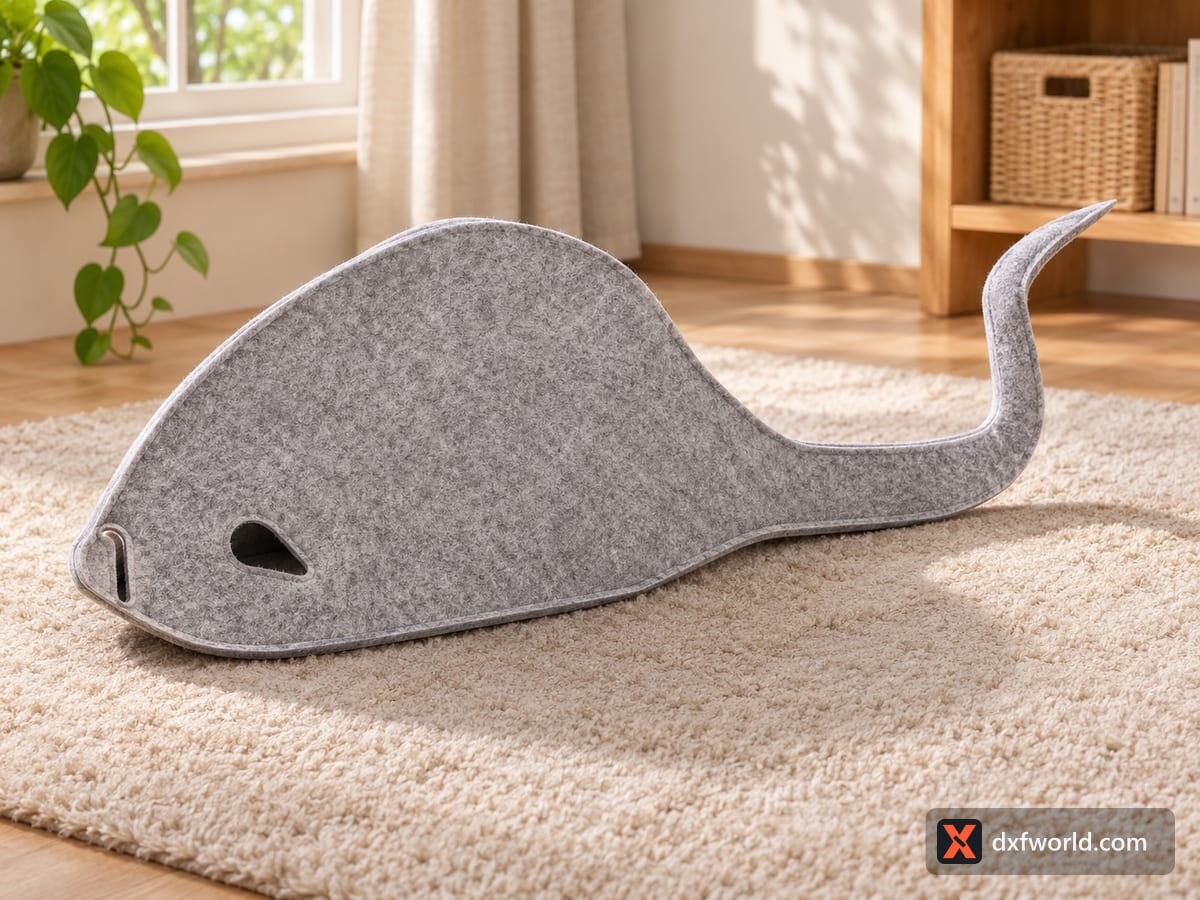 Giant Mouse Silhouette for CatsSize 584 × 249 mm (23.00 × 9.80 in)Est. time, 10 W diode (3 mm) 5 min 51 sEst. time, 40 W CO2 (3 mm) 2 min 26 sSVG · DXF →
A toy for the furry member of the family: a 584 mm mouse outline for a felt cat mat or a cardboard scratcher made of twenty to forty glued layers. Keep the tail tip at least 8 mm wide so it survives the cat.
Pro tip: card and felt cut at low power, but they catch fire more easily than plywood. Stay at the machine, use air assist and clear small offcuts from the bed between jobs.
Finishing and safety for wooden toys
A toy gets handled, chewed, dropped and left in the garden. A little care at the end makes it last:
- Sand every edge. The dark laser edge leaves soot on small hands; a light sand and a damp cloth take most of it off.
- Use a finish meant for toys: a water-based clear coat or paint labeled as safe for toys, fully cured.
- Watch the small parts. Washers, pegs and wheel spacers are small enough to swallow, so keep those kits away from children under three.
- Glue what gets rough play. A garage that a four-year-old drives into needs glue on the posts.
- Check the rules before you sell. Toys for children fall under toy safety rules, for example CE marking in the EU and children's product rules in the US.
Next step: pick the cable car or the tricycle for a first evening, measure your sheet, cut one test pair, and only then run the full layout. When that model stands on the shelf without wobbling, you are ready for the bus, and maybe for the garage after that.
Questions and answers
What plywood thickness do I need for a laser cut 3D puzzle?
The thickness that matches the slots. The tricycle and the toy garage are drawn for 3 mm and the doll chairs for 4 mm; for the bus, race car and cable car, measure a slot in your software and pick a sheet of that thickness.
Can I make a slot-together model bigger?
Yes, but the slots scale with it, so the material must scale too. A model drawn for 3 mm and enlarged to 133% needs 4 mm sheet.
Do slot-together toys need glue?
A firm fit holds a shelf model without glue. For toys that children play with, put a drop of wood glue in the main joints.
What is a good first laser cut toy?
The cable car gondola (about 18 minutes on a 10 W diode) or the fold-up cardboard elephant (about 6 minutes). Both are small and show quickly whether your slot fit or score settings are right.
Can a diode laser cut these toy files?
Yes. A 10 W diode cuts 3–4 mm plywood in one or two passes, and card, cardboard and thin felt easily. The big layouts just take longer: the garage about 2 h 51 min, the jigsaw sheet about 2 h 8 min.