 Visualization
Cardboard Elephant Template SVG, Fold Up Elephant Papercraft DXF, Folding Animal Toy Net Laser Cut File
A one-piece flat net for a fold-up elephant: a long trunk and two round ear flaps at the front, a back strip with two round holes, two side panels that fold down into four legs, and a tail tab at the rear. The free SVG and DXF hold the outline, the eye holes and the straight fold lines on one layer, drawn at 210 × 157 mm (8.27 × 6.18 in) and scalable for card stock or corrugated cardboard.
- Formats
- SVG, DXF
- Size
- 210 × 157 mm (8.27 × 6.18 in)
- Material
- Plywood, MDF, acrylic or metal (scale to your piece)
- Cut length
- 1.78 m
- Est. time, 10 W diode (3 mm)
- 5 min 57 s
- Est. time, 40 W CO2 (3 mm)
- 2 min 29 s
- Layers
- CUT only, no engraving
Free account required to download
How to make it
- 01Move the straight fold lines inside the outline to their own layer and set that layer to a light score.
- 02Cut a test corner from your card or cardboard to check that the score folds without tearing.
- 03Score the folds first, then cut the eye holes, the back holes and the outline.
- 04Fold the sides down into legs, tuck the corner flaps, bend the ears forward and glue the tabs.
How the net folds
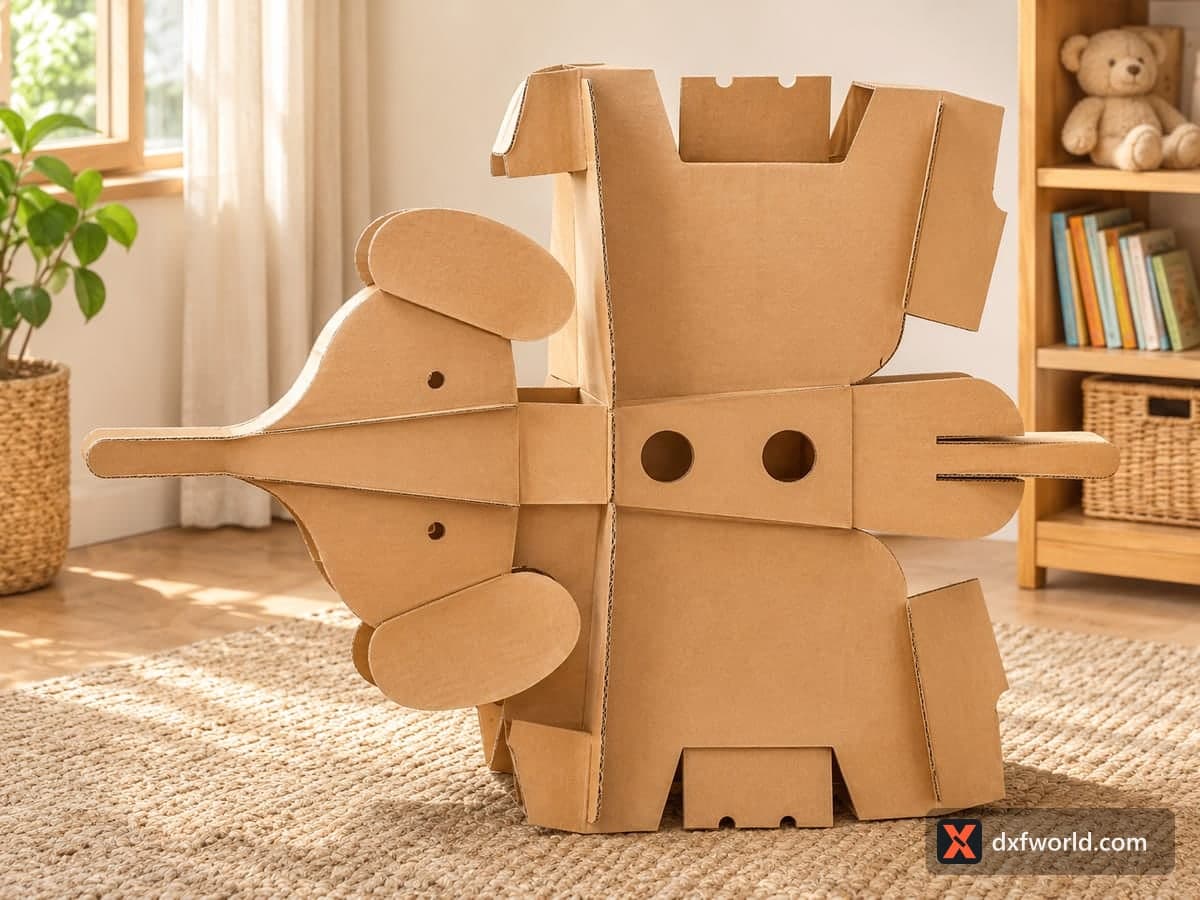
The centre of the net is a long strip that becomes the elephant's back, with two round holes in the middle. At the front it narrows into the head, where two small eye holes sit between the ear flaps, and ends in a long trunk with a rounded tip. Above and below the strip are the two body sides; each folds down and carries a front and a back leg with notched feet, plus small corner flaps that tuck in to close the body. A slim tail tab sticks out at the rear. Folded up, it stands on four legs like the large cardboard elephant in the photo.
Cutting and scoring
All lines in the file sit on one layer. Before cutting, select the straight lines inside the outline and move them to a second layer: these are the folds. Run that layer as a light score, at low power or as a line engrave, so the card bends cleanly instead of falling apart. Then cut the eye holes, the two back holes and the outer outline. On corrugated board, test the score power on a scrap first; too deep and the fold cracks, too shallow and it springs back.
Size and play ideas
At 210 × 157 mm (8.27 × 6.18 in) the net makes a palm-sized elephant from 300 g card. Scale it up to the width of your laser bed for single-wall corrugated cardboard, which gives a sturdy desk toy kids can paint. Teachers use fold-up animals for zoo-theme crafts, and a few in different sizes make a cheerful party table or a gift box topper. Glue or a strip of tape on the tuck flaps keeps the body square.
Questions about this file
Why does the elephant fall apart when I cut it?
The straight lines inside the net are folds drawn on the same layer as the outline. Put them on a score layer at low power and the net stays in one piece.
What material works best?
Card stock of 250 to 350 g at the drawn size, or single-wall corrugated cardboard when you scale it up. Plywood and acrylic will not fold.
Can I make a really big elephant?
Yes, scale the whole net evenly; nothing has to match a material thickness. Big versions need corrugated board and glue on every tuck flap.
What are the two big holes on the back for?
They are round openings in the back strip. Thread a cord through them to hang the elephant, or leave them open as finger grips.
Can kids decorate it?
Plain cardboard takes markers, poster paint and stickers well. Paint after folding so the scored lines stay flexible.
Similar files