
Laser Cut Screen Panel Files: 12 Free Jali, Lattice and Room Divider Designs
A laser cut screen panel is a sheet of plywood, MDF, acrylic or metal pierced with a repeating pattern, used as a room divider, cabinet insert, radiator cover or wall panel. The 12 free files below range from small-drawn patterns you scale up to full-size panels of 2000 × 1200 mm. On a small laser bed you scale them down or cut them in tiles split along a plain band, cutting inner openings first and the outline last.
The first time you cut a lattice panel, you stand at the lid watching hundreds of little openings appear, and wonder why you ever bought curtains. Hold it in front of a lamp and the wall fills with light. A laser cut screen panel is one of those projects that looks far more expensive than the plywood it came from.
This roundup collects 12 laser cut screen panel files from the DXF World library: jali-style room dividers, Moorish and Islamic star screens, Chinese lattices, art deco arches and floral fretwork. They are single cut-file designs with cut lines only, in SVG and DXF, and they are drawn at very different sizes, from 42 mm models you scale up to a 2 m panel. All of them are in the decorative panels and screens category.
All 12 screen panels compared
| File | Drawn size, mm | Closed cut lines | 10 W diode | 40 W CO2 |
|---|---|---|---|---|
| Alhambra star screen | 42 × 85 | 753 | 14 min | 6 min |
| Art deco arches | 176 × 352 | 29 | 17 min | 7 min |
| Two-panel Chinese lattice | 191 × 259 | 110 | 30 min | 13 min |
| Interlocking circles, pair | 160 × 272 | 204 | 32 min | 14 min |
| Blossom tree with two birds | 586 × 560 | 171 | 1 h 7 min | 28 min |
| Retro flower fretwork | 821 × 592 | 129 | 1 h 21 min | 34 min |
| Palmette and vine scroll | 2029 × 677 | 78 | 1 h 24 min | 35 min |
| Geometric lattice door + transom | 1104 × 2880 | 37 | 2 h 31 min | 1 h 3 min |
| Fan petal jali room divider | 947 × 1924 | 325 | 3 h 2 min | 1 h 16 min |
| Baroque scroll and rosette pair | 1600 × 900 | 236 | 4 h 1 min | 1 h 41 min |
| Op art sphere dot panel | 700 × 1950 | 991 | 4 h 16 min | 1 h 47 min |
| Islamic twelve-point star screen | 2000 × 1200 | 347 | 5 h 40 min | 2 h 22 min |
Times are the file pages' estimates for 3 mm plywood at the drawn size. Scale a panel and the cut time scales with it.
Small-drawn screens you scale up
These four are drawn small on purpose: the vectors stay sharp at any size, so you decide between a lantern side and a floor screen.
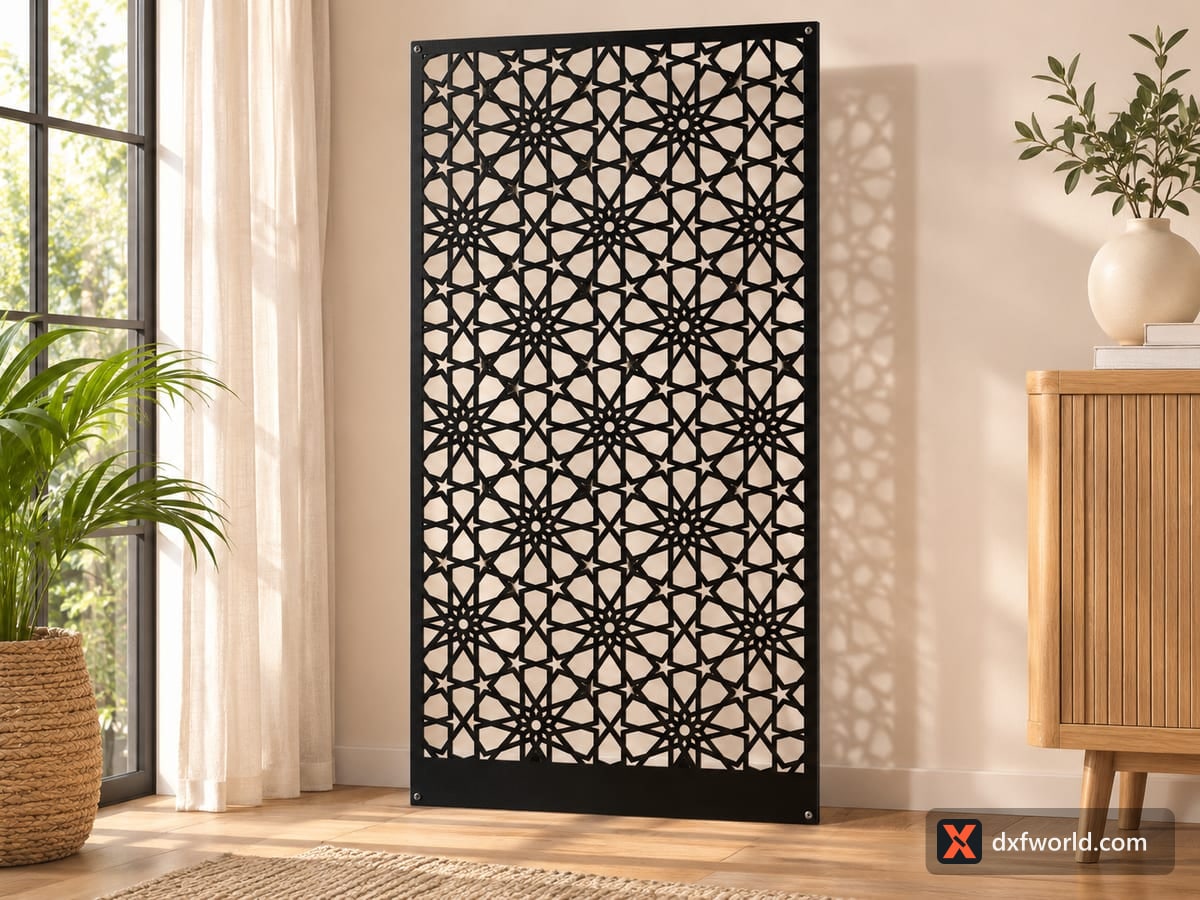 Alhambra Star Screen With Name StripSize 42 × 85 mm (1.66 × 3.33 in)Est. time, 10 W diode (3 mm) 14 min 04 sEst. time, 40 W CO2 (3 mm) 5 min 52 sSVG · DXF →
Moorish rosettes of tiny petal openings linked by star-and-kite strapwork, with a solid base strip carrying the word ALHAMBRA. It is drawn at only 42.2 × 84.5 mm, so scale it, keeping the 1:2 ratio; below about 400 mm tall the petal rings turn into specks.
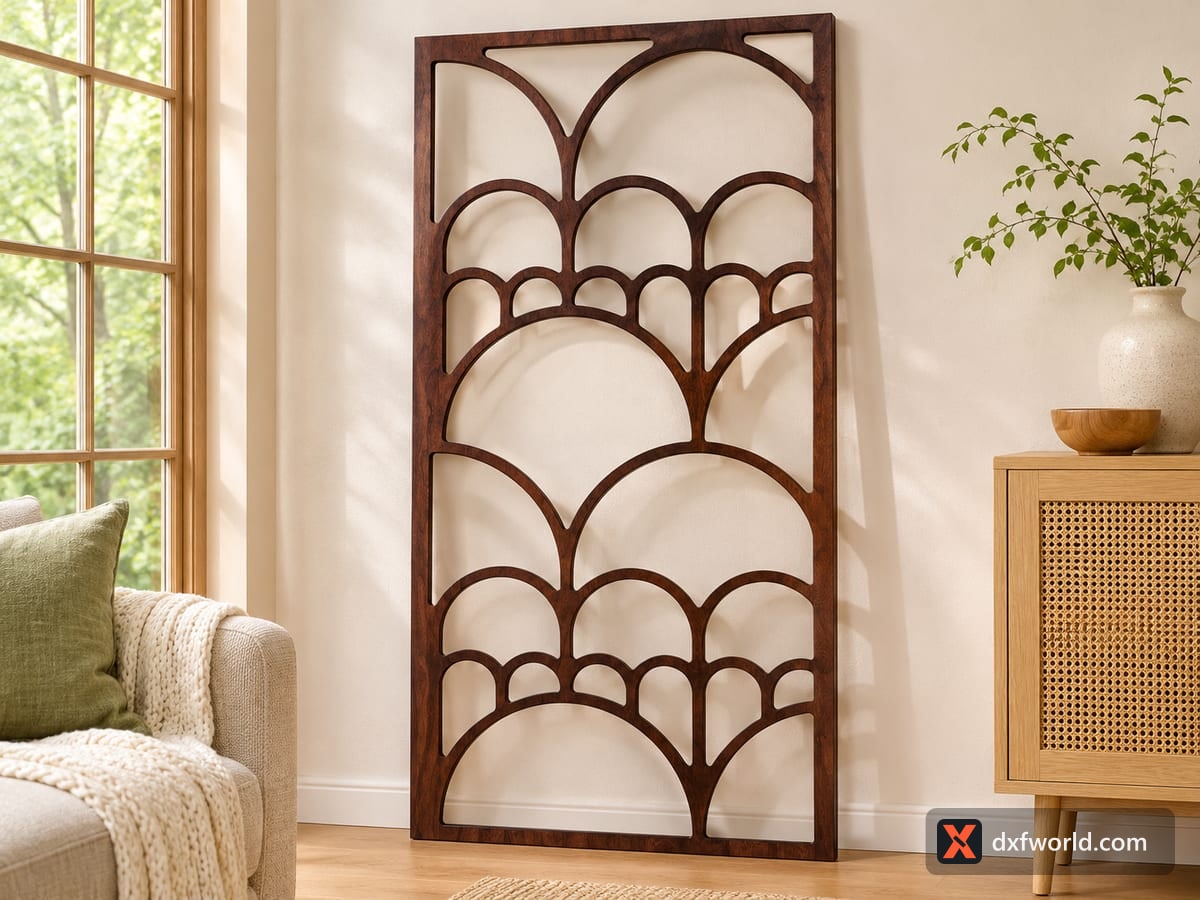 Art Deco Arches Screen PanelSize 176 × 352 mm (6.93 × 13.84 in)Est. time, 10 W diode (3 mm) 17 min 27 sEst. time, 40 W CO2 (3 mm) 7 min 16 sSVG · DXF →
Tiers of rounded arches, from two wide ones down to a row of six small ones, and the whole sequence repeats in the lower half. With only 29 cut lines it is the calmest pattern here, and at 2× it becomes a cabinet door insert or lamp side in 3–4 mm plywood.
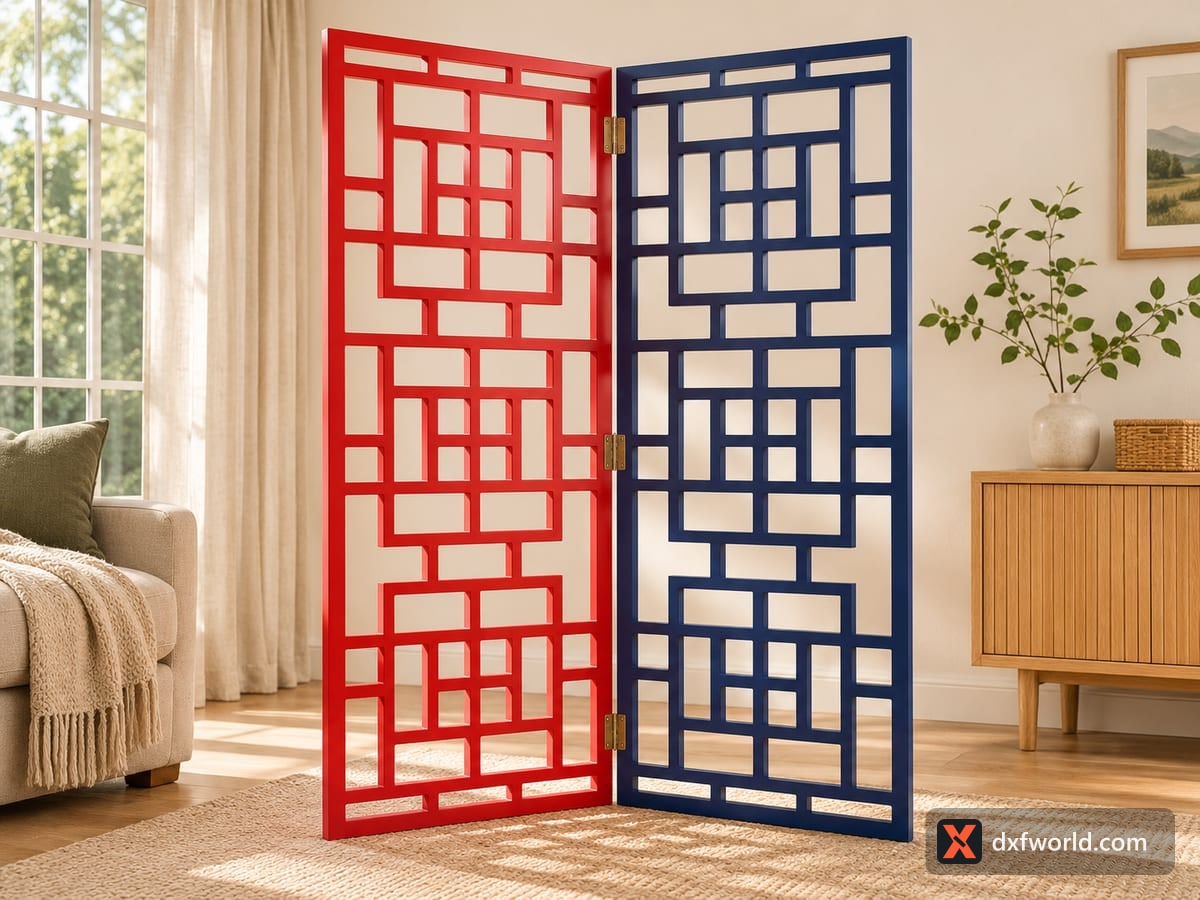 Two Panel Chinese Lattice ScreenSize 191 × 259 mm (7.53 × 10.19 in)Est. time, 10 W diode (3 mm) 30 min 25 sEst. time, 40 W CO2 (3 mm) 12 min 40 sSVG · DXF →
Two identical panels of straight bars, rectangles and L-shaped openings, made to be hinged into a folding screen. As drawn it is a desk-sized model; for a real divider the file page suggests 1700–1800 mm tall on a CNC router.
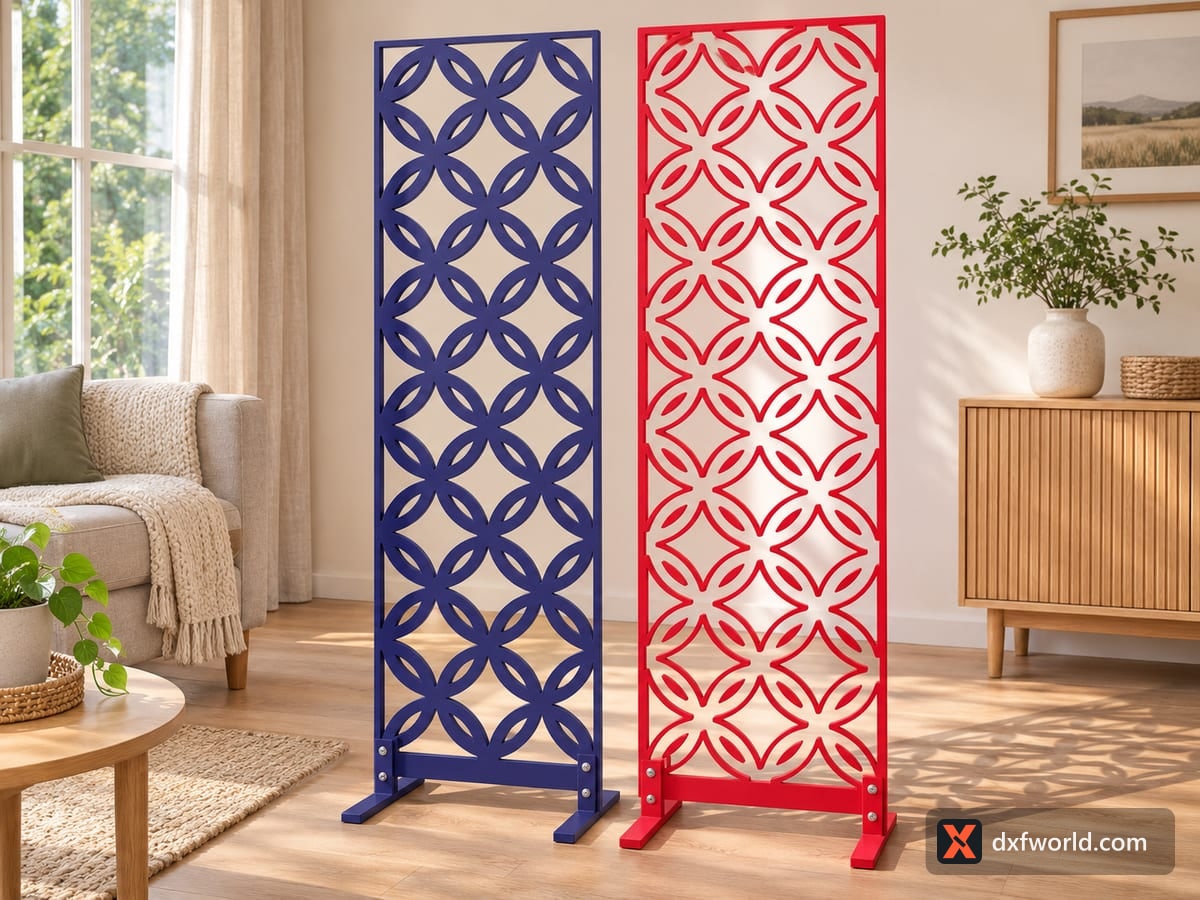 Interlocking Circles Screen Panels, PairSize 160 × 272 mm (6.31 × 10.69 in)Est. time, 10 W diode (3 mm) 32 min 23 sEst. time, 40 W CO2 (3 mm) 13 min 30 sSVG · DXF →
The ancient overlapping rings pattern, as two narrow panels of 74.0 × 271.5 mm each. The wide ring bands make it one of the most forgiving lattices; at 300 mm tall it makes lantern or candle screens in 3 mm plywood.
Jali panels and room dividers
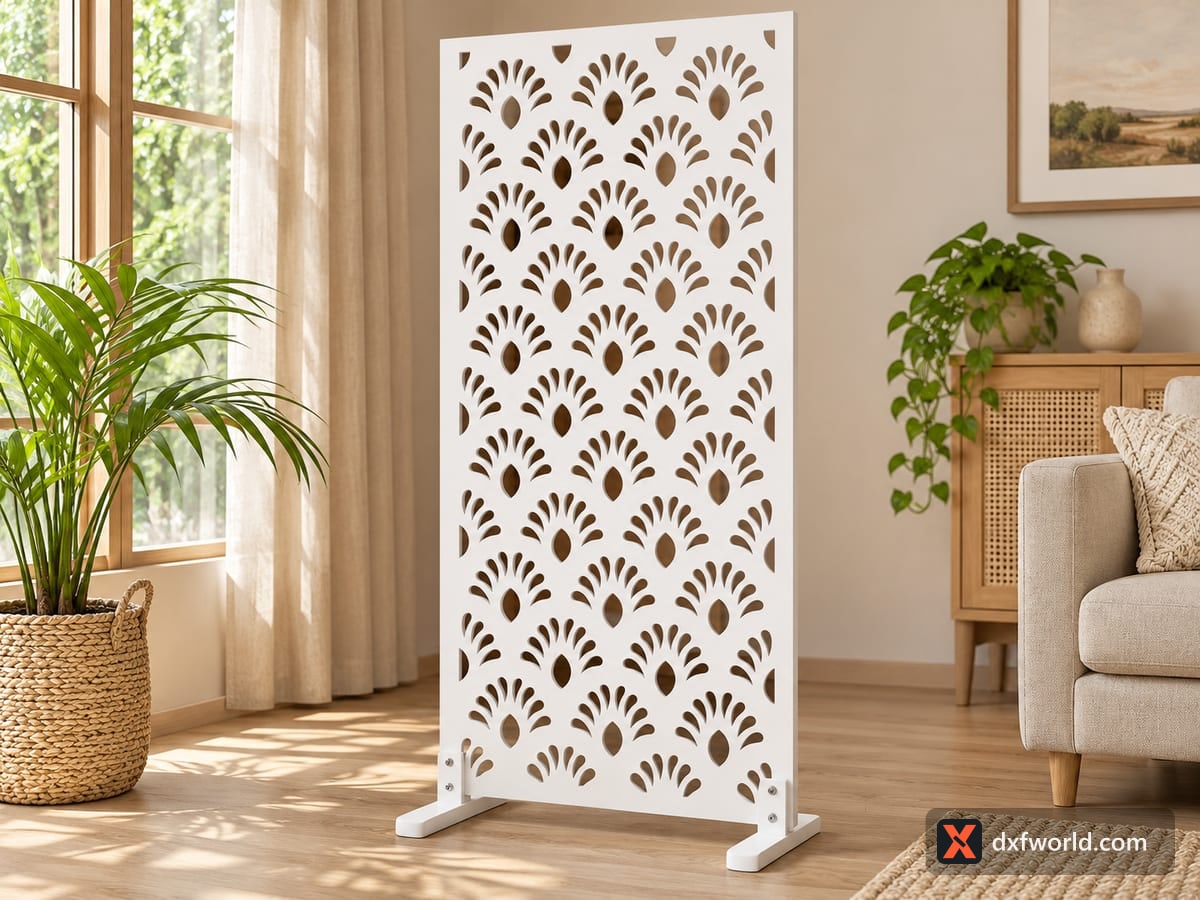 Fan Petal Jali Room Divider PanelSize 947 × 1,924 mm (37.29 × 75.74 in)Est. time, 10 W diode (3 mm) 181 min 55 sEst. time, 40 W CO2 (3 mm) 75 min 48 sSVG · DXF →
A full-height jali: staggered rows of fan motifs, each a half circle of teardrop petals over an almond shape, 324 cut-outs in a solid frame. At almost two metres it needs a router or a 1300 × 2500 mm bed, but the plain gaps between rows are natural places to split it into bands.
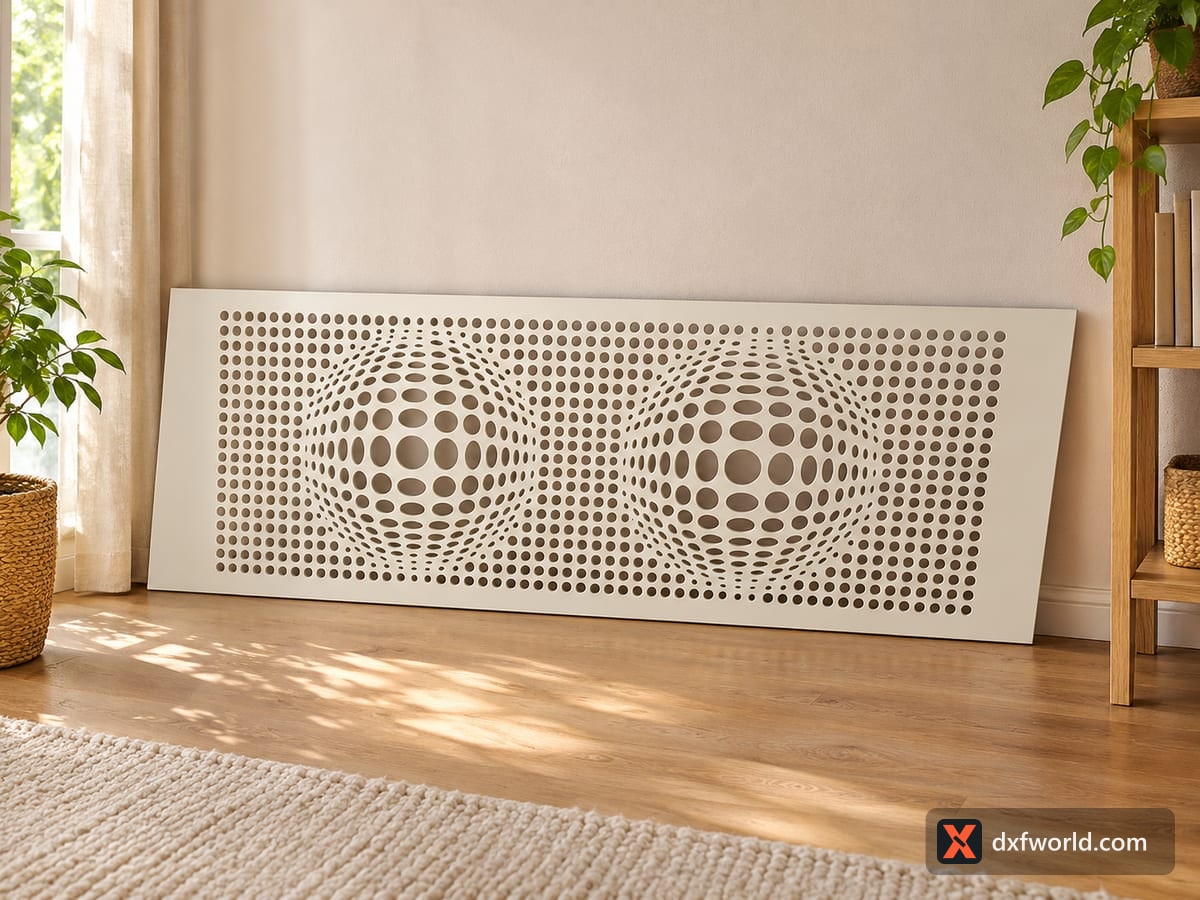 Op Art Sphere Dot PanelSize 700 × 1,950 mm (27.56 × 76.77 in)Est. time, 10 W diode (3 mm) 256 min 19 sEst. time, 40 W CO2 (3 mm) 106 min 48 sSVG · DXF →
991 round holes that swell into ovals in two places, so the flat board seems to bulge into two spheres. Upright it is a room divider; on its side, a radiator cover or headboard.
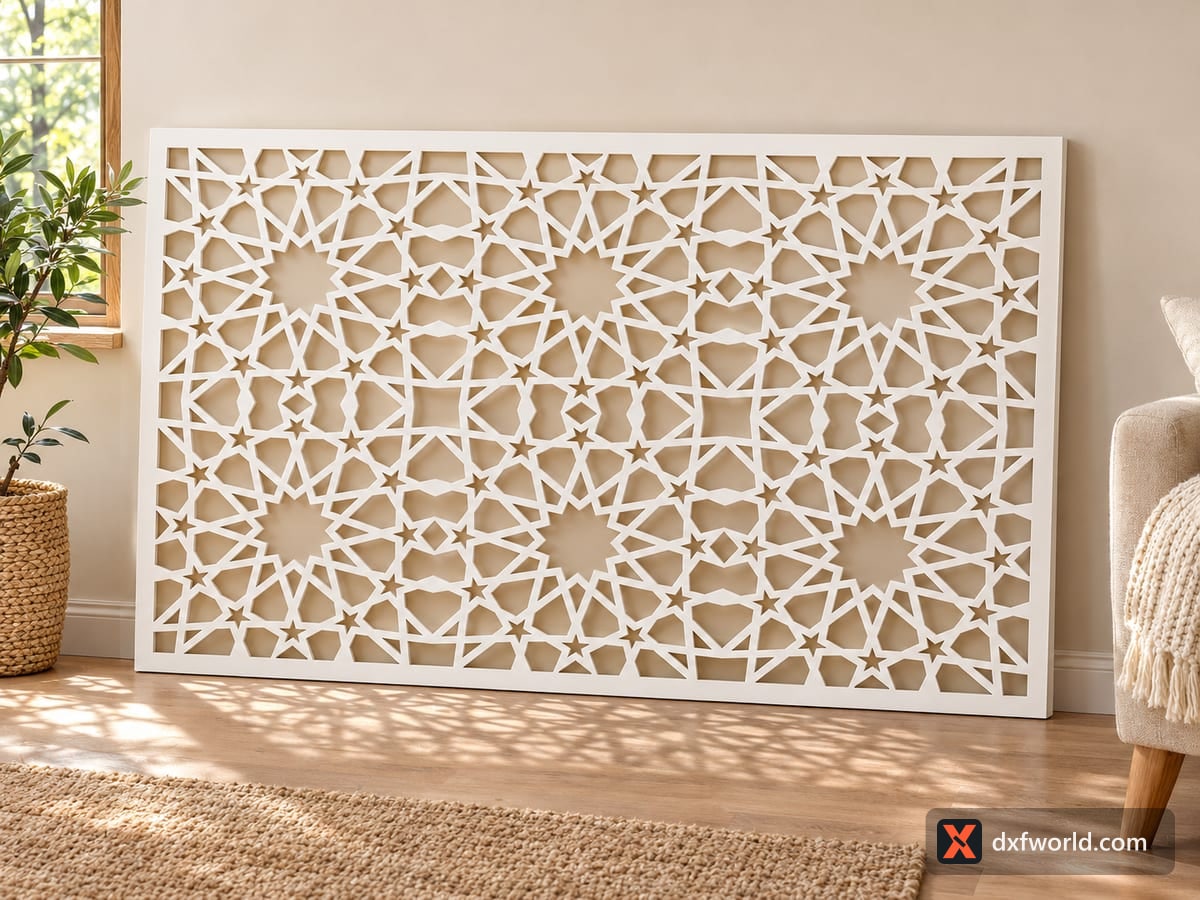 Islamic Star Lattice Screen, 2 × 1.2 mSize 2,000 × 1,200 mm (78.74 × 47.24 in)Est. time, 10 W diode (3 mm) 340 min 19 sEst. time, 40 W CO2 (3 mm) 141 min 48 sSVG · DXF →
Six twelve-point star rosettes in interlaced strapwork, 2000 × 1200 mm, which fits one 2440 × 1220 mm router sheet with room for clamping. The outer rectangle is drawn twice on top of itself: delete one copy before cutting.
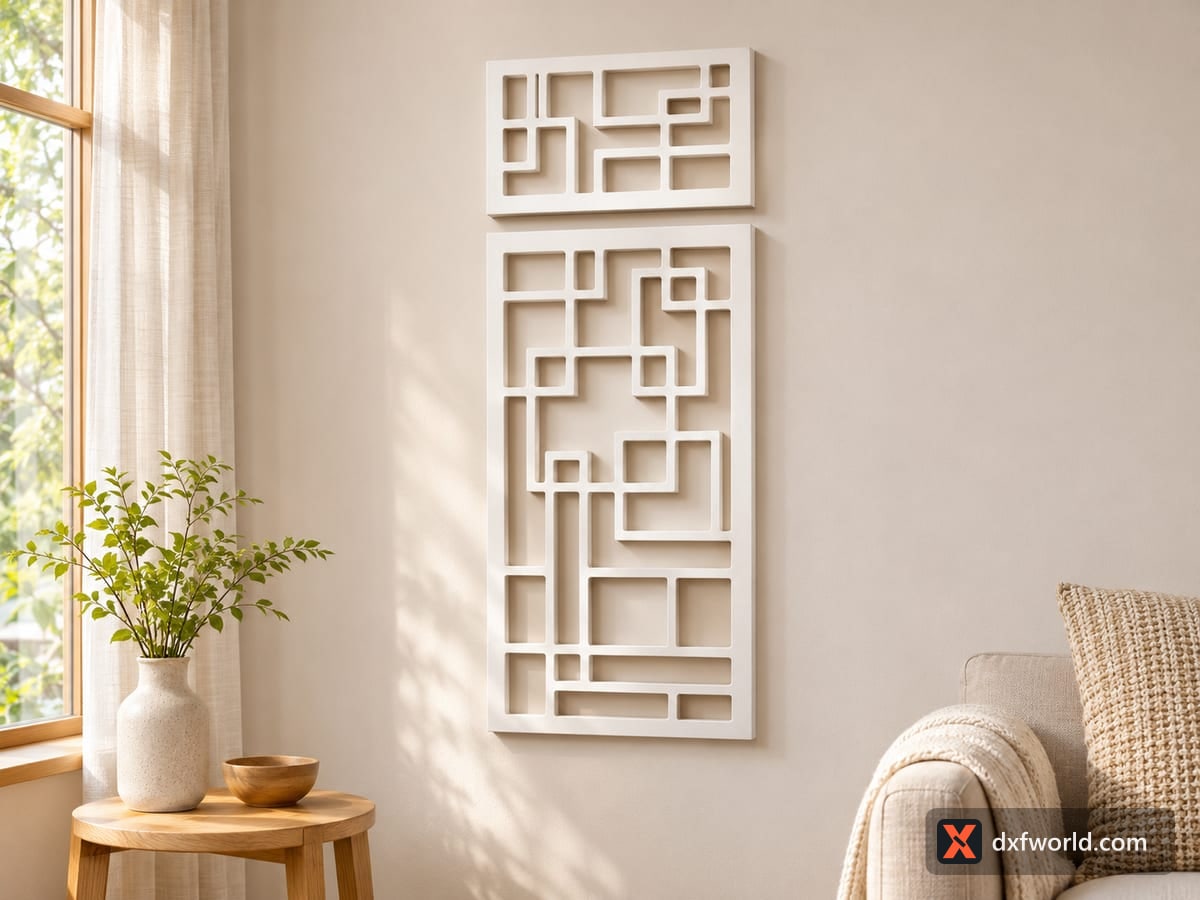 Geometric Lattice Door Panel with TransomSize 1,104 × 2,880 mm (43.46 × 113.38 in)Est. time, 10 W diode (3 mm) 151 min 22 sEst. time, 40 W CO2 (3 mm) 63 min 04 sSVG · DXF →
A door-sized grille and matching transom of stepped bars and offset rectangles, only 37 cut lines in all. At 30% the main panel is about 33 cm wide and fits most large lasers.
Floral and ornamental panels
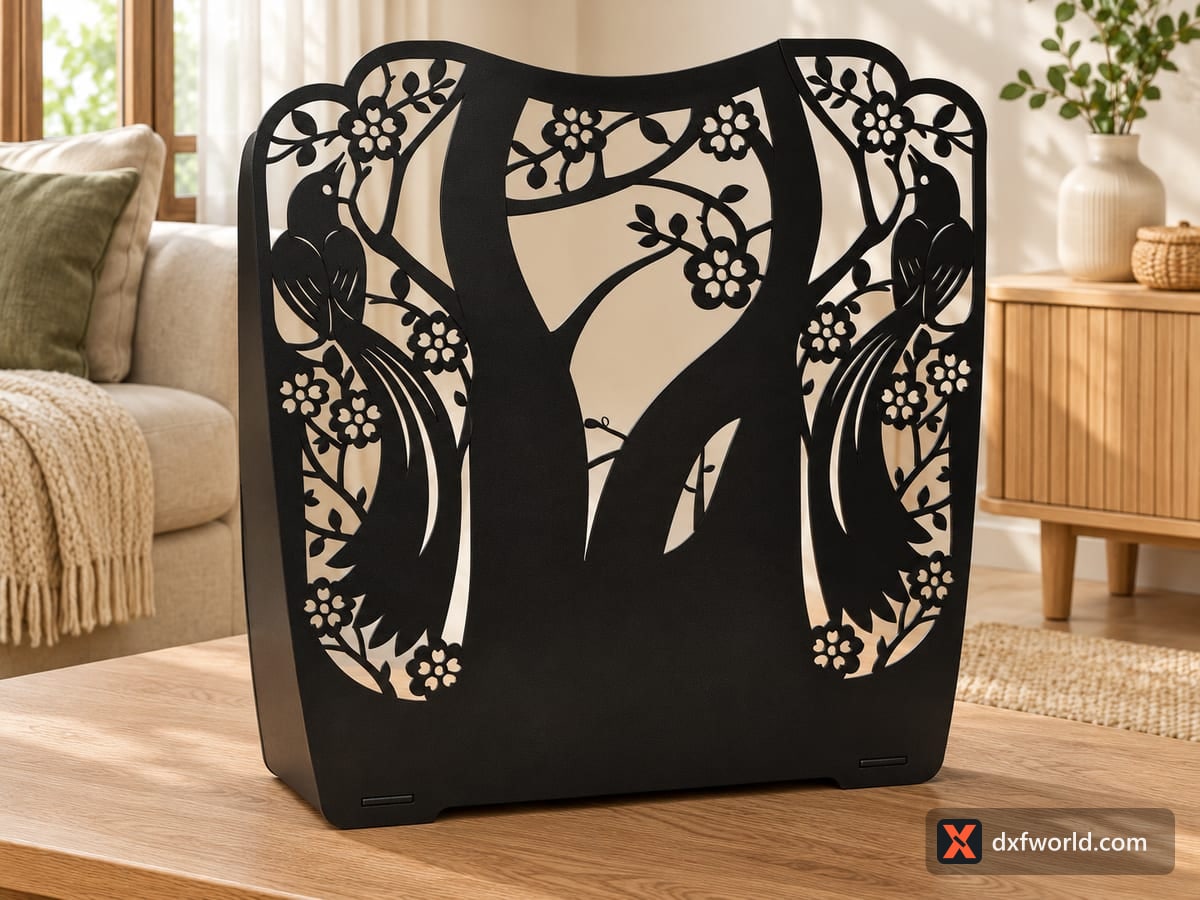 Blossom Tree Panel with Two BirdsSize 586 × 560 mm (23.06 × 22.05 in)Est. time, 10 W diode (3 mm) 66 min 46 sEst. time, 40 W CO2 (3 mm) 27 min 49 sSVG · DXF →
A forked tree trunk with blossom branches and two long-tailed birds in mirrored side sections, under a gently curved top. The solid lower half keeps it strong; do not shrink it below about 300 mm in wood, because the petal bridges get narrow.
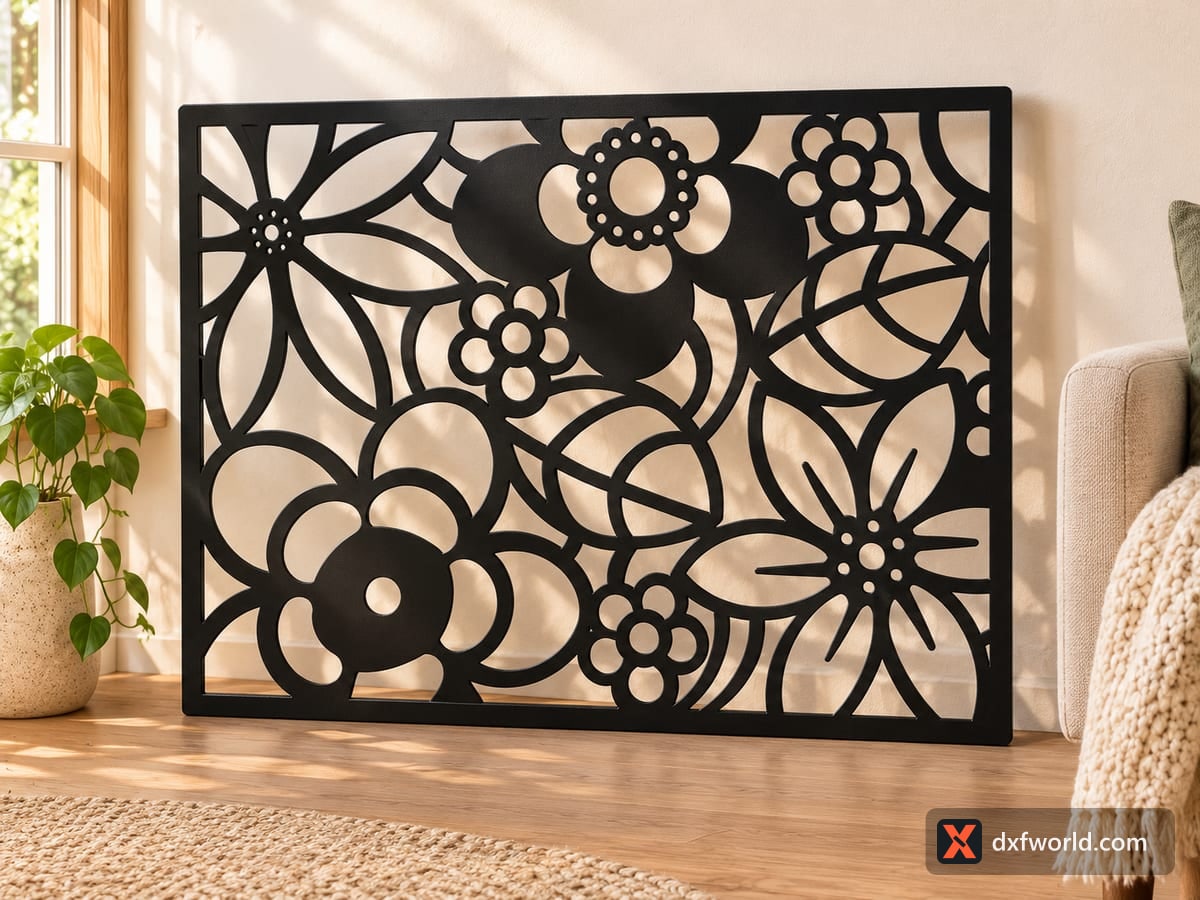 Retro Flower Fretwork Screen PanelSize 821 × 592 mm (32.33 × 23.31 in)Est. time, 10 W diode (3 mm) 81 min 11 sEst. time, 40 W CO2 (3 mm) 33 min 49 sSVG · DXF →
Oversized 1960s-style daisies and poppies with dotted centres. About half the surface is cut away, so it lets light and air through while hiding what is behind it: a good radiator cover front.
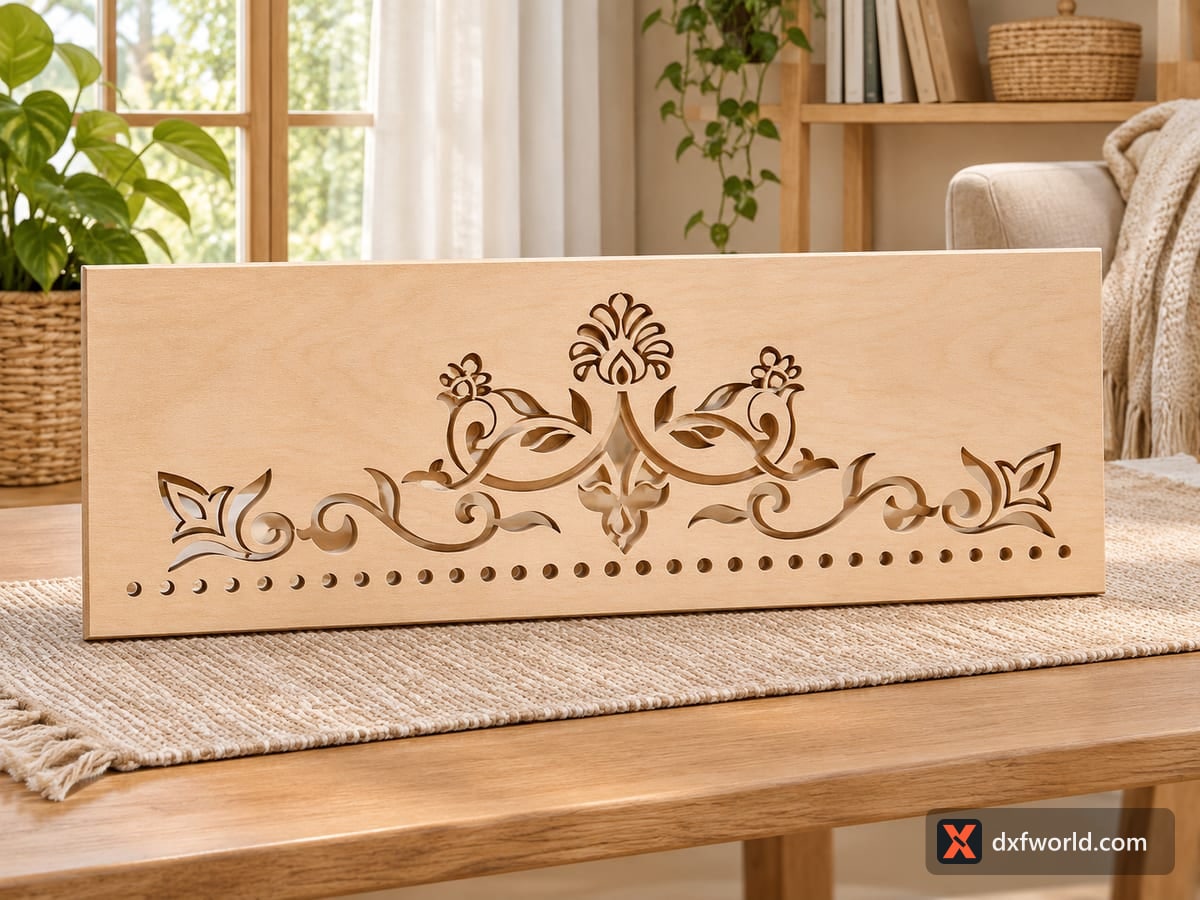 Palmette and Vine Scroll PanelSize 2,029 × 677 mm (79.89 × 26.67 in)Est. time, 10 W diode (3 mm) 84 min 18 sEst. time, 40 W CO2 (3 mm) 35 min 08 sSVG · DXF →
A two-metre frieze: a fan-shaped palmette, buds on curling stems and leafy scrolls to both ends, with a row of round holes along the bottom. The thin stems get weak when it shrinks a lot, so in wood the file page suggests staying above roughly 500 mm wide.
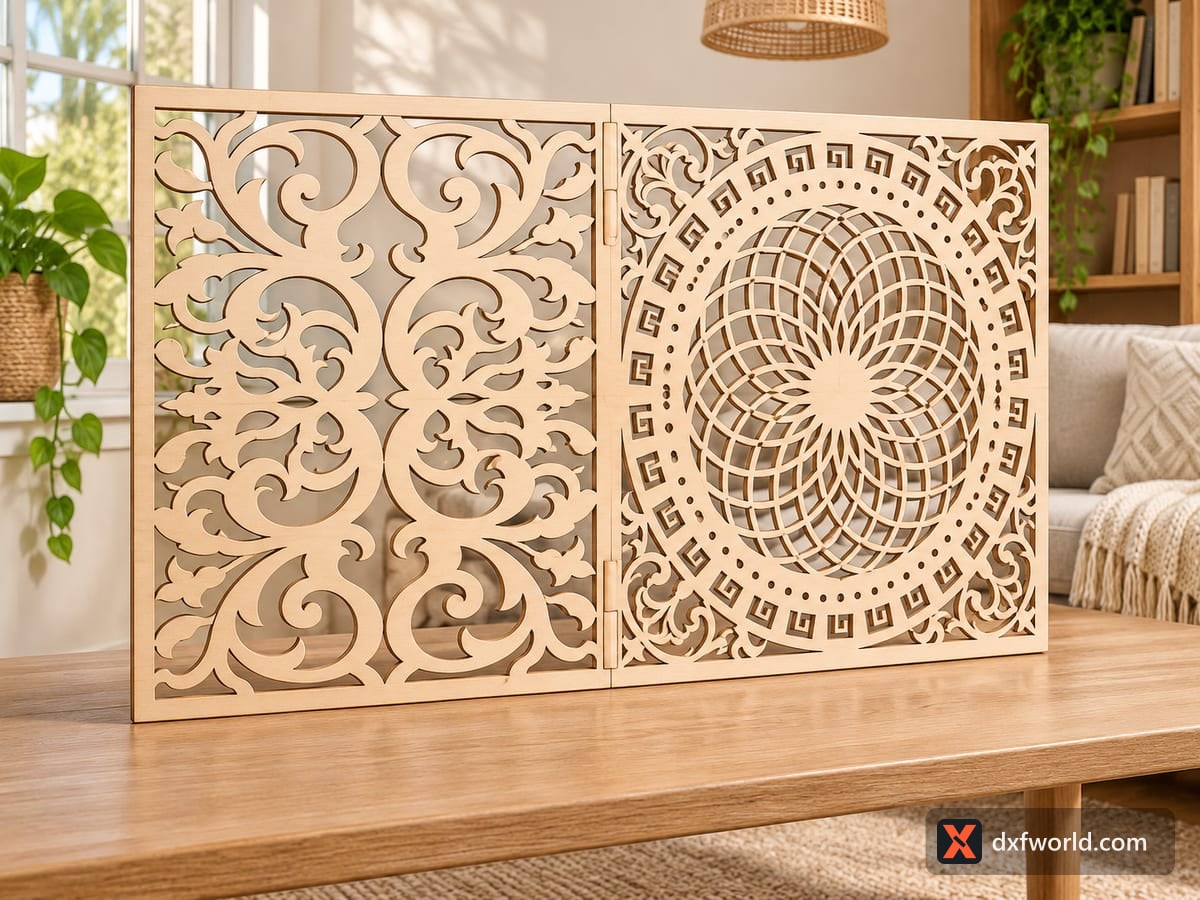 Baroque Scroll and Rosette Screen PanelsSize 1,600 × 900 mm (62.99 × 35.43 in)Est. time, 10 W diode (3 mm) 241 min 12 sEst. time, 40 W CO2 (3 mm) 100 min 30 sSVG · DXF →
Two different panels on one 1600 × 900 mm layout: mirrored acanthus scrolls, and a rosette framed by dots and Greek key squares. Many scroll outlines are chains of segments, so run a join command first. Scaled to 50% it is an 800 × 450 mm desk or fireplace screen in 3–4 mm plywood.
For kitchen or wardrobe fronts there is also a cabinet door pattern with a spindle centre, drawn at 400 × 600 mm for a router or as a laser-cut overlay.
How to cut a large screen panel on a small laser bed
Most hobby lasers have a 300 × 300, 400 × 400 or 600 × 400 mm work area. A screen panel still fits: scale it down, cut it in tiles, or both.
| Your bed | What works | Example from this list |
|---|---|---|
| 300 × 300 mm | Small-drawn panels at 1:1, or scaled to lantern and box sizes | Chinese lattice pair as drawn, 191 × 259 mm |
| 400 × 400 mm | Tiles split along a plain band | Art deco arches at 2×: two halves of about 352 × 352 mm |
| 600 × 400 mm | Mid-size panels scaled to fit, or two tiles | Blossom tree panel scaled to about 400 × 382 mm |
| 1300 × 900 mm | Most ornamental panels in one piece | Retro flower panel at its drawn 821 × 592 mm |
| 1300 × 2500 mm or a CNC router | Full-height dividers | Fan petal jali, twelve-point star screen |
Tiling, step by step:
- Scale the whole panel to its final size first, with the proportions locked; scaling laser files shows how.
- Find a straight plain band or bar that runs across the panel, such as the gap between jali rows, a strapwork band or a horizontal bar of the lattice door, and split the file there.
- Close any shapes the split cuts open.
- Cut each tile, inner openings first.
- Join the tiles on a frame or backer, so the seam sits behind a bar instead of across an opening.
The worked example: the art deco panel at 2× becomes about 352 × 703 mm, with a cut length of roughly 10.5 m, about 35 minutes on a 10 W diode in 3 mm plywood. Because its lower half repeats the upper half, it splits neatly in the middle into two tiles that each fit a 400 × 400 mm bed. Splitting a laser file across sheets covers the software side, and a simple jig for repeatable cuts keeps the tiles square.
Common mistake: cutting the outer border before the inner shapes. Once the outline is free, the panel can shift or tilt on the honeycomb, and every opening cut after that lands in the wrong place. Set the cut order to inside first, outline last, on every tile.
Pro tip: after scaling, measure the narrowest bridge between two openings. A common rule of thumb is to keep every bridge at least as wide as the sheet is thick, and a little wider in plywood, which can hide voids.
Material and mounting for decorative panels
| Material | Thickness | Good for | Watch out for |
|---|---|---|---|
| Birch plywood | 3–4 mm | Lantern sides, cabinet inserts, small screens | Thin bridges snap near voids in cheap sheets |
| MDF | 6 mm | Painted wall panels, radiator covers, headboards | Heavy; seal it before it goes near a radiator |
| Plywood or MDF on a CNC router | 12–18 mm | Full-height room dividers | The bit rounds inside corners; a 3 mm bit keeps small stars sharp |
| Acrylic | 3 mm | Backlit and coloured panels | Clear acrylic needs a CO2 laser, a diode cannot cut it well |
| Steel or aluminium | 1.5–3 mm | Balcony and garden screens | A plasma table or fiber laser job, not a hobby laser |
For more on boards, see laser cutting MDF and laser cutting plywood.
How to mount the finished panel:
- In a frame: set the panel into a timber frame with a groove, like glass in a picture frame. This also hides tile seams.
- As a folding screen: join two or three panels with two or three butterfly hinges per side, or double-action screen hinges if it should fold both ways.
- On the wall: mount the panel on small spacers so the openings throw shadows, and add an LED strip behind it for evening light.
- Backed: frosted acrylic gives privacy on a door, fabric suits a cabinet front.
Pro tip: never leave a long panel job running alone; split big panels into tiles you can cut in separate sessions. Laser cutter safety explains why.
Next step: measure the spot where the screen will live, pick the file whose pattern still looks good at that size, and cut one tile on scrap first. Hold it up to a lamp and enjoy the first shadow on the wall.
Questions and answers
Can I cut a room divider on a small laser?
Yes, in tiles. Scale the panel to its final size, split it along a plain band or bar, cut each tile with the inside first, and join the tiles on a frame so the seams sit behind bars.
What thickness should a laser cut screen panel be?
3–4 mm plywood for lanterns and cabinet inserts, 6 mm MDF or plywood for wall panels and radiator covers, and 12–18 mm on a CNC router for full-height dividers.
What is a jali panel?
Jali is the traditional pierced stone or wood screen of South Asian and Islamic architecture. The fan petal room divider in this list uses staggered rows of fan motifs in that spirit.
How long does a large decorative panel take to cut?
At the drawn size in 3 mm plywood, from about 17 minutes for the art deco arches to 5 h 40 min for the 2000 × 1200 mm twelve-point star screen on a 10 W diode. A 40 W CO2 is roughly two and a half times faster.
How do I hang a laser cut screen panel?
Set it in a grooved frame, hinge several into a folding screen, add floor feet, or mount it on the wall with small spacers so the openings throw shadows.