 Visualization
Interlocking Circles Panel SVG, Overlapping Ring Lattice Screen Cut File, Narrow Room Divider DXF, Shippo Pattern Panel
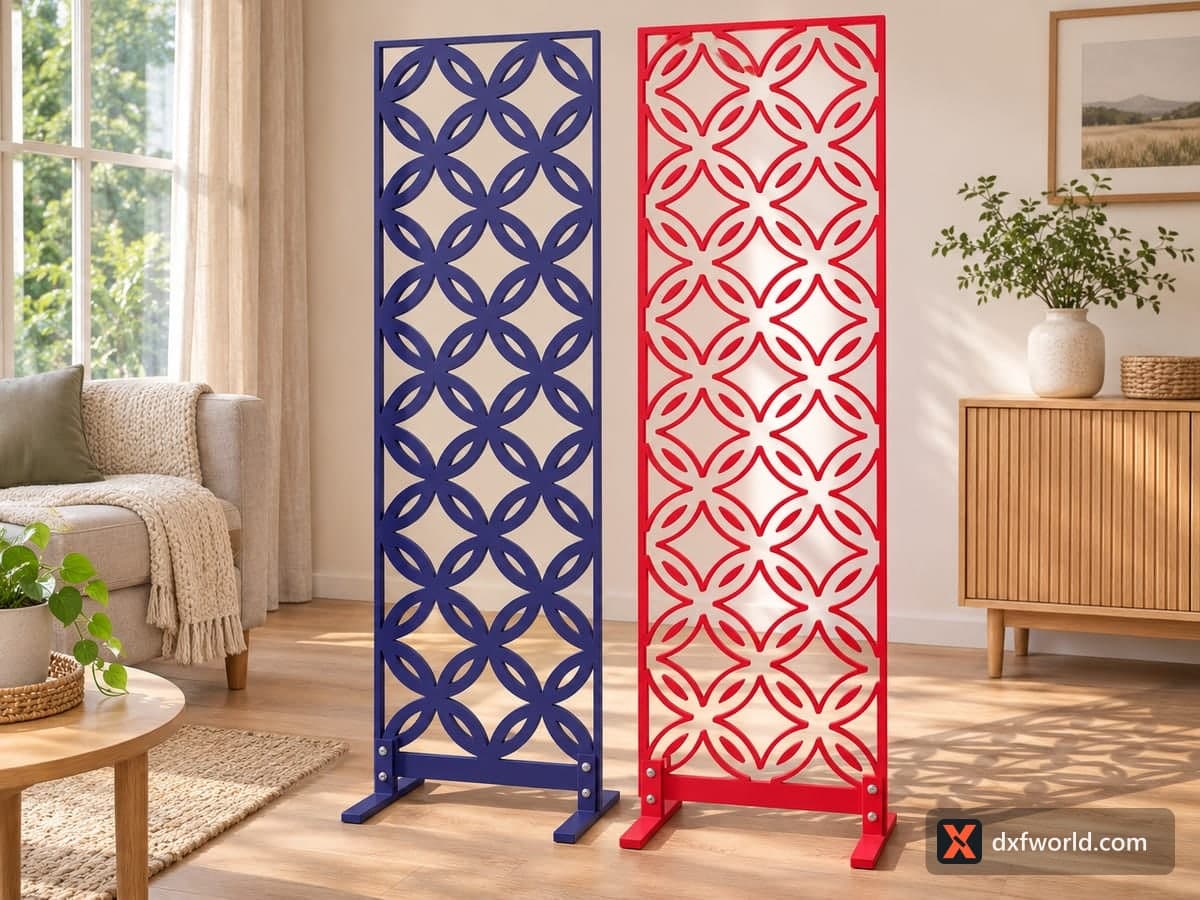
Two tall, narrow lattice panels side by side, each filled with the interlocking circles pattern (also called the shippo or overlapping rings pattern): rows of rings that overlap to leave pointed lens openings and four-point star openings, inside a thin frame. The free download is one SVG and one DXF file with both panels on a 160.4 × 271.5 mm (6.31 × 10.69 in) layout, each panel 74.0 × 271.5 mm, cut lines only and easy to scale.
- Formats
- SVG, DXF
- Size
- 160 × 272 mm (6.31 × 10.69 in)
- Material
- Plywood, MDF, acrylic or metal (scale to your piece)
- Cut length
- 9.72 m
- Est. time, 10 W diode (3 mm)
- 32 min 23 s
- Est. time, 40 W CO2 (3 mm)
- 13 min 30 s
- Layers
- CUT only, no engraving
Free account required to download
How to make it
- 01Scale the layout so each panel reaches your target height; both panels scale together.
- 02Cut one lens opening as a test to check that the pointed tips come out clean in your material.
- 03Cut both panels, inner openings first, then each frame outline.
- 04Sand, paint each panel its own color if you like, and fit them into frames, feet or door openings.
The pattern
The interlocking circles design is one of the oldest lattice patterns, used in Japanese shoji, Chinese window grilles and Roman mosaics. Here the rings are drawn as wide, even bands. Where two rings cross they leave a pointed lens-shaped opening, and the space between four rings becomes a larger square opening with curved sides. Each panel is two rings wide and about seven and a half rings tall, with half-rings tucked against a thin outer frame. The two panels are cropped a little differently at their edges, so they read as a matched pair rather than exact copies. In the photo they stand as two painted metal floor screens, one blue and one red.
Scaling and material
The layout is drawn small. Scale each panel up to the height you need and keep the narrow 1:3.7 proportions:
- 300 mm tall: lantern sides, candle screens or box inlays in 3 mm plywood or acrylic.
- 900 mm tall: a window or shelf-back panel in 6 mm MDF.
- 1.8 m tall: a slim floor divider in 2 mm steel on a plasma table or in 12 mm MDF on a CNC router.
The ring bands stay wide at any size, so this is one of the more forgiving lattices to cut; the lens tips are the only fine points.
Ideas
Use the pair either side of a doorway, as two cabinet door inserts, as backing panels in open shelving, or as a radiator cover front. Painted in two colors, they make a bright divider in a kids' room or a café.
Questions about this file
Are both panels in the file?
Yes. The layout holds two separate panels, each 74.0 × 271.5 mm before scaling, cropped slightly differently at the edges.
What is this pattern called?
Interlocking or overlapping circles; in Japan it is known as shippo. It also appears in many old window grilles.
How do I stand them up as floor screens?
Bolt each panel to two L-shaped metal feet, or slot the bottom edge into a heavy wooden base with a routed groove.
Can I make one wide panel instead?
Yes. Place the two panels edge to edge without the gap, or repeat one panel several times to fill a wider frame.
Does acrylic work for this?
It does, and colored or frosted acrylic looks good backlit in a lamp or cabinet door at smaller sizes.
Similar files