
Laser Cut Cutlery Tray Files: 12 Free Drawer Organizers and Countertop Caddies
A laser cut cutlery tray is a plywood drawer insert or countertop caddy with lanes for forks, spoons and knives, joined with tabs and slots. The 12 free files below range from a 7-part, 240 × 120 × 120 mm upright caddy to a 15-part tiered stand, with drawer trays from 240 to 360 mm wide. Each comes in SVG and DXF for 3, 4, 5 and 6 mm plywood and cuts in about 14 to 40 minutes on a 10 W diode (3 mm).
Every kitchen has one drawer that rattles. You pull it open and the forks, the teaspoons and that one cake server you use twice a year slide into a heap at the front. A laser cut cutlery tray fixes it in a weekend: a plywood box with lanes, sized for the drawer you actually have, put together without a single screw.
Here are 12 cutlery tray files from the DXF World library, from a 7-part drawer tray to a 15-part tiered stand for a buffet. They include open drawer trays, trays with a sloped front, three boxes with lids and three countertop caddies. Every download has SVG and DXF drawn separately for 3, 4, 5 and 6 mm plywood, and all 19 cutlery files are in the cutlery trays category.
Laser cut cutlery tray files compared
| File | Type | Outer size, mm (W × D × H) | Parts | 10 W diode, 3 mm |
|---|---|---|---|---|
| Three-section drawer tray | Open drawer tray | 240 × 280 × 60 | 7 | 18 min 49 s |
| Cutlery drawer tray, 4 slots | Open drawer tray | 320 × 300 × 60 | 8 | 24 min 59 s |
| Wide silverware tray, 6 slots | Open drawer tray | 360 × 300 × 60 | 10 | 32 min 19 s |
| Sloped front silverware tray | Open, sloped front | 260 × 300 × 60 | 7 | 19 min 48 s |
| Tray with teaspoon strip | Open, lanes + cross strip | 320 × 340 × 60 | 8 | 24 min 44 s |
| Deep utensil drawer tray | Open, 70 mm walls | 320 × 320 × 70 | 8 | 26 min 15 s |
| Hinged lid cutlery box | Lid on plywood pins | 240 × 300 × 60 | 8 | 25 min 42 s |
| Sliding lid cutlery box | Sliding lid on rails | 280 × 280 × 60 | 9 | 29 min 2 s |
| Silverware box, lift-off lid | Lift-off lid | 260 × 280 × 60 | 8 | 30 min 44 s |
| Upright countertop caddy | Countertop, sloped | 240 × 120 × 120 | 7 | 14 min 1 s |
| Two-tier square caddy | Countertop, two tiers | 200 × 200 × 140 | 8 | 17 min 55 s |
| Nine-slot tiered stand | Tiered stand | 290 × 320 × 210 | 15 | 39 min 13 s |
Sizes are outer width × depth × height, where depth runs from the front of the drawer to the back. The times are estimates for the 3 mm file; on a 40 W CO2 the same trays take roughly 5 to 17 minutes. Test your own settings on scrap before trusting any number.
Measure the drawer before you pick a tray
A tray that is 5 mm too wide is a tray that never goes in. Measure the inside of the drawer at the bottom, where the tray will sit, and leave a little air: about 5 mm on each side lets you lift it out with one hand. The table adds 10 mm to every outer size.
| Tray | Outer size, mm | Drawer inside needs at least, mm |
|---|---|---|
| Three-section drawer tray | 240 × 280 × 60 | 250 × 290 × 70 |
| Hinged lid cutlery box | 240 × 300 × 60 | 250 × 310 × 70 |
| Sloped front silverware tray | 260 × 300 × 60 | 270 × 310 × 70 |
| Silverware box, lift-off lid | 260 × 280 × 60 | 270 × 290 × 70 |
| Sliding lid cutlery box | 280 × 280 × 60 | 290 × 290 × 70 |
| Cutlery drawer tray, 4 slots | 320 × 300 × 60 | 330 × 310 × 70 |
| Deep utensil drawer tray | 320 × 320 × 70 | 330 × 330 × 80 |
| Tray with teaspoon strip | 320 × 340 × 60 | 330 × 350 × 70 |
| Wide silverware tray, 6 slots | 360 × 300 × 60 | 370 × 310 × 70 |
The third number is height: the space from the drawer floor to the underside of the worktop or the drawer above. Drawer trays here are 60–70 mm tall, so most cutlery drawers have room to spare. A lidded box in a drawer also needs room to open: a lid that lifts or slides out has to clear the drawer above.
Common mistake: measuring the drawer at the top edge. Many drawers have a lip at the front, rounded inside corners or runners that eat into the width lower down. Measure the floor itself, in two or three places, and use the smallest number.
Open drawer trays with long lanes
The classic layout: full-depth dividers, one lane per type of cutlery, nothing to lift or open.
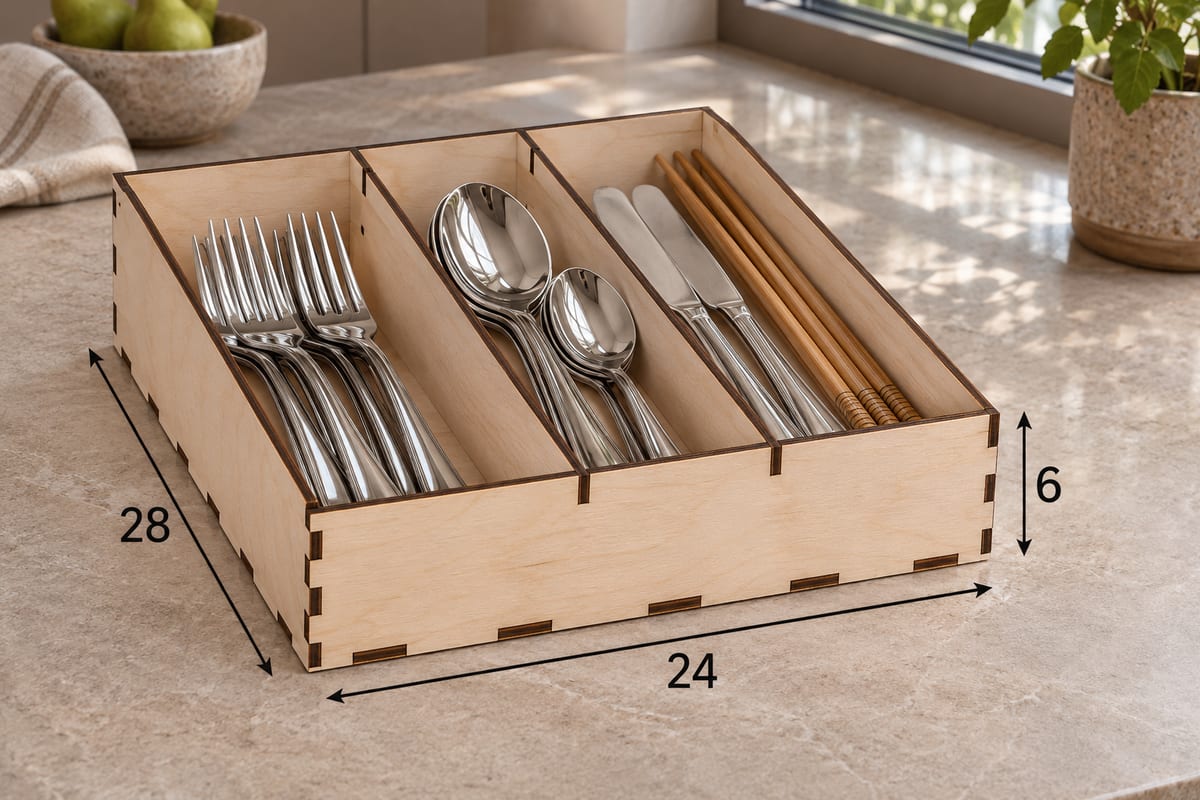 Three-Section Cutlery Drawer TrayOuter size (W × D × H) 240 × 280 × 60 mm (9.45 × 11.02 × 2.36 in)Parts 7Est. time, 10 W diode (3 mm) 18 min 49 sEst. time, 40 W CO2 (3 mm) 7 min 50 sSVG · DXF →
Three equal lanes for forks, spoons and table knives, and only 7 parts. At 240 × 280 × 60 mm it is the narrowest drawer tray here, a good fit for small kitchens and a sensible first cutlery project.
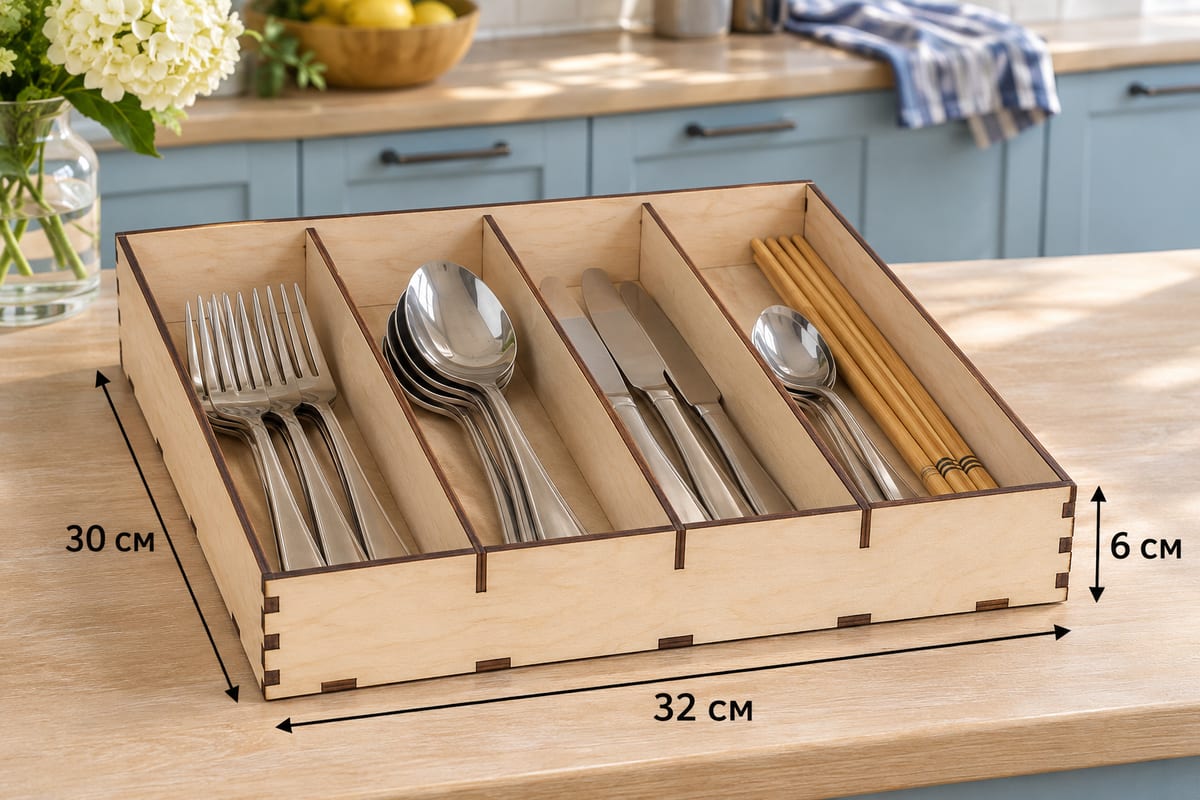 Cutlery Drawer Tray, 4 SlotsOuter size (W × D × H) 320 × 300 × 60 mm (12.60 × 11.81 × 2.36 in)Parts 8Est. time, 10 W diode (3 mm) 24 min 59 sEst. time, 40 W CO2 (3 mm) 10 min 25 sSVG · DXF →
One lane more, so teaspoons get their own place instead of sinking under the big spoons. Three full-depth dividers, eight parts, 320 mm wide.
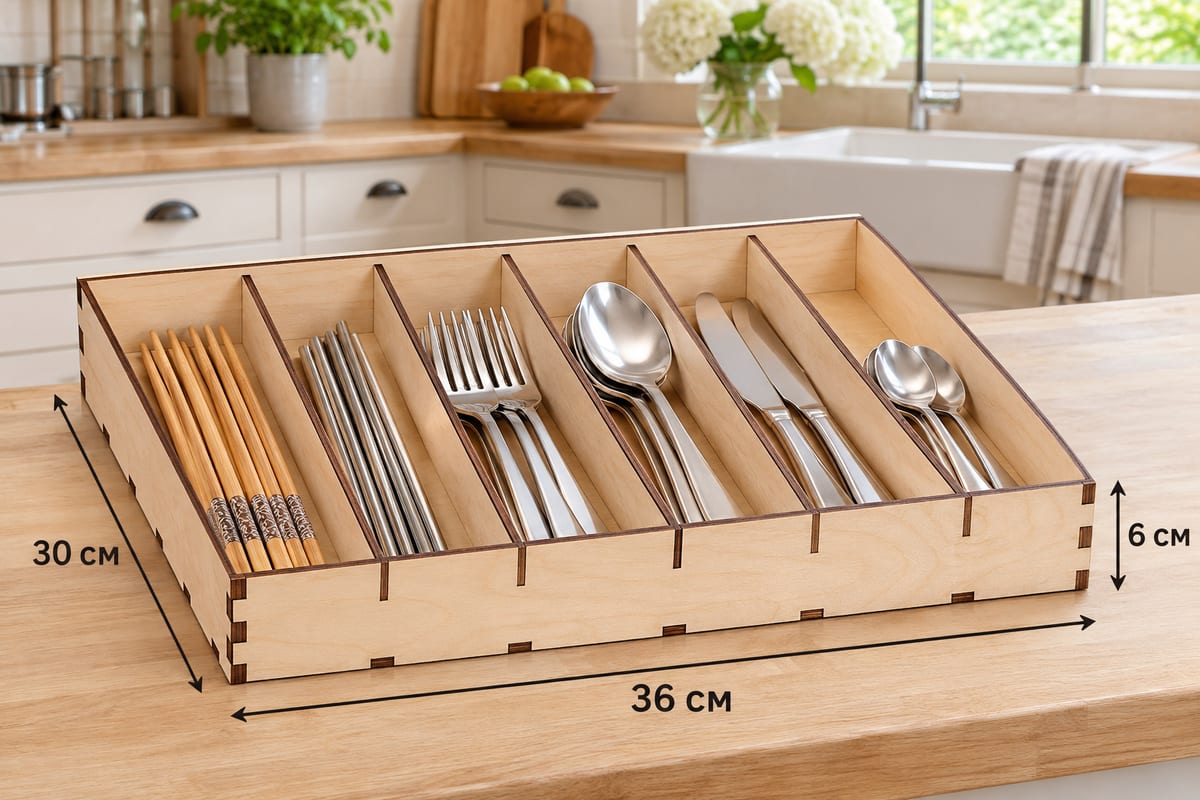 Wide Silverware Tray, 6 SlotsOuter size (W × D × H) 360 × 300 × 60 mm (14.17 × 11.81 × 2.36 in)Parts 10Est. time, 10 W diode (3 mm) 32 min 19 sEst. time, 40 W CO2 (3 mm) 13 min 28 sSVG · DXF →
For a wide drawer and a big household: six slots across 360 mm and five dividers. The front wall is a little lower than the back, so you see what is in each slot at a glance.
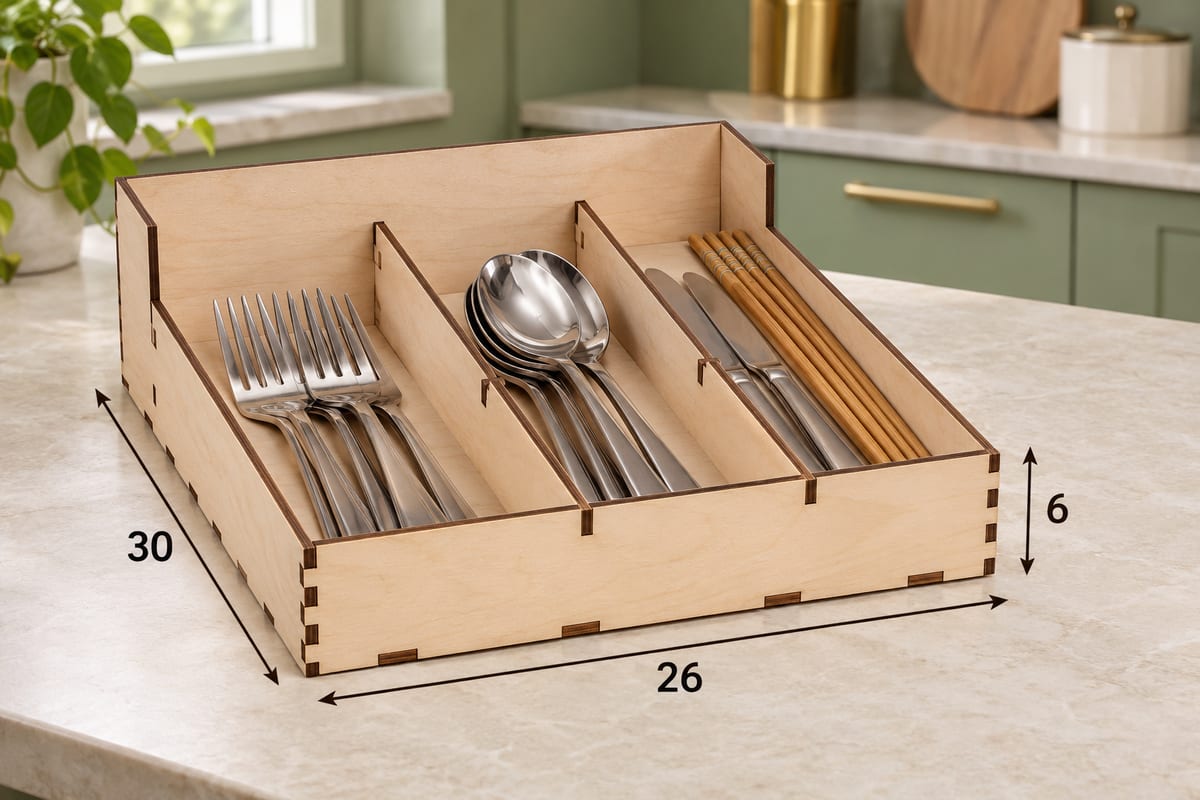 Sloped Front Silverware Tray, 3 LanesOuter size (W × D × H) 260 × 300 × 60 mm (10.24 × 11.81 × 2.36 in)Parts 7Est. time, 10 W diode (3 mm) 19 min 48 sEst. time, 40 W CO2 (3 mm) 8 min 15 sSVG · DXF →
The sides slope down from a 60 mm back to a 36 mm front, so handles are easy to grab even in a shallow drawer. Three lanes, seven parts, 19 min 48 s on a 10 W diode.
Pro tip: cutlery is heavier than it looks. For a full drawer tray that you lift in and out, 4 or 5 mm plywood feels much more solid than 3 mm, and the 6 mm version is close to indestructible. For thick sheets on a diode, read how many passes 6 mm plywood takes.
Trays for teaspoons, chopsticks and big utensils
Real drawers hold more than four kinds of cutlery. These two handle the awkward pieces.
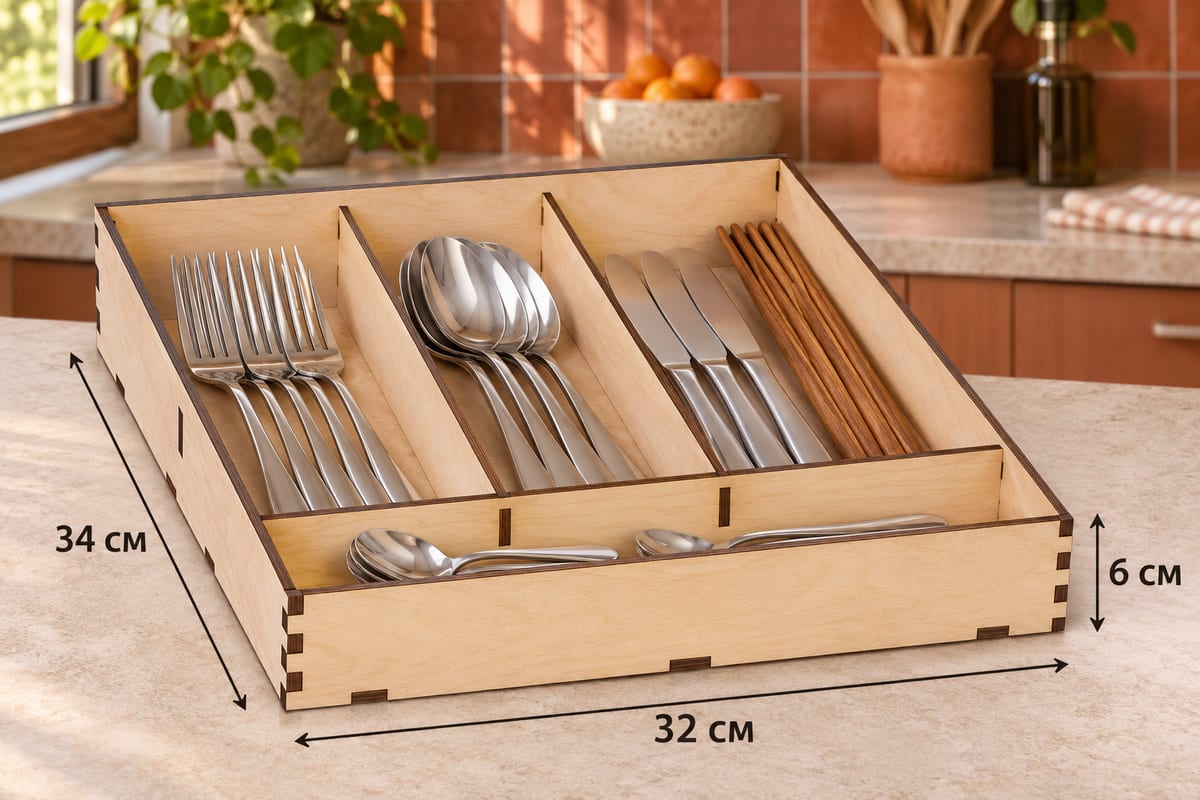 Cutlery Tray With Teaspoon StripOuter size (W × D × H) 320 × 340 × 60 mm (12.60 × 13.39 × 2.36 in)Parts 8Est. time, 10 W diode (3 mm) 24 min 44 sEst. time, 40 W CO2 (3 mm) 10 min 19 sSVG · DXF →
Three long lanes at the back and one strip across the full width at the front for teaspoons, four compartments in all. At 340 mm deep it suits deeper drawers.
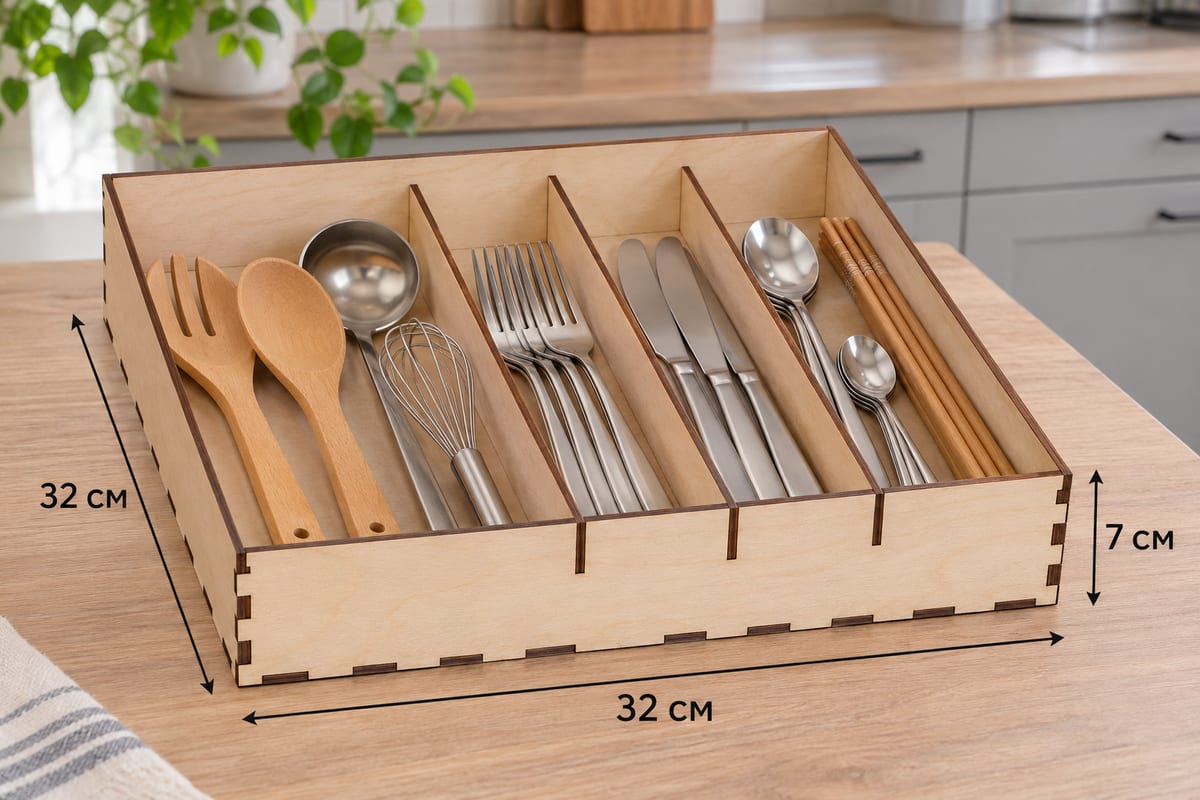 Deep Utensil Drawer Tray, 70 mmOuter size (W × D × H) 320 × 320 × 70 mm (12.60 × 12.60 × 2.76 in)Parts 8Est. time, 10 W diode (3 mm) 26 min 15 sEst. time, 40 W CO2 (3 mm) 10 min 56 sSVG · DXF →
Square, 320 × 320 × 70 mm, with 70 mm walls and four full-depth lanes. It is made for wooden spoons, ladles and whisks as much as for forks, so it can live in the drawer next to the stove.
Cutlery boxes with a lid
A lid turns a tray into a box you can carry: the good silverware for holidays, a picnic set, or chopsticks that should stay clean on an open shelf.
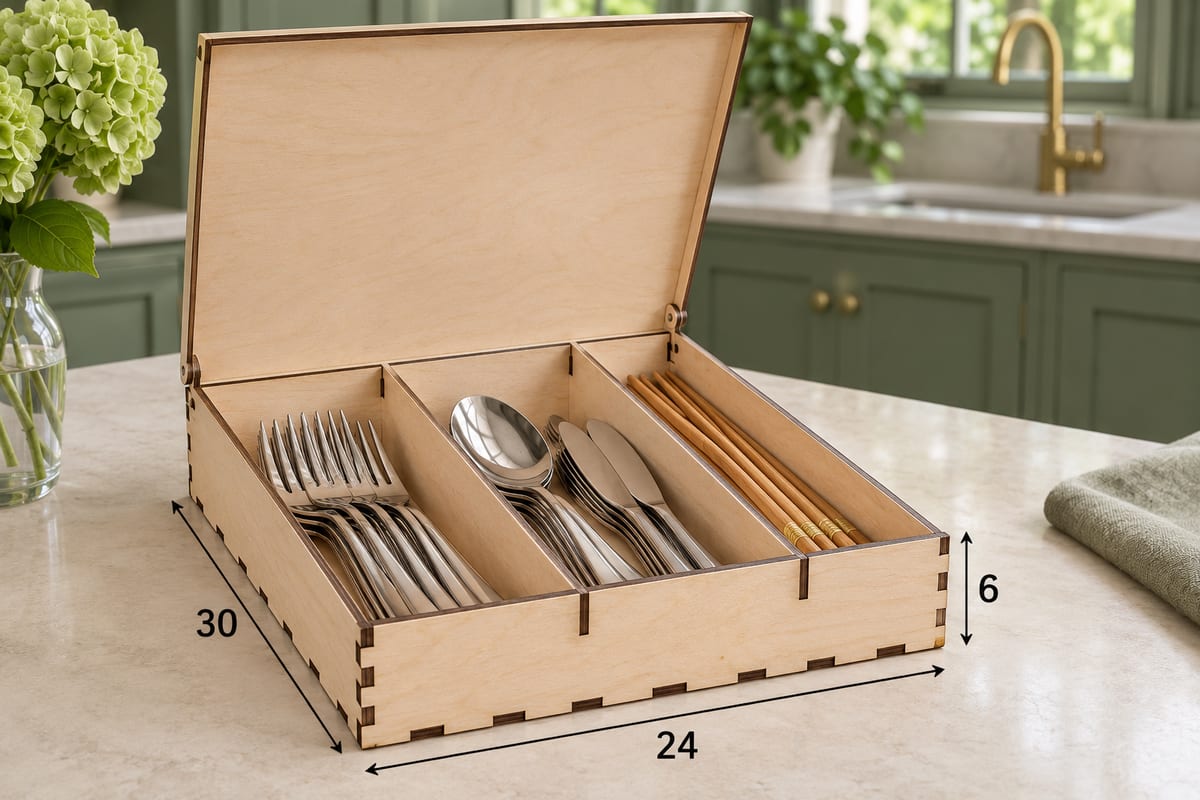 Hinged Lid Cutlery Box, 3 SectionsOuter size (W × D × H) 240 × 300 × 60 mm (9.45 × 11.81 × 2.36 in)Parts 8Est. time, 10 W diode (3 mm) 25 min 42 sEst. time, 40 W CO2 (3 mm) 10 min 43 sSVG · DXF →
The lid flips open at the back on pins cut into the plywood, with three sections for forks, spoons, knives and chopsticks inside. No metal hinge, eight parts.
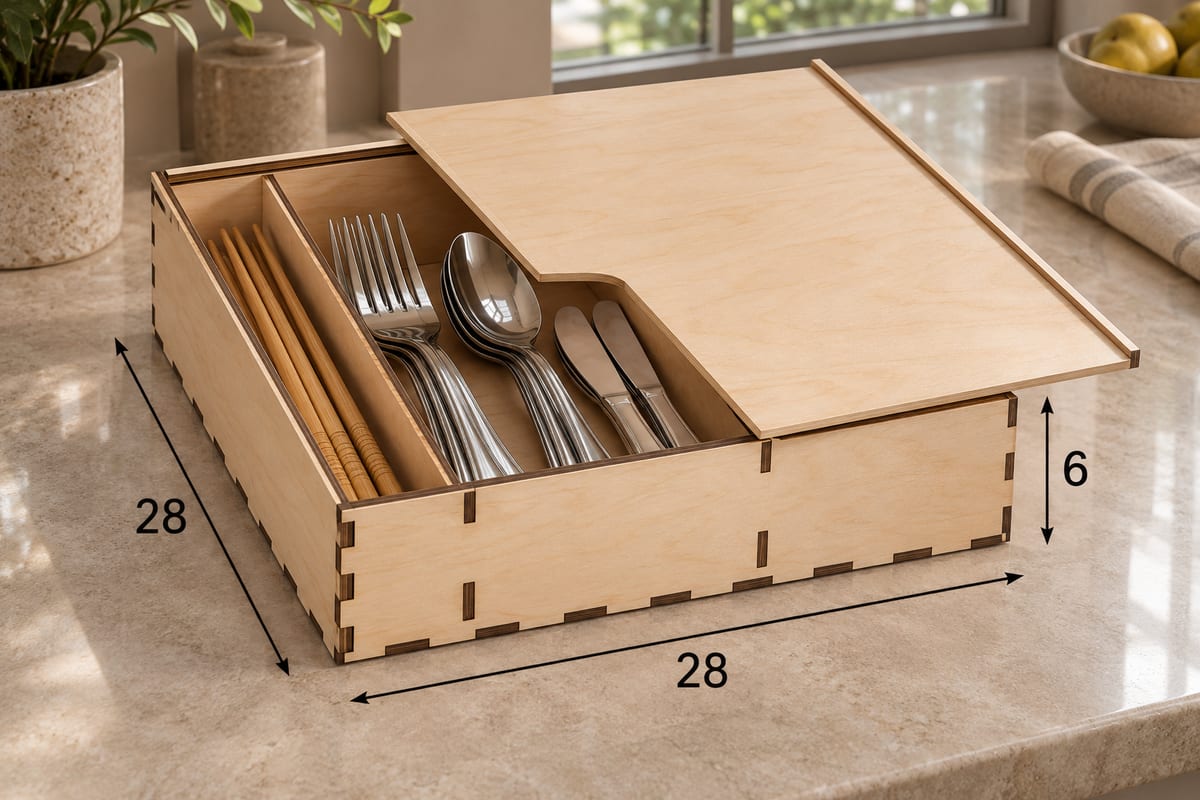 Sliding Lid Cutlery BoxOuter size (W × D × H) 280 × 280 × 60 mm (11.02 × 11.02 × 2.36 in)Parts 9Est. time, 10 W diode (3 mm) 29 min 02 sEst. time, 40 W CO2 (3 mm) 12 min 06 sSVG · DXF →
A square box with a lid that slides in on two rails and two sections inside, for flatware and chopsticks. Its layout is 1140 × 636 mm, the widest of the set, so a small bed needs it split into runs.
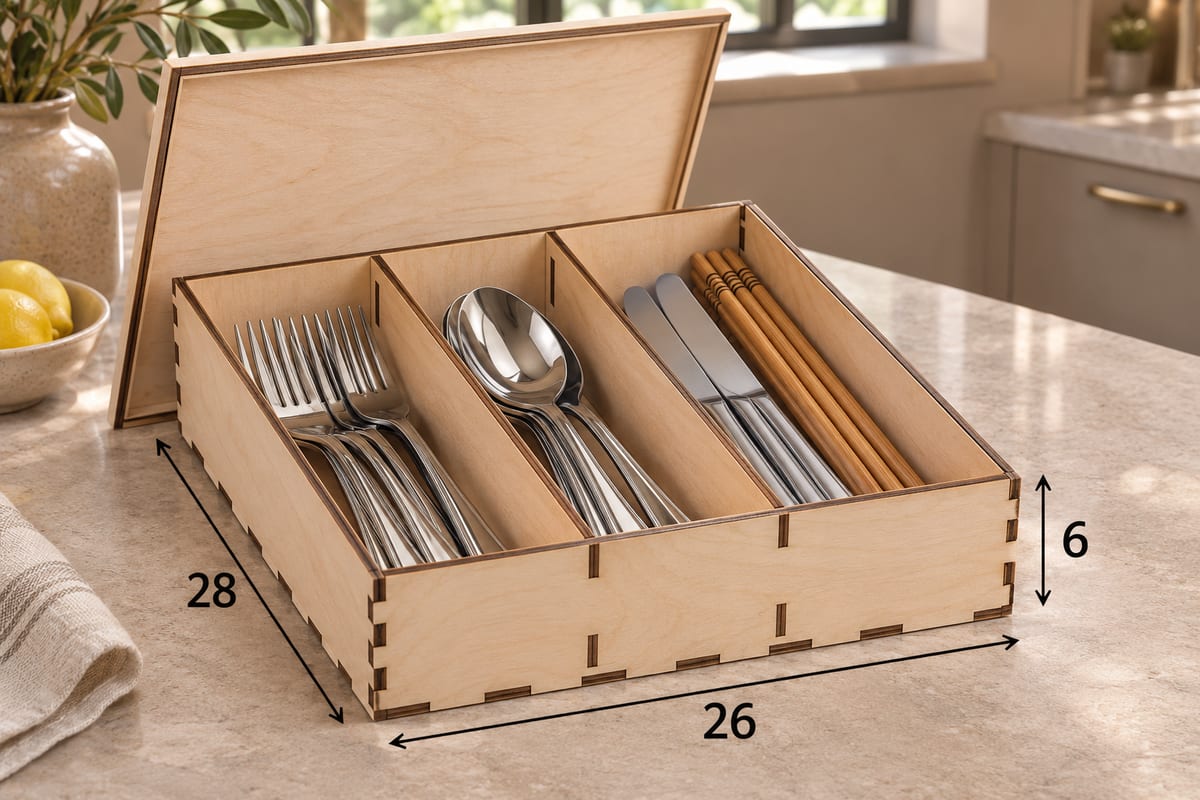 Silverware Box With Lift-Off LidOuter size (W × D × H) 260 × 280 × 60 mm (10.24 × 11.02 × 2.36 in)Parts 8Est. time, 10 W diode (3 mm) 30 min 44 sEst. time, 40 W CO2 (3 mm) 12 min 49 sSVG · DXF →
Three sections and a separate lid that simply sits on top. Only eight parts, yet 30 min 44 s on a 10 W diode, more than the two other lidded boxes, so put on a podcast.
Countertop caddies and tiered stands
No free drawer? Stand the cutlery up instead. These three go on a counter, a dining table or a buffet.
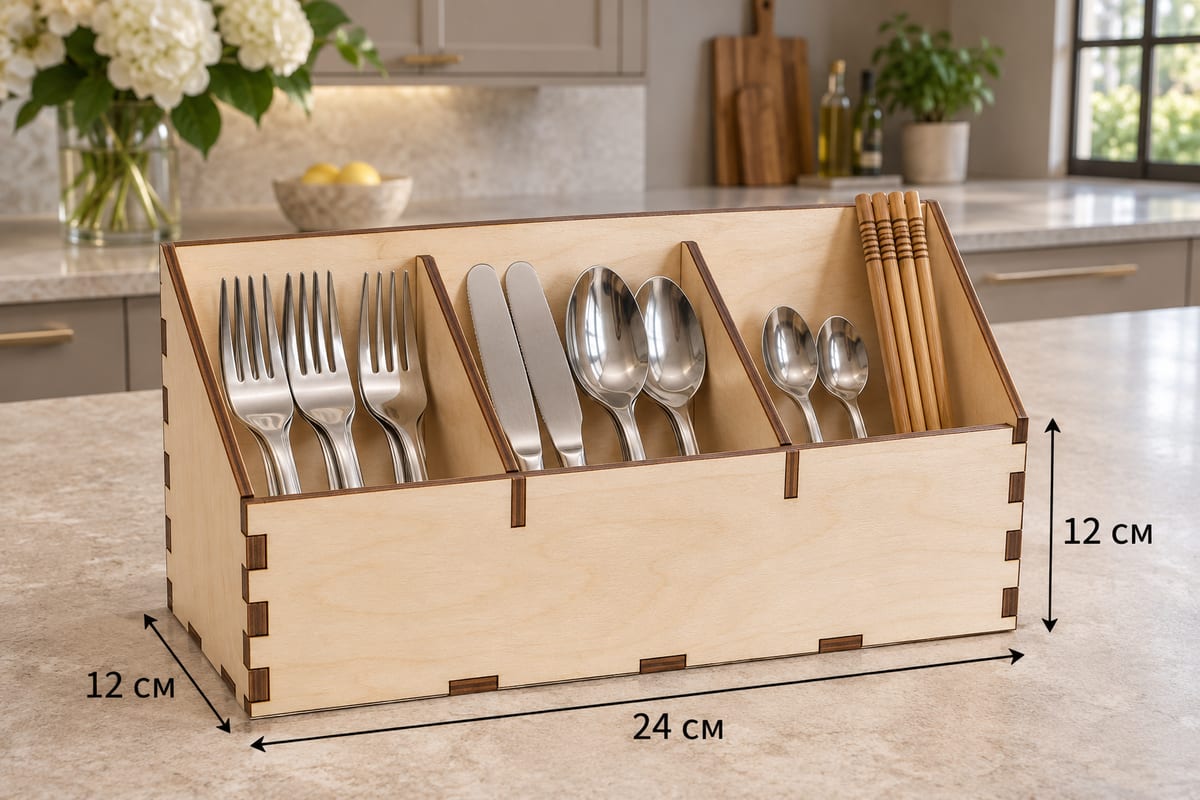 Upright Countertop Cutlery CaddyOuter size (W × D × H) 240 × 120 × 120 mm (9.45 × 4.72 × 4.72 in)Parts 7Est. time, 10 W diode (3 mm) 14 min 01 sEst. time, 40 W CO2 (3 mm) 5 min 51 sSVG · DXF →
The smallest and fastest file in this list: 240 × 120 × 120 mm, seven parts, 14 min 1 s on a 10 W diode. Forks, knives, spoons and chopsticks stand in three sections behind a low front.
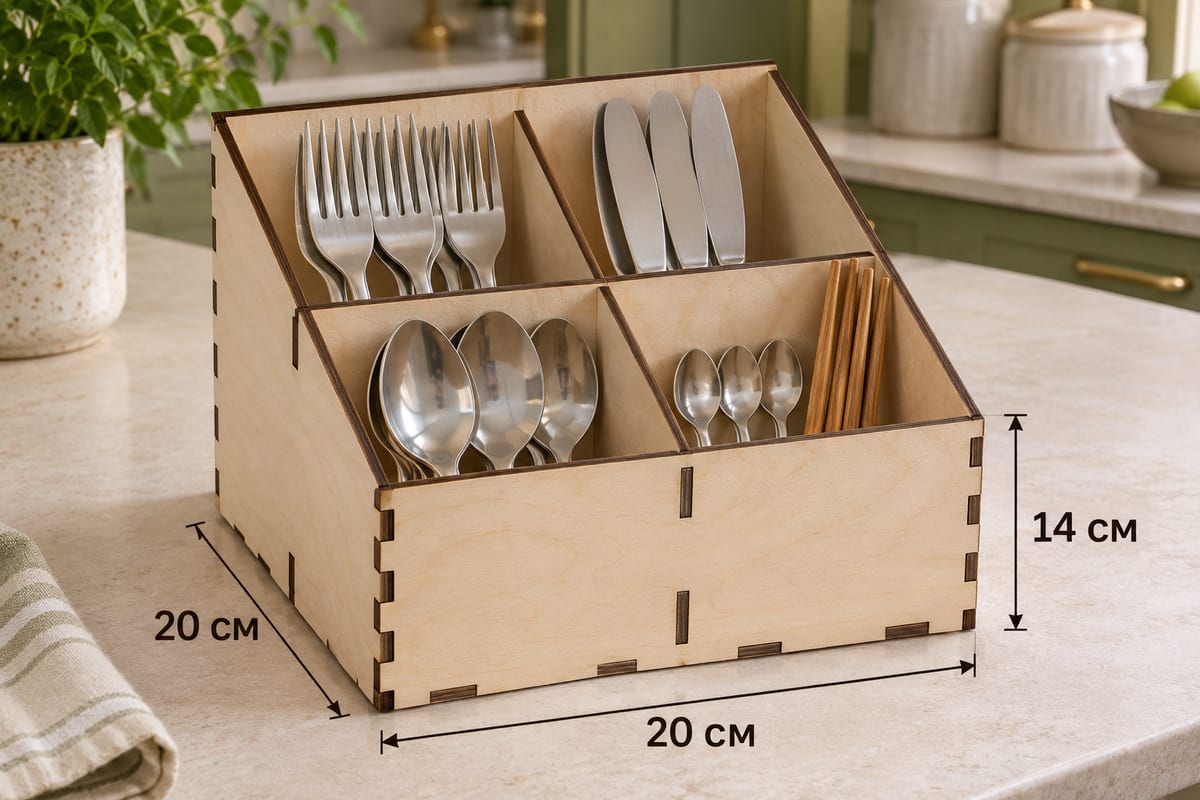 Two-Tier Square Silverware CaddyOuter size (W × D × H) 200 × 200 × 140 mm (7.87 × 7.87 × 5.51 in)Parts 8Est. time, 10 W diode (3 mm) 17 min 55 sEst. time, 40 W CO2 (3 mm) 7 min 28 sSVG · DXF →
Square and 140 mm tall, with two tall compartments at the back and two lower ones in front. Every handle stays visible, which makes it a good table caddy for a family dinner.
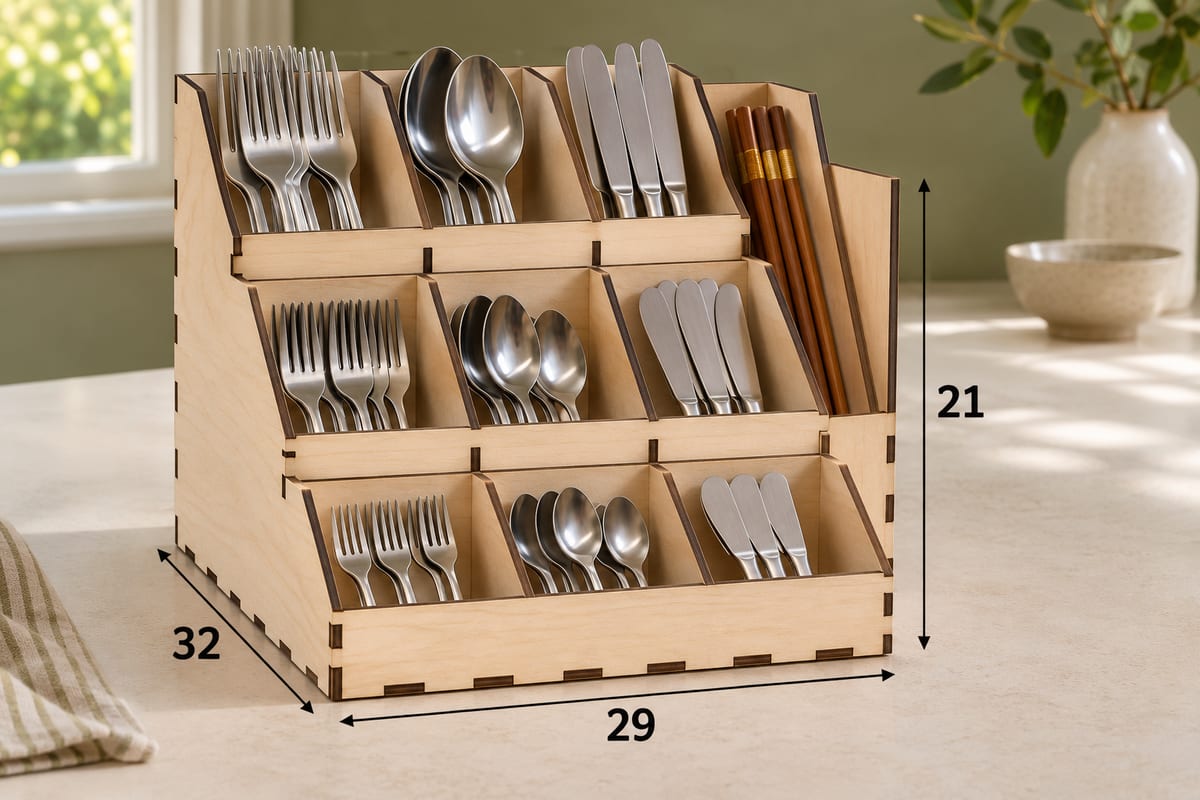 Nine-Slot Tiered Cutlery StandOuter size (W × D × H) 290 × 320 × 210 mm (11.42 × 12.60 × 8.27 in)Parts 15Est. time, 10 W diode (3 mm) 39 min 13 sEst. time, 40 W CO2 (3 mm) 16 min 20 sSVG · DXF →
Three steps, three slots on each, nine in total: a full self-service set for a party or a small café. It is the biggest file here, 15 parts with small engraved part numbers, and 39 min 13 s on a 10 W diode.
Cutting, assembly and finish
- Measure your plywood with calipers and download the version for that thickness.
- Cut a tab and a slot from scrap. Loose or tight? Read what kerf is and correct it before the real cut.
- The layouts here are about 740 to 1340 mm long. If your bed is smaller, rearrange the parts into several runs.
- Fit the dividers into the base first, then add the walls. Glue the outer corners if the tray will be lifted out often.
- Sand the soot off the edges and finish.
Cutlery sometimes goes back into the drawer still damp, so bare plywood will stain and swell over time. Two thin coats of clear varnish or hard wax oil, fully cured before use, keep the tray looking new. The plywood cutting guide has settings and tips for clean edges.
Next step: open that rattling drawer, measure the floor, and pick the tray from the fit table above. Cut the test joint first, and by the end of the weekend the forks will stay where they belong.
Read next: Tab and Slot Laser Cut Joints and Food Safe Finish for Plywood.
Questions and answers
How do I choose the right size cutlery tray for my drawer?
Measure the inside floor of the drawer, width and depth, and choose a tray at least 10 mm smaller in both directions. The drawer trays here are 240–360 mm wide and 280–340 mm deep.
What plywood thickness is best for a cutlery tray?
4 or 5 mm plywood is a good balance for a drawer tray full of cutlery. 3 mm works for small trays and caddies; 6 mm is the sturdiest but usually needs several passes on a diode.
How long does it take to laser cut a cutlery tray?
The 12 files here take about 14 to 40 minutes in 3 mm plywood on a 10 W diode and roughly 5 to 17 minutes on a 40 W CO2, plus assembly and finishing.
Do I need glue to assemble a laser cut cutlery tray?
The tabs and slots hold the tray together on their own if the fit is right. A little wood glue on the outer corners helps if the tray is lifted out of the drawer often.
How do I protect a plywood cutlery tray from water?
Dry the cutlery before it goes in and give the tray two thin coats of clear varnish or hard wax oil. Let the finish cure fully before use.