 Visualization
Cutlery Drawer Organizer SVG, Three Section Silverware Tray Laser Cut File, Wooden Flatware Insert DXF
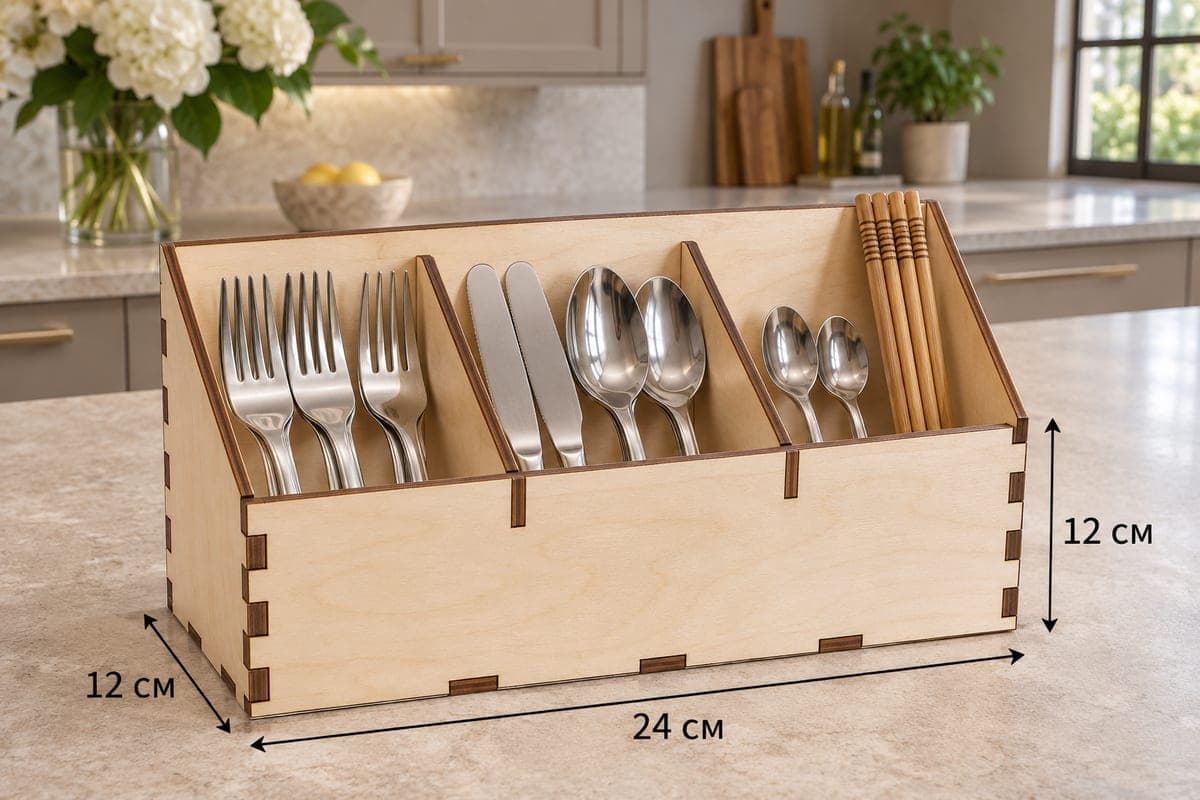
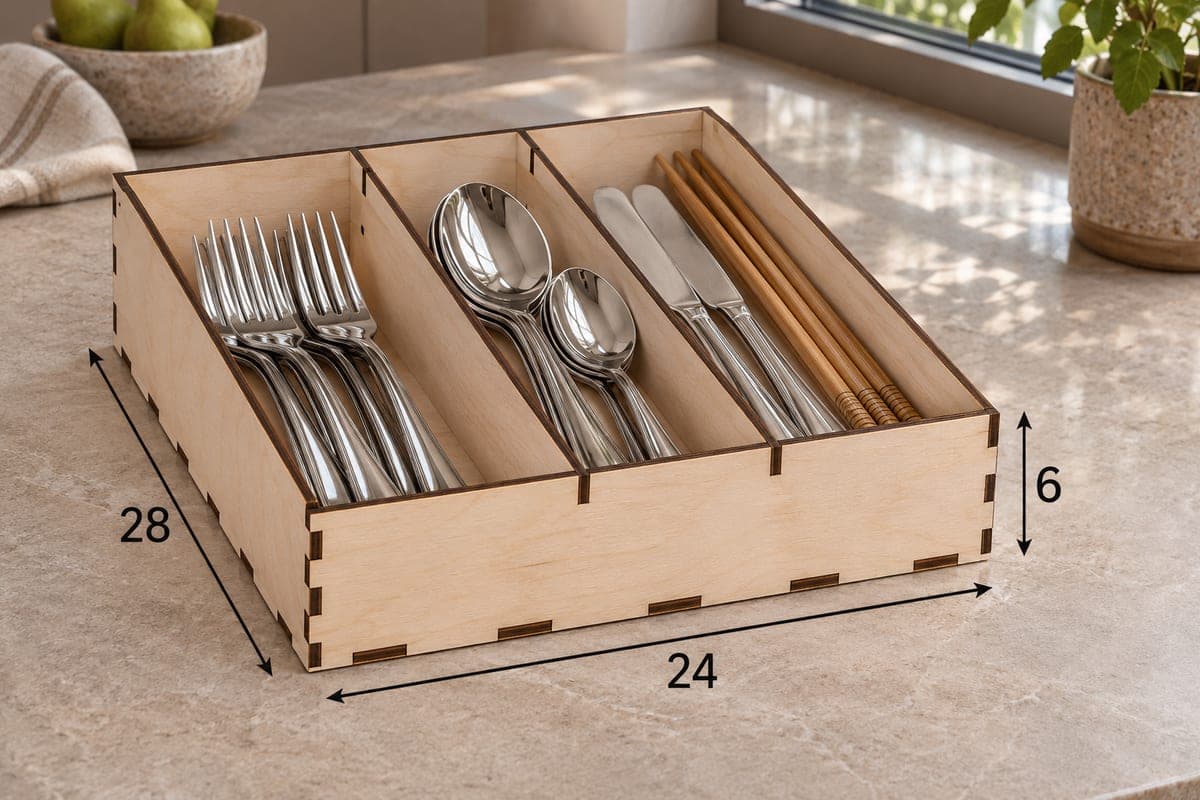
An open cutlery drawer tray with three equal sections running front to back, sized for forks, spoons and table knives. It measures 240 × 280 × 60 mm (9.45 × 11.02 × 2.36 in), is made of 7 plywood pieces that lock together with tabs and slots, and comes as SVG and DXF with a separate file for 3, 4, 5 and 6 mm plywood. The download is free.
- Formats
- SVG, DXF
- Outer size (W × D × H)
- 240 × 280 × 60 mm (9.45 × 11.02 × 2.36 in)
- Parts
- 7
- Material thickness
- 3, 4, 5 or 6 mm plywood (a file for each)
- Layout size (3 mm file)
- 1,060 × 352 mm
- Cut length
- 5.65 m
- Est. time, 10 W diode (3 mm)
- 18 min 49 s
- Est. time, 40 W CO2 (3 mm)
- 7 min 50 s
- Layers
- CUT only, no engraving
Free account required to download
How to make it
- 01Choose the SVG or DXF for your sheet thickness (3, 4, 5 or 6 mm) and test one slot on an offcut so the tabs press in firmly.
- 02Cut the seven parts, splitting them over two sheets if your bed is shorter than 1060 mm.
- 03Set both dividers into the base, slide the long left and right sides on, then close the ends with the front and back walls.
- 04Sand the burnt edges, seal the tray with lacquer or oil, and sort forks, spoons and knives into the three lanes.
Three lanes, one per utensil
Two full-length dividers split this narrow tray into three lanes of the same width. In the photo the left lane takes dinner forks, the middle one holds soup spoons and teaspoons, and the right lane carries table knives with a few wooden chopsticks laid beside them. At 240 mm wide it suits a narrow kitchen drawer or the top drawer of a sideboard, and the 280 mm depth is long enough for standard dinner forks to lie flat. All four walls are the same 60 mm height, so the tray reads as a simple, square-edged box from every side.
Cutting on smaller machines
In the 3 mm version the parts fill a 1060 × 352 mm area, and most diode lasers have a shorter bed, so split the job: base and both long sides on one sheet, the front, back and two dividers on another. Estimated time for the 3 mm file is about 18 min 49 s on a 10 W diode, about 7 min 50 s with a 40 W CO2, or about 3 min 46 s with a 100 W CO2. A 10 W diode gets through 3 mm birch in one or two passes; 5 and 6 mm sheets need more passes or a CO2 tube.
The joints stay put without glue, which lets you take the tray apart for cleaning. If you would rather it never moves, run a thin bead of wood glue into each slot. Sand off scorch marks and seal with clear lacquer or a food-safe oil, since damp cutlery will touch every surface.
Ideas for selling
- A small flat-pack drawer tray ships cheaply in a padded envelope.
- Offer it next to a matching bread board as a starter-kitchen bundle.
- Engrave a family surname on the front wall as a paid extra for wedding gifts.
Questions about this file
Is a 240 mm wide tray too narrow for a family's cutlery?
It holds a set for four to six people comfortably, with forks, spoons and knives each in their own lane. For a bigger household, cut two and set them side by side in a wide drawer.
Can I make the tray deeper so it fills my drawer front to back?
You can stretch the design in a vector editor, but only along the length of the pieces. Keep every slot and tab at the width of your sheet, otherwise the joints will be loose or will not close.
Would 3 mm acrylic work for a cutlery tray?
Yes, acrylic is easy to wipe and does not mind water. Use the 3 mm file, cut a test slot first, and glue the joints with acrylic cement because acrylic has no give.
Which plywood thickness feels sturdiest in a drawer?
4 or 5 mm gives walls that do not flex when you grab a handful of forks. 3 mm is lighter and cuts fastest on a diode laser, and is still plenty for a 60 mm tray.
What finish is safe for a tray that touches cutlery?
A food-safe oil such as mineral oil or a hardwax oil, or a water-based clear lacquer once fully cured. Two thin coats keep moisture from wet spoons out of the wood.
Similar files