 Visualization
Six Slot Silverware Tray SVG, Large Cutlery Drawer Organizer Laser File, Chopstick and Flatware Box DXF
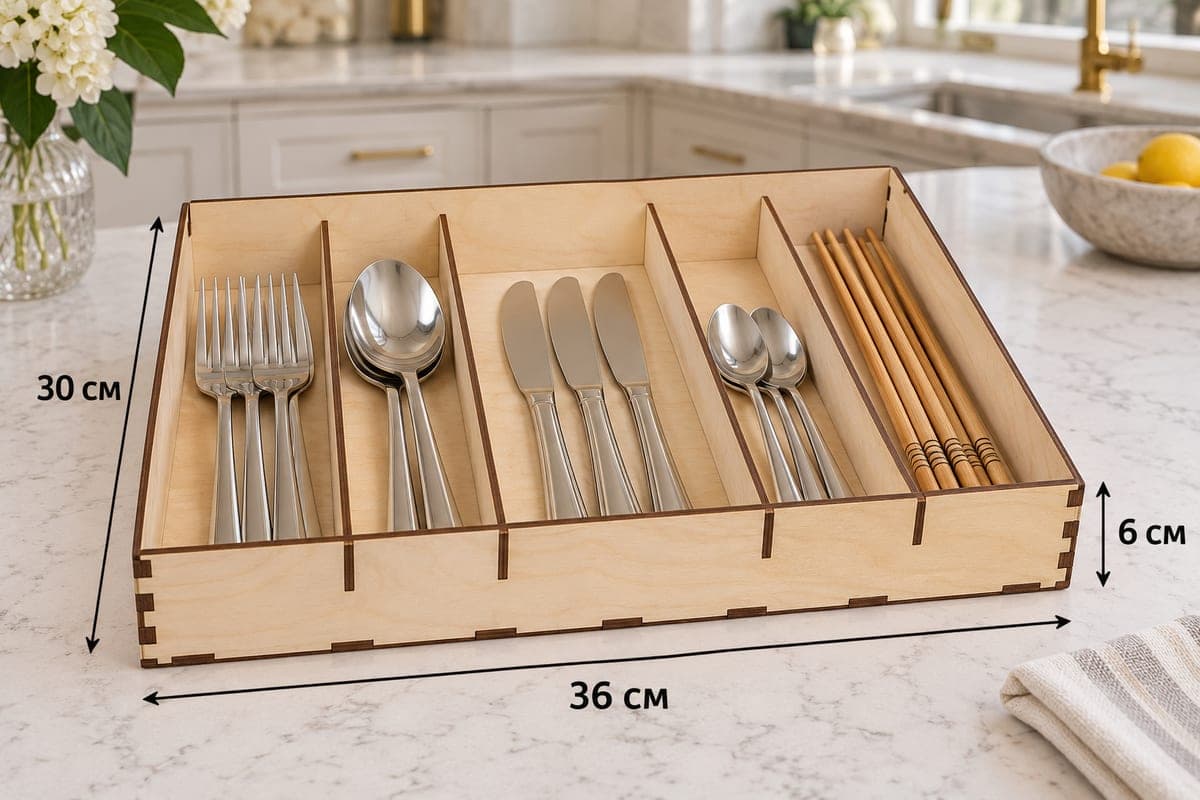
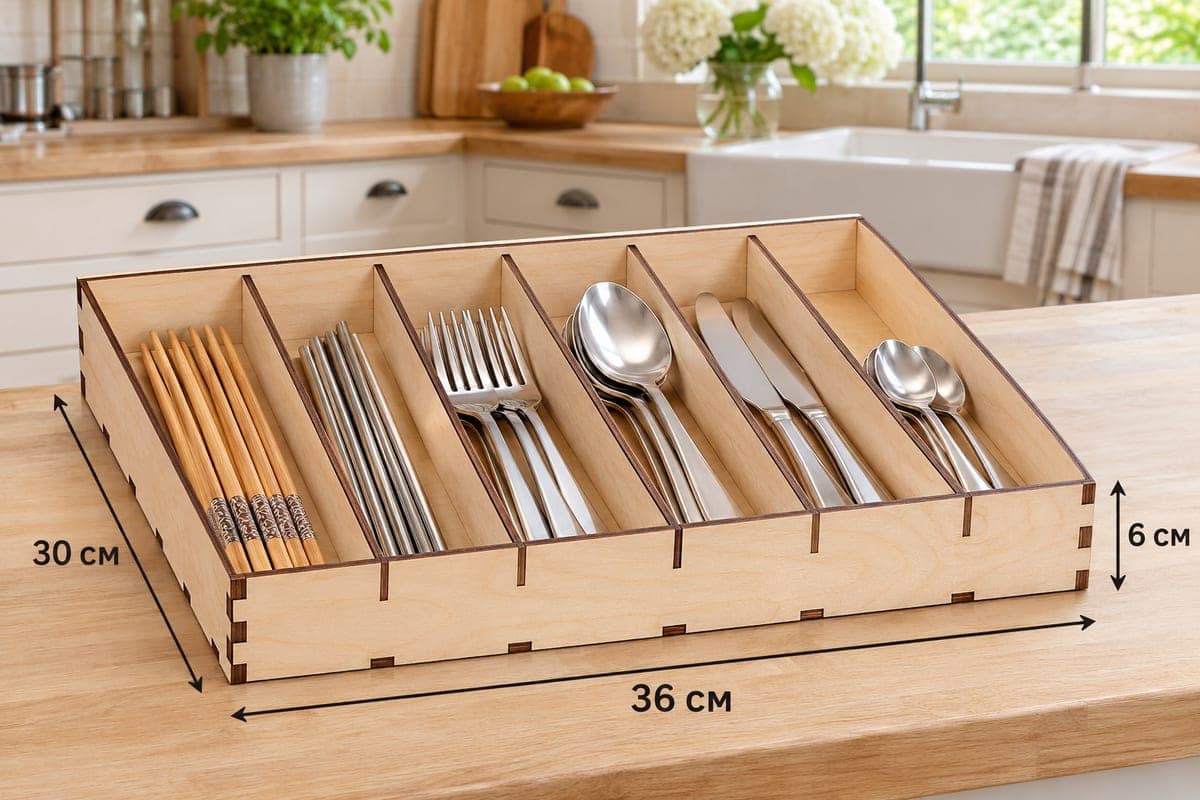
A wide six-slot silverware tray for large cutlery drawers, with a front wall slightly lower than the back so the contents are easy to see. It ships as SVG and DXF with separate files for 3, 4, 5 and 6 mm plywood, measures 360 × 300 × 60 mm (14.17 × 11.81 × 2.36 in), has 10 pieces including five dividers, and assembles with tabs and slots. A free download.
- Formats
- SVG, DXF
- Outer size (W × D × H)
- 360 × 300 × 60 mm (14.17 × 11.81 × 2.36 in)
- Parts
- 10
- Material thickness
- 3, 4, 5 or 6 mm plywood (a file for each)
- Layout size (3 mm file)
- 1,340 × 436 mm
- Cut length
- 9.69 m
- Est. time, 10 W diode (3 mm)
- 32 min 19 s
- Est. time, 40 W CO2 (3 mm)
- 13 min 28 s
- Layers
- CUT only, no engraving
Free account required to download
How to make it
- 01Use the folder for your plywood thickness and cut one slot on scrap; a snug fit matters with five dividers in a row.
- 02Cut the base, the lower front, the back, the two sloped sides and the five dividers.
- 03Sand the dividers, push all five into the base, add the sloped sides, then fit the back and the lower front last.
- 04Seal the tray and fill the six lanes with chopsticks, forks, spoons, knives and teaspoons.
Six narrow lanes
This is the most divided tray in the cutlery set: five dividers turn the 360 mm width into six lanes, each running the full 300 mm depth. Narrow lanes keep cutlery standing in neat rows rather than sliding into a heap. The photo uses them for wooden chopsticks, metal chopsticks, forks, dinner spoons, table knives and teaspoons, which suits a household that sets the table with more than the basic three pieces.
The front wall is 51 mm against a 60 mm back, and the side panels slope gently between them. The difference is small, but it lets you see the tips of the cutlery when the drawer is only half open and makes the front lane easier to reach.
Cutting and finishing the six-lane tray
The 3 mm layout is 1340 × 436 mm, and the cut line is the longest in this group because of the five dividers. Estimated time for the 3 mm file: about 32 min 19 s on a 10 W diode, about 13 min 28 s on a 40 W CO2, about 6 min 28 s on a 100 W CO2. Split the parts over two or three sheets on a smaller bed. For 5 and 6 mm plywood a diode needs repeated passes, so a CO2 machine saves a lot of time.
Sand each divider edge before assembly; it is much harder to reach inside six narrow lanes later. Seal with lacquer or a food-safe oil.
Selling to cafes and restaurants
Restaurants and cafes with self-service cutlery stations like six-lane trays. Engrave a logo on the back wall and offer it as a custom order alongside the napkin caddies.
Questions about this file
How wide is each of the six lanes?
Roughly 55 mm, depending on the plywood thickness; that holds a stack of forks or spoons nested in a row.
Why is the front wall lower than the back?
The front is 51 mm and the back 60 mm, so you can see and grab the cutlery more easily when the drawer is only partly open.
Which thickness keeps the lanes widest?
The 3 mm file, because six dividers and two walls of 6 mm plywood take up noticeably more of the inner width.
Can it hold serving cutlery?
Serving spoons and cake servers up to about 290 mm long fit, but bulky ladles are better in the deep 70 mm utensil tray.
How do I add a cafe logo to the back wall?
Place the logo on the back panel in your laser software as an engraving layer and run it before the cut lines, so the panel does not shift.
Similar files