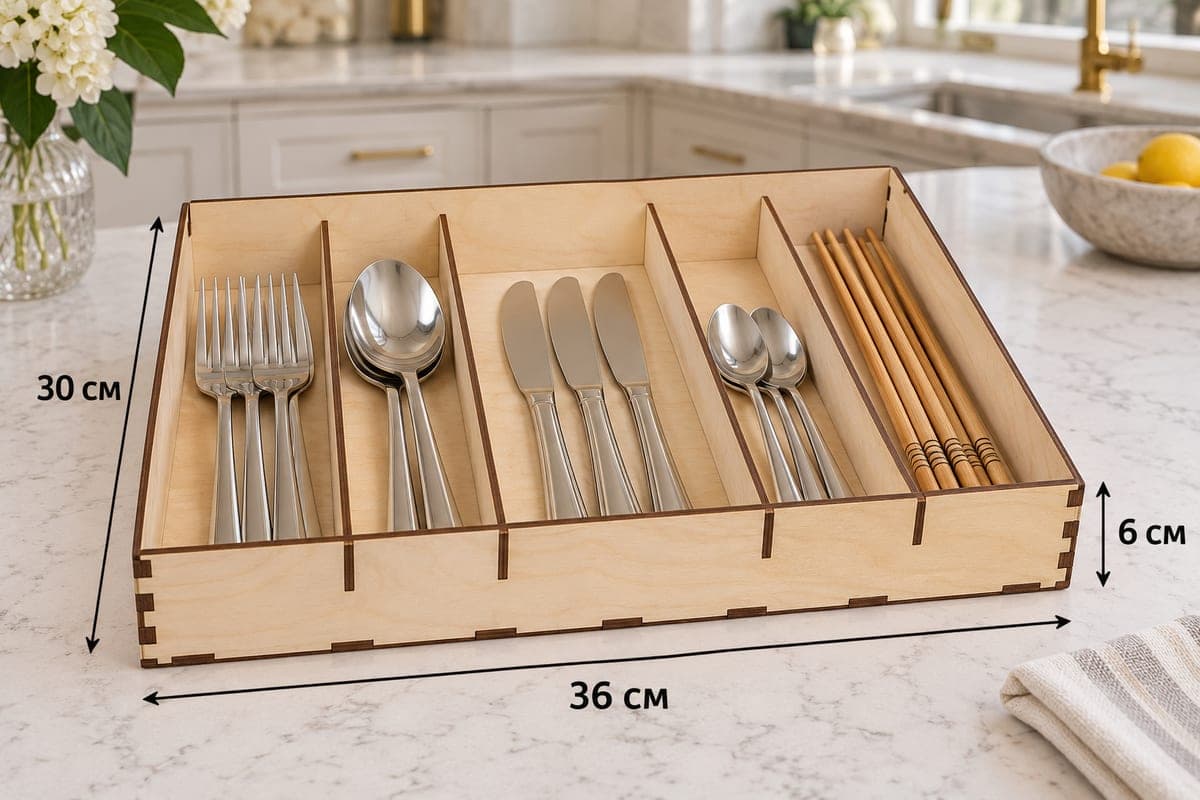
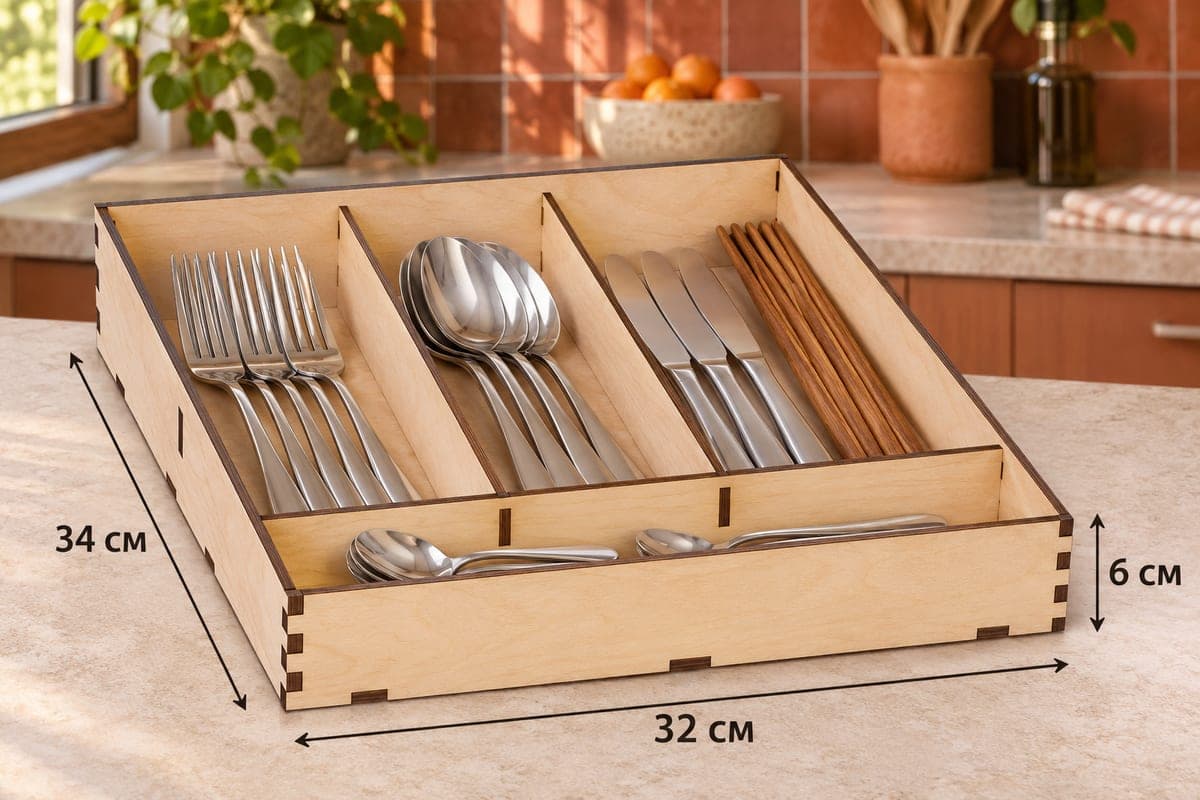
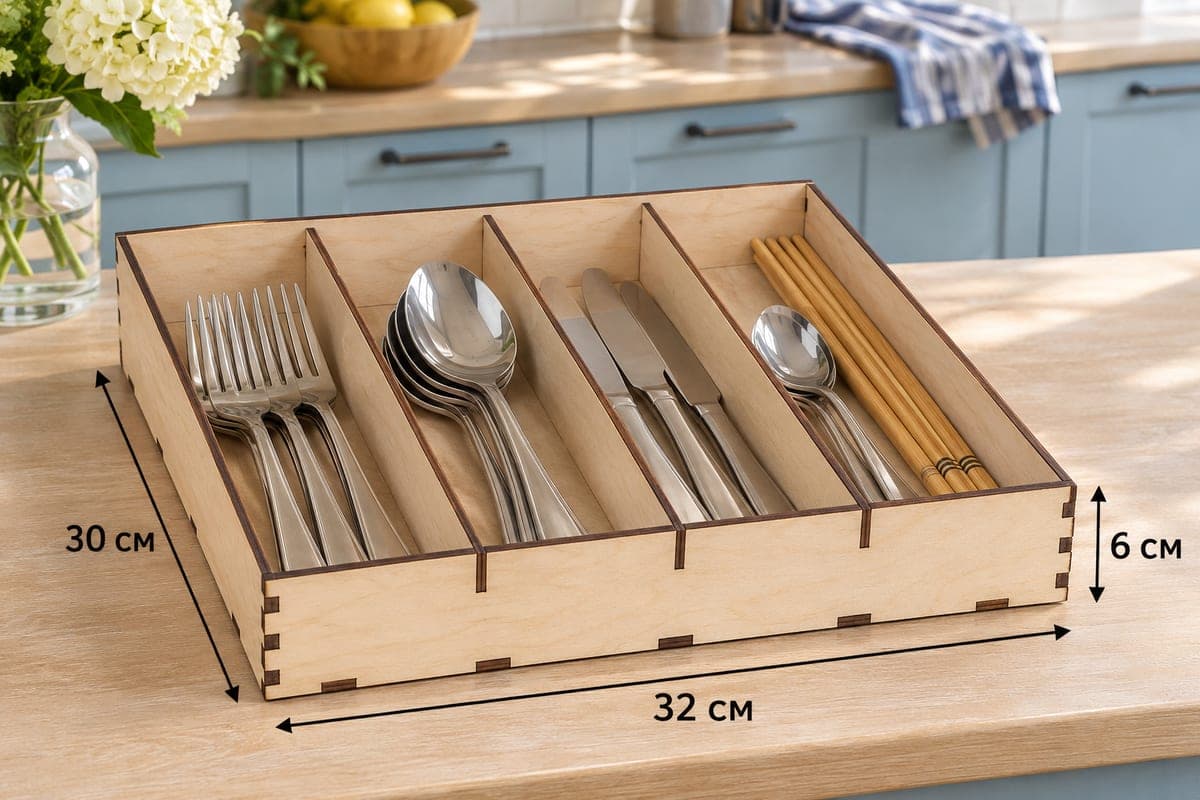
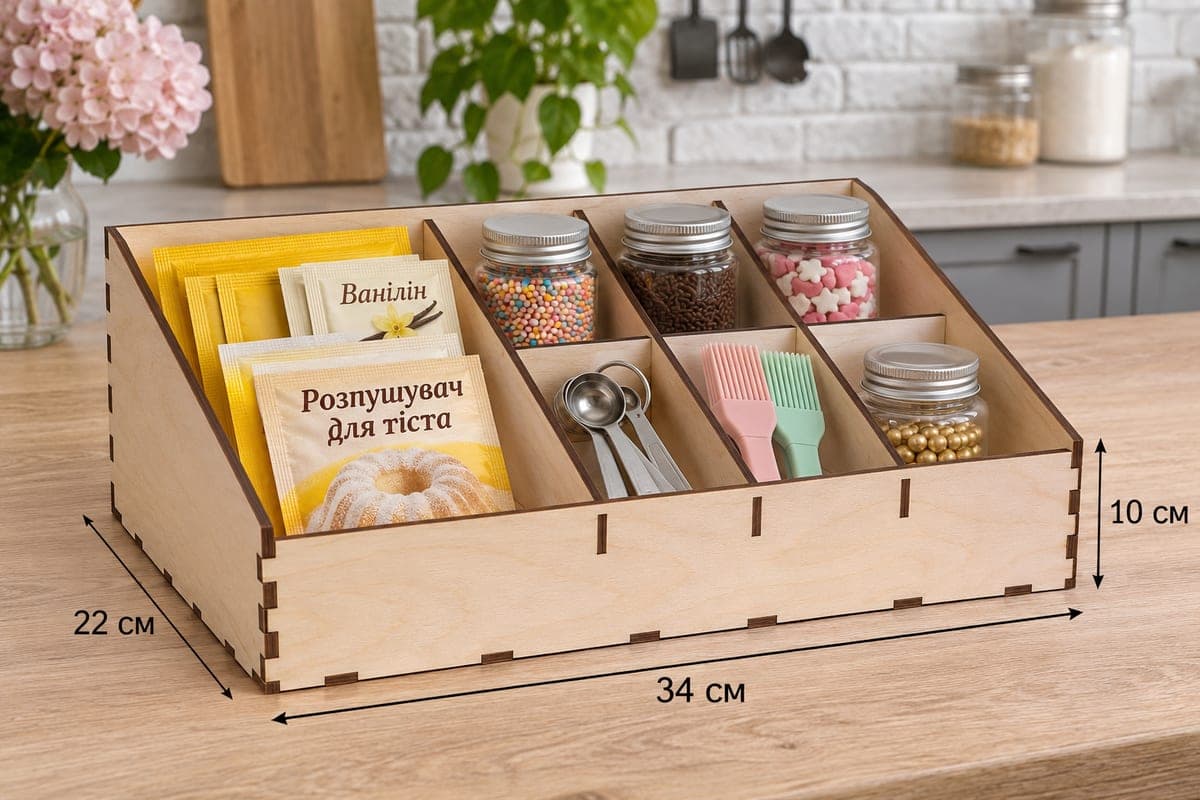
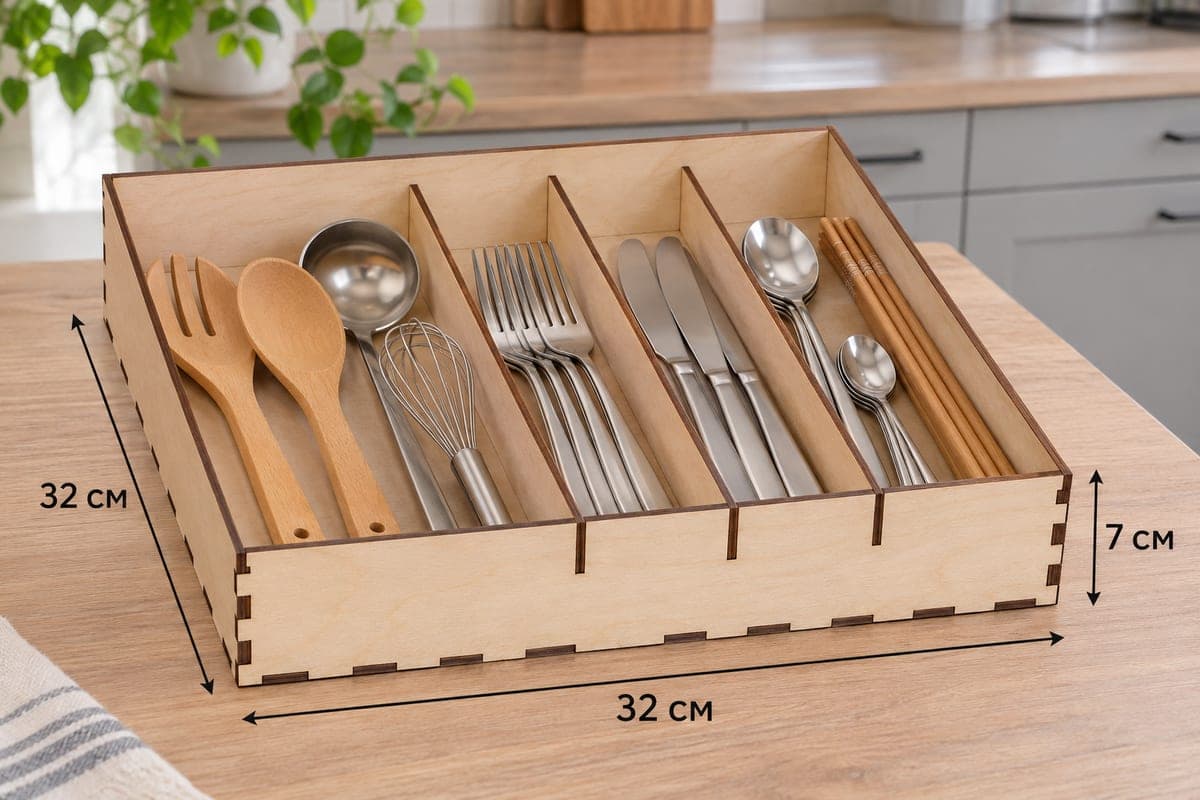
 Visualization
Kitchen Utensil Drawer Organizer SVG, Deep Cooking Tool Tray Laser Cut File, Square Cutlery Box DXF
A deep, square kitchen utensil tray with 70 mm walls and four full-depth lanes, sized for wooden spoons, ladles and whisks as well as everyday cutlery. It comes as SVG and DXF with separate files for 3, 4, 5 and 6 mm plywood, measures 320 × 320 × 70 mm (12.60 × 12.60 × 2.76 in), is cut from 8 pieces and assembles with tabs and slots. Free download.
- Formats
- SVG, DXF
- Outer size (W × D × H)
- 320 × 320 × 70 mm (12.60 × 12.60 × 2.76 in)
- Parts
- 8
- Material thickness
- 3, 4, 5 or 6 mm plywood (a file for each)
- Layout size (3 mm file)
- 1,300 × 402 mm
- Cut length
- 7.88 m
- Est. time, 10 W diode (3 mm)
- 26 min 15 s
- Est. time, 40 W CO2 (3 mm)
- 10 min 56 s
- Layers
- CUT only, no engraving
Free account required to download
How to make it
- 01Choose the file for your plywood thickness; with 70 mm walls, 4 or 5 mm gives a stiffer tray. Test one slot on scrap.
- 02Cut the square base, four 70 mm walls and three full-depth dividers.
- 03Fit the dividers into the base, then the two sides, then press the front and back on so all tabs engage.
- 04Sand and seal, then place ladles, whisks and wooden spoons in the wide lane and cutlery in the other three.
Taller walls for bulky tools
This tray has 70 mm walls instead of the usual 60, which matters once you store a ladle bowl or a balloon whisk that sits higher than a flat fork. It is square, 320 by 320 mm, with three dividers making four lanes front to back. The photo puts the bulky things in the wide first lane (a wooden spatula, wooden spoon, soup ladle and whisk), followed by forks, knives, and a lane of spoons and chopsticks.
Plywood, cutting time and finish
Because the walls are taller, the 4 or 5 mm files give a noticeably stiffer box than 3 mm. The 6 mm file suits a heavy-duty tray for a busy family kitchen. Each thickness has its own SVG and DXF, so the tabs match without editing.
The 3 mm layout is 1300 × 402 mm. For the 3 mm file, plan on about 26 min 15 s with a 10 W diode, about 10 min 56 s with a 40 W CO2 and about 5 min 15 s with a 100 W CO2. Thicker sheets mean several passes on a diode, or a CO2 laser. Small beds will need the base cut alone and the 320 mm strips grouped onto one or two further sheets.
Sand the corners where tabs stand proud, then oil or lacquer the whole tray. Wooden spoons are often put away damp, so a sealed base pays off here.
Selling it as a cooking set
Sell it as a cooking tool tray rather than a cutlery tray, filled with a starter set of wooden spoons. It also pairs well with the five-slot silverware organizer for buyers who want two matching drawers.
Questions about this file
Will a soup ladle fit lying down?
A standard ladle fits along the 320 mm lane, and the 70 mm walls leave room for the bowl to sit without lifting the drawer contents.
Is 70 mm too tall for my drawer?
Measure the clear height under your drawer frame first; if it is under about 75 mm, one of the 60 mm trays is the safer choice.
Can I scale it to fit a 400 mm drawer?
Yes, but scale the panels and keep every slot at your material thickness, or the tabs will not fit; enlarging the file as a whole widens the slots too.
What finish holds up to wet wooden spoons?
A hardening oil or two coats of water-based polyurethane on all faces resists moisture well; let it cure fully before use.
Can I add a lid?
The file has no lid; you could cut a flat 320 by 320 mm panel to rest on top if you want one.
Similar files