
Laser Cut Ideas for Restaurants and Cafes: Table, Counter and Condiment Projects
Good laser cut ideas for restaurants and cafes are napkin and straw caddies, sugar and tea stations, condiment trays, cutlery stands, menu holders and table numbers. Plywood caddies of about 240–340 mm wide cut in roughly 14–29 minutes each on a 10 W diode for 3 mm stock. Seal them so they wipe clean, and test one sample with the cafe's real napkins and bottles before cutting a set.
Sit at a busy cafe table for ten minutes and watch the napkins. The door opens, a draft lifts the top three, someone grabs a handful and the rest slump sideways into a puddle of spilled latte. Sugar sticks live in a chipped mug, the hot sauce has nowhere to stand, and the straws roll off the edge. Small, tidy wooden pieces fix most of that, and they are exactly what a laser does well. Here are practical laser cut ideas for restaurants and cafes: real files for the table, the coffee counter and the condiment station, plus a few ideas you can draw yourself.
What a cafe needs from a laser cut piece
A cafe is a harder customer than a kitchen at home. Pieces get wiped twenty times a day, knocked by trays and filled by staff in a hurry. Before you pick a design, check it against this short list:
- It wipes clean. Bare plywood soaks up syrup and coffee. Everything you deliver should be sealed.
- It stands firm. A wide base and a low front keep it stable when someone pulls out the last napkin.
- It fits the real stock. Napkins, sugar sticks and sauce bottles come in many sizes. The box has to fit what this cafe actually buys.
- It looks like a set. One caddy is a nice object; twelve matching caddies on twelve tables look like a brand.
- It has no hardware. Every design below joins with tabs and slots and has no metal hinges or screws to rust or work loose.
Laser cut ideas for restaurants at a glance
All files below are tab-and-slot plywood boxes with separate versions for 3, 4, 5 and 6 mm plywood. Times are estimates for the 3 mm file.
| Project | Where it goes | Size, mm | Parts | 10 W diode | 40 W CO2 |
|---|---|---|---|---|---|
| Five-slot napkin and straw organizer | Self-service counter | 320 × 220 × 100 | 9 | about 25 min | about 10 min |
| Two-row table setting caddy | Small tables | 270 × 160 × 90 | 9 | about 19 min | about 8 min |
| Napkin and coaster box | Every table, cheapest set | 300 × 160 × 80 | 6 | about 14 min | about 6 min |
| Three-row serving caddy | Large or shared tables | 340 × 240 × 100 | 8 | about 24 min | about 10 min |
| Coffee station organizer | Coffee counter | 300 × 220 × 100 | 10 | about 23 min | about 10 min |
| Three-step tea stand | Tea display | 260 × 200 × 180 | 12 | about 29 min | about 12 min |
| Eight-compartment condiment station | Pickup or sauce counter | 340 × 200 × 90 | 12 | about 26 min | about 11 min |
| Three-section condiment caddy | Bar or narrow counter | 240 × 120 × 100 | 7 | about 14 min | about 6 min |
| Upright cutlery caddy | Cutlery station | 240 × 120 × 120 | 7 | about 14 min | about 6 min |
Napkin and straw caddies for every table
The table caddy is the piece guests touch most, so it is the one that sells the idea to a cafe owner. The five-slot napkin and straw organizer suits a self-service counter: four full-depth dividers give separate lanes for napkins, reusable straws, toothpicks and coasters, and the tall back slopes down to a low front so everything is easy to grab.
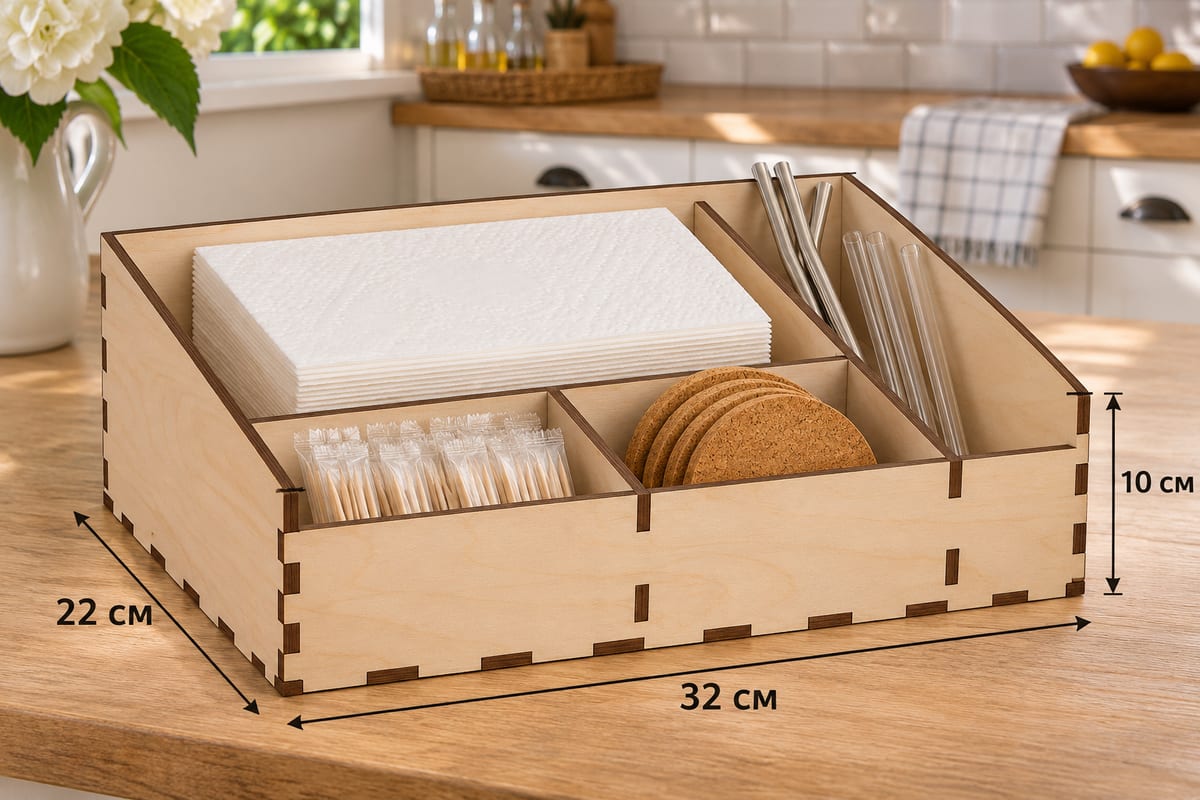 Five-Slot Napkin and Straw OrganizerOuter size (W × D × H) 320 × 220 × 100 mm (12.60 × 8.66 × 3.94 in)Parts 9Est. time, 10 W diode (3 mm) 25 min 01 sEst. time, 40 W CO2 (3 mm) 10 min 25 sSVG · DXF →
For small bistro tables, the two-row table setting caddy is more compact: two wide front pockets for napkins and coasters and three narrow back pockets for straws and toothpicks.
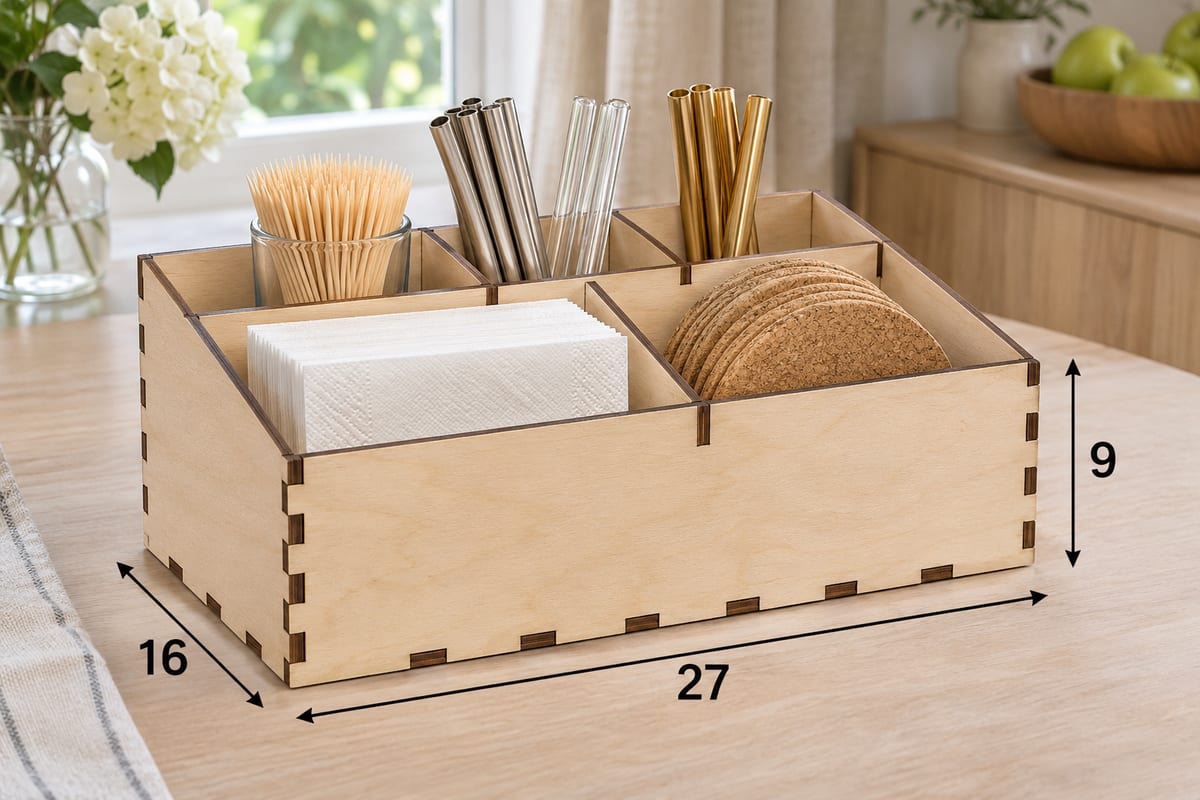 Two-Row Table Setting Caddy, 5 PocketsOuter size (W × D × H) 270 × 160 × 90 mm (10.63 × 6.30 × 3.54 in)Parts 9Est. time, 10 W diode (3 mm) 18 min 45 sEst. time, 40 W CO2 (3 mm) 7 min 49 sSVG · DXF →
If the budget is tight, the napkin and coaster box is cut from only 6 pieces with one divider, which makes it the cheapest piece to repeat across a whole room. The full range is in napkin and table organizers.
Pro tip: for a terrace or a table near the door, cut the 5 or 6 mm version. The extra weight keeps the caddy planted when the wind tries to take the napkins with it.
Sugar, tea and coffee stations
The coffee counter is where clutter breeds fastest: sugar sticks, sweetener, creamer pots, honey, stirrers and five kinds of tea, all in different boxes from different suppliers. The coffee station organizer puts tea bags and coffee sachets in two big bays at the back and sugar sticks, creamer, honey and wooden stirrers in four small cells at the front.
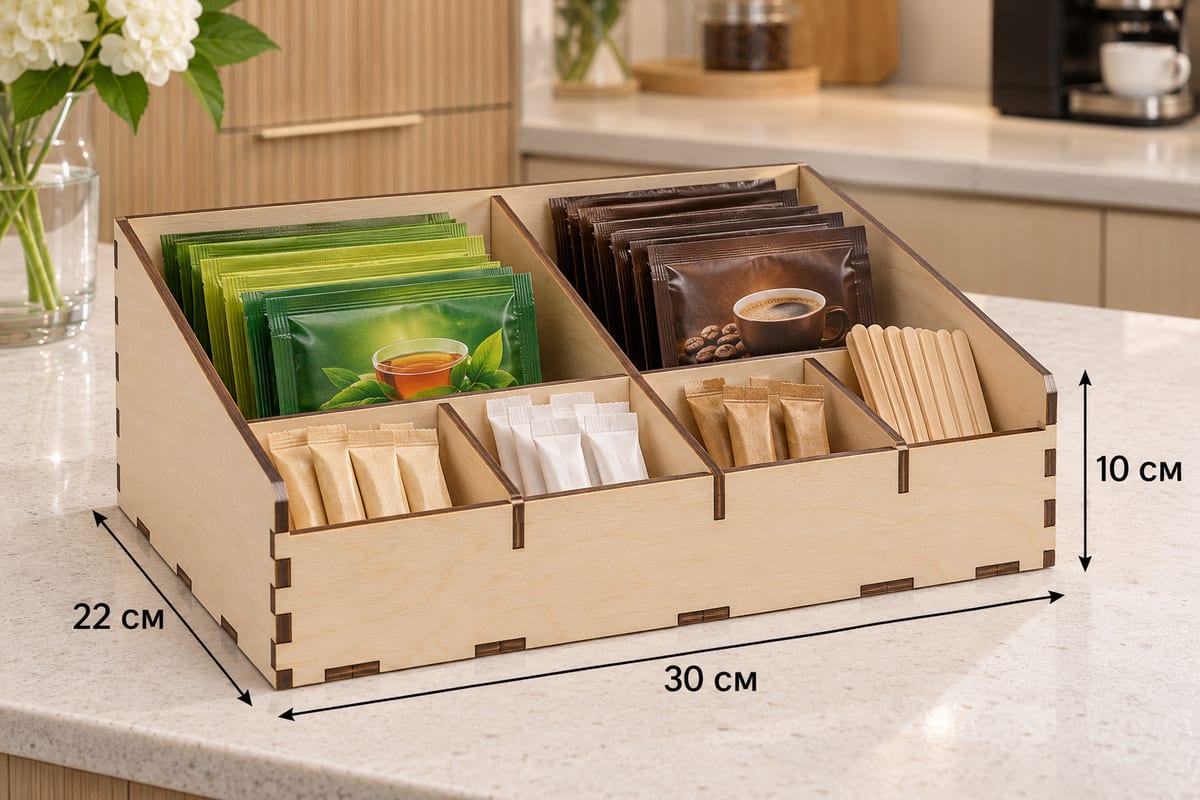 Coffee Station Organizer, 6 SectionsOuter size (W × D × H) 300 × 220 × 100 mm (11.81 × 8.66 × 3.94 in)Parts 10Est. time, 10 W diode (3 mm) 23 min 19 sEst. time, 40 W CO2 (3 mm) 9 min 43 sSVG · DXF →
Cafes that sell tea as a feature like to show the range. The three-step tea stand rises to 180 mm at the back with six pockets on three steps, so every flavour is visible from the queue. More options, including lidded tea boxes, are in tea and coffee organizers.
Condiment and sauce trays
Sauce bottles fall over, leave rings and drift around the counter. The eight-compartment condiment station holds one bottle in each of four back cells and one shaker or small jar in each of four front cells, with sides that slope down to a 54 mm front.
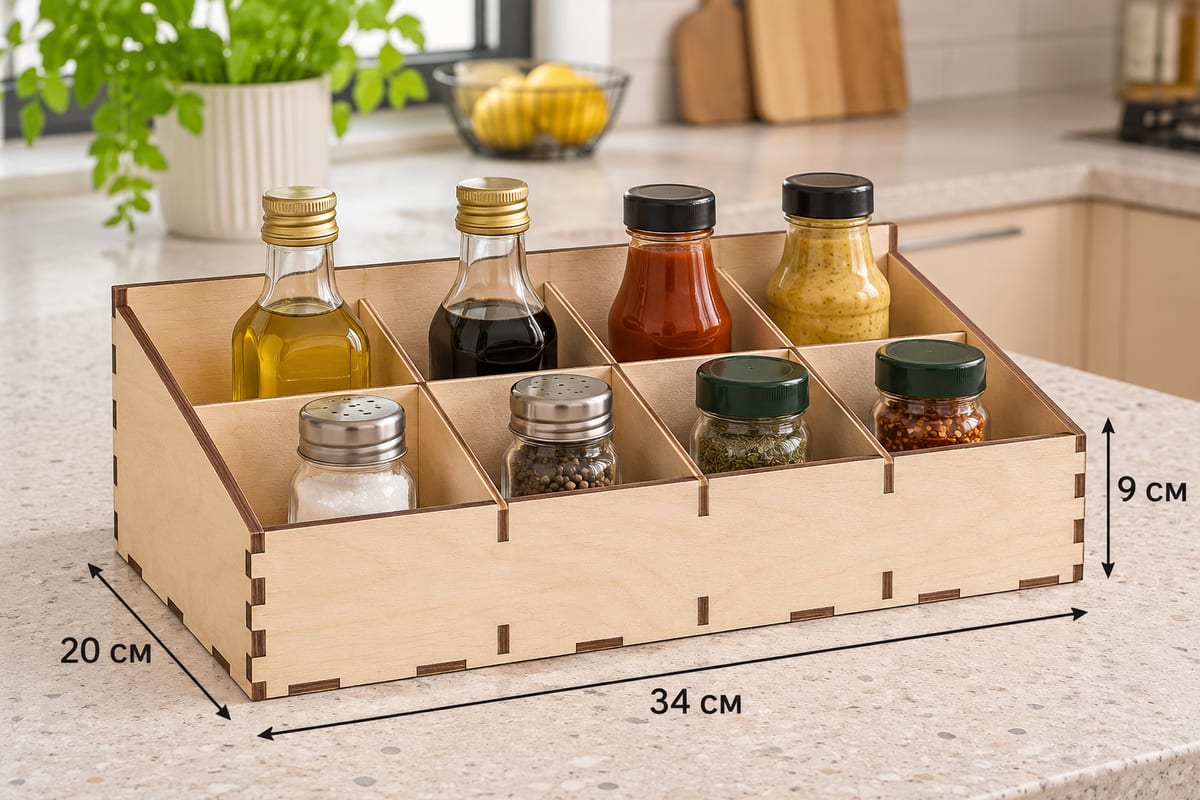 Eight-Compartment Condiment StationOuter size (W × D × H) 340 × 200 × 90 mm (13.39 × 7.87 × 3.54 in)Parts 12Est. time, 10 W diode (3 mm) 26 min 22 sEst. time, 40 W CO2 (3 mm) 10 min 59 sSVG · DXF →
For a bar or a narrow pass, the three-section condiment caddy is only 120 mm deep and takes oil, sauces and salt and pepper side by side. Browse oil and condiment organizers for sloped, stepped and lidded versions.
Common mistake: cutting twenty caddies before checking that the cafe's own napkins, sugar sticks and bottles fit. Napkin folds and bottle widths vary a lot between suppliers. Cut one sample, take it to the cafe, fill it with their real stock, and only then cut the set.
Cutlery at the counter
Self-service cutlery in a plastic tub looks like a canteen. The upright cutlery caddy stands forks, knives, spoons and chopsticks in three sections behind a low front, in a footprint of 240 × 120 mm. For a busy buffet, the nine-slot tiered cutlery stand holds far more, with 15 parts and about 39 minutes on a 10 W diode. Both are in cutlery trays.
Ideas to design yourself: menus, numbers and signs
Our library has no menu holder or table number file yet, but these are simple shapes you can draw in an evening:
- Menu holders. A slotted base with a groove that fits the menu card. Measure the card stock first; an A5 menu is 148 × 210 mm.
- Table numbers. Engraved or cut-out numbers on a small stand. Keep strokes thick enough to survive cleaning.
- QR code stands. A frame that holds a printed QR sticker. Print the code; engraved codes on wood can be hard for phones to read.
- Reserved signs and bill presenters. Small, flat and easy to engrave with the cafe's name.
- Logo coasters. A matching set ties the whole room together; see laser cut coaster size.
For lettering, laser cut name signs explains fonts and bridges. For a box in a custom size, the box generator builds one from inside dimensions.
Finish, cleaning and durability
| Problem in service | Cause | What helps |
|---|---|---|
| Sticky rings and stains | Bare wood absorbs syrup and coffee | Sand, then seal every face, inside too, with a wipeable finish |
| Edges turn grey | Hands, dust and cleaning cloths | Sand off smoke marks before finishing, reseal now and then |
| Caddy wobbles | Warped plywood or loose joints | Choose flat sheets, glue the joints for permanent pieces |
| Napkins blow away | Light caddy, gaps between napkins | Use the 5 or 6 mm file and fill slots snugly |
| Dark marks along the cut | Smoke residue | Masking tape before cutting, light sanding after |
These pieces hold wrapped or packaged items: napkins, sachets, bottles and cutlery. If anything will touch unwrapped food, choose a finish rated for food contact and check the local rules for food businesses. Are laser engraved cutting boards food safe covers the basics.
Selling a set to a cafe
Cafes buy in sets, which makes the maths pleasant. Ten napkin and coaster boxes take about 2 h 17 min on a 10 W diode or about 57 min on a 40 W CO2 for the 3 mm files, before sanding and finishing. Add a small engraved logo on the front panel and test it on one box, because engraving adds time to every piece.
- Bring one finished sample filled with the cafe's own stock.
- Quote per set, including finishing and a spare piece or two.
- Keep the file and your settings so reorders match exactly.
The cost side is covered in how to price laser cut products, and laser cut products that sell has more ideas for local businesses.
Pro tip: offer to replace a damaged caddy for a fixed small fee. It costs you one short job and turns a one-off sale into a relationship.
Next step
Pick one table in a cafe you know. Cut the napkin and coaster box, seal it, fill it with their napkins and leave it there for a week. If it survives, you have a sample, a reference and probably your first order.
Read next: Laser Cut Napkin Holder and Laser Cut Condiment Organizer.
Questions and answers
What can I laser cut for a restaurant or cafe?
Napkin and straw caddies, coffee and tea stations, condiment trays, cutlery caddies, menu holders, table numbers, QR code stands and logo coasters. Matching sets for every table work best.
Which plywood thickness is best for cafe pieces?
3 or 4 mm is fine indoors and cuts fastest. For terraces or busy counters, the 5 or 6 mm files give heavier, sturdier caddies; on a diode laser they usually need several passes.
Are wooden caddies safe in a food business?
For napkins, sachets, bottles and cutlery, a sealed plywood caddy is a common choice. If a piece will touch unwrapped food, use a finish rated for food contact and check your local food business rules.
How long does it take to cut a set for ten tables?
Ten napkin and coaster boxes take about 2 h 17 min on a 10 W diode or 57 min on a 40 W CO2 for the 3 mm files, plus sanding and finishing.
Can I engrave the cafe's logo on the caddies?
Yes. Engrave it on the front panel in the same job as the cut, test the size on scrap first, and remember that engraving adds time to every piece.
Do you have a menu holder file?
Not yet. A menu holder is a simple slotted stand you can draw yourself; measure the menu card first, for example 148 × 210 mm for A5.