 Visualization
Tiered Tea Stand SVG, Three Step Tea Bag Display Laser File, Tea Jar Shelf DXF, Wooden Tea Rack
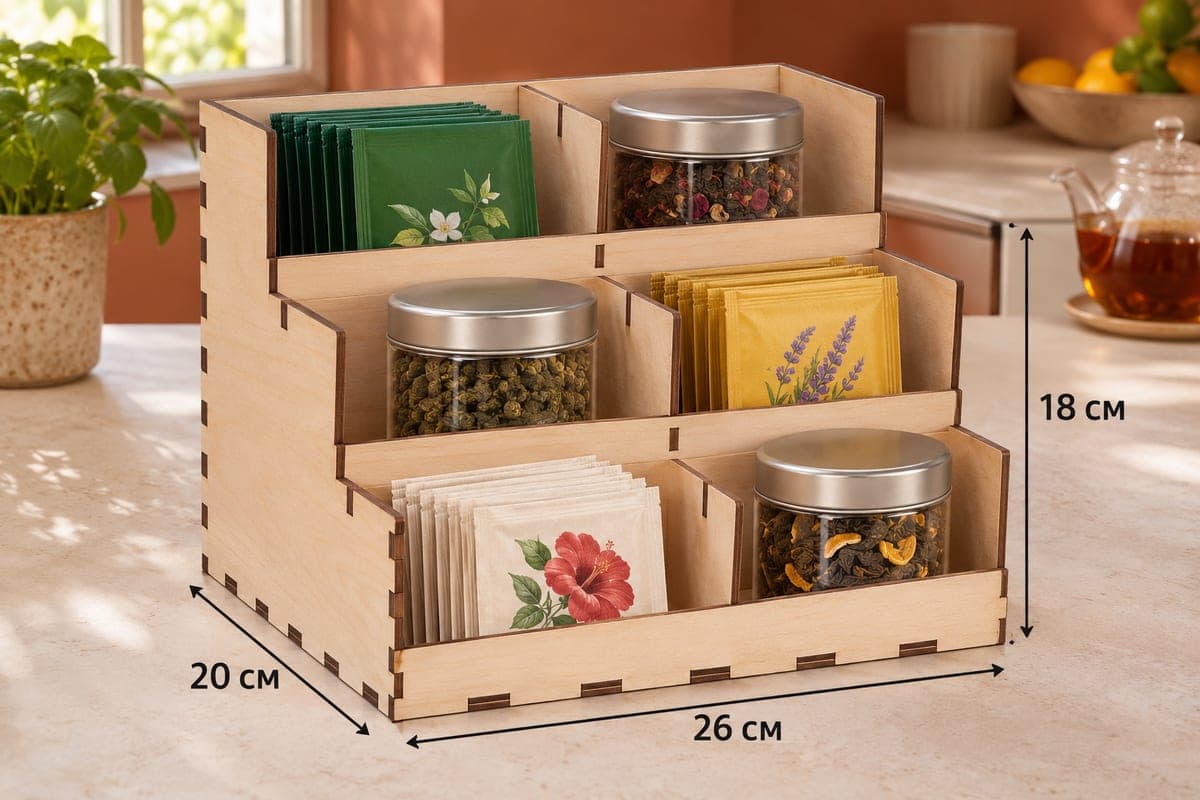
A free tiered tea stand with 3 steps rising to the back, each split by one divider into two pockets, 6 in total, for tea bags and loose-leaf jars. It comes as SVG and DXF in separate files for 3, 4, 5 and 6 mm plywood, measures 260 × 200 × 180 mm (10.24 × 7.87 × 7.09 in) and assembles from 12 pieces with tabs and slots, with small part numbers engraved to guide assembly.
- Formats
- SVG, DXF
- Outer size (W × D × H)
- 260 × 200 × 180 mm (10.24 × 7.87 × 7.09 in)
- Parts
- 12
- Material thickness
- 3, 4, 5 or 6 mm plywood (a file for each)
- Layout size (3 mm file)
- 1,060 × 313 mm
- Cut length
- 8.55 m
- Est. time, 10 W diode (3 mm)
- 28 min 30 s
- Est. time, 40 W CO2 (3 mm)
- 11 min 52 s
- Layers
- CUT only, no engraving
Free account required to download
How to make it
- 01Pick the file for your sheet thickness and test a single tab in a scrap slot before committing a full sheet.
- 02Cut the two stepped sides, three shelves, the front board, two step boards, the brace and three dividers, splitting the layout across sheets if your bed is short.
- 03Follow the engraved numbers: join the shelves and brace to one side, add the second side, then press in the front and step boards and slide one divider into each step.
- 04Sand the stepped edges, seal with clear lacquer, and stock the upper pockets with jars and the lower ones with tea bag envelopes.
Three steps, six pockets
Each step is a shelf with a low board in front and a single divider, so every level gives you one pocket on the left and one on the right. In the photo the top step pairs a stack of green tea envelopes with a jar of rosebud blend, the middle step holds a jar of rolled green tea next to yellow lavender sachets, and the bottom step shows white floral-print bags beside a jar of black tea with orange peel. Because the back rows sit higher, nothing hides behind anything else, and a glance tells you what is running low.
Bed size and cutting time
The 12 parts are laid out on a 1060 × 313 mm sheet, which is longer than most hobby beds. Split them over two or three sheets: the side panels on one, the long shelves and boards on another. The 3 mm file needs about 28 min 30 s on a 10 W diode, about 11 min 52 s on a 40 W CO2 and about 5 min 42 s on a 100 W CO2. A 10 W diode gets through 3 mm in one or two passes; 5 and 6 mm plywood calls for a stronger laser or several passes.
Small engraved part numbers mark each piece, so matching shelves to their slots is quick. Fit the shelves and brace between the sides first, then the front and step boards, and drop in the three dividers. Tabs hold without glue, but a dab of wood glue stiffens a stand that gets handled all day.
Ideas for a cafe or gift shop
- Set it beside the register as a self-serve tea station with your logo engraved on the front board.
- Sell it filled with six sample teas as a tasting gift.
- Make a matching pair for a tea bar: one for bags, one for jars.
Questions about this file
What fits on each step?
Every step has two pockets, enough for a jar of loose leaf on one side and a stack of tea bag envelopes on the other, as the photo shows. Shorter jars sit best on the lower steps.
What do the engraved digits on each part mean?
The file engraves small part numbers on each piece so you can tell the similar shelves and boards apart. That is the only engraving; everything else is cut.
Can I scale the stand to fit bigger canisters?
Only if you keep the slots at the true thickness of your sheet. Scaling stretches the slots too, so after enlarging you have to reset them, otherwise the shelves will not lock.
Will a 10 W diode handle the 6 mm version?
It can with several slow passes, but the long cut line makes that a lengthy job. For a diode, the 3 or 4 mm files are the practical choice.
How should I finish it for a busy tea bar?
Sand all edges, then apply two thin coats of clear lacquer so spilled tea wipes off. Oil also works but needs topping up more often.
Similar files