 Visualization
Condiment Caddy SVG, Three Section Oil and Sauce Holder Laser Cut File, Wooden Kitchen Counter Box DXF
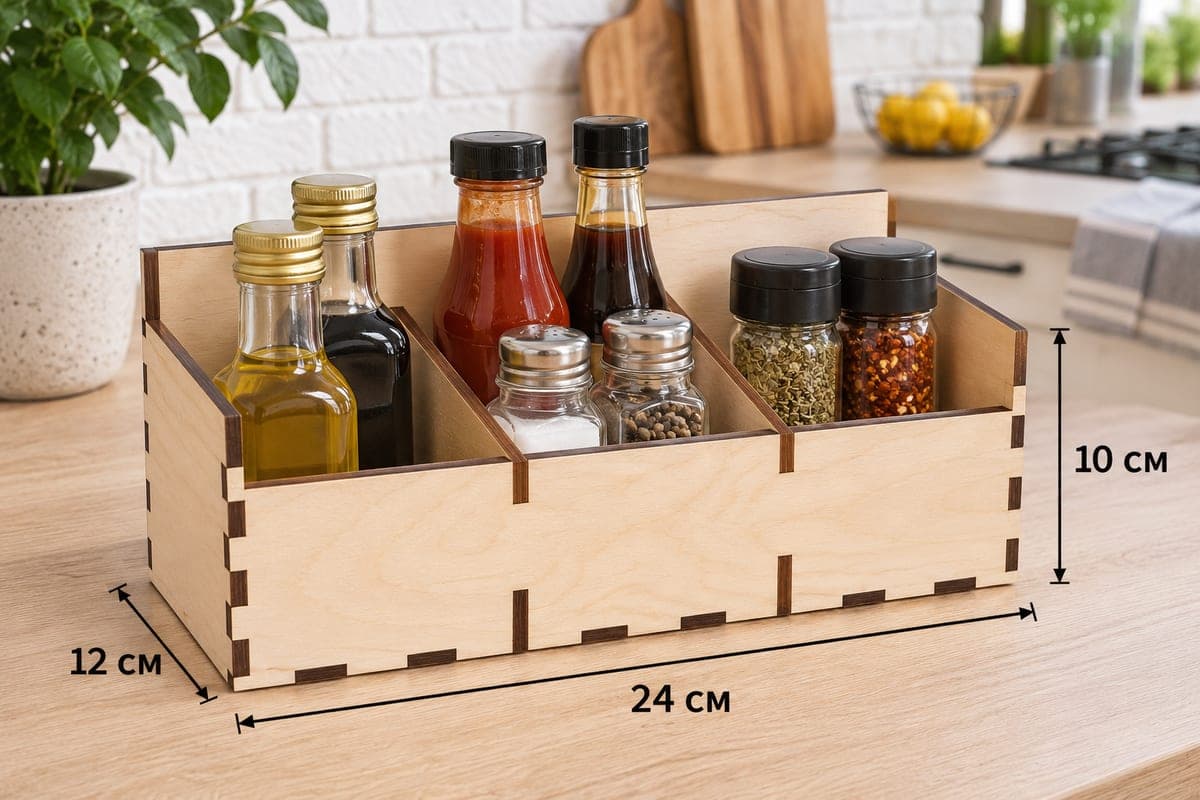
A narrow three-section condiment caddy for oil bottles, sauces, salt and pepper shakers and small herb jars on a kitchen counter. The download has SVG and DXF files for 3, 4, 5 and 6 mm plywood; the box measures 240 × 120 × 100 mm (9.45 × 4.72 × 3.94 in), is cut from 7 pieces with a slightly lower 85 mm front, and assembles with tabs and slots. Free to download.
- Formats
- SVG, DXF
- Outer size (W × D × H)
- 240 × 120 × 100 mm (9.45 × 4.72 × 3.94 in)
- Parts
- 7
- Material thickness
- 3, 4, 5 or 6 mm plywood (a file for each)
- Layout size (3 mm file)
- 740 × 232 mm
- Cut length
- 4.18 m
- Est. time, 10 W diode (3 mm)
- 13 min 56 s
- Est. time, 40 W CO2 (3 mm)
- 5 min 48 s
- Layers
- CUT only, no engraving
Free account required to download
How to make it
- 01Pick the SVG or DXF folder that matches your measured plywood thickness and cut one divider slot on scrap to check that a tab goes in snugly.
- 02Cut all seven parts: the 240 × 85 mm front, the 240 × 100 mm back, two sides, the base and the two dividers.
- 03Push the back and both sides into the base, close the box with the low front, then drop the two dividers into their slots.
- 04Sand the edges, wipe on food-safe oil or clear lacquer, and load the bottles in the outer bays and the shakers in the middle.
What fits inside
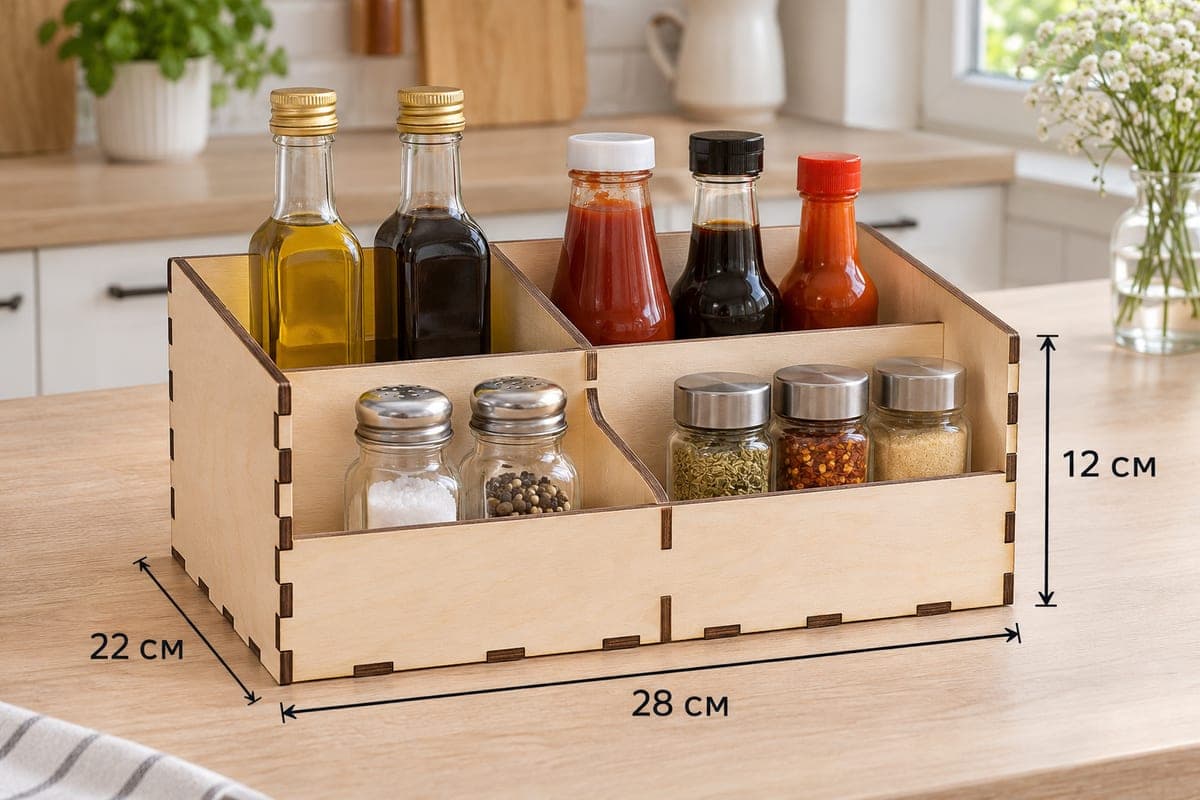
This is the smallest box in the oil and condiment set: a slim 240 mm long caddy only 120 mm deep, so it sits against the backsplash without taking over the counter. Two full-height dividers split it into three equal bays, each roughly 75 mm wide. In the photo the left bay holds a bottle of olive oil and a dark soy sauce, the middle one a ketchup bottle, a darker sauce and a salt and pepper pair, and the right one two jars of dried herbs and chili flakes.
The front wall is 85 mm against a 100 mm back, so the sides only drop slightly. Tall bottles stay upright and supported, while short jars are still easy to lift out.
Choosing the thickness and cutting
The download has separate SVG and DXF files for 3, 4, 5 and 6 mm plywood, with tabs sized for each sheet. Full glass bottles are heavy for such a narrow base, so 4 mm birch is a sensible minimum; 3 mm works if you mostly store light plastic squeeze bottles. A 10 W diode handles 3 mm in one or two passes, while 5 and 6 mm need several passes or a CO2 tube. Estimated time for the 3 mm file: about 13 min 56 s on a 10 W diode, about 5 min 48 s on a 40 W CO2 and about 2 min 47 s on a 100 W CO2.
The layout is 740 × 232 mm. On a compact bed, move the base and the two sides to a second sheet.
Ideas for selling
The small size makes this caddy cheap to cut and easy to ship flat. Sell it as a housewarming gift with a set of oil and vinegar bottles, offer a version with a family name engraved on the front, or list it for restaurant and cafe tables where it keeps ketchup, mustard and shakers together next to the menu.
Questions about this file
Will a standard 250 ml olive oil bottle fit?
Yes, each bay is about 75 mm wide inside, which takes two slim 250 ml bottles side by side or one round 500 ml bottle. Very wide jugs will not fit.
Can I make the caddy longer for four sections?
You can stretch the base, front and back in your editor and add a divider, but leave the slot widths untouched so they still match your plywood thickness.
Is 3 mm plywood strong enough for glass bottles?
For two or three bottles it is fine, but a fully loaded caddy feels steadier in 4 or 5 mm because the base flexes less.
How do I protect it from oil drips?
Seal all faces, including the base, with a clear lacquer or a hard wax oil. Wipe spills quickly, since raw plywood absorbs oil and darkens.
What is a good price point when selling these caddies?
Because it uses only seven parts and under 15 minutes of diode time, it suits a lower price tier; bundling it with oil bottles raises the order value.
Similar files