 Visualization
Coffee Station Organizer SVG, Tea and Coffee Bar Caddy Laser Cut File, Sugar and Stirrer Holder DXF, Wooden Coffee Box
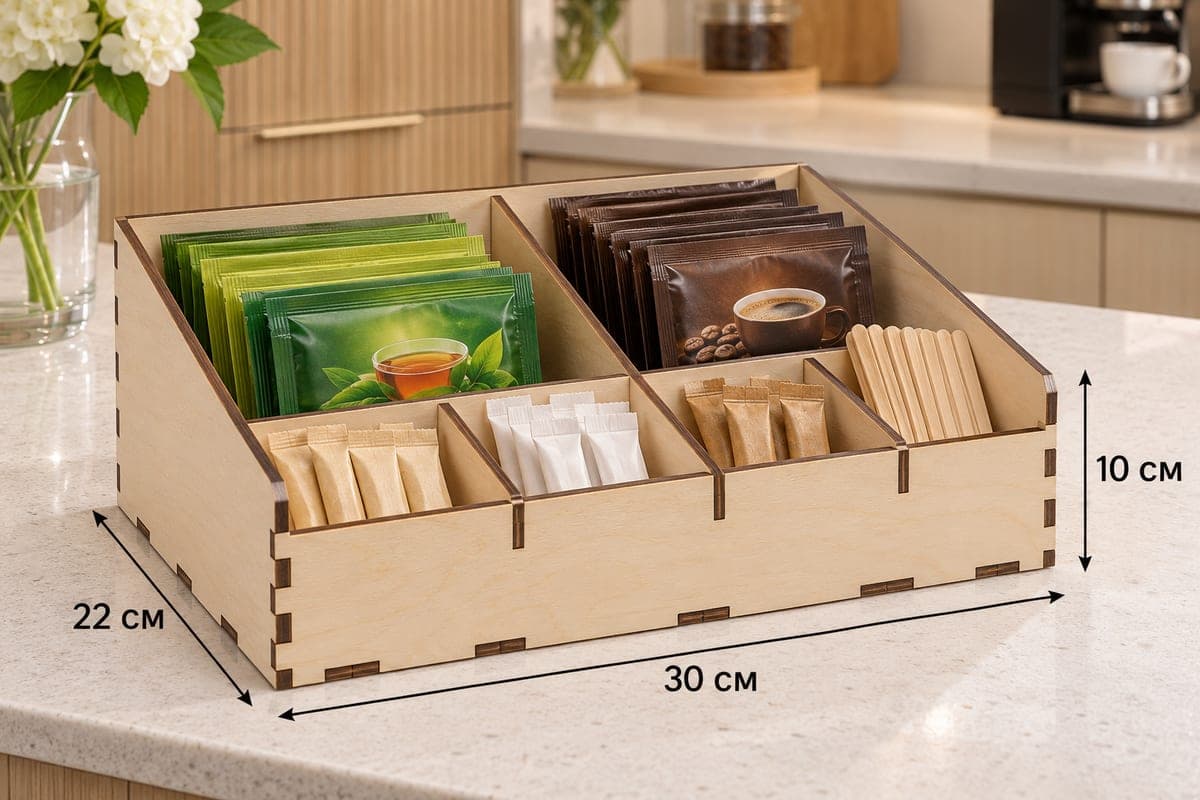
A coffee station organizer with two large bays at the back for tea bags and coffee sachets and four small cells in front for sugar sticks, creamer, honey and wooden stirrers. The free download includes SVG and DXF files for 3, 4, 5 and 6 mm plywood; the box measures 300 × 220 × 100 mm (11.81 × 8.66 × 3.94 in), is cut from 10 pieces that join with tabs and slots, and slopes from a 100 mm back to a 60 mm front.
- Formats
- SVG, DXF
- Outer size (W × D × H)
- 300 × 220 × 100 mm (11.81 × 8.66 × 3.94 in)
- Parts
- 10
- Material thickness
- 3, 4, 5 or 6 mm plywood (a file for each)
- Layout size (3 mm file)
- 1,060 × 332 mm
- Cut length
- 6.99 m
- Est. time, 10 W diode (3 mm)
- 23 min 19 s
- Est. time, 40 W CO2 (3 mm)
- 9 min 43 s
- Layers
- CUT only, no engraving
Free account required to download
How to make it
- 01Open the file for your plywood thickness and cut a single test slot to check that the small front dividers will grip.
- 02Cut the 10 pieces: base, back, front, two sloped sides, the cross divider, three short front dividers and one taller back divider.
- 03Assemble the outer box, set the cross divider, add the back divider to make the two bays, then press the three short dividers into the front row.
- 04Sand, lacquer twice, and fill the bays with tea and coffee and the four front cells with sugar, creamer, honey and stirrers.
A coffee bar in one box
This is the organizer for the corner next to the coffee machine. It is one of the tallest boxes in the tea and coffee set, with a 100 mm back wall, and its layout is lopsided on purpose: big storage behind, small extras in front.
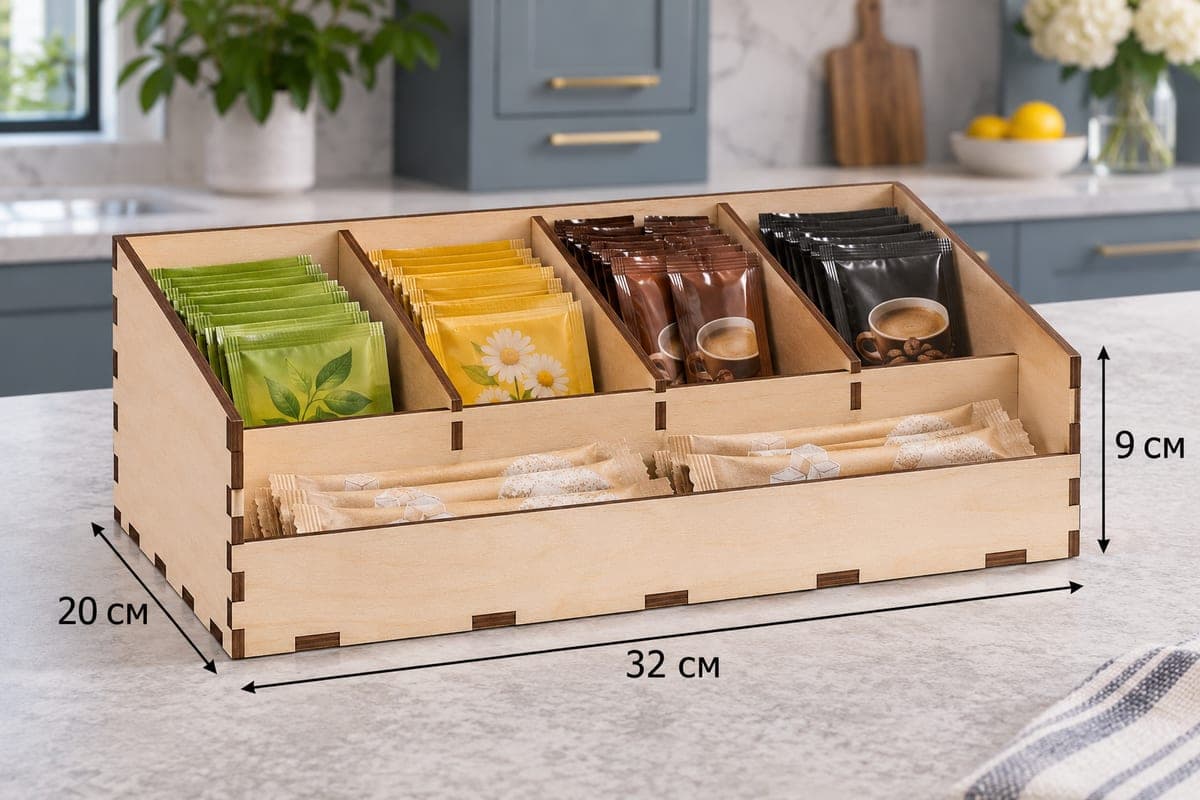
A full-width cross divider, 77.8 mm tall, separates the rows. The back row has just one divider, giving two wide bays about 119 mm deep; in the photo the left one is packed with green tea bags and the right one with ground-coffee sachets. The front row has three short dividers and four small cells, here holding paper sugar sticks, white creamer sticks, honey sticks and a bundle of wooden stirrers. Putting the stirrers in their own cell means nobody digs through the sugar to find one.
Cutting it
The 3 mm layout is 1060 × 332 mm, so it fits a large-format bed in one go while a desktop laser needs it split over two or three sheets; keep the four short dividers together on one sheet so they stay matched. In laser time the 3 mm file costs about 23 min 19 s on a 10 W diode, about 9 min 43 s on a 40 W CO2 and only about 4 min 40 s on a 100 W CO2. For 5 or 6 mm plywood, a CO2 is the realistic choice; a diode would need many passes.
The joints are friction fit. A dot of glue at the bottom of each small front divider is worth it here, because you will pull stirrers and sticks out of those cells many times a day.
Finishing and selling
Coffee drips and wet spoons are the enemy, so finish it with two coats of clear water-based lacquer, sanding lightly between coats. Coffee-bar decor sells well; try it in a dark stain for a cafe look, as a wedding favour station, or as a hotel-room tea tray with matching coasters.
Questions about this file
Do wooden stirrers fit standing up?
Yes, standard stirrers stand in one of the front cells and lean on the cross divider, as in the photo.
How do I protect it next to an espresso machine?
Seal every face, including the underside, with water-based lacquer so steam and drips do not raise the grain.
Is 3 mm plywood strong enough?
Yes for sachets and sticks; choose 4 mm if the box will be moved around full, for example on a hotel tray.
Can I make the two back bays into four?
That needs two more dividers and matching slots in the base and cross divider, drawn at your plywood thickness.
Can I put a name on the front?
Add an engraving layer to the front panel with a family name or the word coffee before cutting; the file only contains cut lines.
Similar files