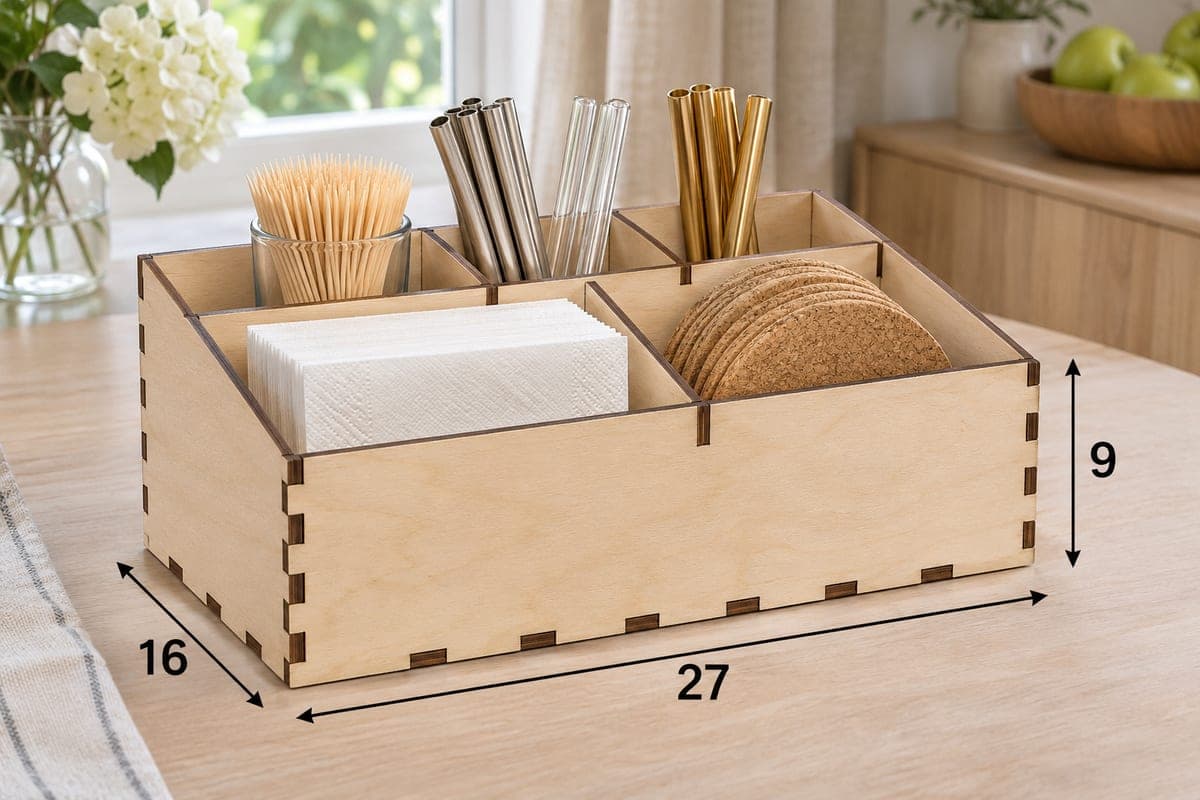
 Visualization
Table Setting Caddy SVG, Two Row Napkin Organizer Laser Cut File, Straw and Coaster Station DXF
A free two-row table caddy with five pockets: two wide ones at the front for napkins and coasters and three narrow ones along the back for straws and toothpicks, behind a low sloped front. The download has SVG and DXF files for 3, 4, 5 and 6 mm plywood; the caddy measures 270 × 160 × 90 mm (10.63 × 6.30 × 3.54 in) and is made of 9 pieces that join with tabs and slots.
- Formats
- SVG, DXF
- Outer size (W × D × H)
- 270 × 160 × 90 mm (10.63 × 6.30 × 3.54 in)
- Parts
- 9
- Material thickness
- 3, 4, 5 or 6 mm plywood (a file for each)
- Layout size (3 mm file)
- 880 × 262 mm
- Cut length
- 5.62 m
- Est. time, 10 W diode (3 mm)
- 18 min 45 s
- Est. time, 40 W CO2 (3 mm)
- 7 min 49 s
- Layers
- CUT only, no engraving
Free account required to download
How to make it
- 01Select the file that matches your board and cut one slot from scrap to make sure the tabs fit without force.
- 02Cut the 9 parts, using one 880 × 262 mm sheet or two smaller ones.
- 03Seat the back and sloped sides in the base, insert the long cross divider, then the front divider and both back dividers, and finish with the front wall.
- 04Lightly sand, coat with clear lacquer, and load napkins and coasters in front with straws and picks behind.
Front row, back row
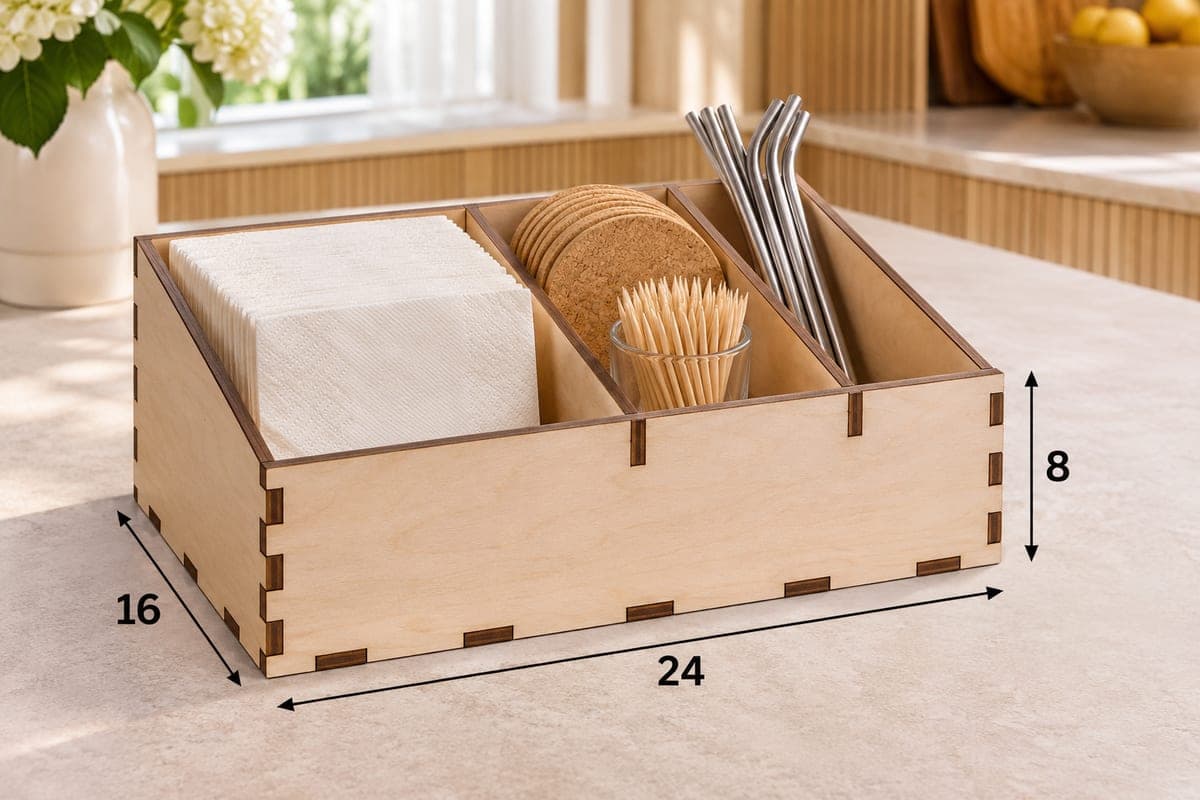
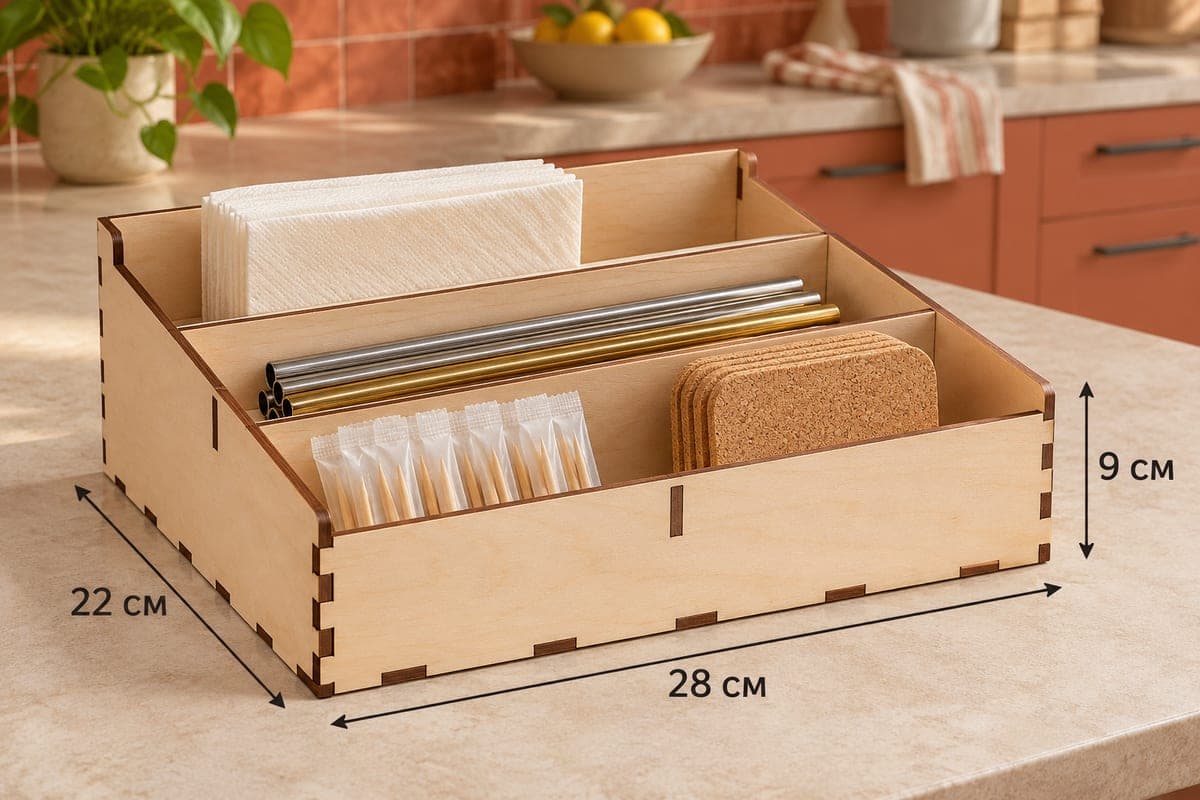
A long cross divider runs the full 270 mm and splits the caddy into two rows. The front row has two broad pockets: in the photo, folded white napkins sit on the left and a row of cork coasters leans on the right. Behind them, two short dividers make three slim slots that hold a glass of toothpicks, a bunch of steel and glass straws, and a handful of gold straws. Because the back row is taller and the front wall is only 54 mm, nothing in the back is hidden.
At 90 mm, this is also the tallest of the open napkin caddies, which helps long straws stay upright.
Laser time and sheet layout
Cutting time for the 3 mm file is about 18 min 45 s on a 10 W diode, about 7 min 49 s on a 40 W CO2 and about 3 min 45 s on a 100 W CO2. The parts fill an 880 × 262 mm area. Owners of compact diode machines can cut the base, back and front on one sheet and the sides plus the four dividers on another. Thicker 5 or 6 mm plywood is fine for a sturdy cafe version but needs more passes on a diode.
Building it in the right order
Put the back and both sloped sides into the base first. Slide the long cross divider in next, then the short front divider and the two back dividers. Close up with the low front. A drop of glue on the cross divider stops it from lifting when you pull out coasters.
This five-pocket layout works as a self-serve station for a coffee cart, a drinks table at a wedding or a family dinner table, and a version with your engraved logo on the front is an easy pitch to small cafes.
Questions about this file
What fits in the three back slots?
They are narrow and deep, sized for straws, stirrers, toothpicks or a small jar of cocktail picks. Each slot is roughly a third of the caddy length.
Could the narrow straw slots go at the front instead?
The cross divider is fixed by the slots, so the two-pocket row always sits at the low front. That keeps the napkins easiest to grab.
Is glue required?
Not for the walls. One spot of glue on the long cross divider is a good idea for daily use.
Which material looks best for a cafe counter?
Birch plywood of 4 or 5 mm gives a solid feel. Dark-stained MDF of the same thickness also cuts cleanly and hides marks.
How do I protect it from drink spills?
Seal all faces with two coats of water-based polyurethane. Wipe spills quickly and avoid soaking it in a sink.
Similar files