
Laser Cut Organizers to Sell: Kitchen Boxes, Real Cut Times and Sets
Kitchen organizers sell because they fix a mess people see every day and they make easy gifts. Our 141 kitchen organizer files have 6–16 parts and cut in about 14–39 minutes in 3 mm plywood on a 10 W diode, 6–16 minutes on a 40 W CO2 and 3–8 minutes on a 100 W CO2. Lidded tea boxes, spice racks and matching sets are the easiest to sell; price from your full time, not laser minutes alone.
It is a slow Saturday at the market until someone picks up the tea box. She slides the lid back, looks at the three neat rows of tea bags, slides it shut again and asks: "Can you put our name on the lid?" That is the moment kitchen organizers start paying for the laser. They solve a mess people stare at every morning, and they look like a present at the same time.
This guide is about laser cut organizers to sell, with the kitchen as the focus: which boxes buyers reach for, real cutting times and part counts from our files, rough material costs, photos that sell wood, sets, and where to sell. For the pricing formula itself, read how to price laser cut products; for broader product ideas, see laser cut products that sell.
Which kitchen organizers sell
Buyers do not pay for plywood. They pay for a drawer that stops rattling, a tea corner that looks tidy when guests come, or a gift that is useful and personal. Each type of box answers a different buyer.
| Organizer | Who buys it | Why it works | Example from the library |
|---|---|---|---|
| Tea boxes with a lid | Gift buyers, tea lovers | Looks like a present; the lid is a canvas for engraving | Sliding lid tea box, 10 parts |
| Spice trays and tiered racks | Home cooks | A visible daily mess; often bought in pairs | Six-bay tiered spice rack, 12 parts |
| Cutlery drawer trays | New homes, kitchen makeovers | Measured to the drawer; custom sizes are welcome | Five-slot silverware organizer, 9 parts |
| Oil and condiment caddies | Cooks, barbecue fans, cafes | Carried from stove to table every day | Condiment caddy, 3 sections, 7 parts |
| Napkin caddies | Cafes, terraces, hosts | Businesses order several at once | Napkin caddy with straw pockets, 8 parts |
| Coffee stations | Office kitchens, coffee fans | Turns a pile of sachets into a little bar | Coffee station organizer, 10 parts |
Boxes with a lid deserve extra attention. A sliding lid, a lift-off lid or a lid that pivots on plywood pins makes the box feel finished and gives you a flat surface for a name, a monogram or a pattern, and personalisation is where the margin usually is.
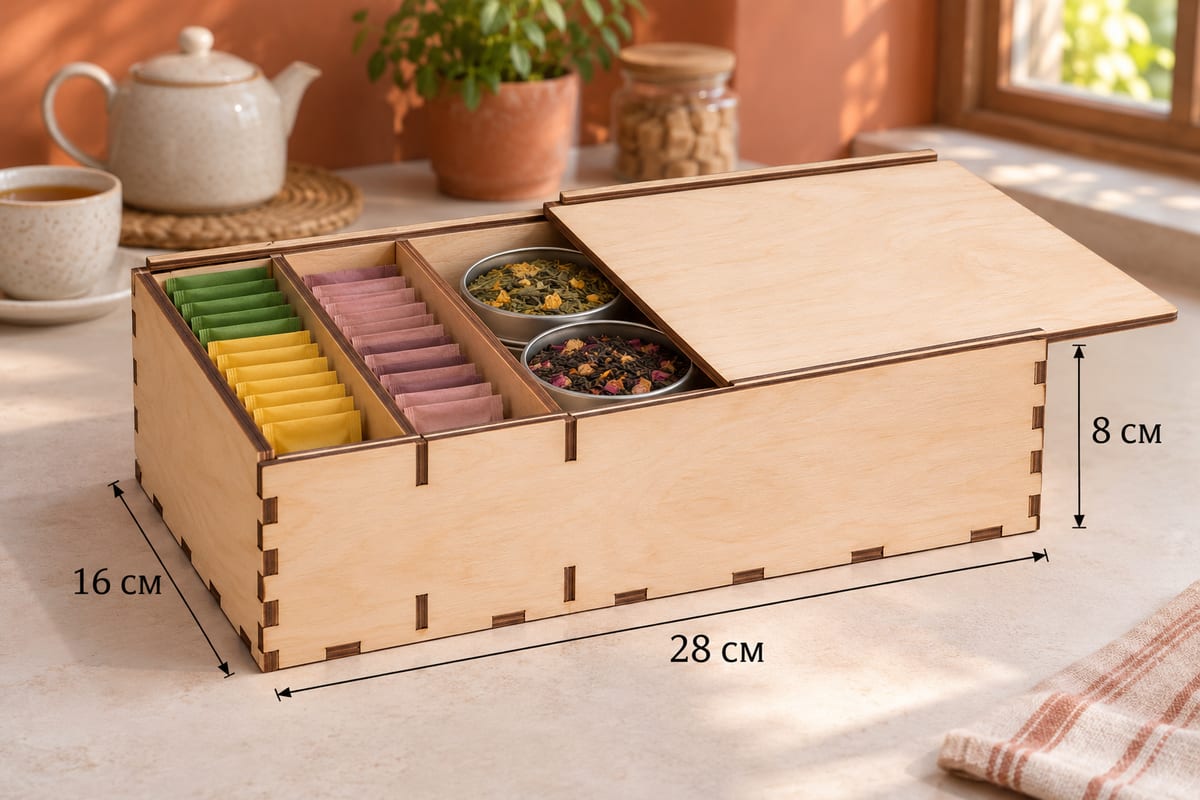 Sliding Lid Tea Box, 3 SectionsOuter size (W × D × H) 280 × 160 × 80 mm (11.02 × 6.30 × 3.15 in)Parts 10Est. time, 10 W diode (3 mm) 23 min 50 sEst. time, 40 W CO2 (3 mm) 9 min 56 sSVG · DXF →
The classic market box: compact at 280 × 160 × 80 mm, a lid that glides on two rails, and room for three kinds of tea. Engrave the lid and it becomes a gift, not just storage.
Real cutting times and part counts
Laser time is the number makers guess most often and get wrong. Here are the estimates from our file pages for the 3 mm versions. They come from the cut length of each file, so treat them as a starting point and time your own first run.
| File | Parts | 10 W diode | 40 W CO2 | 100 W CO2 |
|---|---|---|---|---|
| Upright countertop cutlery caddy | 7 | About 14 min | About 6 min | About 3 min |
| Condiment caddy, 3 sections | 7 | About 14 min | About 6 min | About 3 min |
| Napkin caddy with straw pockets | 8 | About 19 min | About 8 min | About 4 min |
| Sliding lid tea box | 10 | About 24 min | About 10 min | About 5 min |
| Eight-compartment tea chest | 12 | About 27 min | About 11 min | About 5 min |
| Six-bay tiered spice rack | 12 | About 29 min | About 12 min | About 6 min |
| Five-slot silverware organizer | 9 | About 29 min | About 12 min | About 6 min |
| Nine-slot tiered cutlery stand | 15 | About 39 min | About 16 min | About 8 min |
Across all 141 kitchen organizer files in the library, boxes have 6 to 16 parts, most around 9. The middle of the range is about 23 minutes on a 10 W diode, 9–10 minutes on a 40 W CO2 and 4–5 minutes on a 100 W CO2. In plain terms, a 10 W diode cuts two or three average boxes per hour of laser time, a 40 W CO2 about six, and a 100 W CO2 about twelve. Thicker 5 and 6 mm sheets need extra passes on a diode, so the gap between machines grows.
Do not forget the time around the laser. On a small bed most boxes need two or three runs, each with loading and framing; splitting a file across sheets shows how to plan them. Then come sanding, assembly, finishing and drying.
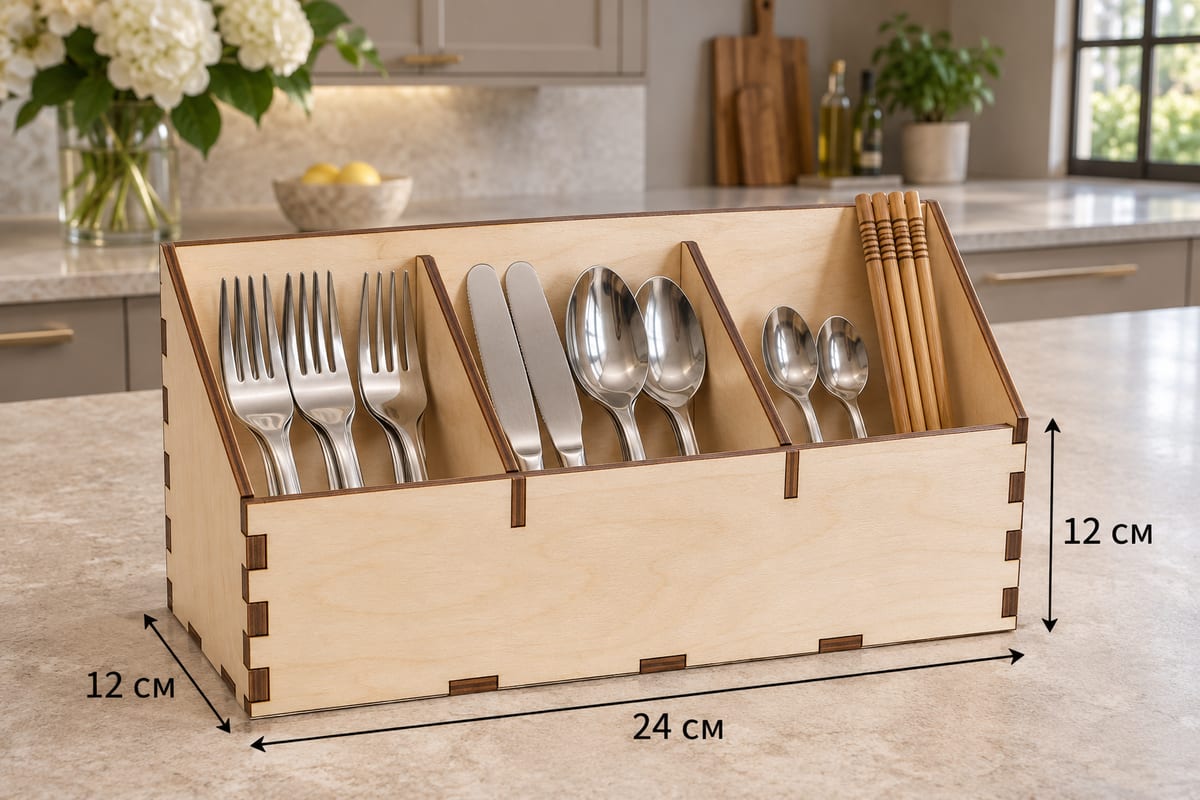 Upright Countertop Cutlery CaddyOuter size (W × D × H) 240 × 120 × 120 mm (9.45 × 4.72 × 4.72 in)Parts 7Est. time, 10 W diode (3 mm) 14 min 01 sEst. time, 40 W CO2 (3 mm) 5 min 51 sSVG · DXF →
One of the fastest kitchen files we have: seven parts and about 14 minutes on a diode. Good as an add-on item at a lower price, or as the entry box in a cutlery set.
Material cost: rough ranges
Material is usually the small part of the price, but it is worth knowing. The rectangles around all parts of one box add up to about 0.12 m² for the smallest caddies, about 0.2 m² for a typical box and about 0.42 m² for the tall cutlery stand. Add gaps and offcuts, and you need roughly 1.3–1.5 times that area of plywood.
| Box size | Parts area | 12 × 12 in sheets, roughly | 3 mm plywood cost, rough 2026 range |
|---|---|---|---|
| Small caddy (7 parts) | About 0.12 m² | 2 | Roughly $2–6 |
| Typical box (9–10 parts) | About 0.2 m² | 3 | Roughly $3–9 |
| Large stand (15 parts) | About 0.42 m² | 6–7 | Roughly $7–21 |
These cost ranges are rough estimates only. Prices depend on the grade, the thickness, the pack size and your supplier, and 5–6 mm sheets cost more. Buying larger sheets and cutting several boxes together brings the cost down; reducing plywood waste has the tricks. Add a little for finish, glue and packaging, and use the food safe finish guide to pick a finish you can describe honestly to buyers.
Common mistake: pricing a box from laser minutes alone. A 23-minute cut is only the start: two or three sheet changes, sanding char off the edges, assembly, two coats of finish, a day of drying, photos and packing. Time your first three boxes from start to finish and price from that number.
Sets sell better than single boxes
A single tray solves one drawer. A set makes the whole kitchen look planned, and it raises the order value without adding much work, because you cut everything from the same plywood in one session with the same settings.
- Tea corner: a lidded tea box plus a coffee station.
- Cooking zone: a spice tray plus an oil and condiment caddy.
- Drawer pair: a cutlery tray plus a deep utensil tray for ladles and whisks.
- Cafe pack: four to ten identical napkin or condiment caddies, with the cafe's logo engraved on the front.
Keep the finish, the edge colour and the engraving style the same across a set, so the photos look like one product line.
Pro tip: list the inside sizes of each compartment as well as the outer size. Buyers measure their drawers and their tea bags, and clear numbers prevent returns.
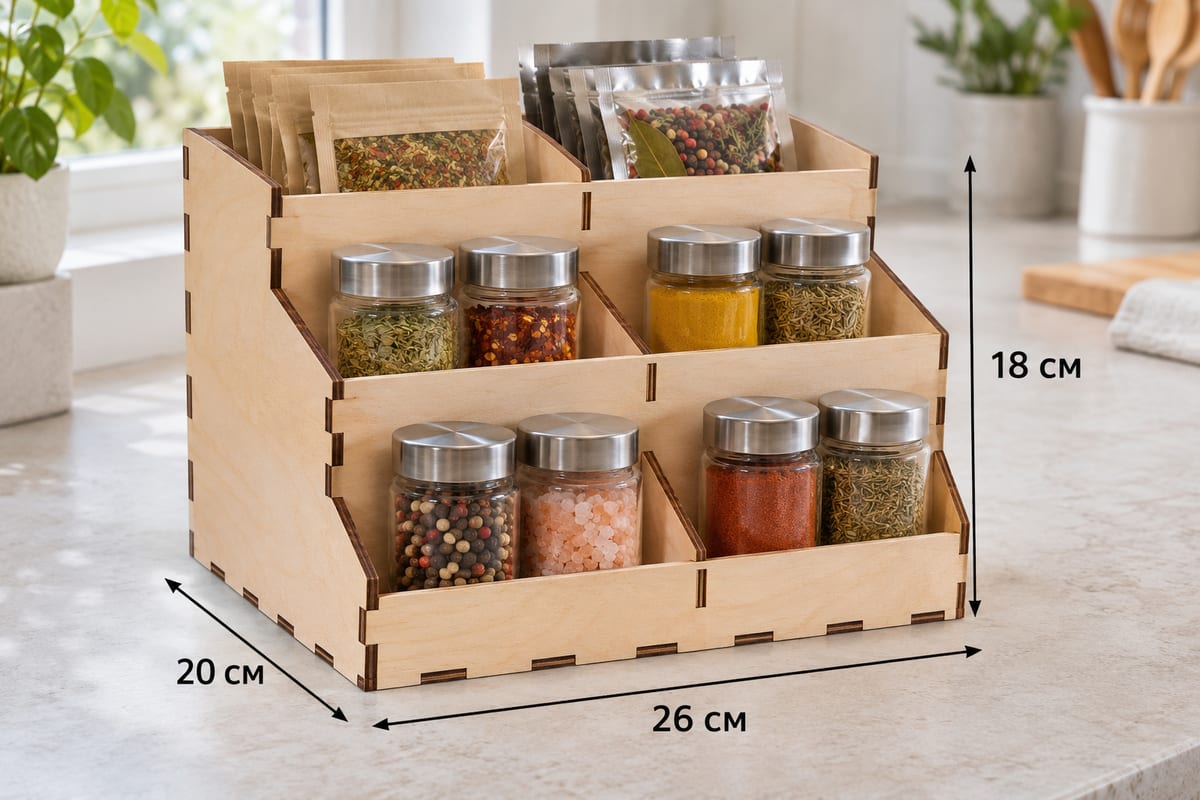 Tiered Spice Rack, 3 Steps, 6 BaysOuter size (W × D × H) 260 × 200 × 180 mm (10.24 × 7.87 × 7.09 in)Parts 12Est. time, 10 W diode (3 mm) 28 min 30 sEst. time, 40 W CO2 (3 mm) 11 min 52 sSVG · DXF →
Six bays on three steps, so the back row of jars stays visible. Its stepped shape photographs well and pairs naturally with a flat condiment caddy as a cooking set.
Photos that sell kitchen organizers
- Fill it. An empty box is just plywood. Real tea bags, jars and cutlery show the size and the purpose at once.
- Shoot from above. The top-down view shows every compartment, which is the whole point of an organizer.
- Show it in place. In the drawer, on the counter, next to the kettle.
- Give scale. A hand, a spoon or a ruler in one photo, plus the size in the text in both millimetres and inches.
- Show the details. Clean joints, the lid half open, the engraving close up.
- Use soft daylight. Near a window, on a plain background, no harsh flash on the burnt edges.
Where to sell
On Etsy, buyers search for exactly these things, and personalisation fields let them type a name for the lid. At craft fairs and markets, people can slide the lids and feel the finish, and a filled tea box on the table stops passers-by. Locally, cafes, tea shops and kitchen stores may order small batches of napkin caddies or branded tea displays.
Most buyers expect an assembled, finished box. A flat-pack kit with instructions can be a second, cheaper listing for people who enjoy putting things together, and it ships in a slim envelope.
Next step: cut three boxes this week, a small caddy, a lidded tea box and a spice rack, and time every step from loading the sheet to wrapping the parcel. With those three real numbers, your prices stop being guesses. Start with the kitchen categories in the library.
Read next: Laser Cut Ideas for Restaurants and Cafes and Laser Cut Tea Box.
Questions and answers
Which laser cut organizers sell best?
Kitchen organizers that solve a daily mess sell well: lidded tea boxes, spice racks, cutlery trays and condiment caddies. Lidded boxes are the easiest to personalise and sell as gifts.
How long does it take to laser cut a kitchen organizer?
Our kitchen files take about 14–39 minutes in 3 mm plywood on a 10 W diode, 6–16 minutes on a 40 W CO2 and 3–8 minutes on a 100 W CO2. Sanding, assembly and finishing come on top.
How much does the plywood for one organizer cost?
As a rough 2026 estimate, about $2–9 of 3 mm plywood for a small or typical box and more for large stands or thicker sheets. Your supplier, grade and sheet size change this a lot.
What plywood thickness should I use for organizers I sell?
3–4 mm suits drawer trays and tea boxes; 5–6 mm suits heavy bottles and boxes near the sink. Every file comes in 3, 4, 5 and 6 mm versions, so cut the one that matches your measured sheet.
Should I sell organizers assembled or flat-packed?
Most buyers expect an assembled, finished box. A flat-pack kit can be a second, cheaper listing that is easier to ship.
Do sets sell better than single boxes?
Sets usually raise the order value with little extra work, because you cut them in one session. Tea box plus coffee station, or spice tray plus oil caddy, are natural pairs.