 Visualization
Napkin and Straw Organizer SVG, Sloped Table Caddy Laser Cut File, Coaster and Toothpick Holder DXF
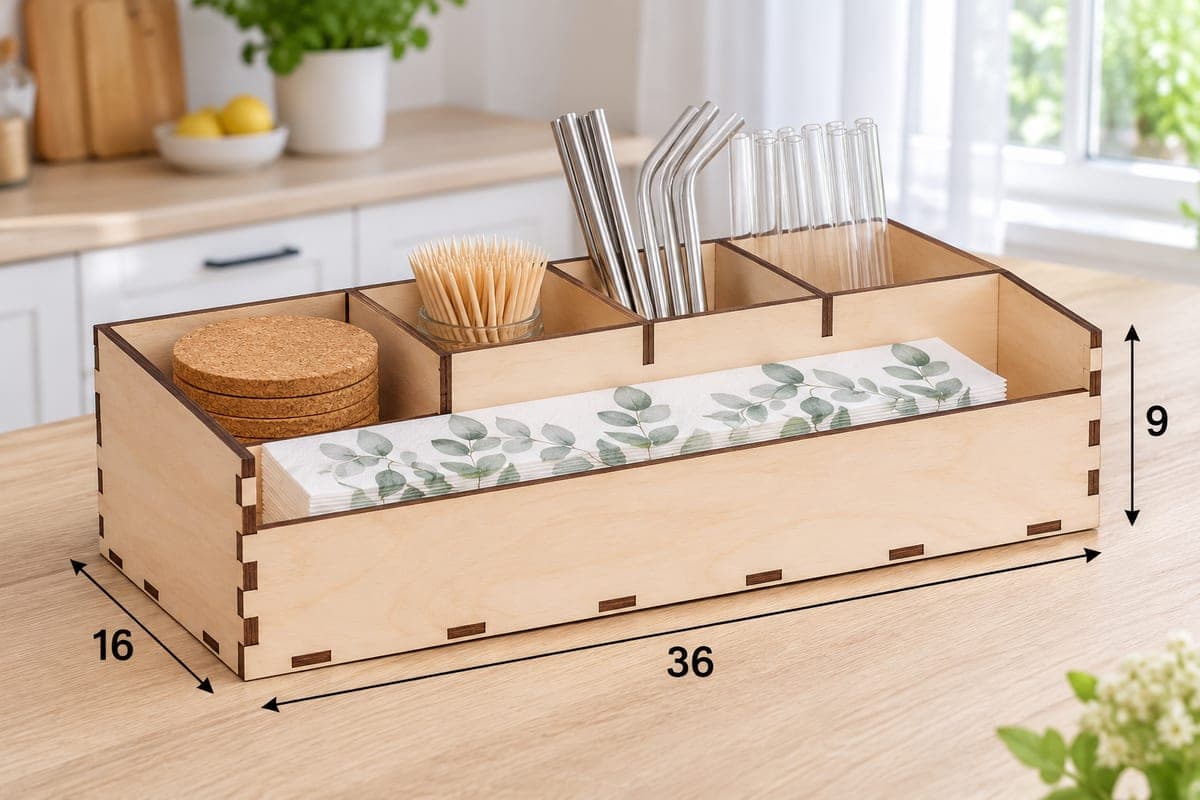
A free wide napkin organizer with a low sloped front bay that runs the full length for flat paper napkins and a back row of four slots for straws, coasters and toothpicks, five compartments in all. The download has SVG and DXF files for 3, 4, 5 and 6 mm plywood; the box measures 360 × 160 × 90 mm (14.17 × 6.30 × 3.54 in) and its 9 pieces join with tabs and slots.
- Formats
- SVG, DXF
- Outer size (W × D × H)
- 360 × 160 × 90 mm (14.17 × 6.30 × 3.54 in)
- Parts
- 9
- Material thickness
- 3, 4, 5 or 6 mm plywood (a file for each)
- Layout size (3 mm file)
- 1,424 × 262 mm
- Cut length
- 6.51 m
- Est. time, 10 W diode (3 mm)
- 21 min 43 s
- Est. time, 40 W CO2 (3 mm)
- 9 min 03 s
- Layers
- CUT only, no engraving
Free account required to download
How to make it
- 01Pick the SVG or DXF that matches your plywood, from 3 to 6 mm, and cut a single slot on scrap to check the fit.
- 02Run the 1424 mm layout as two or three smaller jobs if your bed is shorter, keeping the long cross divider in one piece.
- 03Join the back and both sloped sides to the base, add the low front, then slide in the long cross divider and the three short ones behind it.
- 04Sand and oil the caddy, lay the napkins flat in the front bay and stand straws, coasters and toothpicks in the four back slots.
One long bay, four small slots
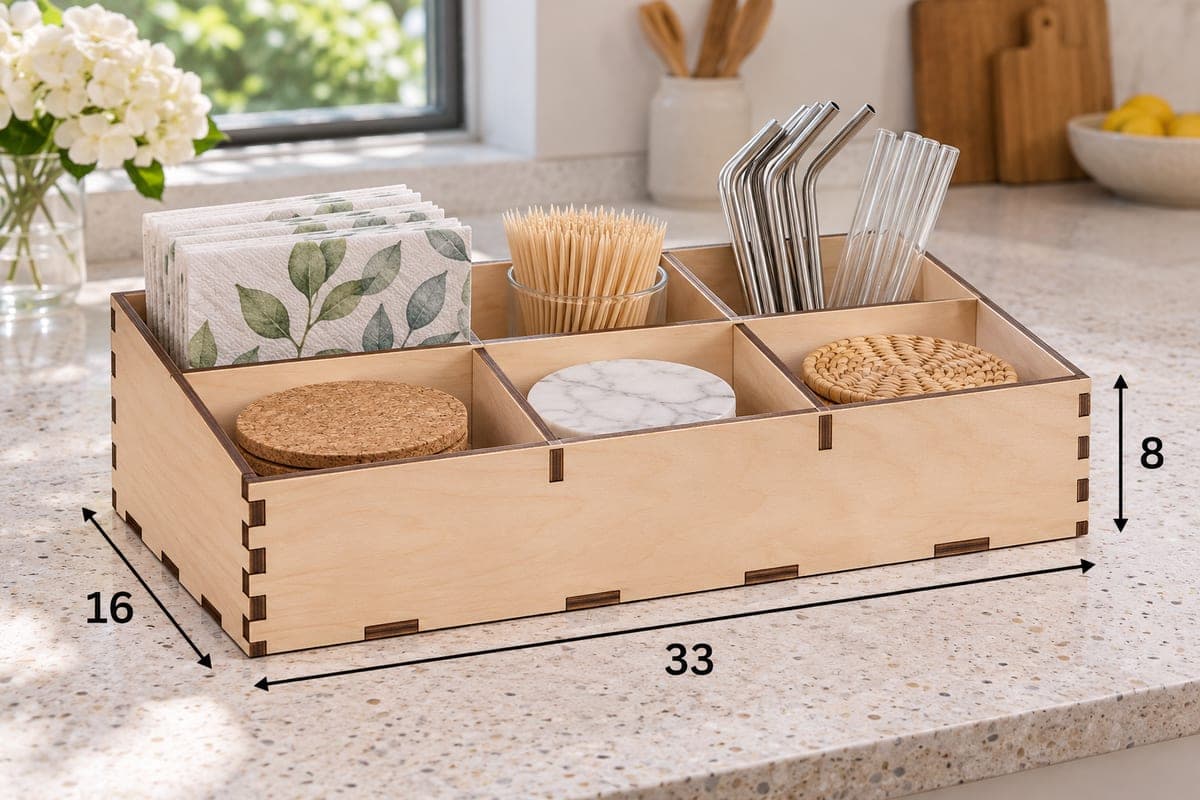
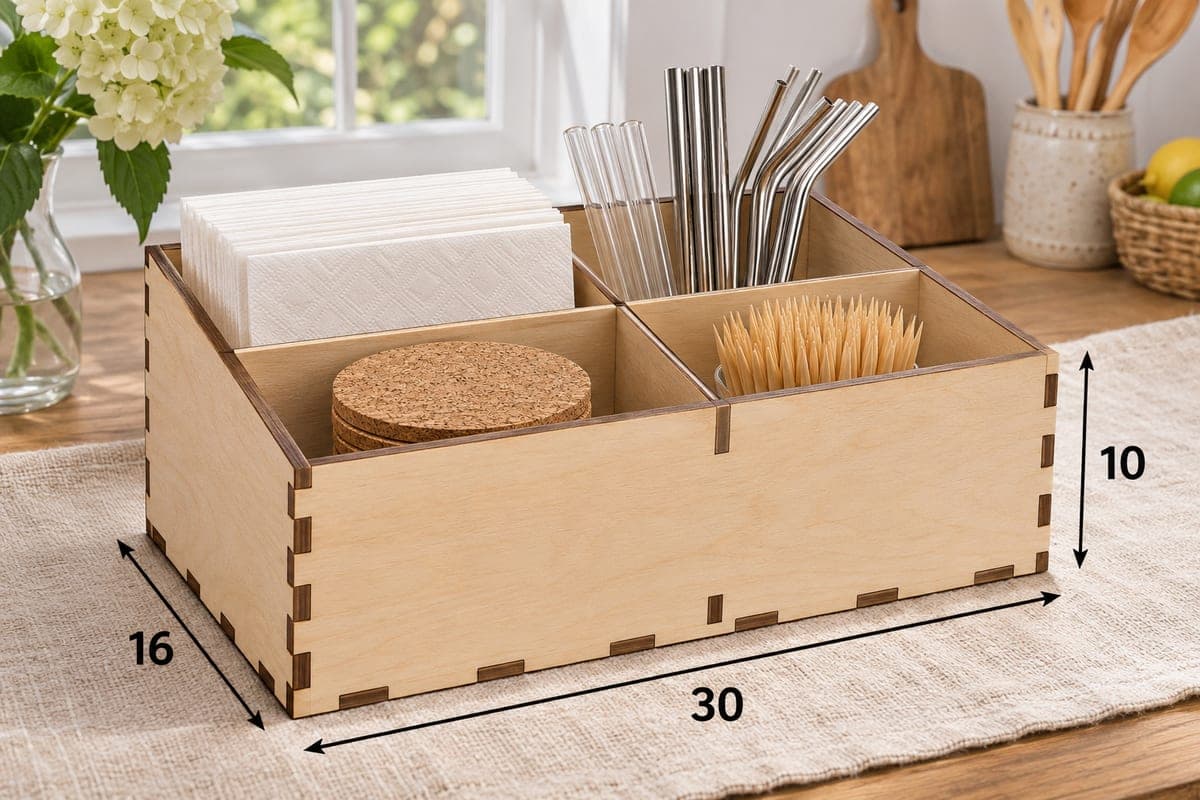
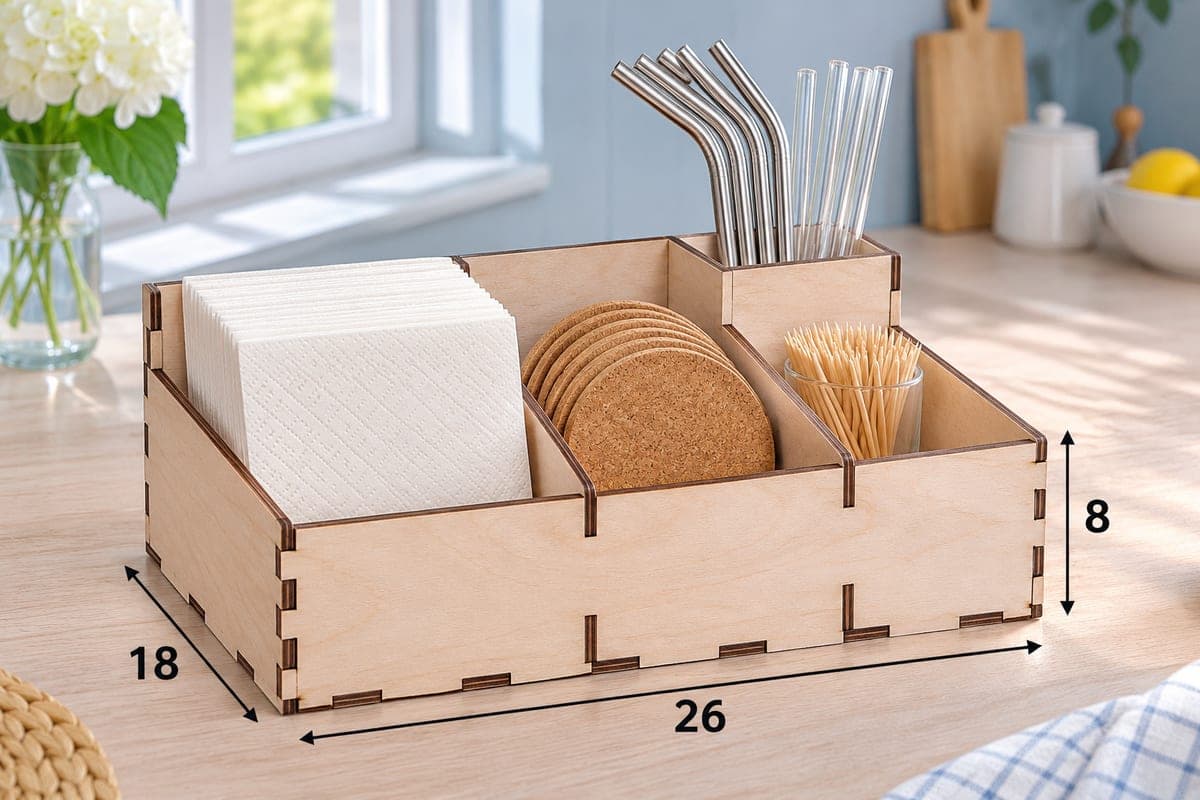
The front wall is only 50 mm high against a 90 mm back, and the side panels slope between the two, so a stack of luncheon napkins lying flat stays in plain view. One long cross divider runs the full 360 mm and separates that front bay from the back row, where three short dividers make four upright slots. In the photo they hold cork coasters, a glass of toothpicks, bent metal straws and clear glass straws, which keeps the tall items behind the napkins instead of hiding them.
Cutting a long, narrow layout
All nine pieces sit in a strip 1424 × 262 mm for the 3 mm version, so very few hobby machines take it in one go. Split it into two or three jobs: the back, front and base first, then the sides and the long cross divider, then the three small dividers. Estimated time for the 3 mm file: about 21 min 43 s on a 10 W diode, about 9 min 03 s on a 40 W CO2 and about 4 min 21 s on a 100 W CO2. A diode handles 3 mm in one or two passes; for 5 or 6 mm plan several passes or a CO2 machine. The files carry cut lines only.
Glue, finish and where to use it
Tabs and slots hold without glue, but a thin line of wood glue along the base keeps the long front from bowing. Sand the darkened edges lightly and wipe on a food-safe oil, since napkins and straws sit close to drinks. This size suits a kitchen island, a breakfast nook or the end of a buffet. Sell it filled with reusable straws and a pack of printed napkins as a housewarming present, or offer it to small cafes as a self-service caddy for the condiment counter.
Questions about this file
What lies in the long front section?
Flat folded paper napkins, as in the photo, or guest towels and cutlery rolls. The 50 mm front lets you lift them out from above without tipping the stack.
Can I shrink the organizer for a smaller table?
Yes, but resize only the outline in your editor and keep every slot exactly as wide as your sheet. Plain scaling shrinks the slots too, and the tabs will no longer fit.
Will it work in acrylic?
Clear or frosted acrylic cuts well on a CO2 laser and looks smart on a bar, but join it with acrylic cement. Diode lasers cannot cut clear acrylic.
Which thickness suits such a long box?
4 mm is a good middle ground: stiffer than 3 mm along the 360 mm walls and still quick on a diode. Choose 6 mm for a heavy-duty cafe version.
Is there room for a name on the low front?
The low front strip is 360 mm long, enough for a short name or a cafe logo. Add your own engraving layer in your laser software before cutting.
Similar files