 Visualization
Sliding Lid Box SVG, Wooden Cutlery Chest Laser Cut File, Flatware Storage Box DXF, Silverware Case
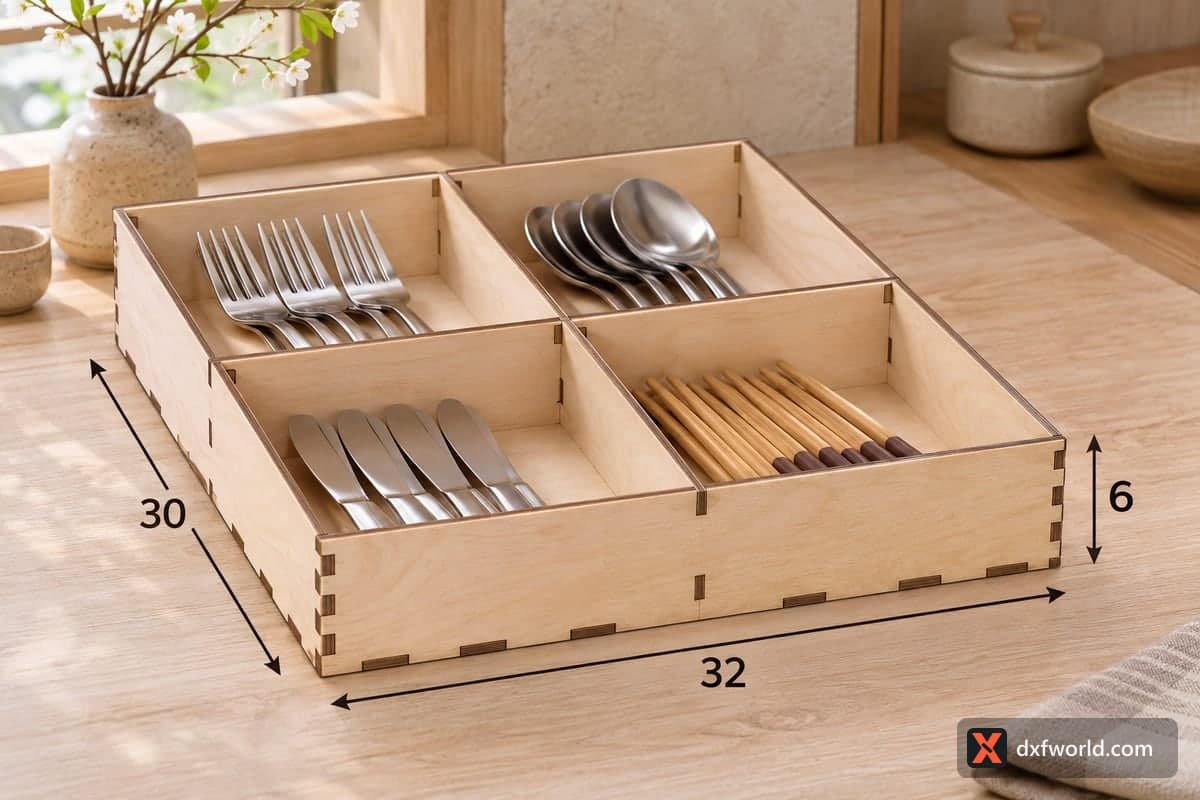
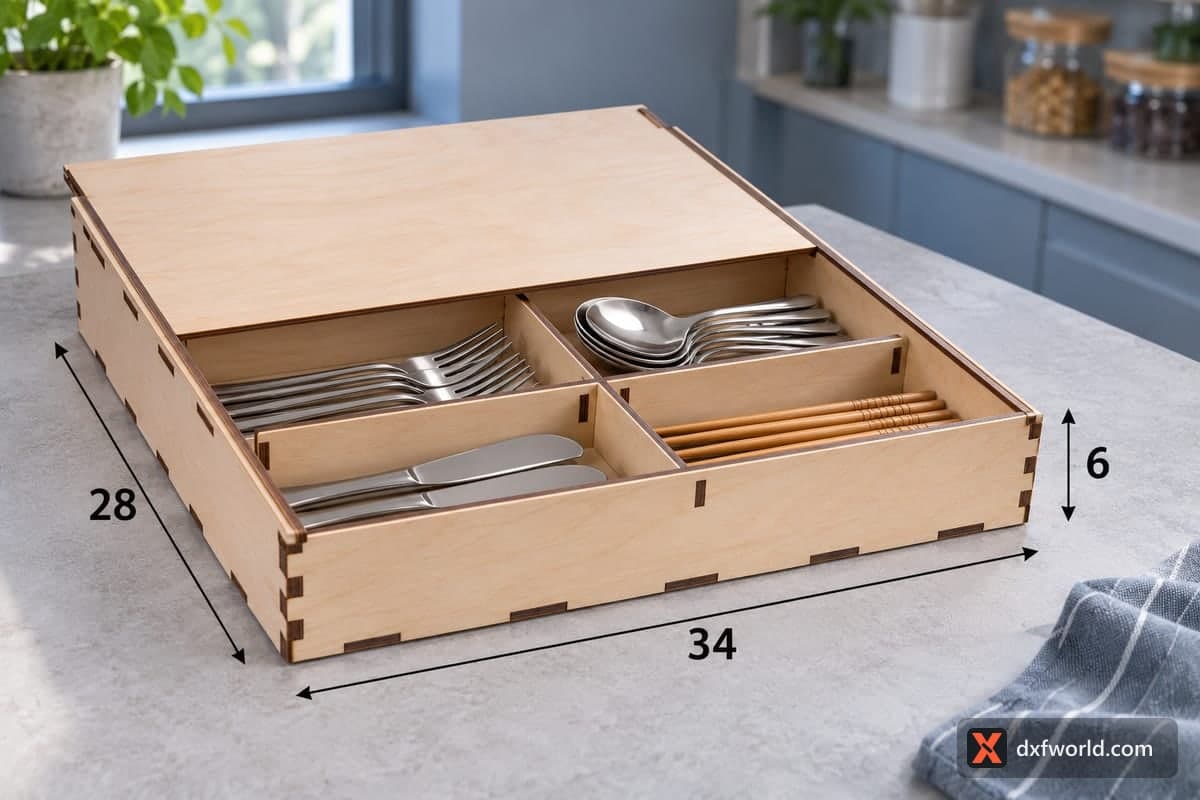
A free cut file for a wide wooden cutlery chest whose flat lid slides in along two rails, with four compartments made by a cross of dividers. It measures 340 × 280 × 60 mm (13.39 × 11.02 × 2.36 in), has 10 plywood pieces joined with tabs and slots, and comes as SVG and DXF for 3, 4, 5 and 6 mm plywood.
- Formats
- SVG, DXF
- Outer size (W × D × H)
- 340 × 280 × 60 mm (13.39 × 11.02 × 2.36 in)
- Parts
- 10
- Material thickness
- 3, 4, 5 or 6 mm plywood (a file for each)
- Layout size (3 mm file)
- 1,260 × 636 mm
- Cut length
- 10.31 m
- Est. time, 10 W diode (3 mm)
- 34 min 22 s
- Est. time, 40 W CO2 (3 mm)
- 14 min 19 s
- Layers
- CUT only, no engraving
Free account required to download
How to make it
- 01Choose the file that matches your plywood and cut one test slot, then check that a scrap of the same sheet fits it without forcing.
- 02Cut all ten pieces, keeping the lid flat on the bed so it stays true; split the 1260 mm layout over two sheets on a compact laser.
- 03Join the side walls, back and lower front to the base, add the two rails, slot the dividers together into a cross and slide the lid in to test the fit.
- 04Wax the rails and lid edges, oil the box and sort forks, spoons, knives and chopsticks into the four bays.
Inside the chest
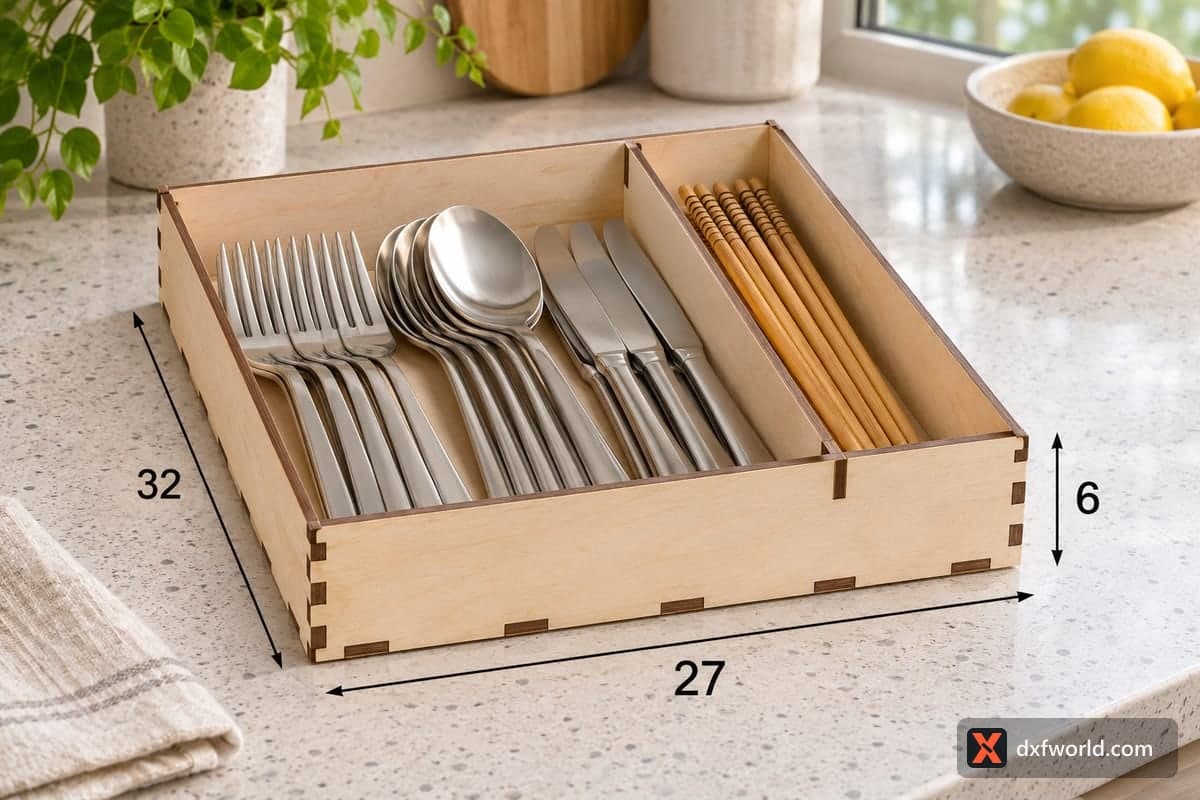
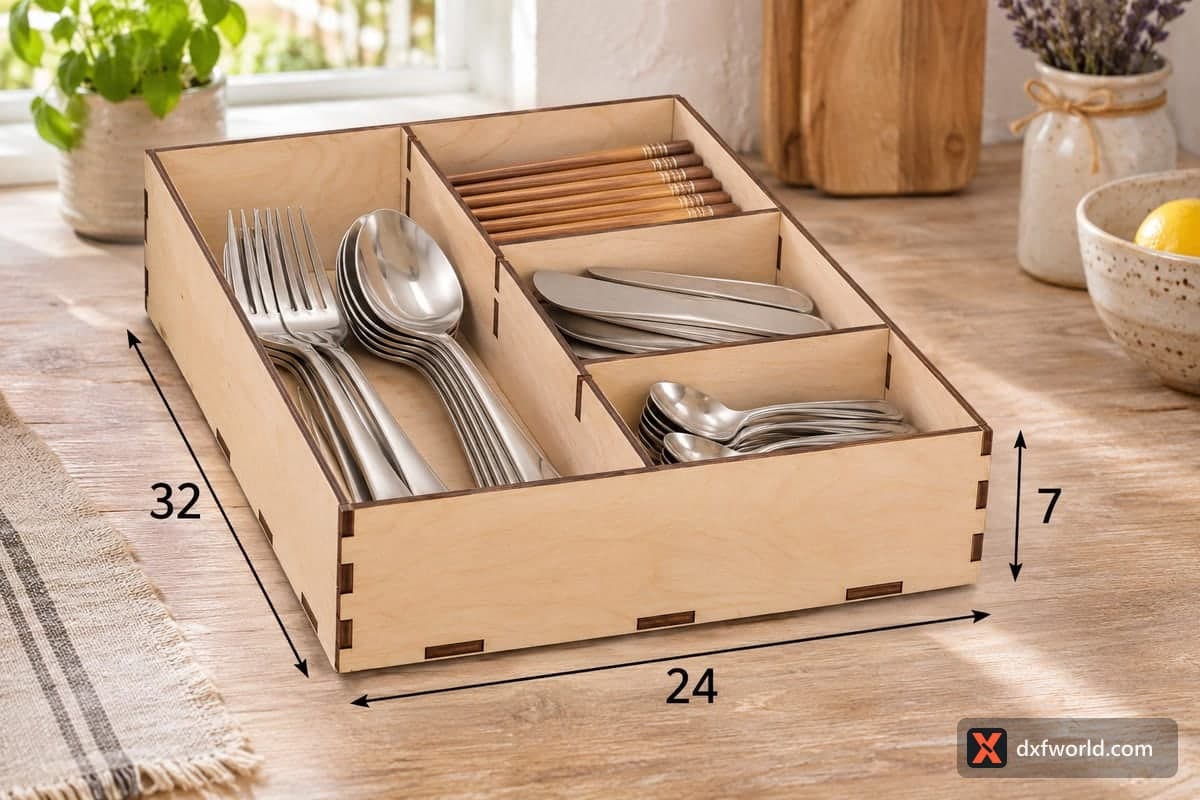
Two dividers cross in the middle and give four bays of similar size. In the photo the back pair holds dinner forks and spoons, the front pair table knives and a bundle of chopsticks, which is roughly the order you reach for them when laying a table. The front wall is a little lower than the back so the lid can pass over it, and the dividers stop below the rim so the lid glides above them without catching. There is no hinge and no lock: the lid simply slides along its rails to open and close.
Cutting the lid and rails
At 340 mm across this is one of the wider boxes in the cutlery range, and its layout is 1260 × 636 mm. On a smaller bed, put the lid and the base on one sheet and the walls, rails and dividers on another. For the 3 mm file the job takes about 34 min 22 s on a 10 W diode, about 14 min 19 s on a 40 W CO2 and about 6 min 52 s on a 100 W CO2. A diode gets through 3 mm in one or two passes, while 5 and 6 mm sheets need more power or more passes. Fit the two thin rails to the side walls as the layout shows, and try the lid before any glue sets so a rail can still be nudged if the lid binds.
Finishing and gifts
Rub a little paste wax or candle wax on the lid edges and rails so the lid runs smoothly, and oil the rest with a food-safe finish. The big flat lid is a natural place for a monogram or a wedding date that you engrave yourself. Filled with a new flatware set, the chest makes a thoughtful wedding or housewarming present, and it also travels well as a picnic or camping cutlery case.
Questions about this file
What keeps this cutlery chest closed?
It rides in two rails along the side walls and is held by them, so it cannot lift off while closed. There are no hinges, magnets or catches.
The lid feels tight after finishing. What helps?
Oil and lacquer can swell the edges a little. Sand the lid edges lightly and rub wax on the rails, and it will slide freely again.
Can I scale the chest to hold a larger cutlery set?
You can enlarge the outline, but the slots must keep the real plywood thickness and the rail gap must still match the lid. Adjust those in your editor after scaling.
Which thickness is best for the sliding lid?
4 mm birch plywood is a good middle choice: the lid stays flat and the box is not too heavy to carry. 3 mm works for a lighter chest.
Could I put a monogram on the sliding panel?
The file has cut lines only, but you can place your own text or logo on the lid in your laser software and engrave it before cutting the outline.
Similar files