 Visualization
Cutlery Drawer Organizer SVG, Wooden Silverware Tray Laser Cut File, Kitchen Drawer Insert DXF
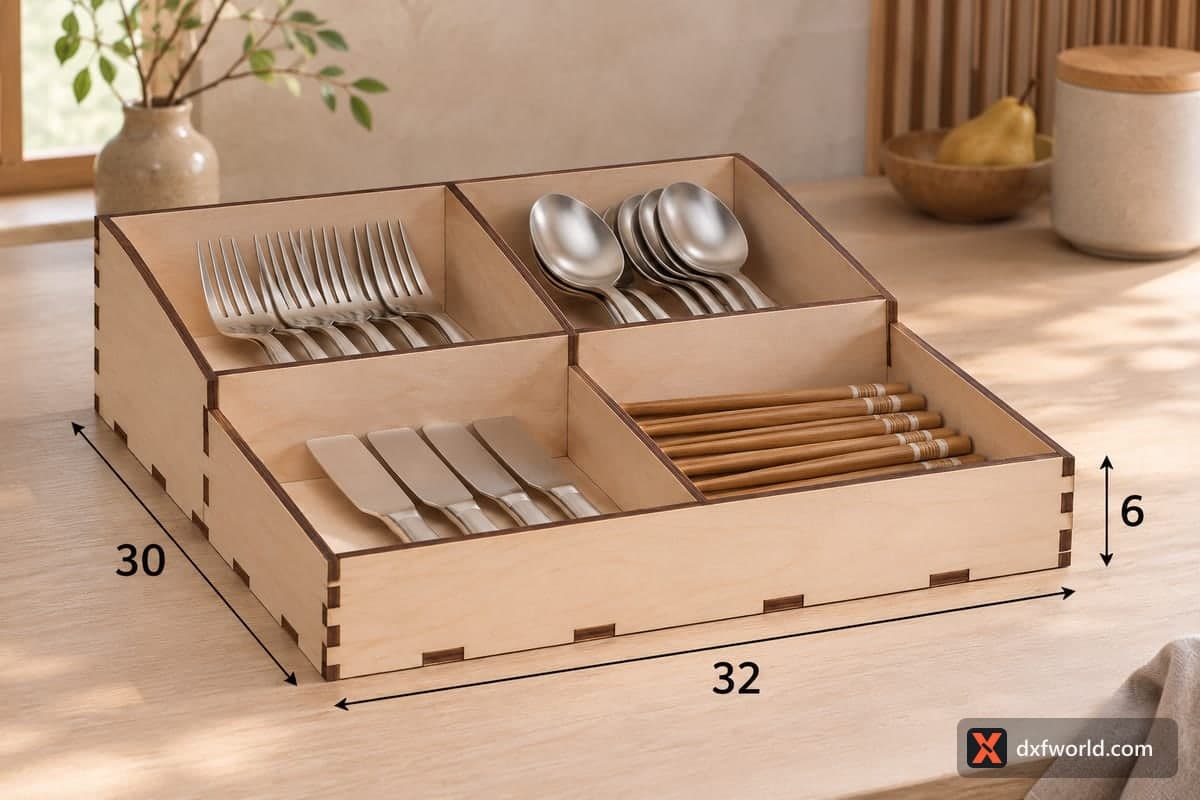
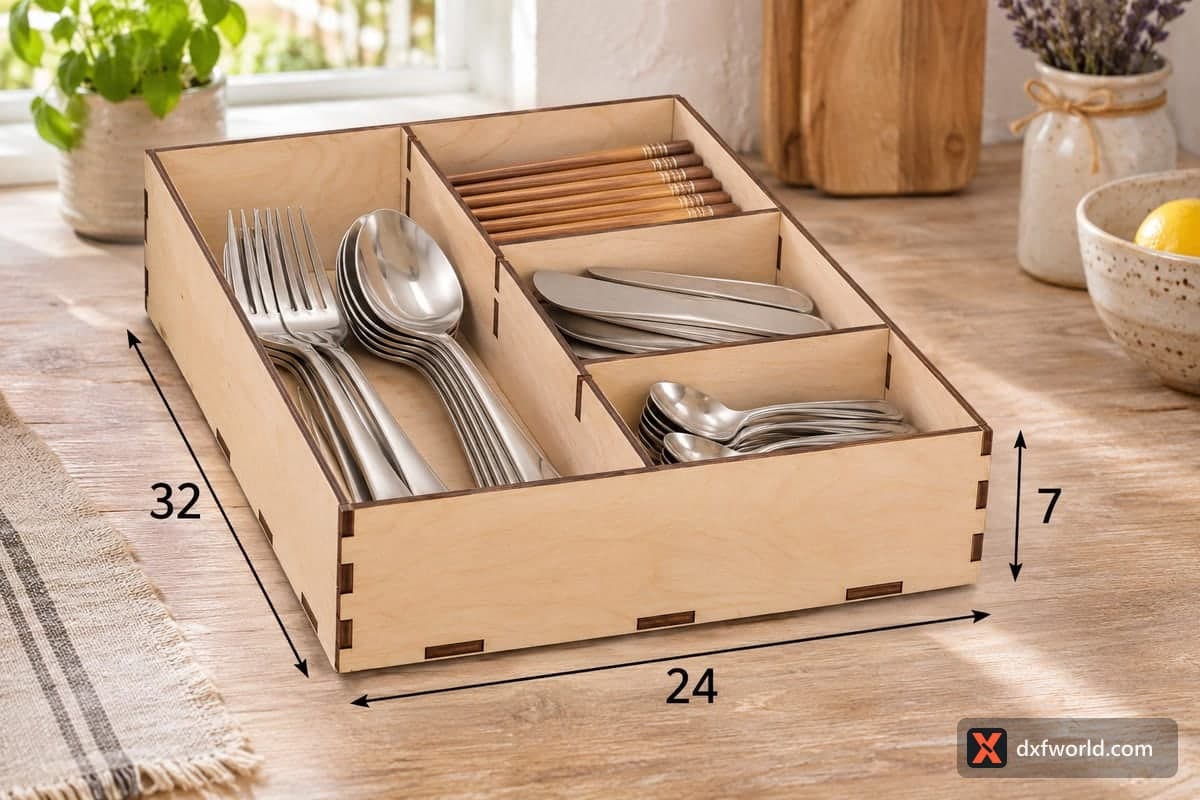
This is a free laser cut file for a wooden cutlery drawer tray with one long full-depth bay and three smaller pockets stacked beside it, four compartments in total. It measures 240 × 320 × 70 mm (9.45 × 12.60 × 2.76 in) and is made from 8 plywood pieces that join with tabs and slots. The download includes SVG and DXF files for 3, 4, 5 and 6 mm plywood.
- Formats
- SVG, DXF
- Outer size (W × D × H)
- 240 × 320 × 70 mm (9.45 × 12.60 × 2.76 in)
- Parts
- 8
- Material thickness
- 3, 4, 5 or 6 mm plywood (a file for each)
- Layout size (3 mm file)
- 1,140 × 402 mm
- Cut length
- 6.17 m
- Est. time, 10 W diode (3 mm)
- 20 min 34 s
- Est. time, 40 W CO2 (3 mm)
- 8 min 34 s
- Layers
- CUT only, no engraving
Free account required to download
How to make it
- 01Pick the SVG or DXF for your plywood thickness and cut a single slot from scrap to check that a strip of the same sheet slides in snugly.
- 02Cut the base, four walls, the long divider and the two short cross dividers, splitting the layout across two sheets if your bed is under 1140 mm.
- 03Fit the side walls into the base, close the box with front and back, then stand the long divider in place and push both cross dividers into the right-hand lane.
- 04Sand the corners, oil the wood and load forks and spoons into the wide bay, then knives, teaspoons and chopsticks into the three pockets.
How the four compartments work
The tray is narrower than it is deep, so it slides into a kitchen drawer front to back. One long divider runs the full 320 mm depth and splits the box into a wide left bay and a narrower right lane. Two short cross dividers cut that lane into three pockets. In the photo the wide bay holds dinner forks and soup spoons side by side, while the pockets keep chopsticks, table knives and teaspoons apart. The 70 mm walls are tall enough that serving spoons and ladle handles stay put when the drawer is pulled hard.
Cutting and assembly
All eight pieces sit on a layout of 1140 × 402 mm, which is longer than most diode and desktop CO2 beds, so move the base and the side walls onto a second sheet if needed. Cutting time for the 3 mm file is about 20 min 34 s on a 10 W diode, about 8 min 34 s on a 40 W CO2 and about 4 min 07 s on a 100 W CO2. A 10 W diode handles 3 mm in one or two passes; 5 and 6 mm need a stronger tube or extra passes. Start with the base, add the two long side walls, then front and back. Drop in the long divider and slide the two cross dividers into its slots last. The joints hold without glue, and a thin line of wood glue makes the tray permanent.
Finishing and gift ideas
Sand the edges lightly and wipe on food-safe oil or clear lacquer so crumbs and water spots come off easily. Sell it as a housewarming gift bundled with a set of wooden chopsticks, make a matching pair for a kitchen with two cutlery drawers, or engrave a family name on the front wall yourself before assembly.
Questions about this file
Will full-size dinner forks and knives fit in the long bay?
Yes. The bay runs the full 320 mm depth of the tray, which takes standard dinner forks, knives and soup spoons lying flat with room to spare.
Can I make the tray smaller for a narrow drawer?
You can change the length and depth in your design software, but the slot width must stay equal to your plywood thickness. Scaling the whole drawing also scales the slots, so correct them afterwards or the tabs will be loose.
Which plywood thickness suits a cutlery drawer?
3 or 4 mm birch plywood keeps the tray light and leaves more room inside. Pick 5 or 6 mm if it will carry heavy serving utensils every day.
Is it fine to keep the tray in a drawer next to the sink?
Plywood dislikes standing water. Seal every face with food-safe oil or lacquer and let washed cutlery dry before it goes back in.
Does the file work with acrylic or MDF?
Yes, as long as you use the version that matches the sheet thickness. MDF swells when wet, so give it a good seal for kitchen use.
Similar files