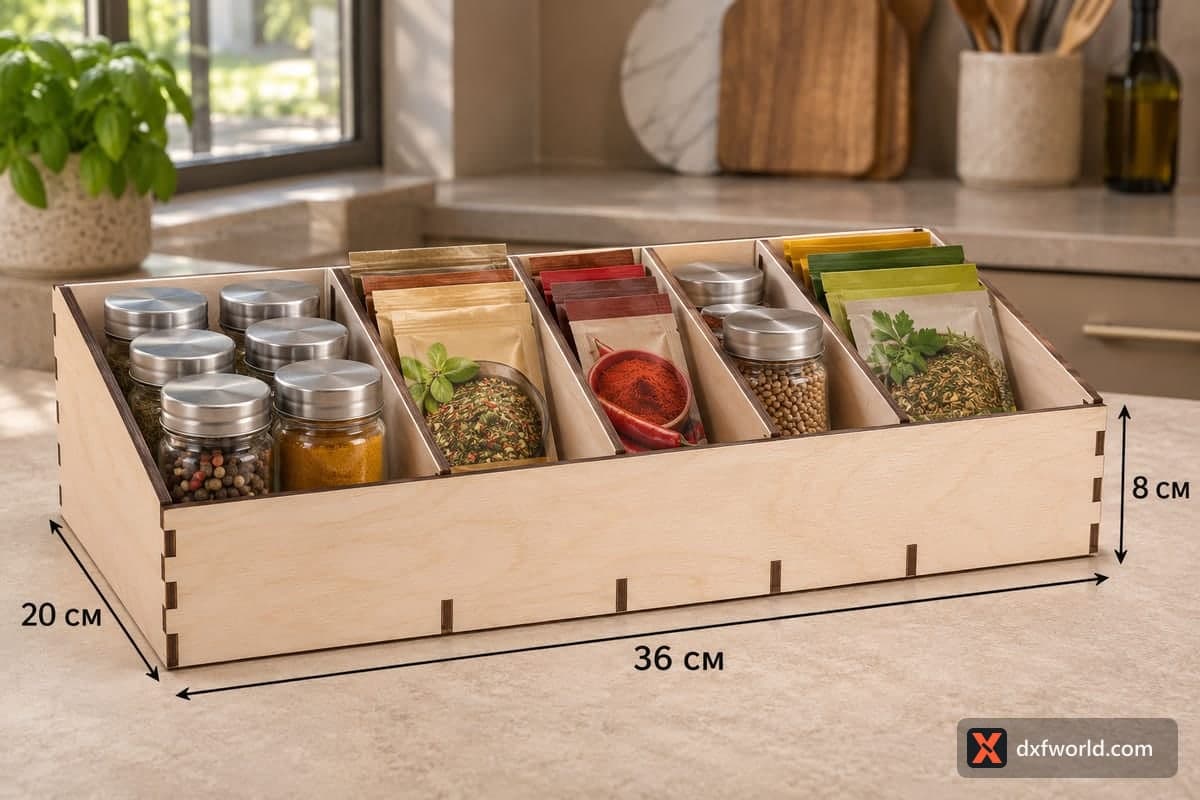
 Visualization
5 Section Spice Tray SVG, Wide Low Front Spice Organizer Laser Cut File, Spice Pouch and Jar Bin DXF
A free laser cut file for a wide, open spice tray with five sections side by side and a front wall half the height of the back, so the side panels slope down toward you. It measures 360 × 200 × 80 mm (14.17 × 7.87 × 3.15 in), is cut from 9 plywood pieces that fit together with tabs and slots, and holds both jars and spice pouches. You get eight files in the download: an SVG and a DXF for each of 3, 4, 5 and 6 mm plywood.
- Formats
- SVG, DXF
- Outer size (W × D × H)
- 360 × 200 × 80 mm (14.17 × 7.87 × 3.15 in)
- Parts
- 9
- Material thickness
- 3, 4, 5 or 6 mm plywood (a file for each)
- Layout size (3 mm file)
- 1,184 × 292 mm
- Cut length
- 6.90 m
- Est. time, 10 W diode (3 mm)
- 22 min 59 s
- Est. time, 40 W CO2 (3 mm)
- 9 min 35 s
- Layers
- CUT only, no engraving
Free account required to download
How to make it
- 01Pick the SVG or DXF that matches your plywood, then cut a single divider slot in scrap to check that the tab drops in snugly.
- 02Cut the nine pieces, rearranging the 1184 mm strip over two sheets if your bed is short.
- 03Fit the back and both sloped sides to the base, add the 40 mm front, then slide the four dividers in from above.
- 04Sand the sloped edges where hands reach in, oil or lacquer the tray, and load jars on the left and pouches in the remaining sections.
Five sections in one long row
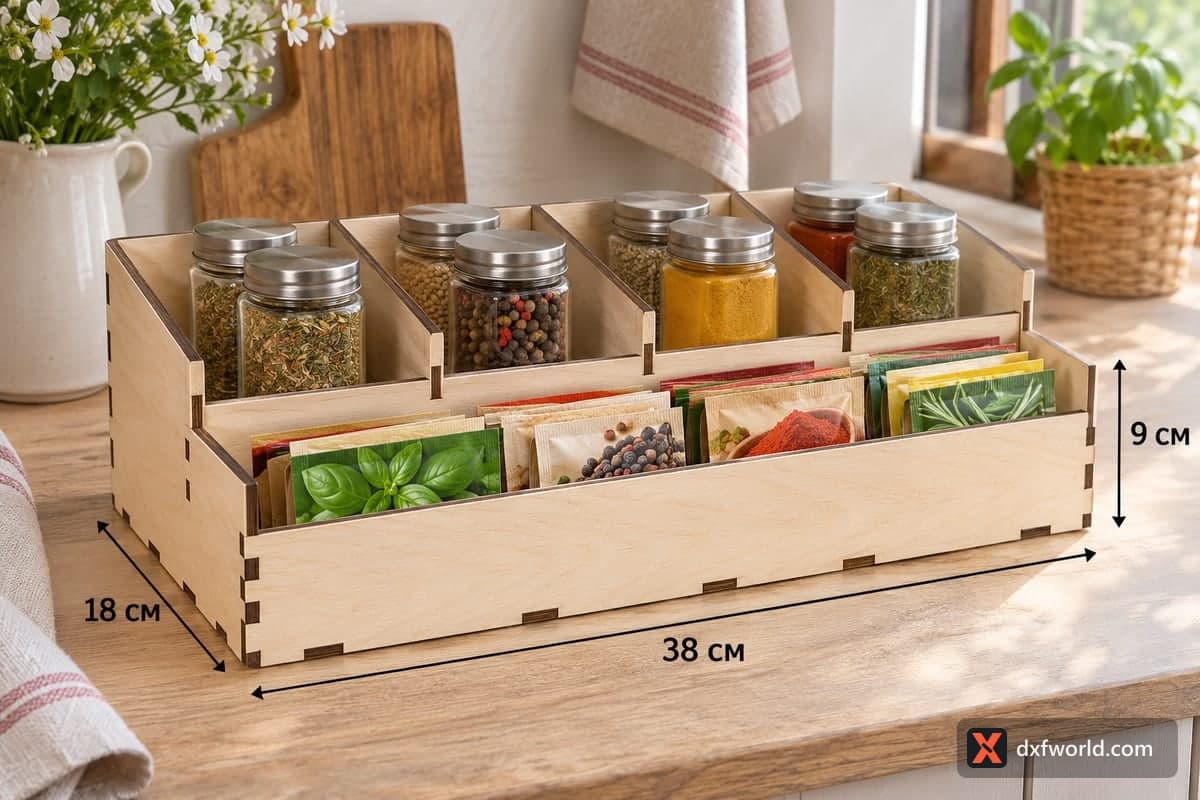
This is the widest open tray in the spice set: 36 cm along the counter, 20 cm deep and 8 cm tall at the back. The front wall is only 40 mm high, half the back, and the two side panels and all four dividers follow that slope. Four full-depth dividers split the tray into five sections of similar width, each running from the front to the back wall.
In the photo the left section holds six silver-lidded jars in two rows of three (peppercorns, turmeric and dried herbs). The next two sections are packed with herb and chili pouches standing upright, the fourth carries two jars of coriander seed, and the right section takes green and yellow seasoning packets. Because the front is low, you read every label without lifting anything out.
Cutting it on your laser
Cutting time for the 3 mm file is about 22 min 59 s on a 10 W diode, about 9 min 35 s on a 40 W CO2 and about 4 min 36 s on a 100 W CO2. The nine pieces sit in a strip 1184 × 292 mm, longer than most hobby beds, so move the base and back to one sheet and the sides, front and dividers to a second. The 360 mm base and back are the longest parts and set the minimum bed width. A diode handles 3 mm in one or two passes; 5 and 6 mm plywood need several passes or a CO2.
Gift and market ideas
Fill it with five matching jar-and-pouch blends as a housewarming present. Spice sellers at farmers markets can use it as a counter display for sample packets, one blend per section. A pair of these trays side by side covers a deep kitchen drawer.
Questions about this file
How many spice jars fit in the left section?
The photo shows six small jars in two rows of three in one section. Pouches and flat seasoning packets fill the other four sections standing on edge.
Can I make the tray shorter to fit a narrow shelf?
Shortening it means redrawing the base, front and back rather than scaling the whole file. Scaling would shrink the slots too, and they must stay equal to the plywood thickness.
Could I cut this tray from MDF or acrylic?
Yes, 3 mm MDF cuts cleanly and acrylic gives a modern look; use the file that matches the sheet thickness. MDF should be sealed if it sits near the sink.
Does the tray need glue?
The tab and slot joints hold it together for everyday use. A drop of wood glue in the corner joints makes it permanent if you move it around a lot.
Can I add spice names to the front wall?
The file has cut lines only, but the 40 mm front is wide enough to engrave five short labels, one under each section, as an extra layer you add yourself.
Similar files