
Laser Cut Spice Rack and Spice Organizer Files: 10 Free SVG and DXF Designs
A laser cut spice rack is a plywood tray or box with lanes or cells for spice jars and seasoning packets, joined with tabs and slots. The 10 free files below range from a 7-part, 280 × 180 mm packet box to a 16-part, 320 × 240 mm tiered tray with 12 compartments, each in SVG and DXF for 3, 4, 5 and 6 mm plywood, and cut in about 17–33 minutes on a 10 W diode (3 mm).
You open the cupboard to grab the paprika and three jars of cumin fall out instead. Every kitchen has that shelf. A laser cut spice rack fixes it in an afternoon: the jars stand in lanes, the packets stop hiding behind them, and you finally see that you already own four jars of cumin.
Here are all 10 spice organizer files from the DXF World library, from a slim shelf box to a 12-cell tiered tray. Each one is a tab-and-slot plywood box, each download contains SVG and DXF versions for 3, 4, 5 and 6 mm plywood, and all of them are collected in the spice organizers category.
All 10 spice organizers compared
| File | Outer size, mm | Compartments | Parts | 10 W diode, 3 mm |
|---|---|---|---|---|
| Tall 3-lane packet box | 280 × 180 × 100 | 3 | 7 | about 17 min |
| Narrow 5-slot shelf box | 360 × 100 × 80 | 5 | 9 | about 18 min |
| Compact jar tray | 240 × 160 × 80 | 6 | 10 | about 19 min |
| Four-lane jar organizer | 300 × 200 × 90 | 4 | 8 | about 20 min |
| Jar lanes + packet pockets | 280 × 200 × 90 | 6 | 10 | about 22 min |
| Two-row jar organizer | 300 × 160 × 80 | 8 | 12 | about 23 min |
| Deep jar and sachet box | 300 × 220 × 90 | 6 | 10 | about 24 min |
| Pouch and jar caddy | 320 × 200 × 100 | 7 | 11 | about 25 min |
| Square stepped, 9 cells | 270 × 270 × 80 | 9 | 13 | about 28 min |
| Tiered tray, 12 cells | 320 × 240 × 80 | 12 | 16 | about 33 min |
On a 40 W CO2 laser the same files take roughly 7 to 14 minutes. These are estimates from the cut length; your speed, power and number of passes change them.
Spice racks with lanes for jars
Lanes are the classic spice rack: jars stand one behind another, and you read the labels from above.
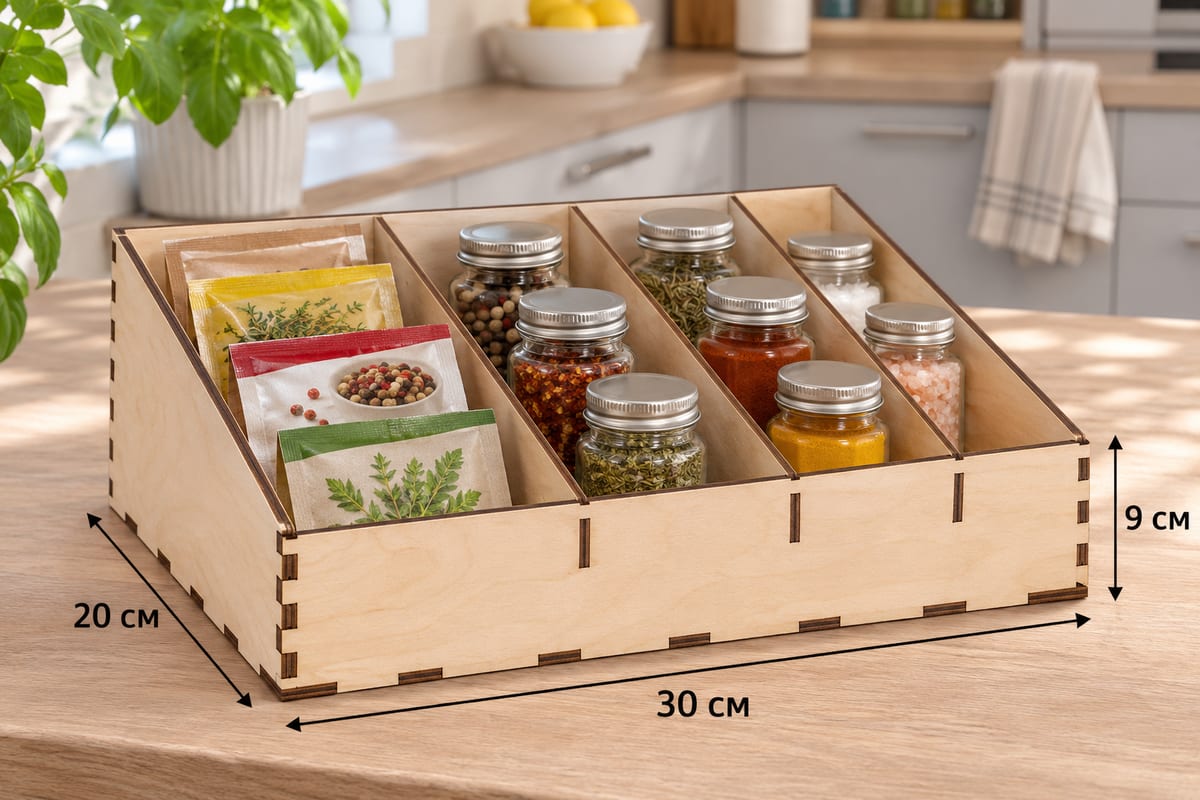 Four-Lane Spice Jar OrganizerOuter size (W × D × H) 300 × 200 × 90 mm (11.81 × 7.87 × 3.54 in)Parts 8Est. time, 10 W diode (3 mm) 19 min 59 sEst. time, 40 W CO2 (3 mm) 8 min 20 sSVG · DXF →
Three dividers run the full depth of the box and make four lanes. The simplest layout, and the easiest to keep tidy: one lane for sweet spices, one for hot, one for herbs, one for everything else.
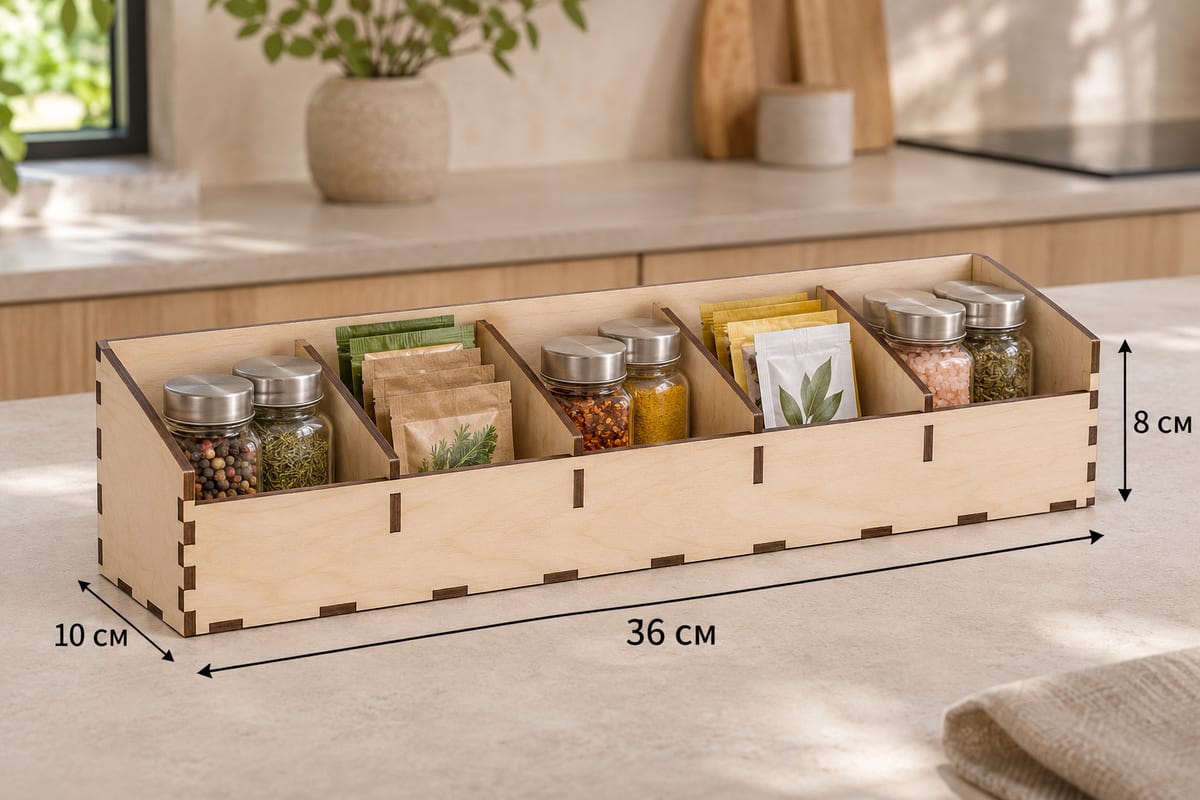 Narrow 5-Slot Spice Shelf BoxOuter size (W × D × H) 360 × 100 × 80 mm (14.17 × 3.94 × 3.15 in)Parts 9Est. time, 10 W diode (3 mm) 17 min 54 sEst. time, 40 W CO2 (3 mm) 7 min 27 sSVG · DXF →
Only 100 mm deep, so it stands on a narrow shelf, a windowsill or at the back of the counter. Five slots in one row hold the jars you use every day.
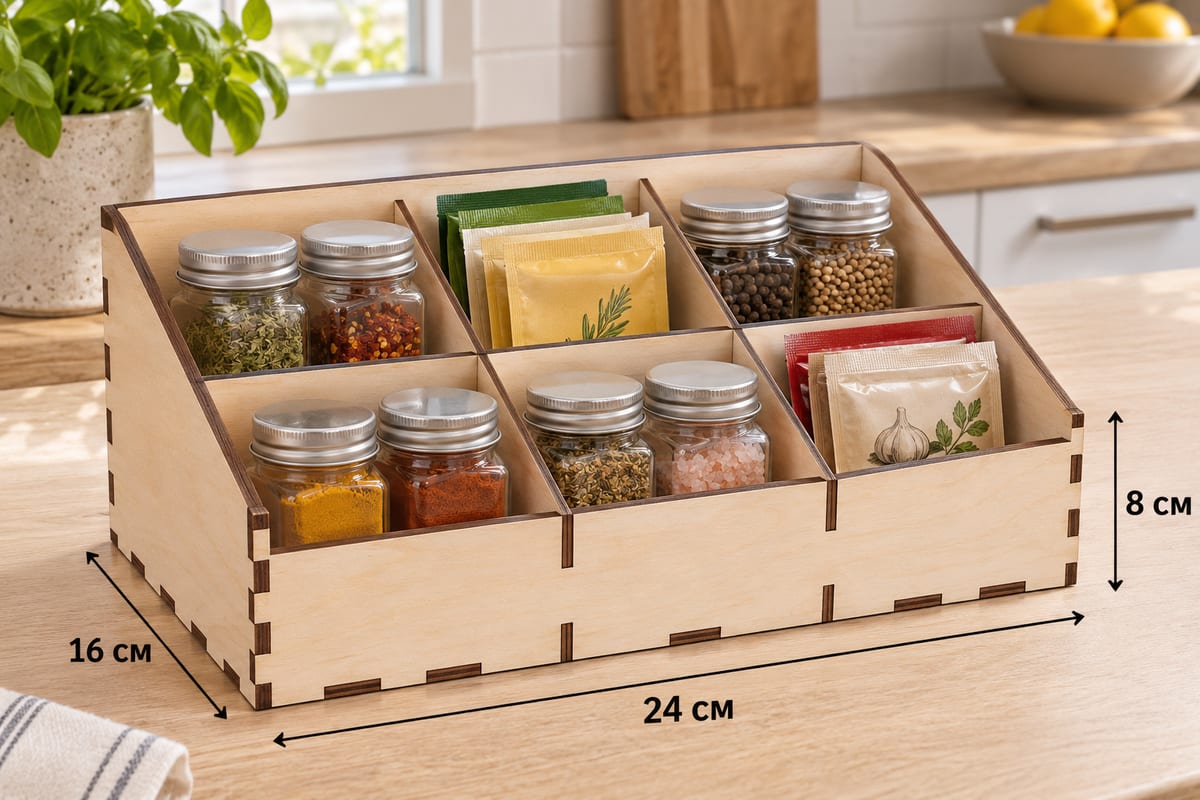 Compact Spice Jar Tray, 6 SectionsOuter size (W × D × H) 240 × 160 × 80 mm (9.45 × 6.30 × 3.15 in)Parts 10Est. time, 10 W diode (3 mm) 18 min 53 sEst. time, 40 W CO2 (3 mm) 7 min 52 sSVG · DXF →
Six sections in two rows of three in a 240 × 160 mm footprint, the smallest box here. The front drops to 48 mm, so the front row stays visible.
Pro tip: measure your jars before you choose a file. Spice jars differ a lot from brand to brand: note the diameter and height of your biggest jar and compare them with the cell size on the file page.
Spice organizers with cells and tiers
Cells keep every jar in its place, and tiers lift the back rows so nothing hides.
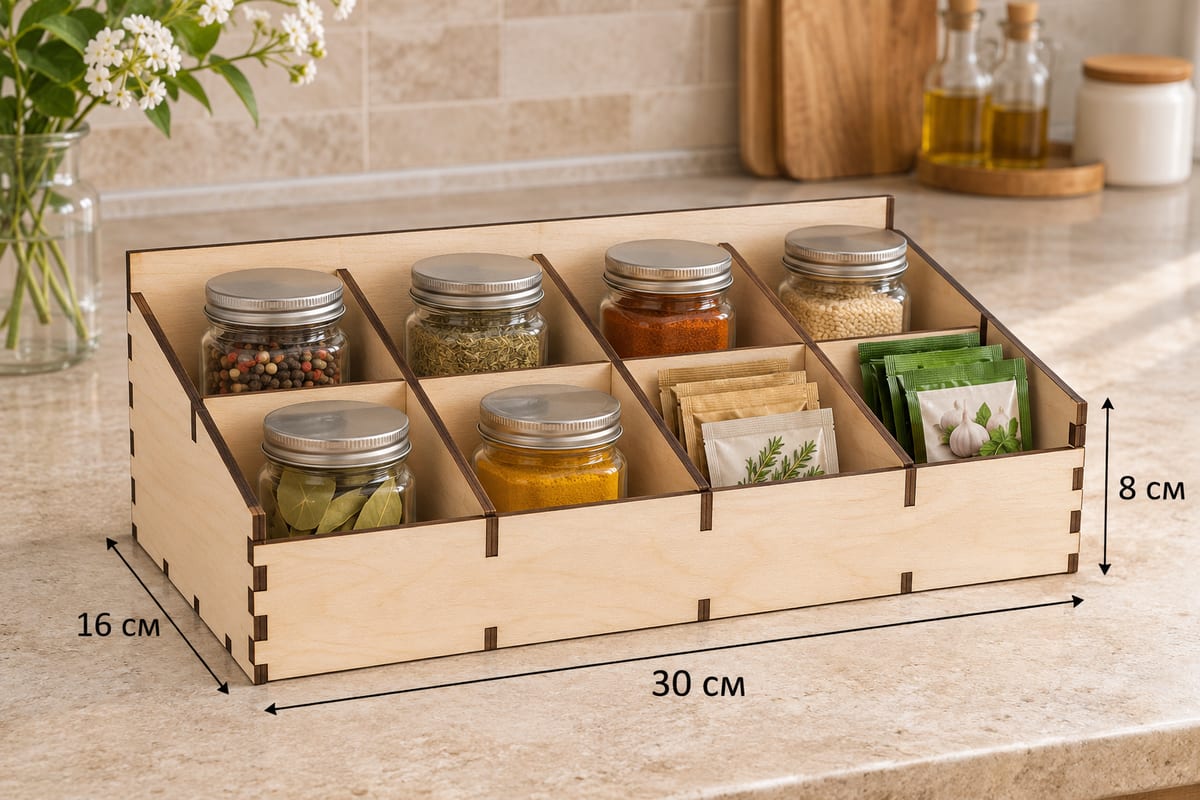 Two-Row Spice Jar Organizer, 8 CellsOuter size (W × D × H) 300 × 160 × 80 mm (11.81 × 6.30 × 3.15 in)Parts 12Est. time, 10 W diode (3 mm) 23 min 07 sEst. time, 40 W CO2 (3 mm) 9 min 38 sSVG · DXF →
Two rows of four cells, eight in total. Sloping sides go from an 80 mm back to a 48 mm front, so the back row stays readable.
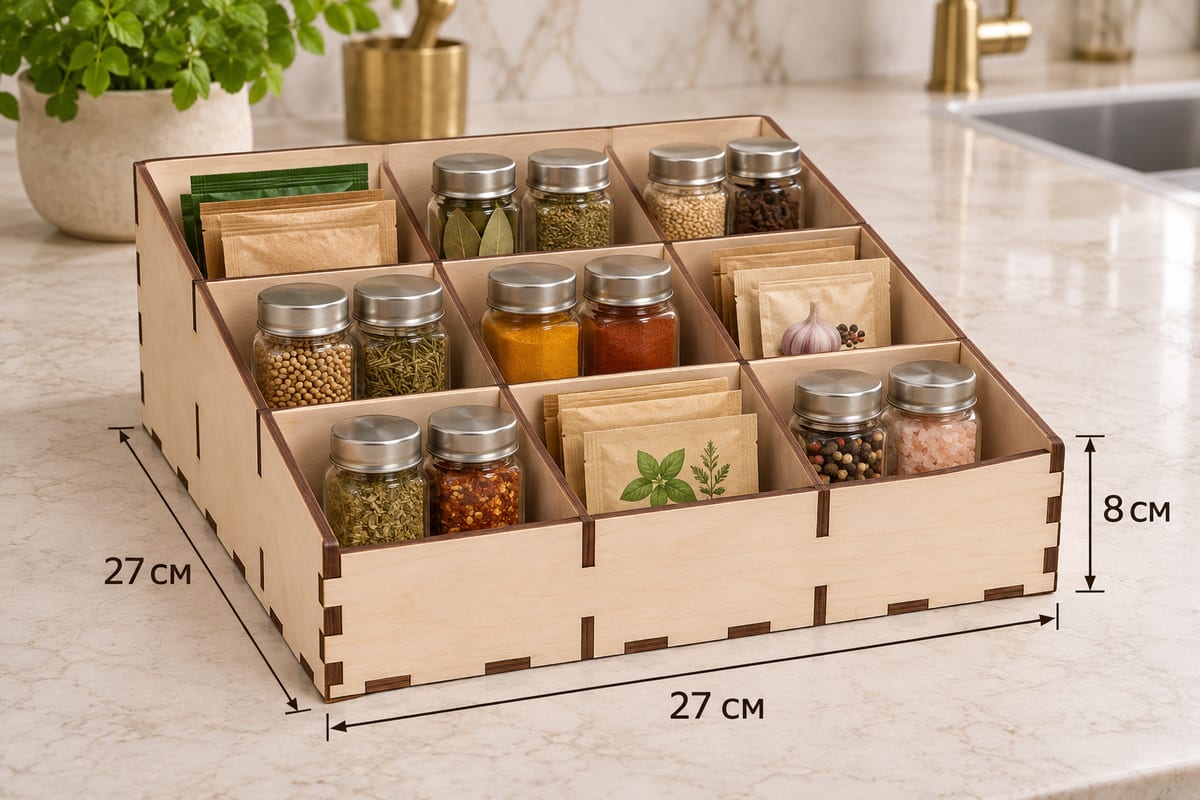 Square Stepped Spice Organizer, 9 CellsOuter size (W × D × H) 270 × 270 × 80 mm (10.63 × 10.63 × 3.15 in)Parts 13Est. time, 10 W diode (3 mm) 27 min 37 sEst. time, 40 W CO2 (3 mm) 11 min 30 sSVG · DXF →
Nine cells in three stepped rows of three, made for a counter corner or a deep shelf. A square box uses a corner that is usually wasted.
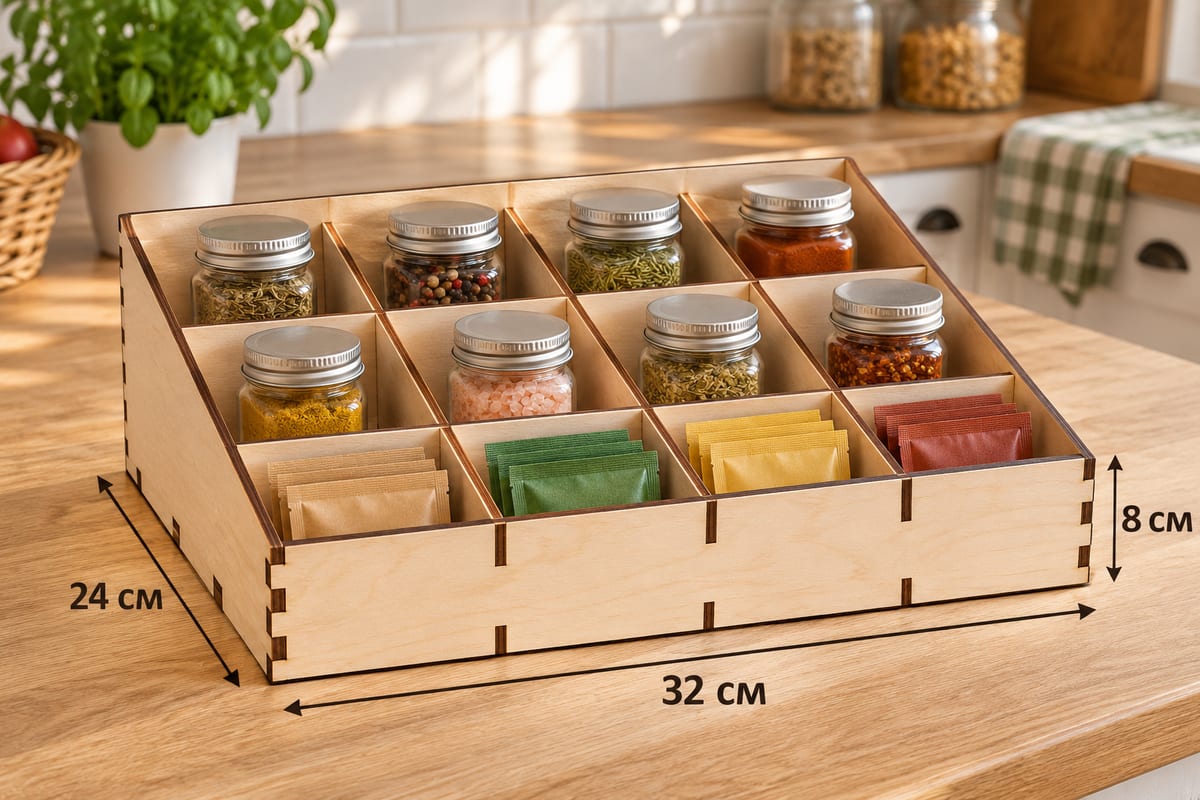 Tiered Spice Tray, 12 CompartmentsOuter size (W × D × H) 320 × 240 × 80 mm (12.60 × 9.45 × 3.15 in)Parts 16Est. time, 10 W diode (3 mm) 32 min 41 sEst. time, 40 W CO2 (3 mm) 13 min 37 sSVG · DXF →
The biggest spice file in the library: twelve compartments in three stepped rows of four, 16 parts. It fits a counter, a pantry shelf or a wide kitchen drawer. The layout is about 1232 × 405 mm, so on a desktop laser plan two or three runs.
Organizers for jars and seasoning packets together
Packets of seasoning are the real chaos in most kitchens. These four files give them their own place next to the jars.
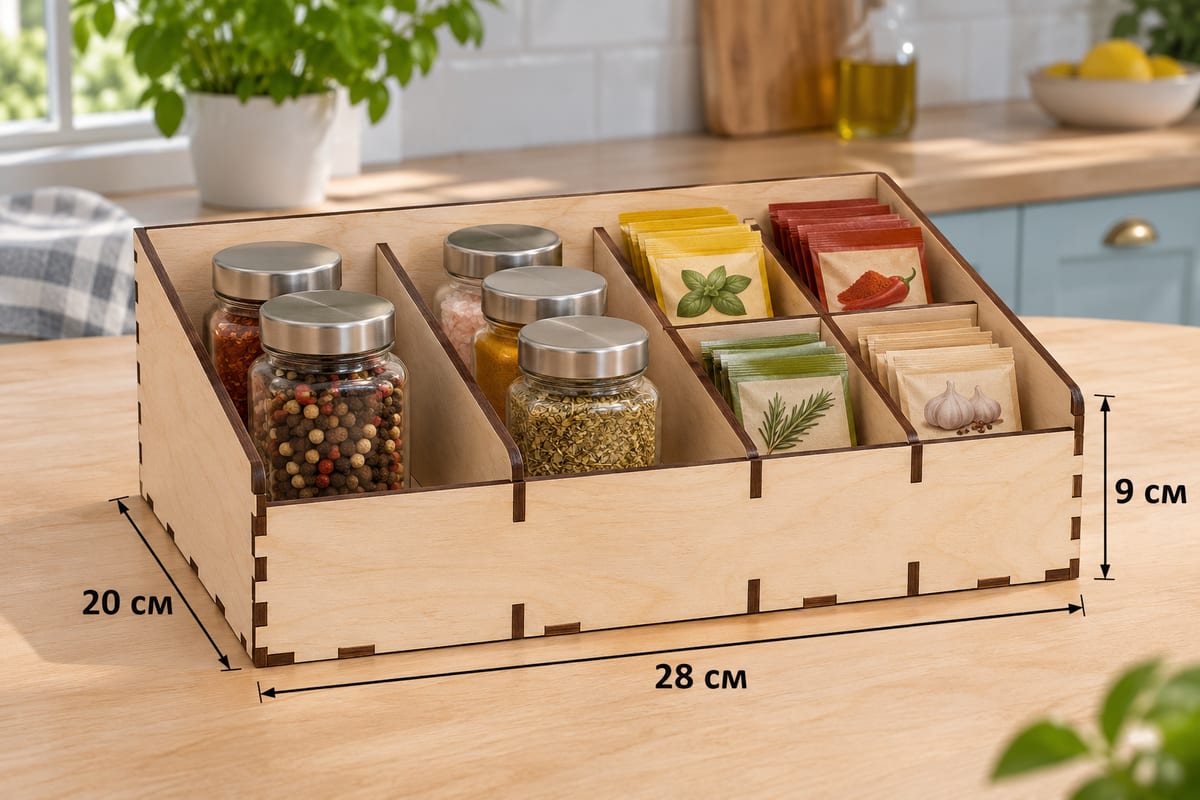 Spice Lanes with Packet PocketsOuter size (W × D × H) 280 × 200 × 90 mm (11.02 × 7.87 × 3.54 in)Parts 10Est. time, 10 W diode (3 mm) 22 min 03 sEst. time, 40 W CO2 (3 mm) 9 min 11 sSVG · DXF →
Two long lanes for jars and a block of four small pockets for packets. A good choice if you cook with both but mostly use jars.
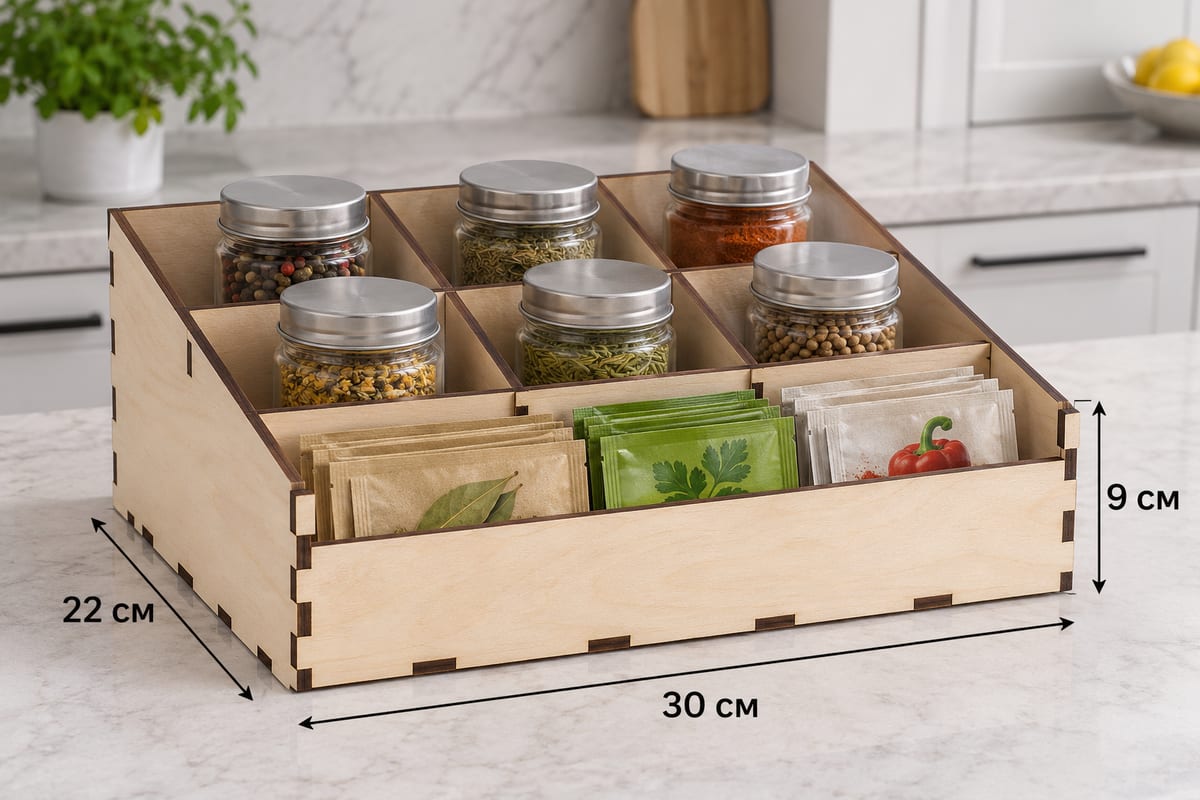 Deep Spice Jar and Sachet OrganizerOuter size (W × D × H) 300 × 220 × 90 mm (11.81 × 8.66 × 3.54 in)Parts 10Est. time, 10 W diode (3 mm) 23 min 36 sEst. time, 40 W CO2 (3 mm) 9 min 50 sSVG · DXF →
Three long back compartments for jars and three shallow front ones for sachets. The front pockets are low, so packets stand upright and you flip through them like cards.
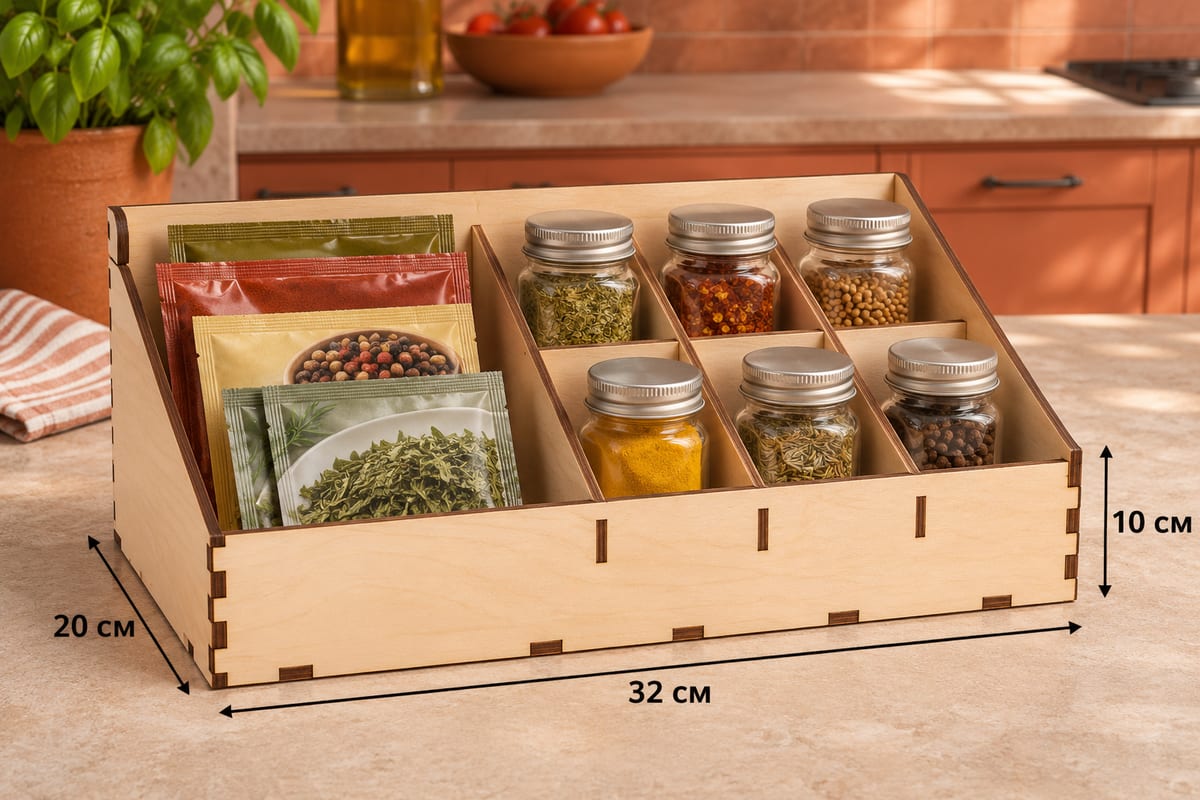 Seasoning Pouch and Jar CaddyOuter size (W × D × H) 320 × 200 × 100 mm (12.60 × 7.87 × 3.94 in)Parts 11Est. time, 10 W diode (3 mm) 24 min 51 sEst. time, 40 W CO2 (3 mm) 10 min 21 sSVG · DXF →
One wide bay for big seasoning pouches and six small cells for jars, seven compartments in all. It suits people who buy spices in bags and refill jars from them.
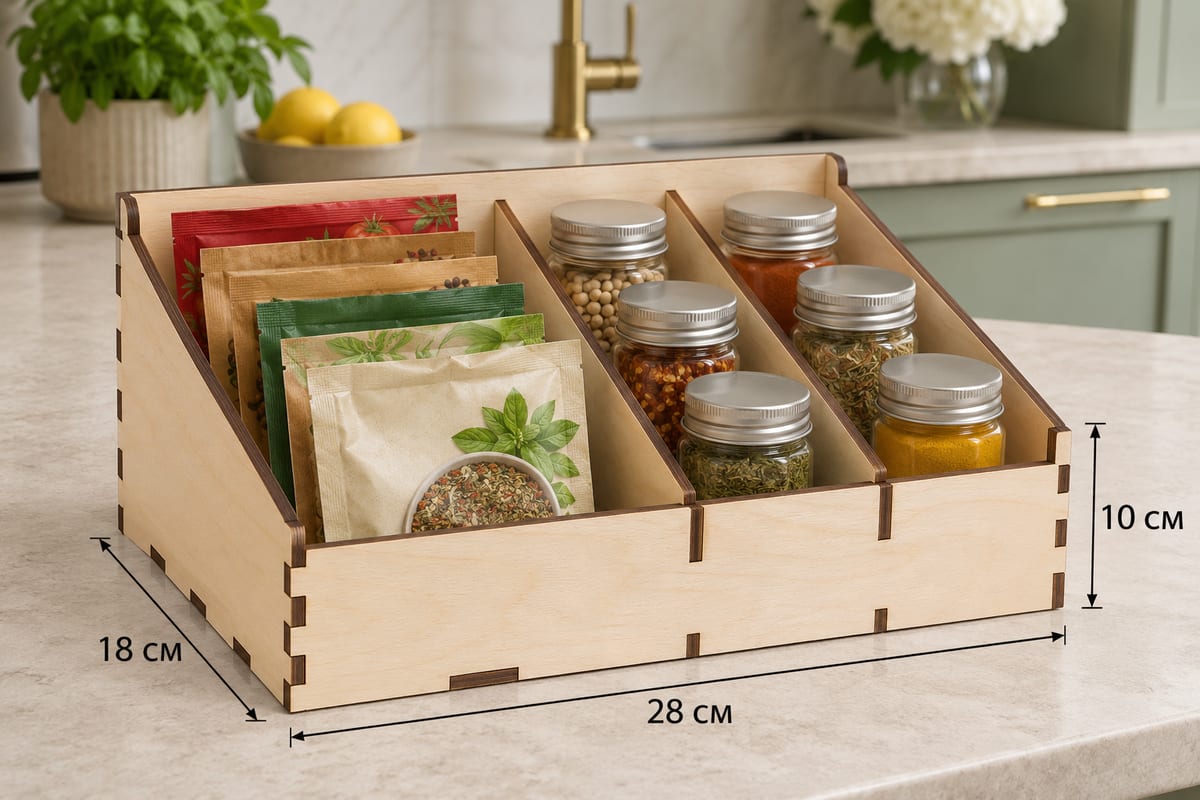 Tall 3-Lane Spice and Packet BoxOuter size (W × D × H) 280 × 180 × 100 mm (11.02 × 7.09 × 3.94 in)Parts 7Est. time, 10 W diode (3 mm) 16 min 43 sEst. time, 40 W CO2 (3 mm) 6 min 58 sSVG · DXF →
Only seven parts and two full-depth dividers: three tall lanes for packets and small jars. Quick to cut and a good first project.
Common mistake: putting a spice organizer right next to the stove. Heat and steam are bad for spices and for bare plywood. Keep it on a shelf or in a drawer away from the hob, and varnish it if it lives near the sink.
Plywood thickness and finish for a kitchen
Every download has four versions, and each one only fits its own sheet thickness: slot width matches the material.
| Thickness | Best for | Note |
|---|---|---|
| 3 mm | Small trays, shelf boxes | Fast on a 10 W diode, light |
| 4 mm | Everyday kitchen boxes | A good balance of weight and strength |
| 5 mm | Big trays with many jars | Glass jars are heavy, thicker walls help |
| 6 mm | The 12-cell tray, a drawer insert | Usually several passes on a diode |
A kitchen is a damp place, so the finish matters more than for a decoration. Sand the edges, remove the soot around the cuts and apply two thin coats of clear varnish or hard wax oil. The jars touch the box, the spices do not, so this is about protecting the wood, not food contact.
How to cut a spice organizer
- Measure your plywood with calipers and download the version for that thickness.
- Cut one test joint from scrap. If the tab is loose, read about kerf and compensate.
- Cut all parts; split long layouts into runs that fit your bed.
- Assemble the dividers into the base, then add the back, the sides and the front.
- Glue the outer corners if the box will be moved often.
- Finish and let it dry for a day before the jars go in.
For settings, see laser power for 3 mm plywood. If you want a spice box with a lid, the finger joint box guide explains the joints. More kitchen ideas are in the tea and coffee organizers and condiment organizers.
Next step: count your jars and packets, pick the file with the right number of lanes, and cut the test joint tonight. Tomorrow's dinner will start with the paprika exactly where you expect it.
Questions and answers
What is the best size for a laser cut spice rack?
Measure the shelf or drawer first. The files here range from 240 × 160 mm to 360 × 100 mm and 320 × 240 mm; leave about 1–2 cm of space around the box so it slides in easily.
What plywood thickness should I use for a spice organizer?
3–4 mm plywood works for small trays and shelf boxes. For big trays full of glass jars, 5–6 mm is sturdier. Always cut the version that matches your measured sheet.
Will standard spice jars fit these organizers?
Jar sizes vary by brand, so check the cell sizes on each file page against your biggest jar. Lane organizers are the most forgiving because jars stand in a row without cross dividers.
How long does it take to laser cut a spice rack?
In 3 mm plywood the files here take about 17–33 minutes on a 10 W diode and roughly 7–14 minutes on a 40 W CO2, plus time for assembly and finishing.
How do I protect a plywood spice organizer in the kitchen?
Sand it and apply two thin coats of clear varnish or hard wax oil, and keep it away from the stove and direct steam.