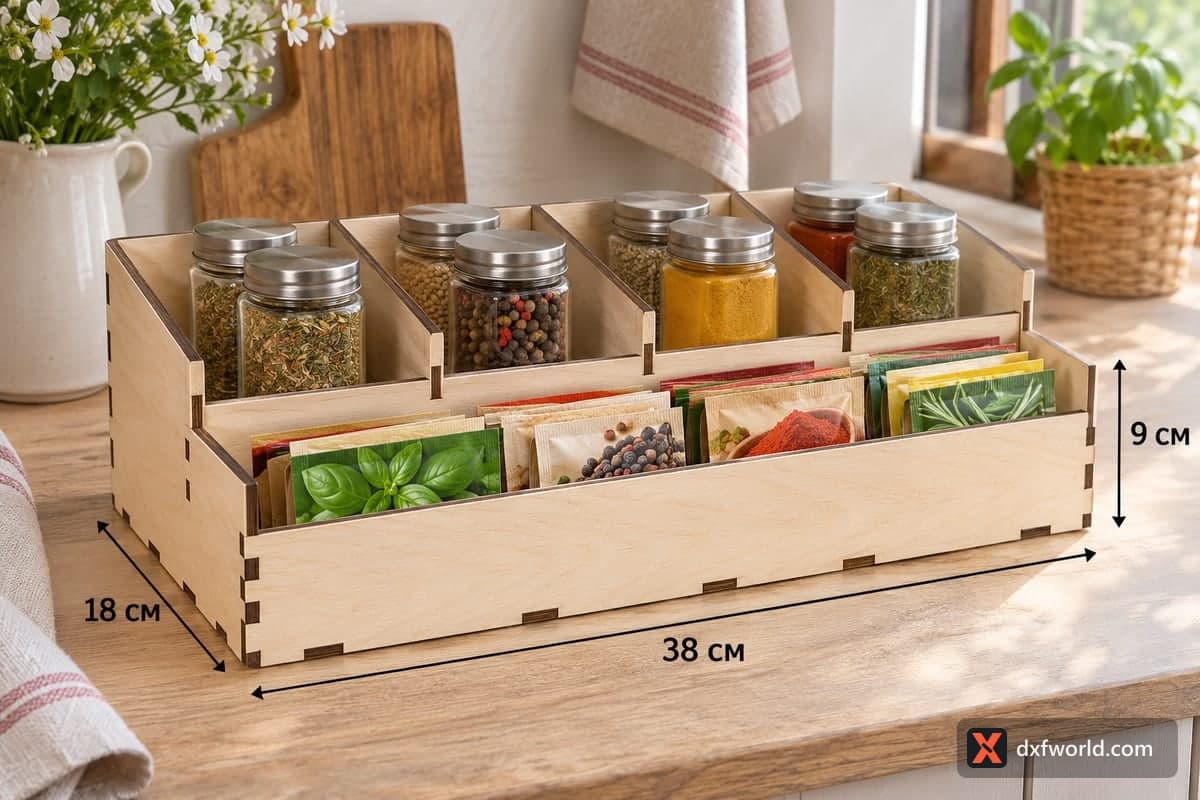
 Visualization
Spice Jar and Seasoning Packet Tray DXF, Four Cell Two Level Spice Caddy Laser Cut File, Packet Trough SVG
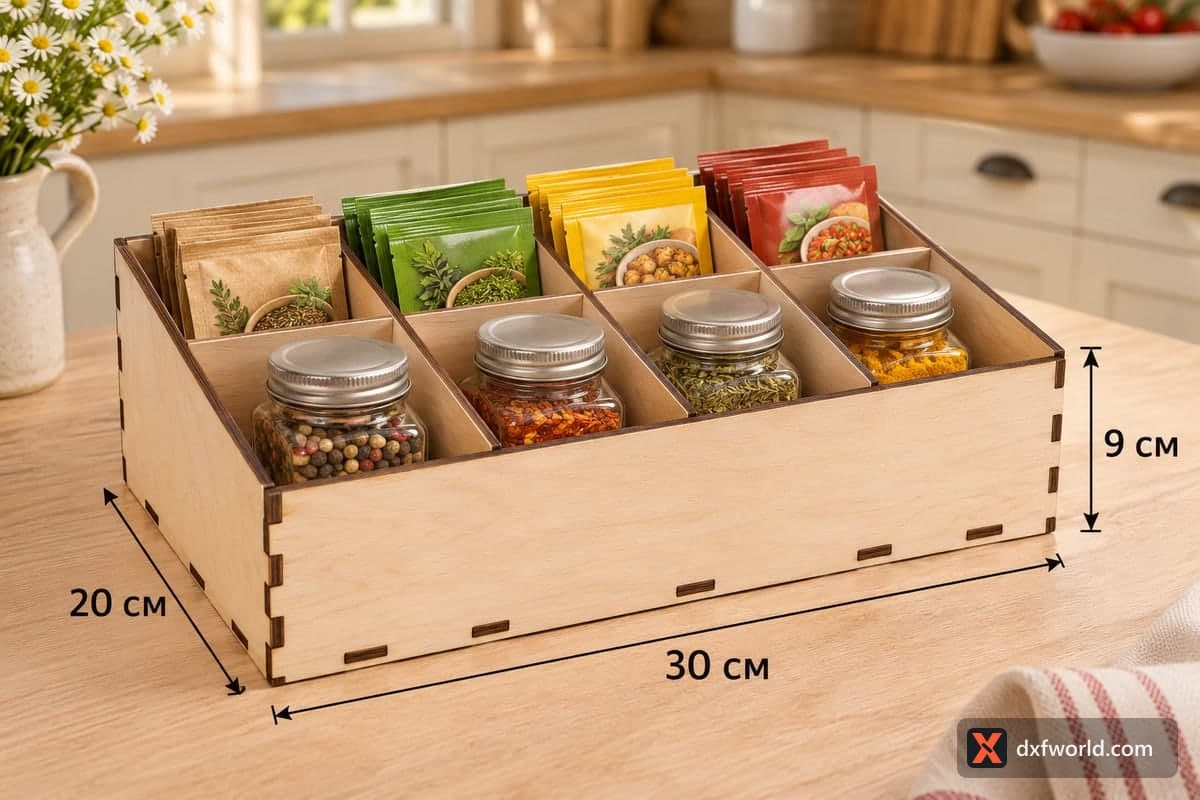
A free laser cut file for a spice organizer with 5 compartments: four tall cells along the back for jars and one long, low trough across the front for seasoning packets. It measures 380 × 180 × 90 mm (14.96 × 7.09 × 3.54 in), the sides drop to a 50 mm front, and the 9 pieces fit together with tabs and slots. Your download includes matching SVG and DXF files sized for 3, 4, 5 and 6 mm plywood.
- Formats
- SVG, DXF
- Outer size (W × D × H)
- 380 × 180 × 90 mm (14.96 × 7.09 × 3.54 in)
- Parts
- 9
- Material thickness
- 3, 4, 5 or 6 mm plywood (a file for each)
- Layout size (3 mm file)
- 1,524 × 282 mm
- Cut length
- 6.96 m
- Est. time, 10 W diode (3 mm)
- 23 min 13 s
- Est. time, 40 W CO2 (3 mm)
- 9 min 40 s
- Layers
- CUT only, no engraving
Free account required to download
How to make it
- 01Choose the file for your plywood (3, 4, 5 or 6 mm) and test-cut a single divider to make sure it drops into the base slots without forcing.
- 02Cut the 9 parts, splitting the 1524 mm layout over several sheets when your bed is smaller.
- 03Fit the back, both stepped sides and the base, press in the low front, then add the long cross divider and finish with the three back dividers.
- 04Sand the step corners on the side panels, finish with clear oil or lacquer and fill the back cells with jars and the trough with packets.
Four jar cells and one long trough
Three dividers, 90 mm high and 108.6 mm long, split the back of the box into four equal cells about 94 mm wide. A single cross divider, 65.7 mm high, closes them off from the front, and everything in front of it is one open trough running the full 380 mm length. In the photo each back cell holds two tall square jars with steel lids (mixed herbs, peppercorns, coriander, turmeric and chili), and the trough keeps a long row of seed and spice packets standing on edge, where you can flick through them like index cards.
The side panels rise to 90 mm at the back, ease down slightly over the jar cells and then step down to the 50 mm front wall. The low front means packets are easy to pull out, while the taller back keeps jars from tipping.
Laser bed and cutting time
The pieces are laid out on a 1524 × 282 mm strip for the 3 mm version, longer than most hobby beds, so plan to spread them over two or three sheets; the base alone is 380 × 180 mm. Expect about 23 min 13 s on a 10 W diode, about 9 min 40 s on a 40 W CO2 and about 4 min 39 s on a 100 W CO2 for the 3 mm file. Thicker 5 or 6 mm plywood needs a stronger machine or several passes on a diode.
Selling it and making a set
This one suits a seed swap or garden stall as much as a kitchen: jars of dried herbs at the back, seed packets in front. Pair it with a smaller tray from the same category for a matching countertop set, or engrave a herb name above each cell yourself before you sell it. Brush on clear oil so the birch shrugs off sticky fingers.
Questions about this file
How many jars fit in the back cells?
Each cell is about 94 mm wide and 108 mm deep, so two small square jars stand side by side, as in the photo. One larger round jar per cell also fits.
Will standard seasoning packets fit in the front trough?
The trough is around 66 mm deep from front wall to cross divider and runs the whole 380 mm length, so flat packets stand upright in a row. Tall packets rise above the 50 mm front, which makes them easier to grab.
Can I scale it to fit a deeper drawer?
You can, but resize the box and then restore every slot to the actual sheet thickness, otherwise the tabs fit loosely or not at all.
Should I glue it?
Not necessarily: the tabs lock firmly when the plywood matches the file. Glue the walls to the base if it will be carried around full, and keep the dividers dry if you like to tweak them.
Is there a way to label each jar cell?
Yes. Add text over each cell in your laser software as an engraving layer before cutting, or stick on chalkboard labels afterwards.
Similar files