 Visualization
Sliding Lid Utensil Box SVG, Wooden Flatware Case With Chopstick Slot Laser Cut File, Covered Cutlery Tray DXF
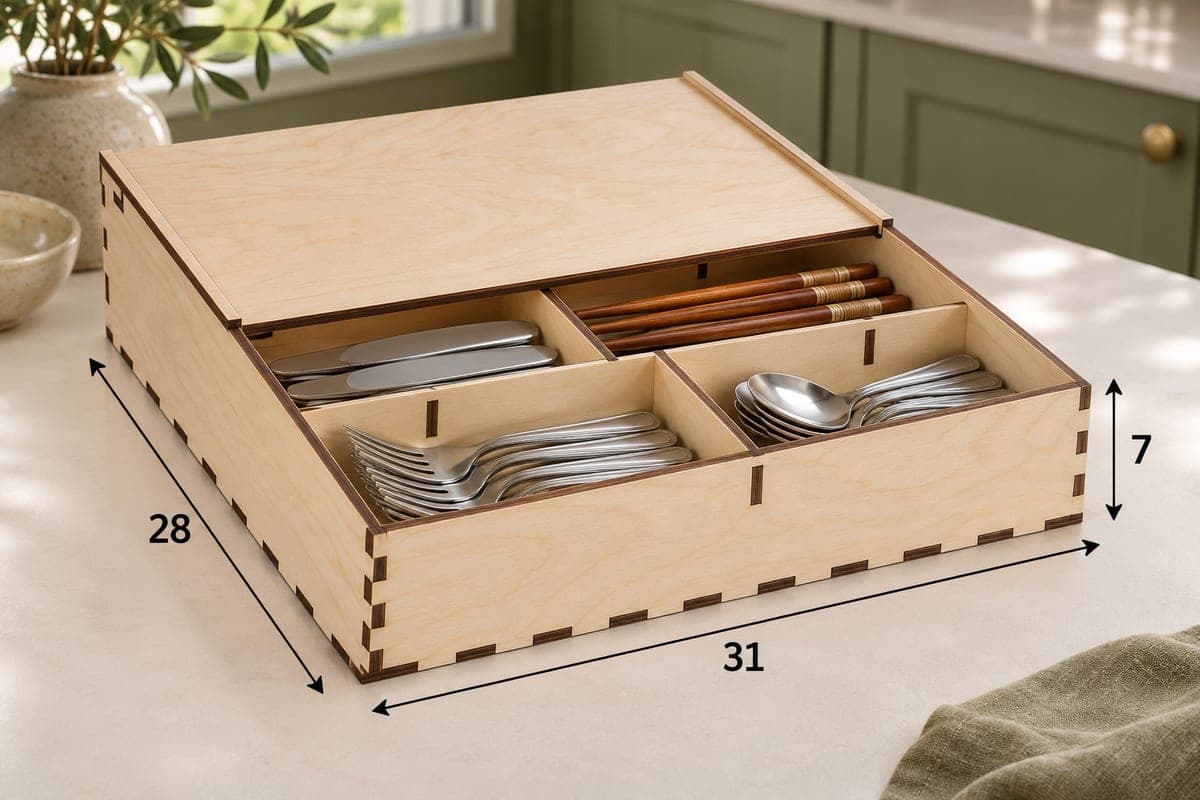
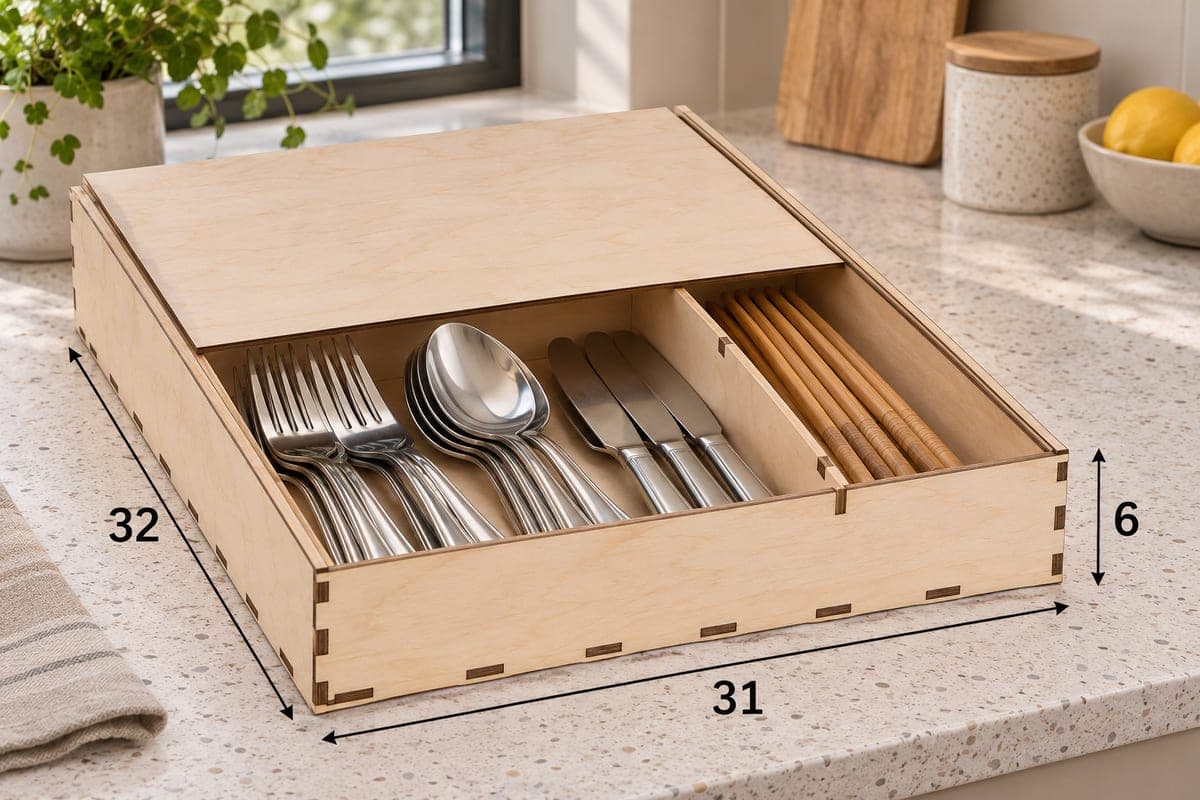
A shallow utensil box with a sliding lid on two rails and two sections inside: a wide bay for mixed cutlery and a narrow slot down one side. It measures 310 × 320 × 60 mm (12.20 × 12.60 × 2.36 in), uses 9 plywood pieces that lock together with tabs and slots, and is a free SVG and DXF download with separate files for 3, 4, 5 and 6 mm plywood. There is no hinge or lock.
- Formats
- SVG, DXF
- Outer size (W × D × H)
- 310 × 320 × 60 mm (12.20 × 12.60 × 2.36 in)
- Parts
- 9
- Material thickness
- 3, 4, 5 or 6 mm plywood (a file for each)
- Layout size (3 mm file)
- 1,280 × 716 mm
- Cut length
- 9.76 m
- Est. time, 10 W diode (3 mm)
- 32 min 32 s
- Est. time, 40 W CO2 (3 mm)
- 13 min 34 s
- Layers
- CUT only, no engraving
Free account required to download
How to make it
- 01Download the file set for your sheet thickness and cut a single wall corner first to check the tab fit.
- 02Cut the base and lid on their own sheets if needed, then the four walls, the long divider and the two rails.
- 03Assemble walls and base, set the divider so it makes one wide and one narrow bay, then glue the rails with the lid in its track and paper spacers.
- 04Pull out the spacers, rub candle wax on the lid edges, finish with oil and lay chopsticks in the slim bay.
One wide bay and one narrow slot
A single divider runs from front to back and splits the box unevenly. The large bay in the photo takes forks, spoons and table knives lying side by side, and the slim bay on the right holds a row of bamboo chopsticks. You could use that narrow side for steak knives, pastry forks or a set of skewers instead. The box is almost square and only 60 mm tall, so it slips into a drawer or stacks on a pantry shelf.
The lid slides in along two rails on the inside of the side walls. The front wall is 53.7 mm high instead of 60 mm, which leaves the opening the 303.4 × 319.7 mm lid passes through. In the photo the lid is pulled about a third of the way out, enough to reach the front of both bays.
Cutting and fitting the lid
The 3 mm layout covers 1280 × 716 mm because the base and the lid are both large panels. On a small machine cut those two on separate sheets and nest the walls, rails and divider around them. Cutting time for the 3 mm file is about 32 min 32 s with a 10 W diode, about 13 min 34 s with a 40 W CO2 or about 6 min 30 s with a 100 W CO2.
Build the walls on the base first and add the divider. Then glue the two 317 mm rails in with the lid already sitting in its track, using a sheet of printer paper on each side as a spacer, so it runs freely once dry.
Gift and sales ideas
- A sushi night gift with lacquered chopsticks in the slim bay.
- A camping or picnic cutlery case that keeps dust off.
- Engrave initials on the lid for a personalised wedding present.
Questions about this file
Why is the front wall shorter than the back?
That lower edge is where the lid exits. The front is 53.7 mm high and the other walls are 60 mm, which gives the lid room to pass.
How wide is the narrow section?
It is a slim side bay sized for chopsticks lying flat, roughly a quarter of the inner width. Forks and spoons go in the wide bay next to it.
My lid sticks. What can I do?
Sand the long lid edges lightly and rub them with wax. Swelling from humidity is the usual cause, so a coat of finish on the lid helps too.
Can I cut the lid from acrylic?
A 3 mm clear acrylic lid works and lets you see the cutlery inside. Cut the box from the 3 mm file so the rail gap matches.
Is 6 mm plywood too heavy for this box?
It works but makes a heavy lid that drags in the rails. 3 or 4 mm is the better choice for a box you open every day.
Similar files