 Visualization
Utensil Drawer Tray SVG, Five Compartment Flatware Organizer Laser Cut File, Wide Wooden Silverware Insert DXF
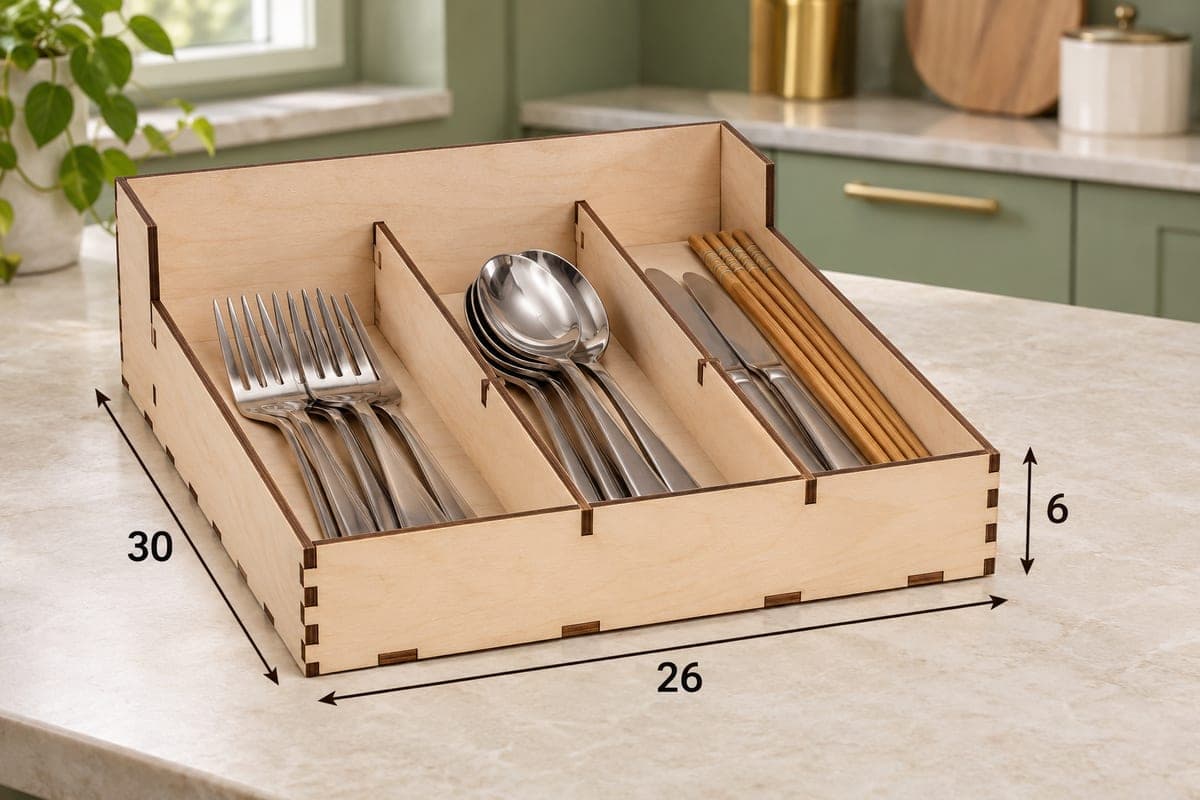
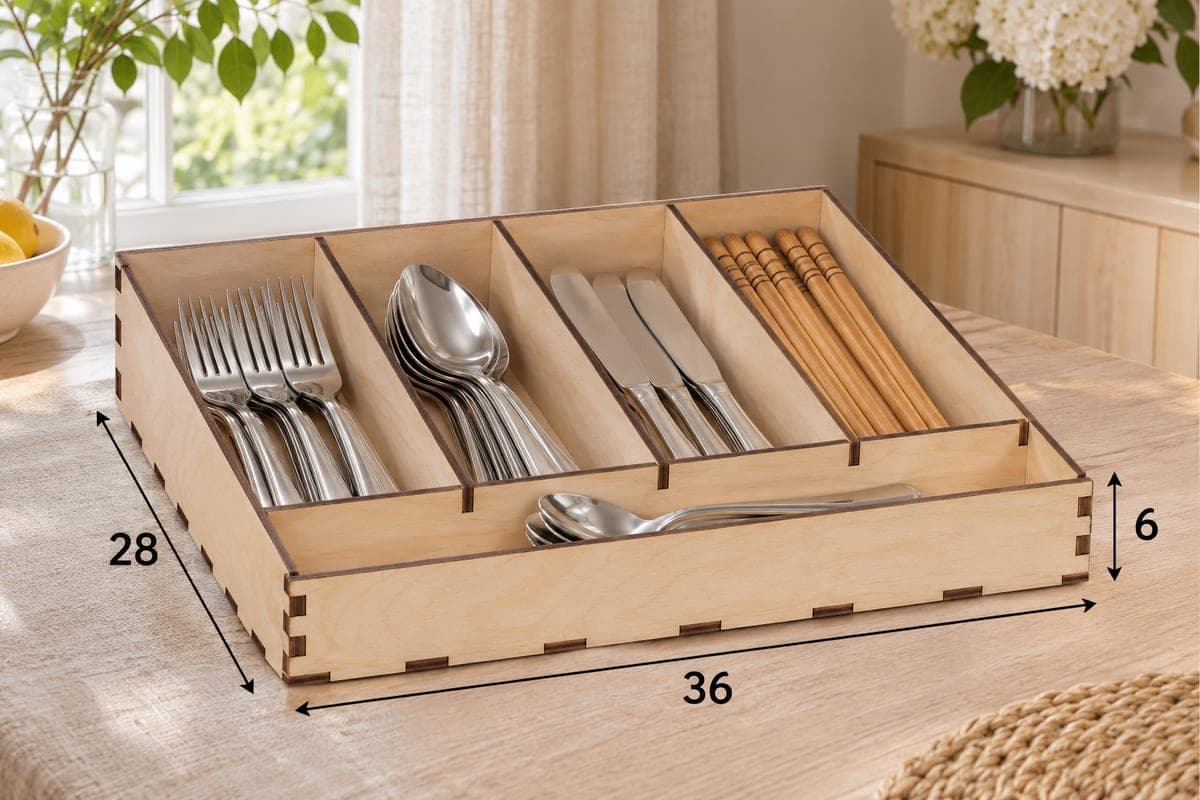
An open utensil tray with four long bays at the back and one lane that runs the full width of the front, five compartments in all. It measures 360 × 280 × 60 mm (14.17 × 11.02 × 2.36 in), is cut from 9 plywood pieces that join with tabs and slots, and comes as a free SVG and DXF download with separate files for 3, 4, 5 and 6 mm plywood. All four walls are the same 60 mm height.
- Formats
- SVG, DXF
- Outer size (W × D × H)
- 360 × 280 × 60 mm (14.17 × 11.02 × 2.36 in)
- Parts
- 9
- Material thickness
- 3, 4, 5 or 6 mm plywood (a file for each)
- Layout size (3 mm file)
- 1,412 × 352 mm
- Cut length
- 8.11 m
- Est. time, 10 W diode (3 mm)
- 27 min 02 s
- Est. time, 40 W CO2 (3 mm)
- 11 min 16 s
- Layers
- CUT only, no engraving
Free account required to download
How to make it
- 01Pick the SVG or DXF for the plywood you have, then cut one wall slot and check that a scrap of the same sheet slides in snugly.
- 02Cut the base and four walls first, then the 360 mm cross divider and the three 222.8 mm bay dividers.
- 03Join the walls around the base, then fit the three bay dividers into the cross divider and lower that assembly into the tray.
- 04Sand the top edges, wipe on food-safe oil and load forks, spoons, knives and chopsticks into the back bays with serving pieces in front.
How the five compartments are split
One cross divider runs the whole 360 mm width and separates a shallow front lane from the main storage area. Behind it, three dividers of 222.8 mm divide the back into four equal bays that run front to back. In the photo the bays hold dinner forks, soup spoons, table knives and a bundle of bamboo chopsticks, while the front lane carries a few spoons lying sideways. That lane is handy for things that do not fit the long bays: serving spoons, a cake server, a ladle laid flat or teaspoons you grab every morning.
At 360 mm wide this tray suits a standard 40 cm kitchen drawer with room to lift it out. The straight 60 mm walls keep it low enough for most drawers and still deep enough to stop forks sliding over the top.
Cutting and fitting the pieces
The 3 mm layout is 1412 × 352 mm, a long strip because the base is 360 × 280 mm and the walls line up beside it. A small diode laser bed will not take that in one go, so split it: base on one sheet, walls and dividers on a second. Cutting time for the 3 mm file is about 27 min 02 s on a 10 W diode, about 11 min 16 s on a 40 W CO2 and about 5 min 24 s on a 100 W CO2. Plan for two passes on a diode with 5 or 6 mm stock.
Slot the three short dividers into the long cross divider before you drop the set into the walls. Glue is optional; the joints hold on their own once the base is in.
Ideas to sell or give
- Pair it with a boxed cutlery set as a housewarming gift.
- Offer it in three thicknesses at a craft fair so buyers can match their drawer depth.
- Oil it and fill the front lane with wooden serving spoons for a ready-made kitchen bundle.
Questions about this file
What goes in the front lane?
It runs the full 360 mm width, so long flat items like serving spoons, a pie server or a pair of tongs lie across it. Teaspoons also fit if you want them apart from the soup spoons.
Will this tray fit my cutlery drawer?
Measure the drawer inside: you need at least 360 mm across, 280 mm front to back and a little more than 60 mm of height. If your drawer is smaller, scale the whole file down and keep the slot width at your sheet thickness.
Is MDF a workable swap for the plywood here?
Yes, 3 or 4 mm MDF cuts cleanly, but seal it well because bare MDF swells when wet cutlery goes in.
Which plywood thickness works best for a drawer?
4 mm is a good middle ground: stiff enough for heavy forks and still light. 6 mm walls eat a little of the inner space of each bay.
Should I glue the dividers?
Leave them loose if you might want to lift them out for cleaning. A drop of wood glue in each slot makes the tray rigid for good.
Similar files