 Visualization
Six Pocket Cutlery Tray SVG, Kitchen Counter Silverware Organizer Laser Cut File, Two Row Flatware Box DXF
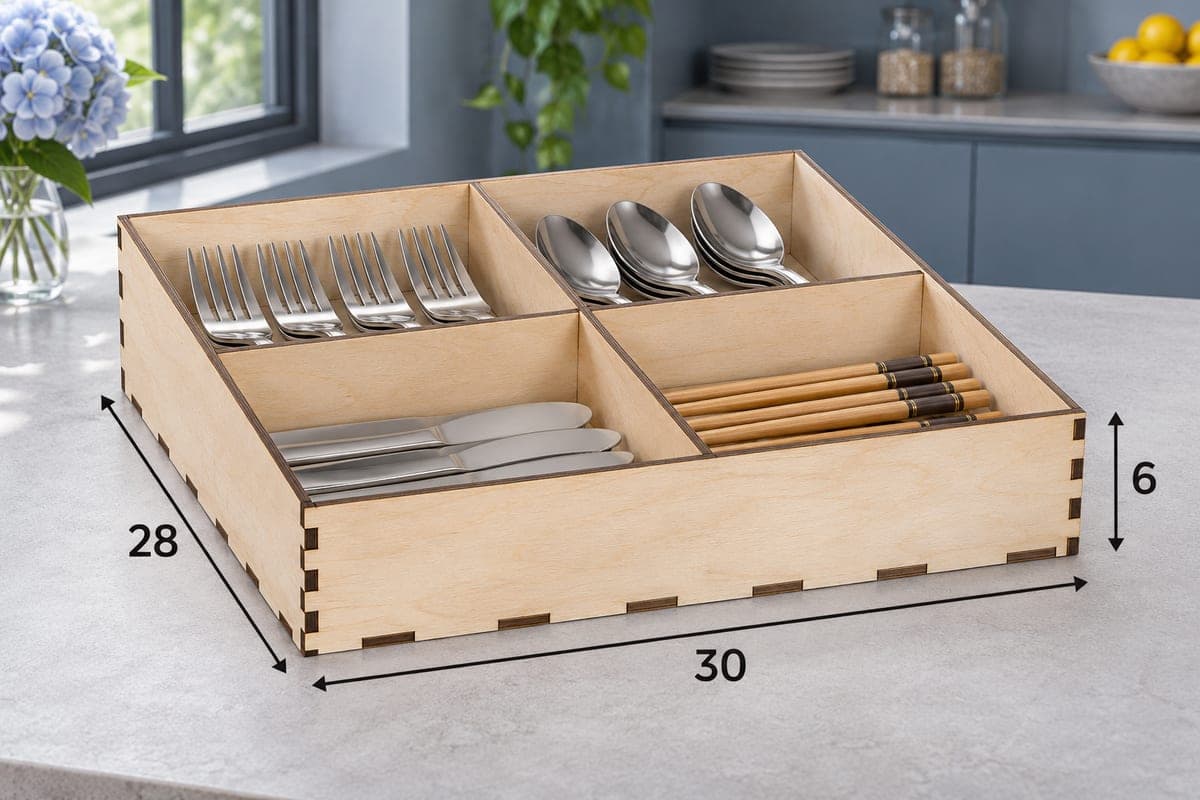
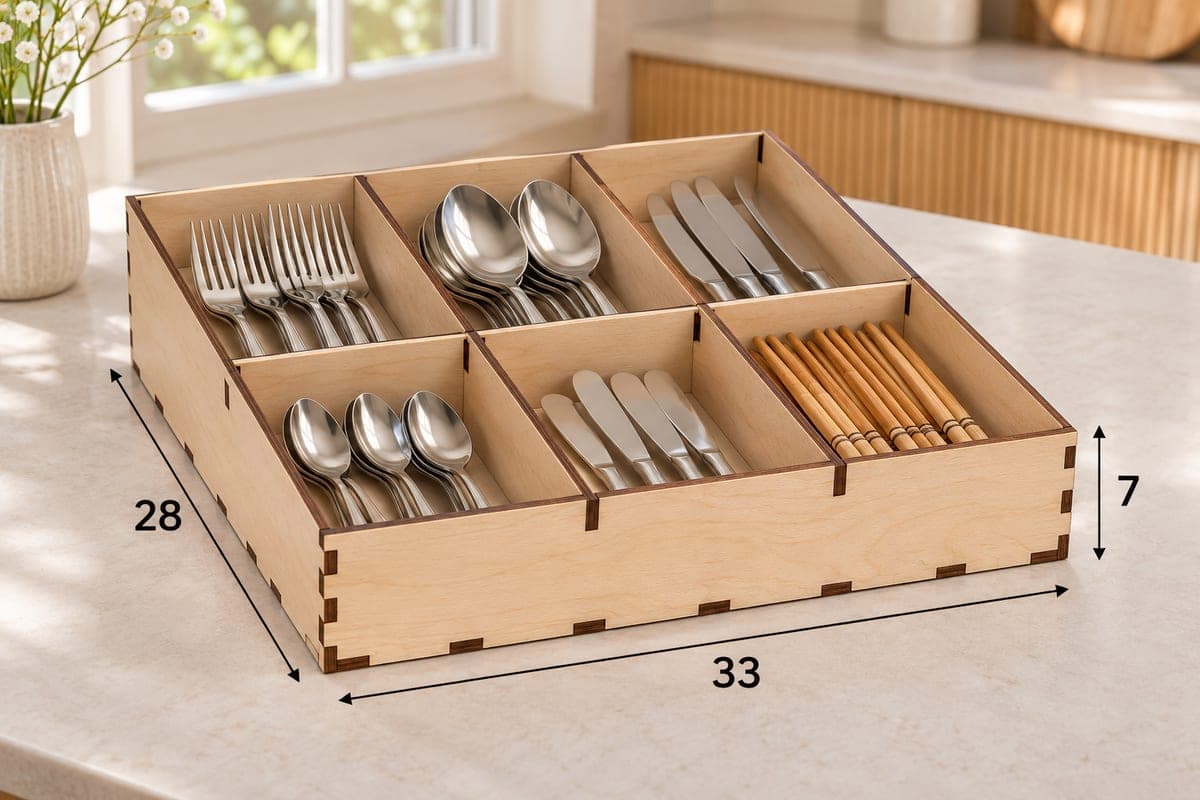
An open cutlery tray with six pockets in two rows of three, sized for a kitchen counter, dining sideboard or a wide drawer. It measures 330 × 280 × 70 mm (12.99 × 11.02 × 2.76 in), is built from 10 plywood pieces that lock together with tabs and slots, and is a free SVG and DXF download with separate files for 3, 4, 5 and 6 mm plywood.
- Formats
- SVG, DXF
- Outer size (W × D × H)
- 330 × 280 × 70 mm (12.99 × 11.02 × 2.76 in)
- Parts
- 10
- Material thickness
- 3, 4, 5 or 6 mm plywood (a file for each)
- Layout size (3 mm file)
- 1,248 × 362 mm
- Cut length
- 7.90 m
- Est. time, 10 W diode (3 mm)
- 26 min 19 s
- Est. time, 40 W CO2 (3 mm)
- 10 min 58 s
- Layers
- CUT only, no engraving
Free account required to download
How to make it
- 01Choose the file for your sheet thickness and cut a corner and one divider slot to check the joint before the full run.
- 02Cut the 330 × 280 mm base, the four 70 mm walls, the long cross divider and the four short dividers.
- 03Press the walls onto the base, set the cross divider in the middle, then add two short dividers to each half to form six pockets.
- 04Sand all top edges, seal the tray with clear lacquer and set out forks, spoons, knives and chopsticks.
Room for a full table setting
Six pockets mean every piece of a place setting can have its own spot. A full-width cross divider runs across the middle, and two short dividers stand in each half, giving three pockets at the back and three at the front. In the photo the back row holds dinner forks, soup spoons and table knives, while the front row takes dessert spoons, butter knives and a stack of bamboo chopsticks. With 330 mm of width it is the widest open tray in this group, so the pockets are roomy enough for heavier restaurant-style flatware.
All walls are straight and 70 mm tall, so the tray stands square on a counter and lifts out of a drawer without tipping.
Laser settings and layout
The 3 mm sheet is 1248 × 362 mm with 7896 mm of cut line. Plan on about 26 min 19 s with a 10 W diode, about 10 min 58 s with a 40 W CO2 or about 5 min 16 s with a 100 W CO2 for the 3 mm file. The base is 330 × 280 mm, which is wider than many 300 mm diode beds, so check your work area before you start or scale the whole file slightly. A diode cuts 3 mm in one or two passes; 5 or 6 mm needs a stronger tube or several slower passes.
Selling and gifting ideas
- List it as a kitchen counter cutlery caddy for small apartments without a cutlery drawer.
- Bundle it with a set of chopsticks for a new-home gift.
- Cut it from 6 mm plywood and finish it in hard wax oil for a cafe self-service counter.
Questions about this file
Will it fit on a 300 mm laser bed?
The base is 330 mm wide, so it will not fit a 300 mm bed as is. Scale the file to about 90% and keep slot widths equal to your material.
How big is each pocket?
Each pocket is a little over 100 mm wide and about 135 mm deep inside. That holds a dozen forks or spoons lying flat.
Plywood or MDF for a counter tray?
Birch plywood is stronger at the thin tabs and copes better with damp cutlery. MDF works if you seal it fully before use.
Do the dividers need glue?
They hold by friction in the slots. Add a drop of wood glue only if the tray will be carried around a lot.
Can I add a name or monogram?
The file has cut lines only. You can add your own engraving to the front wall before cutting, since it is a plain 330 × 70 mm panel.
Similar files