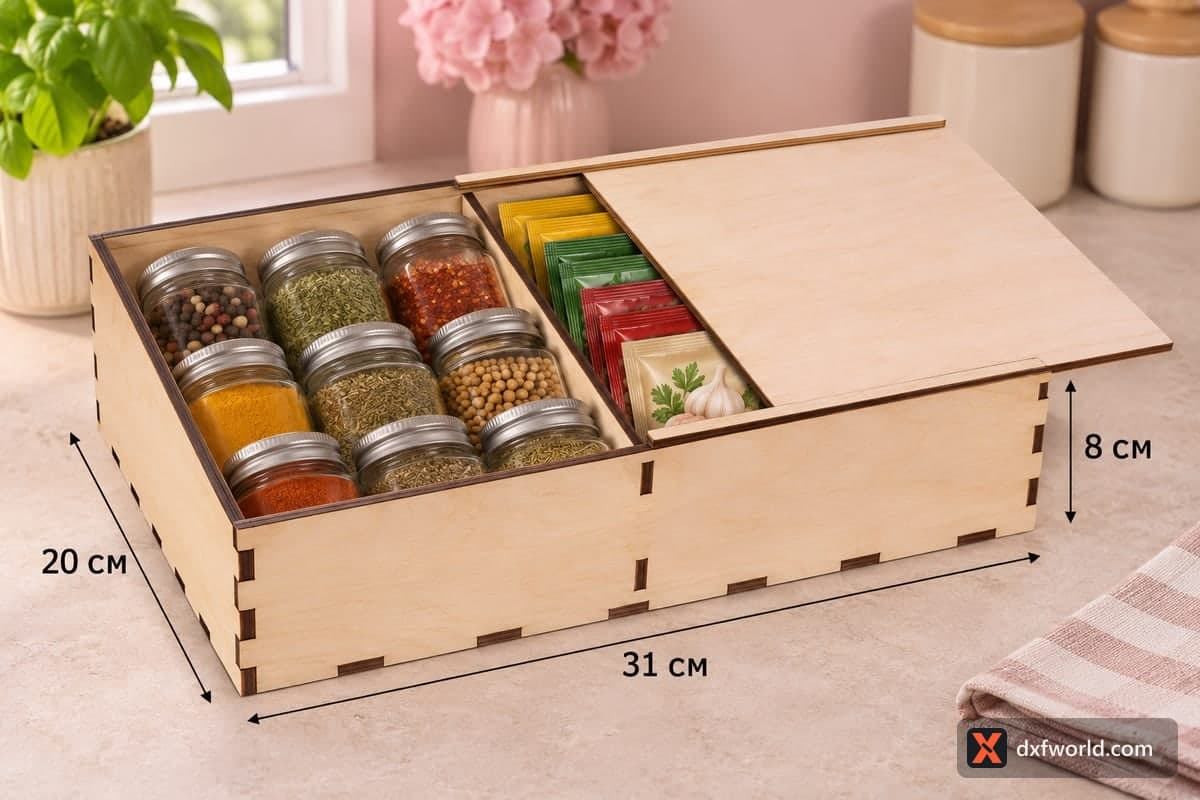
 Visualization
2 Section Sliding Lid Spice Box SVG, Spice Jar and Packet Box Laser Cut File, Slide Top Seasoning Box DXF
A free laser cut file for a spice box with a sliding lid and two sections: a large one for jars and a narrow one for seasoning packets. It measures 310 × 200 × 80 mm (12.20 × 7.87 × 3.15 in), is cut from 9 plywood pieces that assemble with tabs and slots, and the lid runs on two thin rails with no hinge or lock. It comes as SVG and DXF, with its own file for 3, 4, 5 and 6 mm plywood.
- Formats
- SVG, DXF
- Outer size (W × D × H)
- 310 × 200 × 80 mm (12.20 × 7.87 × 3.15 in)
- Parts
- 9
- Material thickness
- 3, 4, 5 or 6 mm plywood (a file for each)
- Layout size (3 mm file)
- 1,225 × 292 mm
- Cut length
- 7.67 m
- Est. time, 10 W diode (3 mm)
- 25 min 34 s
- Est. time, 40 W CO2 (3 mm)
- 10 min 39 s
- Layers
- CUT only, no engraving
Free account required to download
How to make it
- 01Select the file for your plywood thickness and cut one rail plus a lid corner from scrap to check the sliding clearance.
- 02Cut all nine pieces; keep the lid flat on a board while it cools so it does not warp.
- 03Build the base, back, sides and lower front, push the divider into place, then fix a rail along the top inside each side wall.
- 04Slide the lid in to test it, sand any tight spot on its edges, wax the rails and load jars left and packets right.
Jars on one side, packets on the other
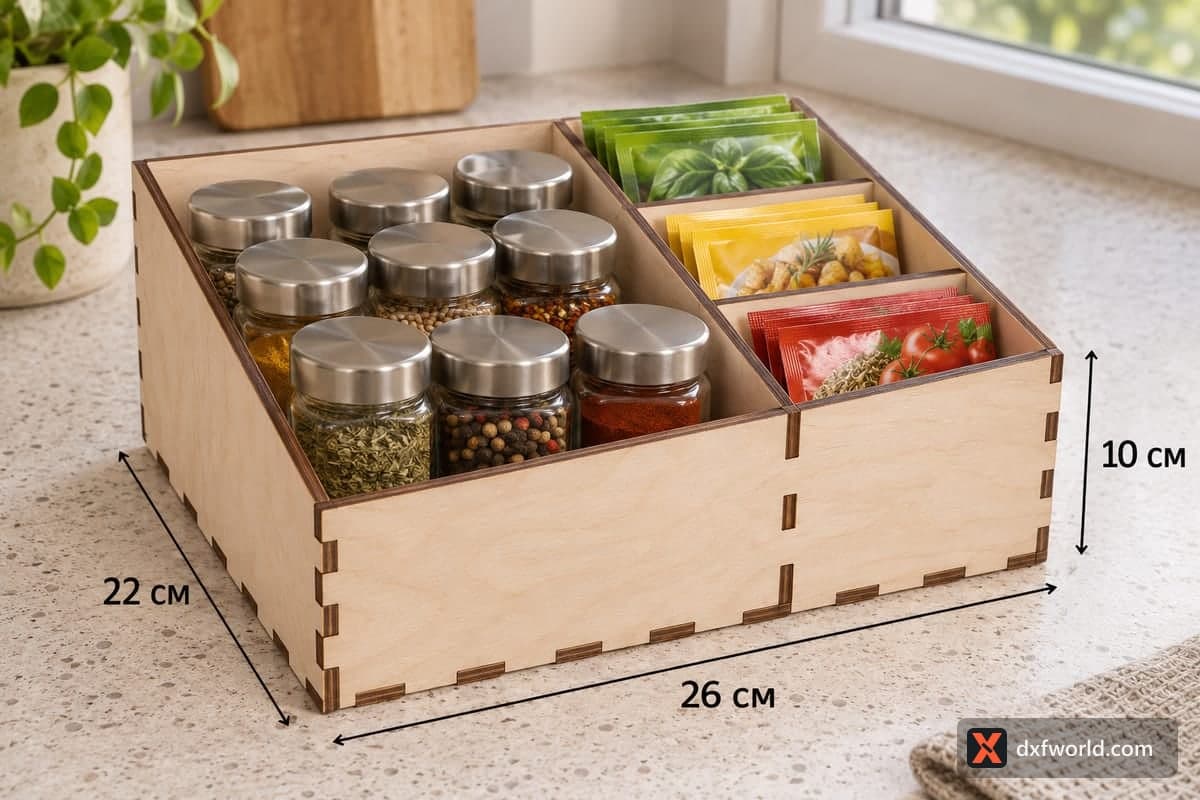
One long divider runs from front to back and splits the box into two sections. In the photo the larger left section takes nine small jars with silver screw lids in three rows of three: peppercorn mix, dried herbs, chili flakes, turmeric, oregano, coriander, paprika and more. The narrow right section holds flat seasoning packets standing on edge, green, red and yellow, with a garlic blend at the front.
The lid is a single flat panel that slides along two rails fitted inside the side walls, and the front wall is a few millimetres lower than the back to let it pass. Slide it part way to reach the packets while the jars stay covered, or pull it off to fill the box. Covered spices stay out of dust and direct light.
Cutting and fitting the lid
The nine pieces are front, back, two sides, base, divider, two rails and the lid. Cutting time for the 3 mm file is about 25 min 34 s with a 10 W diode, about 10 min 39 s on a 40 W CO2 and about 5 min 07 s on a 100 W CO2. The 3 mm layout is 1225 × 292 mm; on a smaller bed cut the base and lid on one sheet and the walls on another. Fix the rails level on both sides (a thin line of wood glue keeps them put) and test the lid before the glue sets: it should move with a light push. A little paste wax on the rails keeps it gliding.
As a gift
Fill it with nine favourite spices and a stack of blend packets for a new kitchen. Engrave a name or a short recipe on the lid as your own extra layer.
Questions about this file
What keeps the sliding lid on the box?
It rests on two narrow rails inside the side walls and slides in over the slightly lower front. There is no hinge or catch, so carry the box level.
Which thickness gives the smoothest sliding lid?
3 or 4 mm birch plywood is lightest and slides most easily. Use the matching file, since rail spacing is set for that thickness.
The lid sticks. What can I do?
Sand the lid edges slightly and rub candle wax or paste wax on the rails. Swelling from kitchen humidity is the usual cause, so seal the lid as well.
Can I resize it for bigger jars?
Make taller walls and a deeper divider in the drawing rather than scaling the file. Scaling changes slot widths, which must stay equal to your plywood thickness.
What finish suits a spice box?
A food-safe oil or a clear water-based lacquer protects it from splashes. Keep finish off the rails or wax them afterward.
Similar files