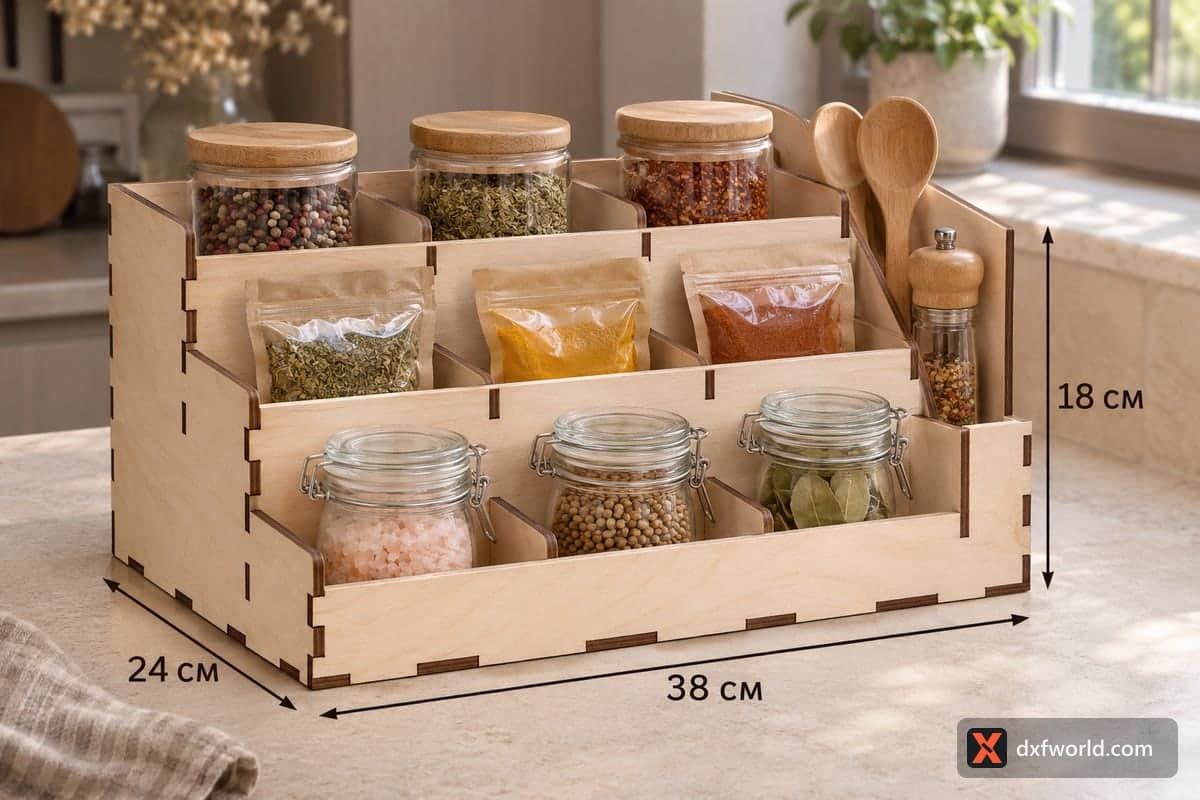
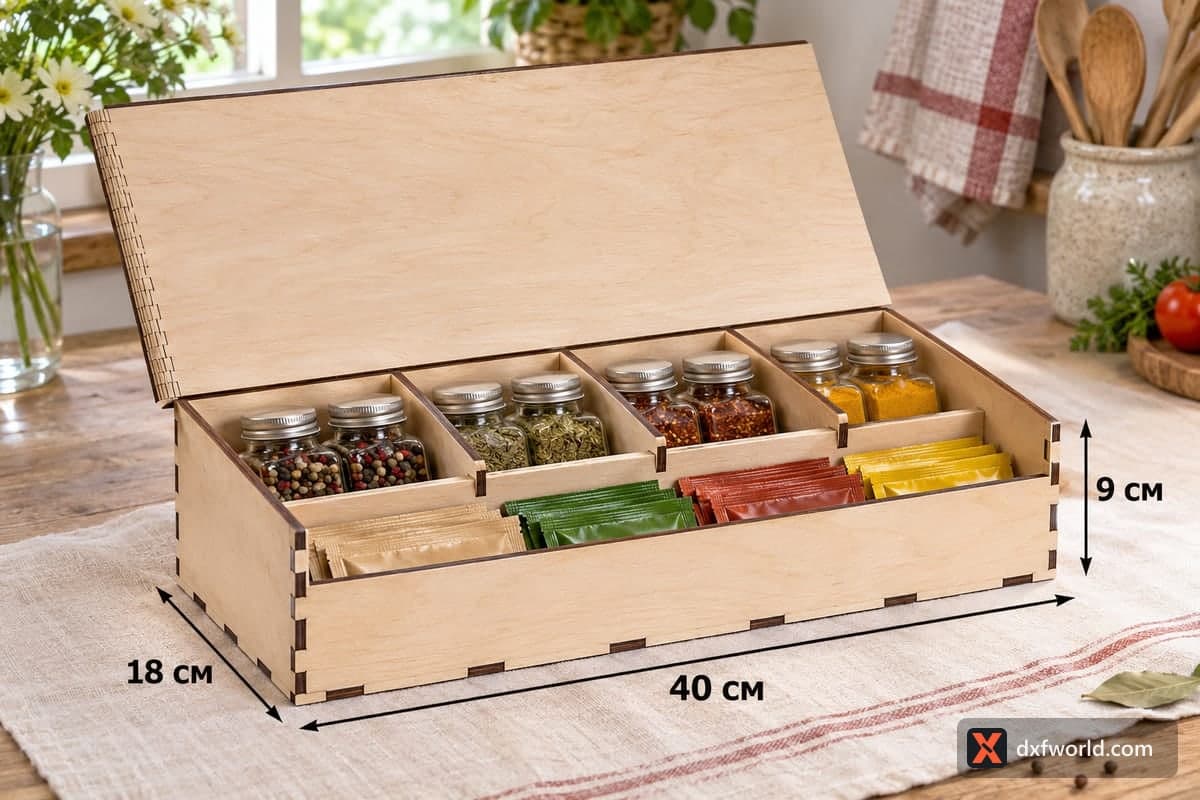
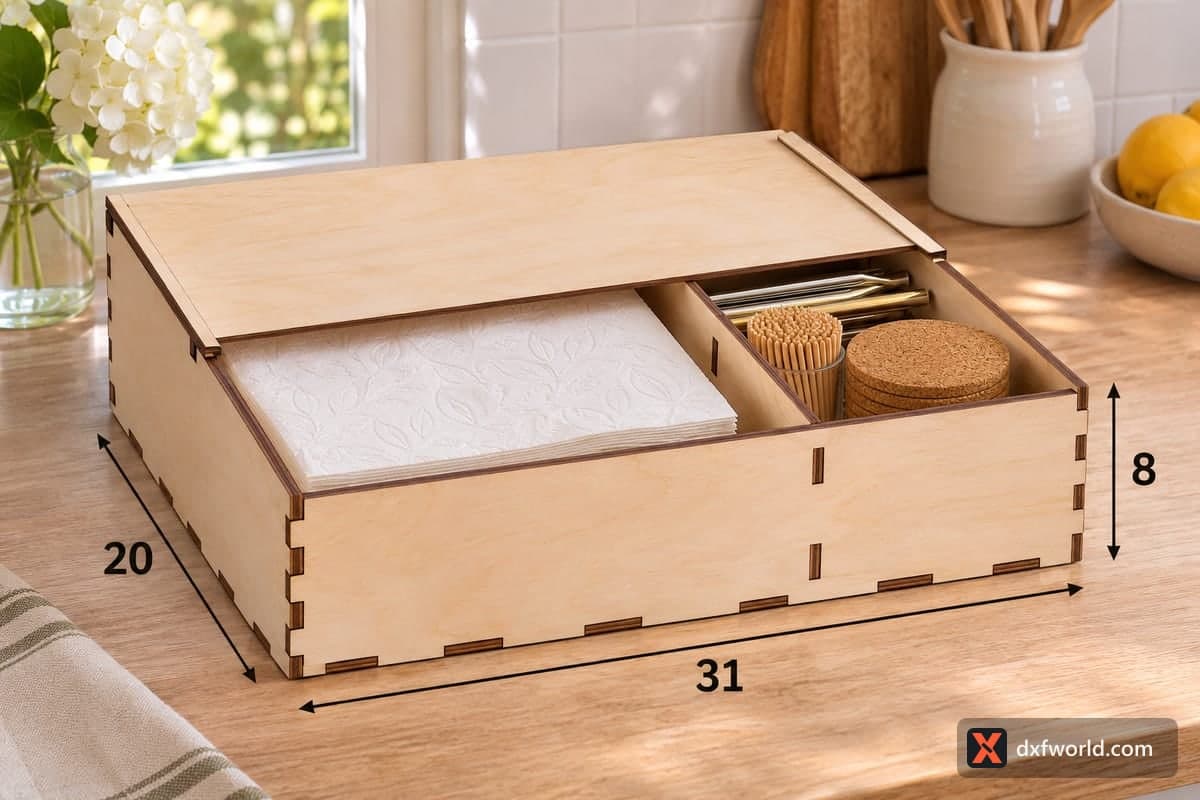
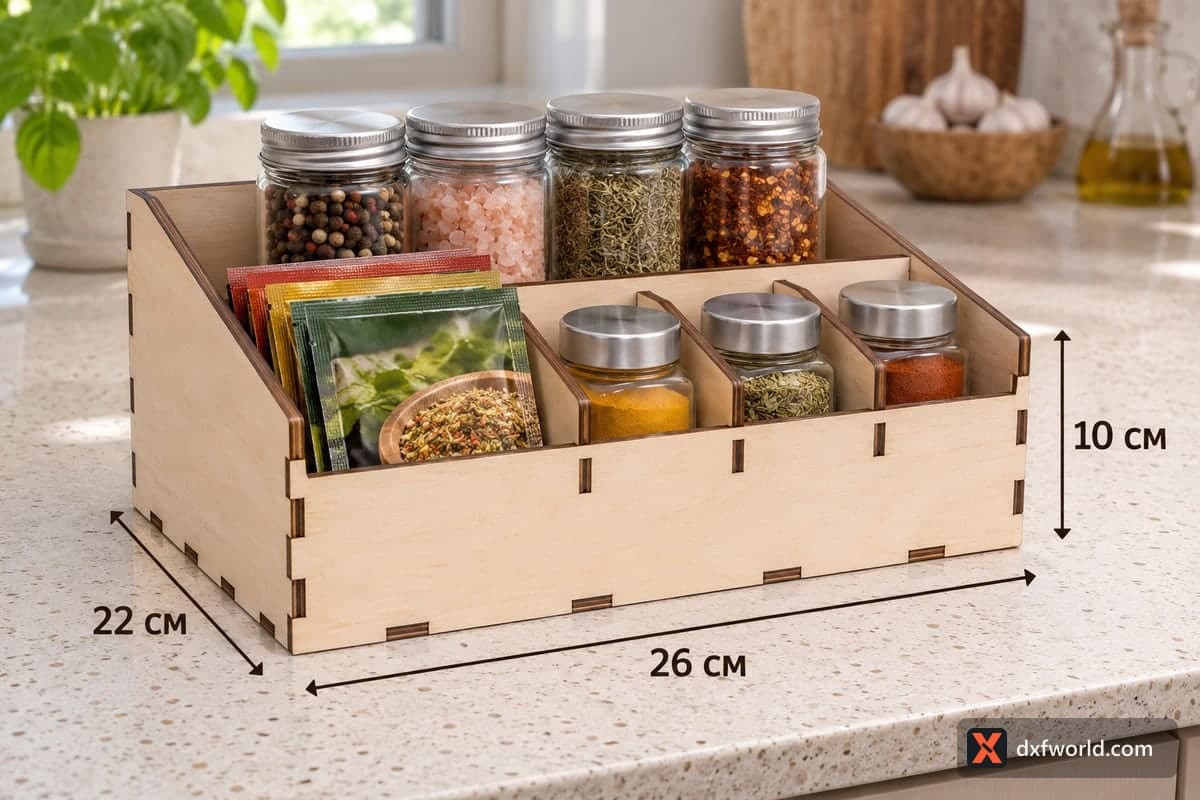
 Visualization
Two Row Spice Caddy DXF, Front and Back Row Spice Organizer SVG, Sloped Spice Jar Holder Laser Cut File
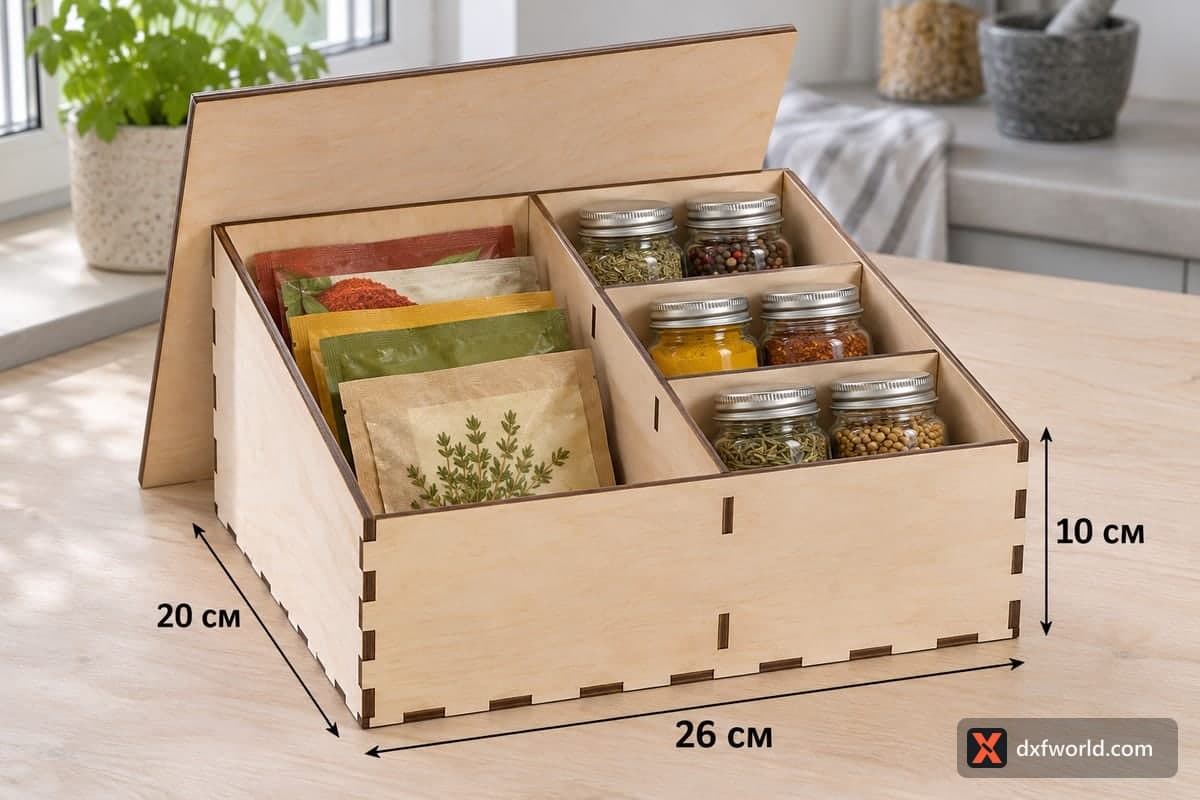
A free laser cut file for a two-row spice caddy with 5 compartments: a low front row split into four sections and one long back row for taller jars, with side panels that slope from the 100 mm back down to a 55 mm front. It measures 260 × 220 × 100 mm (10.24 × 8.66 × 3.94 in) and is cut from 9 plywood pieces that assemble with tabs and slots. Files come in SVG and DXF format for 3, 4, 5 and 6 mm plywood, one set per thickness.
- Formats
- SVG, DXF
- Outer size (W × D × H)
- 260 × 220 × 100 mm (10.24 × 8.66 × 3.94 in)
- Parts
- 9
- Material thickness
- 3, 4, 5 or 6 mm plywood (a file for each)
- Layout size (3 mm file)
- 980 × 332 mm
- Cut length
- 6.09 m
- Est. time, 10 W diode (3 mm)
- 20 min 18 s
- Est. time, 40 W CO2 (3 mm)
- 8 min 28 s
- Layers
- CUT only, no engraving
Free account required to download
How to make it
- 01Choose the file for your plywood and cut a short divider and a matching slot in scrap to check the fit.
- 02Cut all nine pieces and set the three short dividers aside together.
- 03Build the base with back and sloped sides, add the low front, push in the long cross divider, then fit the three short dividers into the front row.
- 04Sand the sloped side edges, seal with lacquer or oil, and line tall jars along the back row with small jars and packets in front.
Two rows at two heights
A cross divider runs the full width of the box and splits it into a back row and a front row. The back row is one long compartment against the 100 mm back wall, sized for a line of tall jars. The front row sits below the 55 mm front wall and three short dividers cut it into four sections, so smaller jars and packets stand in front without hiding what is behind.
In the photo the back row holds four tall jars with steel lids: black peppercorns, pink salt, dried thyme and chili flakes. In front, the wide left section carries a bundle of seasoning packets, and the three narrow sections each take one squat jar of turmeric, dried herbs or paprika. Labels on both rows face you at the same time, which is the point of the stepped layout.
Cutting and assembly
The nine pieces are front, back, two sloped sides, base, the long cross divider and three short dividers. Cutting time for the 3 mm file is about 20 min 18 s on a 10 W diode, about 8 min 28 s on a 40 W CO2 and about 4 min 04 s on a 100 W CO2. The 3 mm layout is 980 × 332 mm, so a small bed takes it in two or three batches. Fit the cross divider before the short ones, because the front-row dividers lean against it. A diode cuts 3 mm in one or two passes, 5–6 mm in several.
Ideas
Make it as a gift with four whole-spice jars at the back and ground spices in front. At a market stall it shows a product range in two rows: large jars behind, sample sizes in front.
Questions about this file
What goes in the back row?
It is one long compartment for tall jars; the photo shows four jars of about 10 cm side by side. Bottles of oil or vinegar can stand there too.
What is the point of the 55 mm front wall?
The 55 mm front keeps the front row easy to reach and lets you see the back row over it, so nothing gets lost behind.
What sheet thickness works best for this caddy?
3 or 4 mm is plenty for jars and packets and cuts quickly on a diode. Choose 5 or 6 mm for a heavier, workshop-style look.
Can I rearrange the front sections?
The slot positions are fixed in the file, but you can leave a short divider out to make one wider section for packets.
Is it safe to keep beside the sink?
Give it two coats of clear lacquer so water splashes bead off instead of swelling the plywood edges.
Similar files