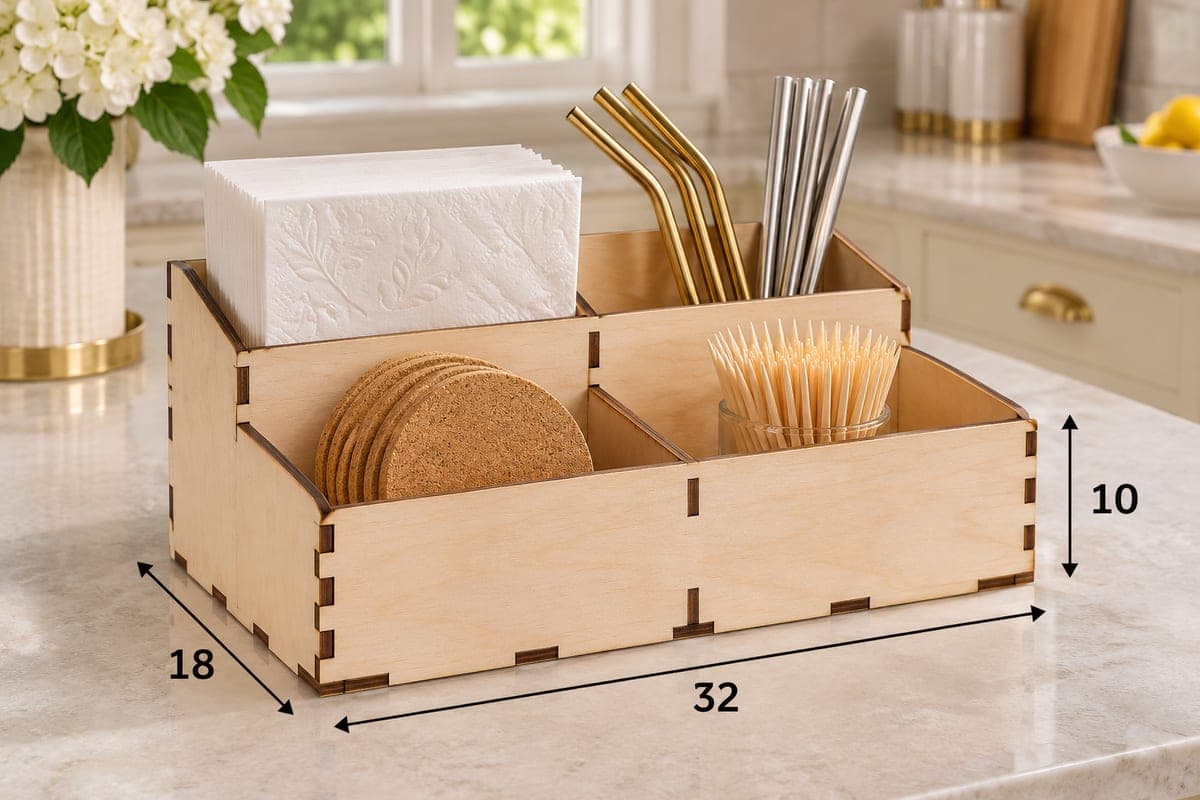
 Visualization
Napkin Caddy SVG, Four Pocket Counter Organizer Laser Cut File, Straw and Coaster Holder DXF
A free napkin caddy with four pockets in two rows of two and a front wall that sits lower than the back, with sides sloping down to it, for upright napkins, coasters, straws and toothpicks. The download has SVG and DXF files for 3, 4, 5 and 6 mm plywood; the caddy is 320 × 180 × 100 mm (12.60 × 7.09 × 3.94 in) and is made of 8 pieces with tabs and slots.
- Formats
- SVG, DXF
- Outer size (W × D × H)
- 320 × 180 × 100 mm (12.60 × 7.09 × 3.94 in)
- Parts
- 8
- Material thickness
- 3, 4, 5 or 6 mm plywood (a file for each)
- Layout size (3 mm file)
- 1,020 × 292 mm
- Cut length
- 5.96 m
- Est. time, 10 W diode (3 mm)
- 19 min 51 s
- Est. time, 40 W CO2 (3 mm)
- 8 min 16 s
- Layers
- CUT only, no engraving
Free account required to download
How to make it
- 01Select the SVG or DXF matching your sheet, from 3 to 6 mm, and check one tab against its slot on an offcut.
- 02Cut the 8 pieces; on a small machine run the back and base in one job and the rest in another.
- 03Stand the long divider and two cross dividers in the base, then add the back, the two sloped sides and the 75 mm front.
- 04Smooth the edges, apply lacquer, and stand napkins and straws in the back pockets with coasters and toothpicks in front.
Tall in the back, low in the front
The back wall is 100 mm high and the front 75 mm, so the sides drop gently forward and the front pockets stay easy to reach. A single long divider splits the box into a left and a right half, and one cross divider in each half creates a front and a back pocket, four in total. In the photo the back left pocket holds embossed napkins standing on edge, the front left a row of round cork coasters, the back right gold and silver straws, and the front right a glass of toothpicks. Tall things behind short ones is the arrangement that reads best on a counter.
A small, quick cut
Eight pieces fit a 1020 × 292 mm layout for 3 mm plywood, which splits easily into two jobs on a 500 mm bed. Expect about 19 min 51 s on a 10 W diode, about 8 min 16 s on a 40 W CO2 and about 3 min 58 s on a 100 W CO2 for the 3 mm file. With 3 mm stock a diode gets through in one or two passes; at 5 or 6 mm the caddy feels solid, but a low-power diode needs several slow passes. The download contains cut lines and nothing to engrave.
Assembly and selling ideas
Stand the long divider and the two cross dividers in the base, then wrap the back, the sloped sides and the front around them. Tabs hold everything snugly; glue only if you want it permanent. Rub the edges smooth with 180 grit paper and finish with clear lacquer so damp straws do not mark the wood.
Makers sell caddies like this in pairs for kitchen islands, or in batches to cafes and bakeries as a napkin station by the till. Add a cafe logo to the front with your own engraving, or pack one with a set of reusable straws as a gift.
Questions about this file
Do napkins stand upright or lie flat?
The back pockets are deep enough for folded paper napkins standing on edge, as in the photo, which saves counter space.
Can I cut the caddy from MDF?
Yes, 3 mm MDF cuts cleanly and takes paint well for a coloured cafe set, but seal it, because raw MDF swells near spills.
What thickness works best on a diode laser for this caddy?
Stick with 3 or 4 mm for clean edges and a short cutting time. The 5 and 6 mm files are better suited to CO2 lasers.
Can I make the pockets different sizes?
Move the cross divider slots in your editor before cutting. Keep each slot as wide as your sheet so the dividers still lock in place.
Is it fine next to the sink?
With two coats of lacquer or hard-wax oil it handles splashes, but empty it and let it dry out if it ever gets soaked.
Similar files