 Visualization
Three Tier Napkin Rack SVG, Stepped Straw and Coaster Station Laser File, Buffet Caddy DXF
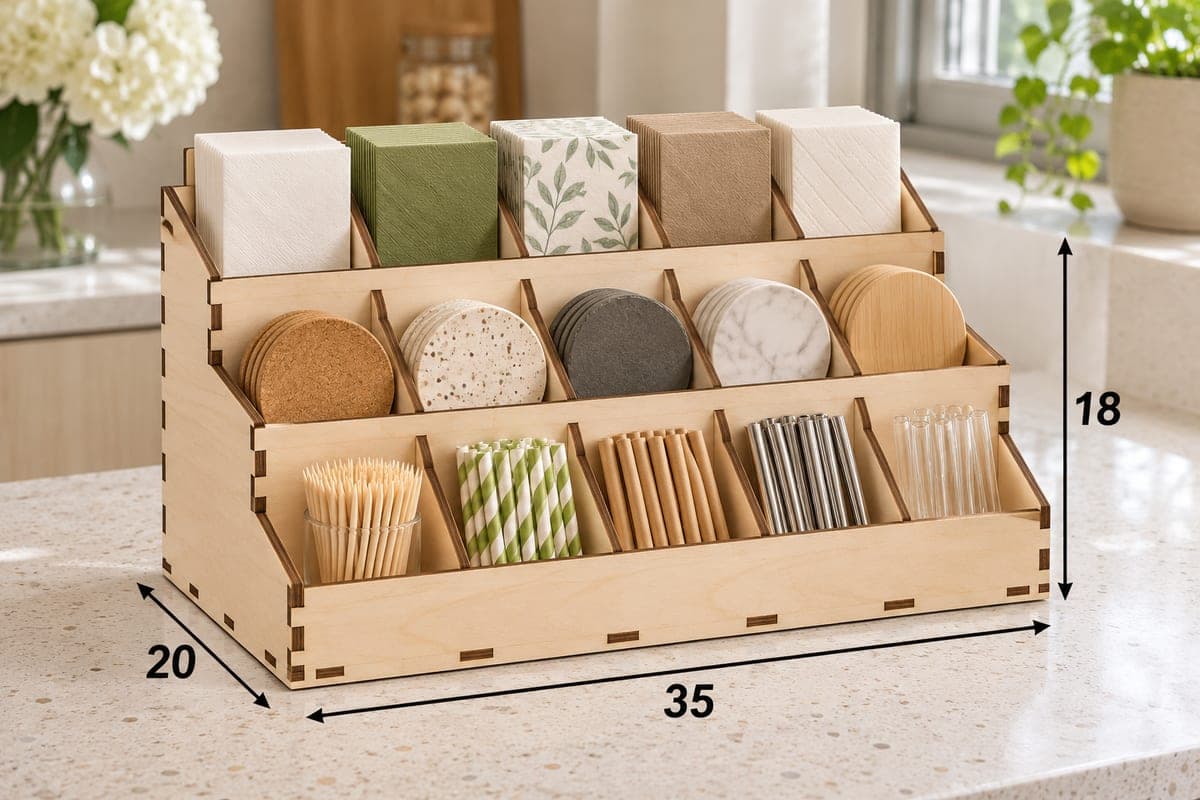
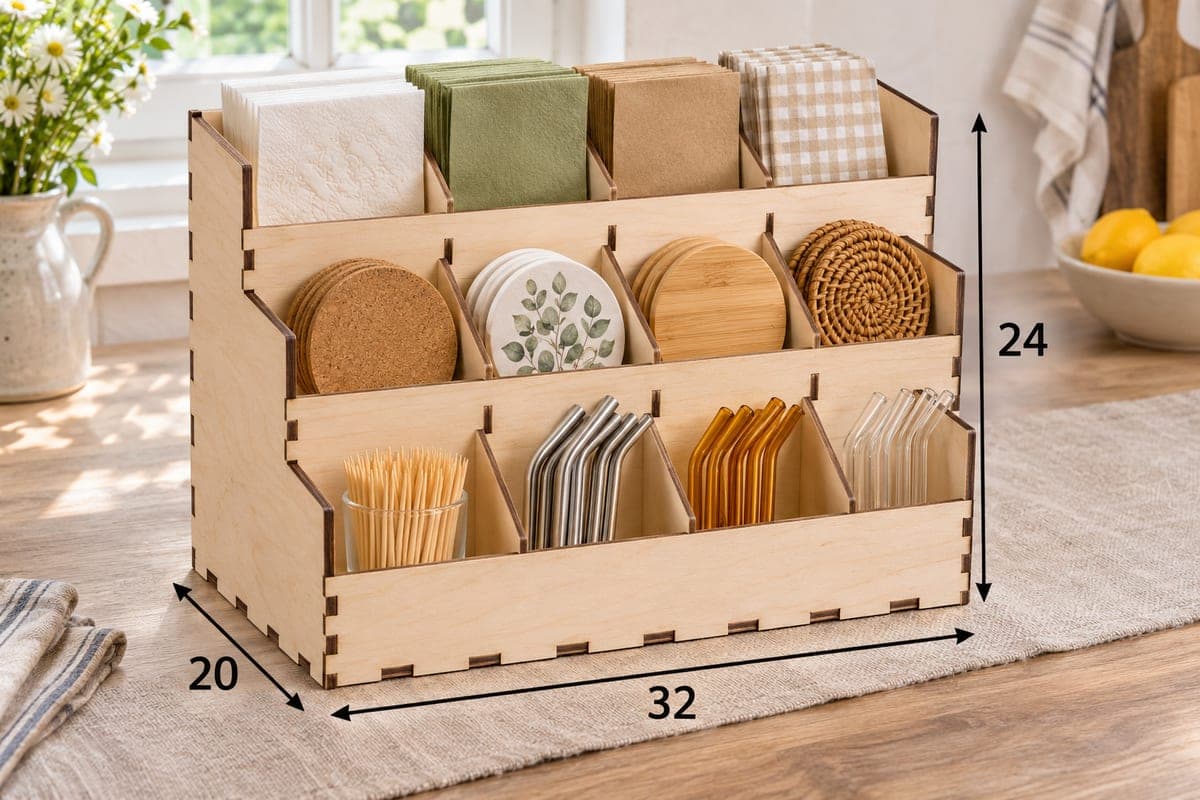
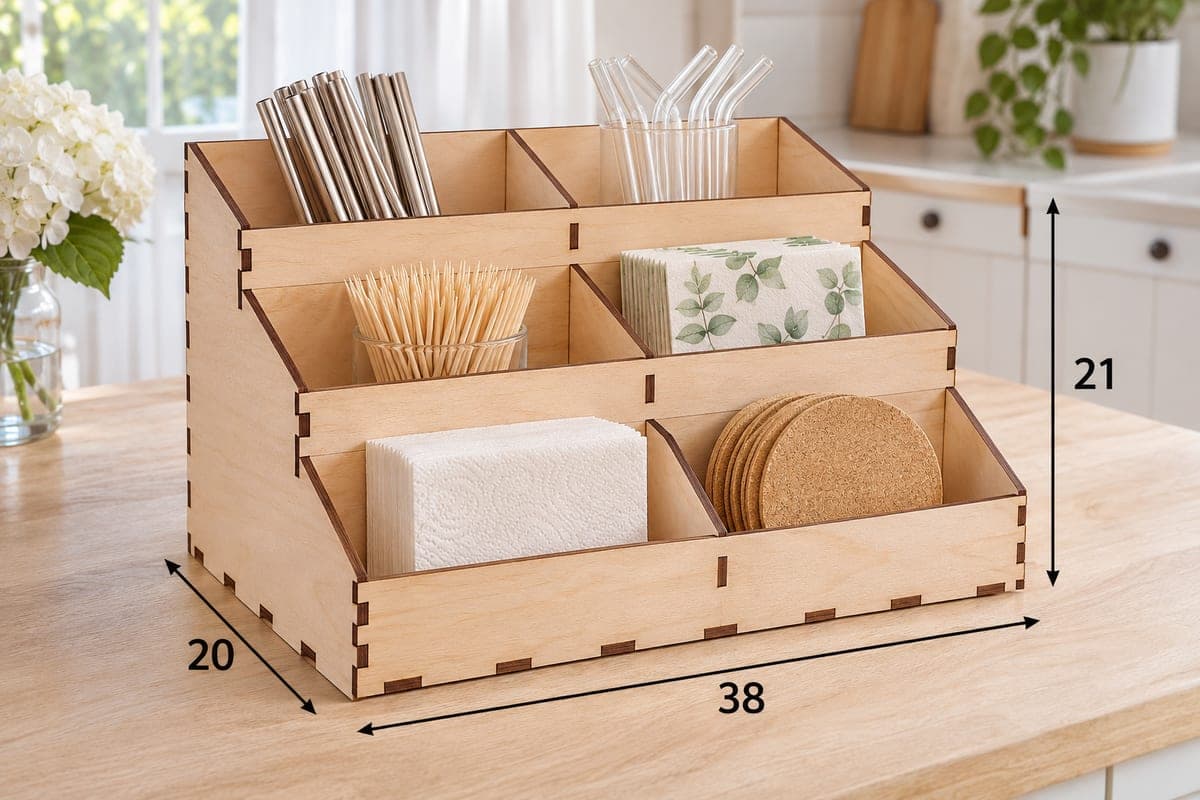
A free stepped rack with three tiers rising to the back, each split in two by a divider, giving six pockets for napkins, coasters, straws and toothpicks. You get SVG and DXF files for 3, 4, 5 and 6 mm plywood; the rack measures 380 × 200 × 210 mm (14.96 × 7.87 × 8.27 in) and has 12 pieces that lock together with tabs and slots, each with a small engraved part number.
- Formats
- SVG, DXF
- Outer size (W × D × H)
- 380 × 200 × 210 mm (14.96 × 7.87 × 8.27 in)
- Parts
- 12
- Material thickness
- 3, 4, 5 or 6 mm plywood (a file for each)
- Layout size (3 mm file)
- 1,540 × 337 mm
- Cut length
- 10.66 m
- Est. time, 10 W diode (3 mm)
- 35 min 32 s
- Est. time, 40 W CO2 (3 mm)
- 14 min 48 s
- Layers
- CUT only, no engraving
Free account required to download
How to make it
- 01Download the files for your plywood thickness and test one shelf slot in a scrap piece first.
- 02Cut the 12 numbered parts, splitting the 1540 mm layout into smaller jobs if your laser bed needs it.
- 03Fit the shelves, step boards, front board and brace into one side, close with the other side, then add one divider per step.
- 04Sand off any scorch, varnish the rack and load straws on the top step, napkins and toothpicks in the middle, coasters at the bottom.
Two pockets on every step
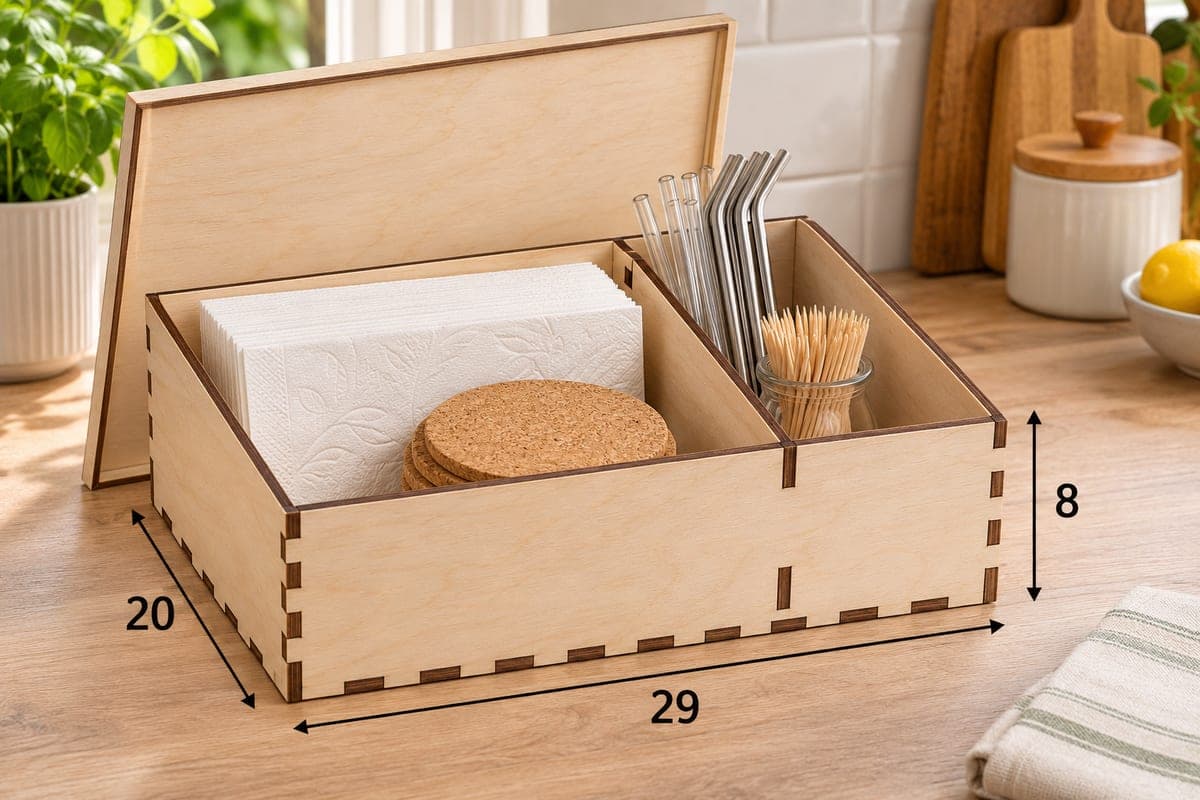
Each of the three shelves has a single divider in the middle, so the rack gives six roomy pockets rather than many narrow ones. The photo puts metal and glass straws on the top step, a glass of toothpicks and a stack of leaf-print napkins in the middle, and plain white napkins beside round cork coasters at the bottom. At 210 mm tall and 200 mm deep it takes about as much counter space as a toaster, and everything stays visible from the front.
Pieces, sheet and timing
The 12 parts are two stepped sides, a front board, two step boards, three shelves, a back brace and three dividers. Every piece carries a small engraved number, the only engraving in the file, so the near-identical shelves are easy to tell apart. The 3 mm layout is 1540 × 337 mm, so split it over two or three sheets on a typical desktop machine. For the 3 mm file allow about 35 min 32 s on a 10 W diode, about 14 min 48 s on a 40 W CO2 or about 7 min 06 s on a 100 W CO2. Thicker 5 and 6 mm sheet makes a sturdier rack for a busy counter but takes several diode passes.
Putting the rack together
Lay one side flat, push in the shelves, step boards, front board and brace, then cap them with the second side. Turn the rack upright and drop in the three dividers. Glue is optional; a few drops at the shelf joints help if guests pull straws out in a hurry. Seal the wood with water-based varnish so a wet glass does not leave a ring.
A rack like this sells well to cafes and food trucks as a self-serve station. With your own monogram engraved on the front board, it also makes a thoughtful gift for a friend who hosts a lot.
Questions about this file
How much does each pocket hold?
Each step is split into two halves of roughly half the 380 mm width, enough for a stack of folded paper napkins or a pile of round coasters.
Why is a number engraved on every rack piece?
Engraved part numbers that tell you which shelf, board or divider goes where. Turn them to face inward during assembly and they will not show.
Can I make the rack taller or wider?
You can stretch it in your design software, but the slots must stay exactly as wide as your plywood. Resize the outline, then set the slot widths back to your sheet thickness.
Is MDF a good choice for this rack?
MDF cuts cleanly and paints well, which suits a coloured cafe station, but it swells when it gets wet. Plywood is the safer pick next to drinks.
Do the joints need glue?
No, they hold by friction. Glue the shelves only if the rack will be carried around full or used every day in a cafe.
Similar files