 Visualization
Napkin Organizer SVG, Split Level Straw and Coaster Holder Laser File, Kitchen Counter Caddy DXF
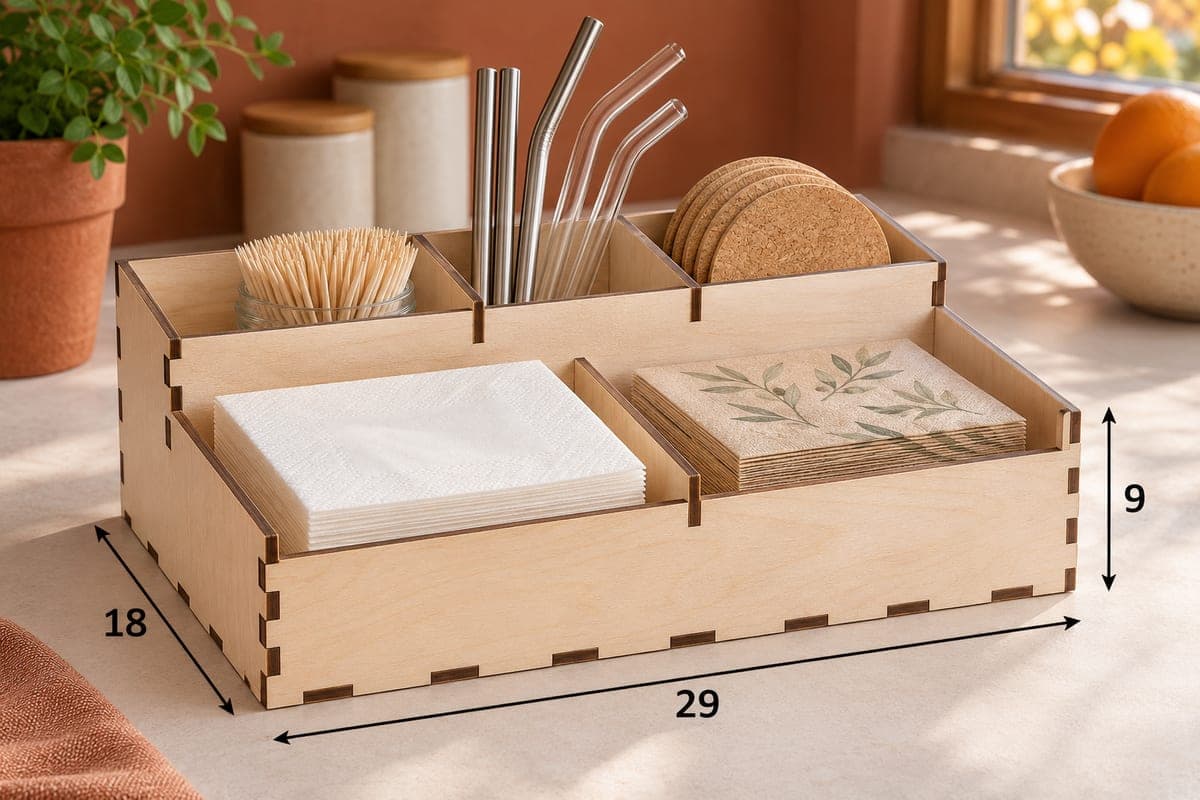
A free split-level napkin organizer with five compartments: two wide pockets behind a low 54 mm front wall and three taller pockets along the 90 mm back. It comes as SVG and DXF files for 3, 4, 5 and 6 mm plywood, measures 290 × 180 × 90 mm (11.42 × 7.09 × 3.54 in) and is made of 9 pieces joined with tabs and slots.
- Formats
- SVG, DXF
- Outer size (W × D × H)
- 290 × 180 × 90 mm (11.42 × 7.09 × 3.54 in)
- Parts
- 9
- Material thickness
- 3, 4, 5 or 6 mm plywood (a file for each)
- Layout size (3 mm file)
- 960 × 282 mm
- Cut length
- 6.13 m
- Est. time, 10 W diode (3 mm)
- 20 min 26 s
- Est. time, 40 W CO2 (3 mm)
- 8 min 31 s
- Layers
- CUT only, no engraving
Free account required to download
How to make it
- 01Pick the 3, 4, 5 or 6 mm file to match your sheet and cut one test slot to confirm the fit.
- 02Cut the 9 pieces from a 960 × 282 mm area, or split the base and cross divider onto a second sheet.
- 03Assemble base, back and sides, slot in the tall cross divider, add the two tall rear dividers and the short front one, then fit the 54 mm front.
- 04Sand and seal, then stack flat napkins in the low front pockets and stand straws, toothpicks and coasters in the back row.
How the five pockets are arranged
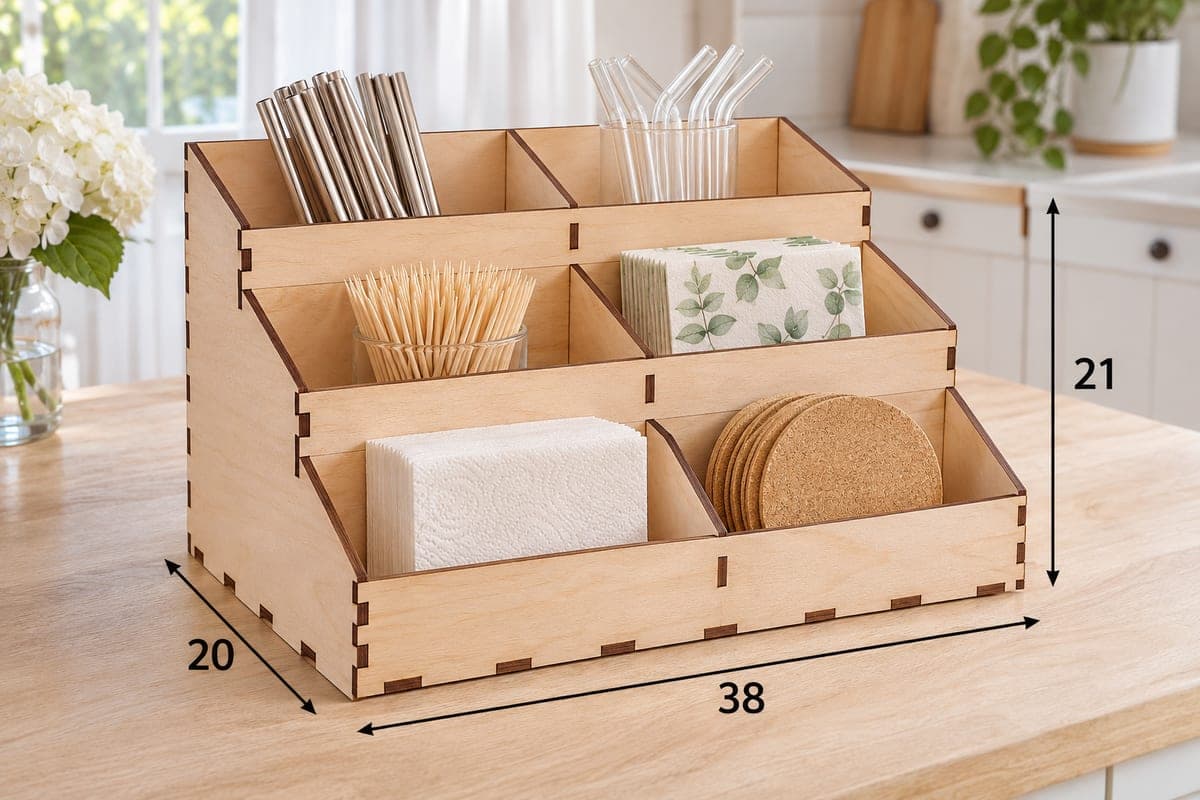
The layout is a planned grid rather than equal cells. A full-height cross divider runs across the box and sets up two levels. In front, one short divider makes two wide pockets where flat napkins lie stacked: in the photo, plain white ones on the left and an olive-branch print on the right. Behind, two tall dividers make three narrower pockets for a jar of toothpicks, metal and glass straws, and cork coasters standing on edge. Because the front wall is only 54 mm high, you can lift a napkin off the top without tipping the pile.
Cutting notes
The parts fit on a 960 × 282 mm layout. With the 3 mm file a 10 W diode needs about 20 min 26 s, a 40 W CO2 about 8 min 31 s and a 100 W CO2 about 4 min 05 s. If your bed is 400 mm square, move the base and the cross divider to a second sheet. The 6 mm version is sturdy for a busy cafe counter, but expect slow, multi-pass cuts on a diode.
Assembly and ideas
Start with the base, back and sides, then the tall cross divider; the two tall dividers go behind it and the short one in front, and the low front wall closes the box. The slots grip without glue, though a drop in each outer corner is worth it on a piece that gets handled at every meal. Sand, then seal with lacquer.
Sell it in pairs with seasonal napkins swapped inside, spring florals in April and plaid in December, or offer it to small cafes as a self-service corner for straws and napkins. Their logo engraved on the tall back wall turns it into branded counter kit.
Questions about this file
Why is the front row lower?
Low walls make flat-lying napkins easy to grab and keep the taller items in the back row visible over them.
Will cocktail napkins fit the front pockets?
Yes, folded cocktail napkins of about 125 mm fit, since each front pocket is roughly 140 mm wide and 100 mm deep. Larger luncheon napkins need one extra fold.
Can I resize the organizer?
You can, as long as the slots are reset to your plywood thickness afterwards. The joints in each file are drawn for exactly 3, 4, 5 or 6 mm stock.
Could I mix acrylic and plywood?
A tinted acrylic front panel with plywood walls looks smart, but the acrylic must be the same thickness as the plywood or the joints will not close.
How do I make it wipe-clean?
Brush two thin coats of water-based polyurethane on every surface, sanding lightly between them, and coffee drips will come off with a damp cloth.
Similar files