 Visualization
Tiered Cutlery Stand SVG, Stepped Silverware Holder Laser Cut File, Buffet Utensil Rack DXF
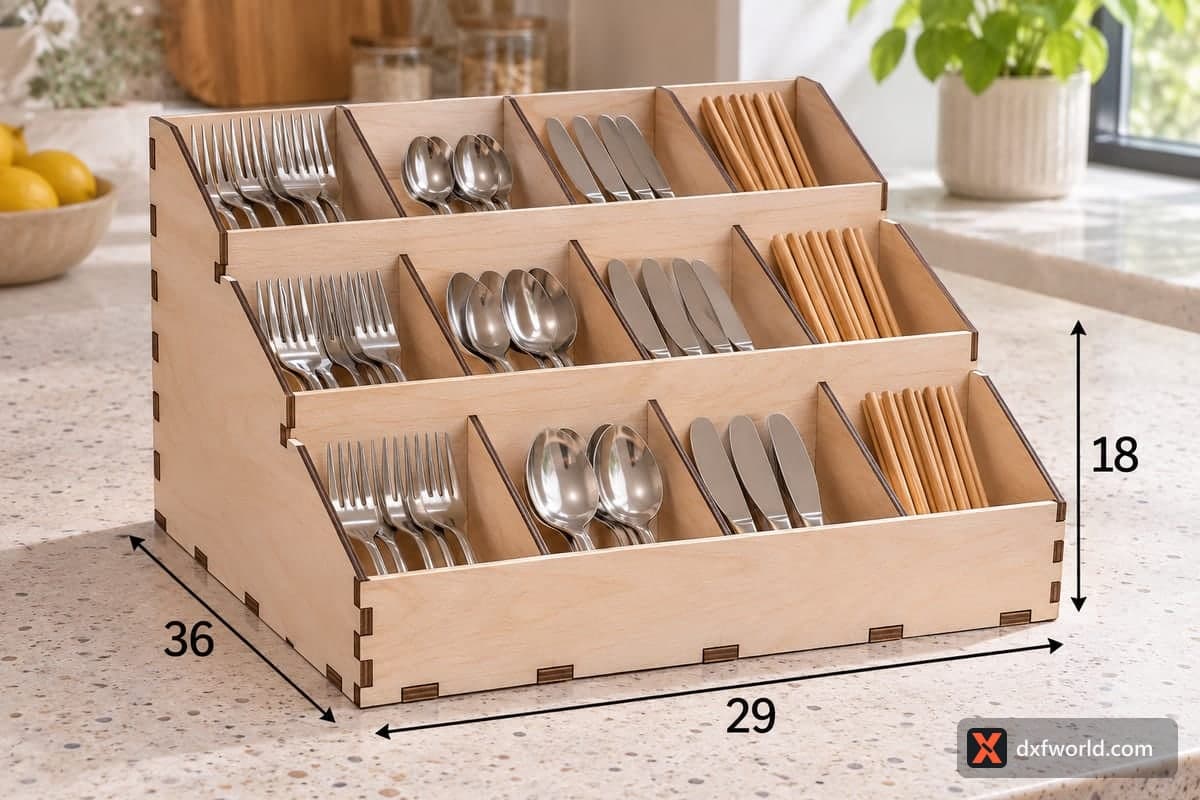
This free SVG and DXF file builds a three-step tiered cutlery stand with four slots on every step, 12 compartments in total, for forks, spoons, knives and chopsticks. It measures 290 × 360 × 180 mm (11.42 × 14.17 × 7.09 in), is made of 18 plywood pieces that join with tabs and slots, has small part numbers engraved to guide assembly, and comes in versions for 3, 4, 5 and 6 mm plywood.
- Formats
- SVG, DXF
- Outer size (W × D × H)
- 290 × 360 × 180 mm (11.42 × 14.17 × 7.09 in)
- Parts
- 18
- Material thickness
- 3, 4, 5 or 6 mm plywood (a file for each)
- Layout size (3 mm file)
- 1,474 × 347 mm
- Cut length
- 13.37 m
- Est. time, 10 W diode (3 mm)
- 44 min 33 s
- Est. time, 40 W CO2 (3 mm)
- 18 min 34 s
- Layers
- CUT only, no engraving
Free account required to download
How to make it
- 01Pick the file that matches your sheet and test one slot on scrap; with this many joints a good fit saves a lot of sanding later.
- 02Cut the two sides, three shelves, two step boards, front board, brace and nine dividers, using the engraved numbers to sort them as they come off the bed.
- 03Slot all shelves, boards and the brace into one side panel, press the second side on, then place three dividers on each step.
- 04Sand the step edges, lacquer the stand and fill each step with forks, spoons, knives and chopsticks.
Three steps, four slots each
The stand rises in three steps from front to back. Each step is a shelf with a short board in front, and three dividers split it into four slots. In the photo every step repeats the same order: forks, spoons, table knives, then chopsticks. That makes it easy for guests to take one of each from any row, and the step behind sits higher so its handles stay visible above the row in front. A brace across the back keeps the two side panels square.
Cutting and putting it together
With 18 pieces this is the largest file in the cutlery set. The 3 mm layout is 1474 × 347 mm, growing to 1628 × 401 mm for 6 mm, so most desktop lasers will need it split over two or three sheets. Cutting time for the 3 mm file is about 44 min 33 s on a 10 W diode, about 18 min 34 s on a 40 W CO2 and about 8 min 55 s on a 100 W CO2. A diode cuts 3 mm in one or two passes; 5 and 6 mm need a stronger machine or extra passes. Every piece carries a small engraved number, which helps a lot with the nine similar dividers. Fit the shelves, step boards, front board and brace into one side panel, close with the second side, then drop the dividers into each step. Glue the frame if the stand will be carried around.
Buffets, cafés and catering
Finish with a wipeable clear lacquer. The stand suits hotel breakfast buffets, wedding and party buffets, staff canteens and catering events where many people help themselves. Engrave your café logo on the front board yourself, or make a pair for both ends of a long table.
Questions about this file
How much cutlery does one slot hold?
Each slot comfortably takes a stack of about a dozen forks or spoons standing upright, so the full stand serves a mid-size buffet.
Why do the stand pieces have little numbers on them?
They are small part numbers that help you match pieces during assembly. Apart from those numbers the file has cut lines only.
Which plywood thickness is best for a buffet stand?
5 or 6 mm makes a rigid stand that copes with daily handling. The 3 mm version is fine for a home kitchen or occasional parties.
Can I use the stand for something other than cutlery?
Yes, the stepped slots also hold sauce packets, straws, sugar sticks or small bottles at a café station.
Is gluing required?
The tab-and-slot frame holds together on its own, but gluing the side panels to the shelves makes the stand stronger if it is moved a lot.
Similar files