 Visualization
Tiered Tea Stand SVG, Tea Bag Display Rack Laser Cut File, Wooden Tea Jar Step Shelf DXF
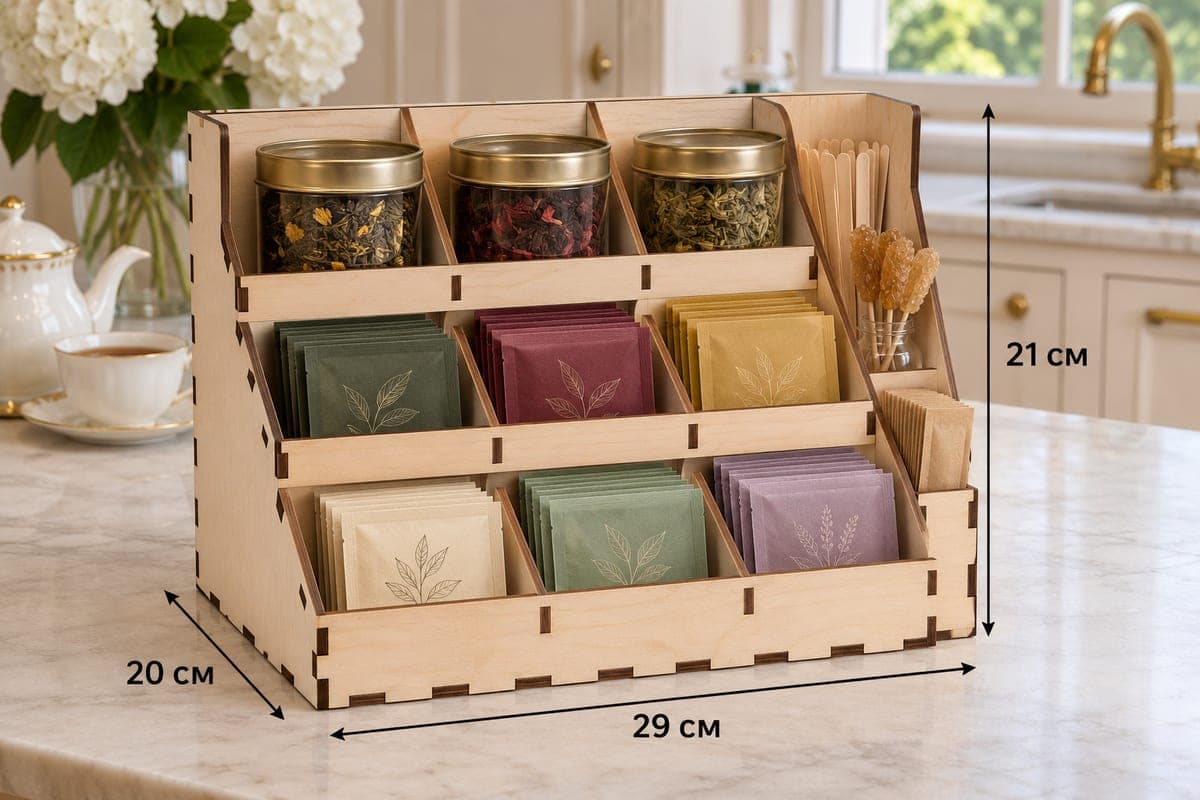
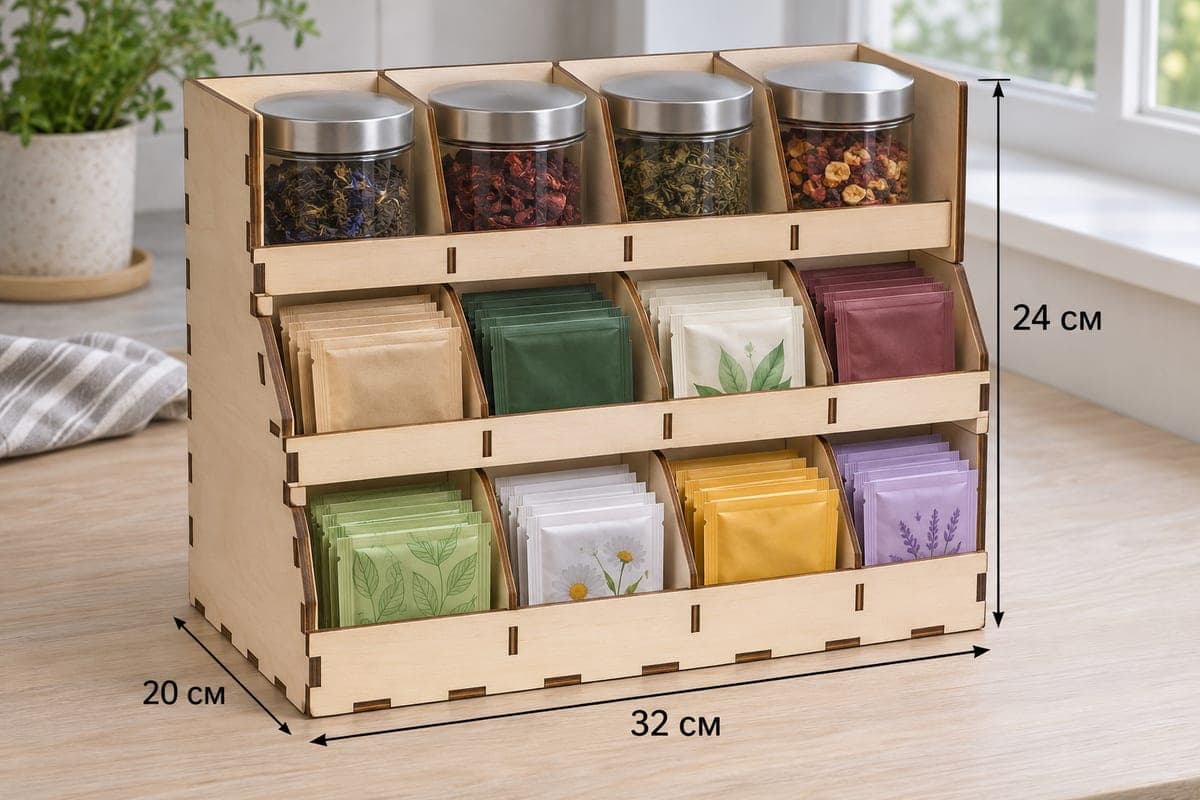
This is a free laser cut file for a three-step tea stand that holds jars on the top step and tea bags on the two lower steps, with four pockets per step and 12 in total. The outer size is 320 × 200 × 240 mm (12.60 × 7.87 × 9.45 in), it is built from 18 plywood pieces that join with tabs and slots, and small part numbers are engraved on the pieces to guide assembly. The download has SVG and DXF files, with a separate version for 3, 4, 5 and 6 mm plywood.
- Formats
- SVG, DXF
- Outer size (W × D × H)
- 320 × 200 × 240 mm (12.60 × 7.87 × 9.45 in)
- Parts
- 18
- Material thickness
- 3, 4, 5 or 6 mm plywood (a file for each)
- Layout size (3 mm file)
- 1,300 × 361 mm
- Cut length
- 11.84 m
- Est. time, 10 W diode (3 mm)
- 39 min 28 s
- Est. time, 40 W CO2 (3 mm)
- 16 min 27 s
- Layers
- CUT only, no engraving
Free account required to download
How to make it
- 01Pick the SVG or DXF that matches your plywood thickness and cut one divider plus a shelf offcut first to check how the slot fits.
- 02Cut all 18 pieces, spreading the 1300 mm layout across two or three sheets if your bed is smaller.
- 03Join the two stepped sides with the shelves and step boards, fit the brace at the back, then slide in the nine dividers using the engraved numbers as a guide.
- 04Sand the edges, apply a clear finish, and load jars on the top step and tea bags on the two lower ones.
How the three steps are used
Each step rises behind the one in front, so every pocket stays in view from the counter. In the photo the top row carries four glass jars of loose leaf tea, and the two lower rows hold envelopes of bagged tea standing on edge, sorted by colour and flavour. Three dividers split each step into four pockets of roughly equal width, which suits standard tea bag envelopes and small jars that sit inside one pocket. The stand is 240 mm tall at the back and 200 mm deep, so it fits under most wall cabinets and still leaves room to lift a jar out.
Cutting and assembly
The 18 pieces are two stepped sides, a front board, two step boards, three shelves, a brace and nine dividers. Each one carries a small engraved part number, which makes it easy to tell the near-identical shelves and dividers apart. On a 10 W diode the 3 mm file takes about 39 min 28 s; a 40 W CO2 needs about 16 min 27 s and a 100 W CO2 about 7 min 54 s. The layout is 1300 mm long, so on a smaller bed move the pieces onto two or three sheets. Thicker 5 or 6 mm plywood gives a sturdier stand for heavy glass jars but needs a stronger laser or several passes. Start with the sides and the shelves, add the step boards and the brace at the back, then drop the dividers into their slots. The tab joints hold on their own; a little wood glue on the side joints makes it permanent.
Ideas for a gift or a stall
Filled with a dozen tea varieties, the stand makes a housewarming present that needs no wrapping. Tea shops and cafes can use it as a counter display for sampler packs, with the shop name engraved on the front board as an extra touch. A clear matte lacquer keeps the plywood from marking when wet cups are set down nearby. For craft fairs, offer it in natural birch and in a darker stain side by side.
Questions about this file
What can stand on each step of this tea stand?
Small glass or tin jars of loose tea fit the top step, and the two lower steps take tea bag envelopes standing on edge. Coffee pods or sugar sticks fit the pockets just as well.
Can I make the stand wider for more flavours?
Scaling the whole file also scales the slots, which then no longer match your plywood. Stretch the shelves and boards instead and keep every slot at the material thickness.
Which plywood thickness suits a stand this tall?
4 mm is a good middle ground. 3 mm is lighter and quick to cut on a diode laser, while 6 mm feels solid under a row of heavy glass jars.
What do the tiny numbers on the shelves and dividers mean?
They are engraved part numbers that show where each shelf and divider goes. They are the only engraving in the file, and you can delete them in your laser software if you prefer clean faces.
Will MDF or acrylic work for this tea stand?
MDF works with the same files when its thickness matches one of the four versions. Acrylic of a matching thickness also cuts well on a CO2 laser and looks smart in a shop window.
Similar files