 Visualization
Tea Canister Display Rack SVG, Three Step Tea Shop Counter Shelf Laser Cut File, Tiered Tea Stand DXF
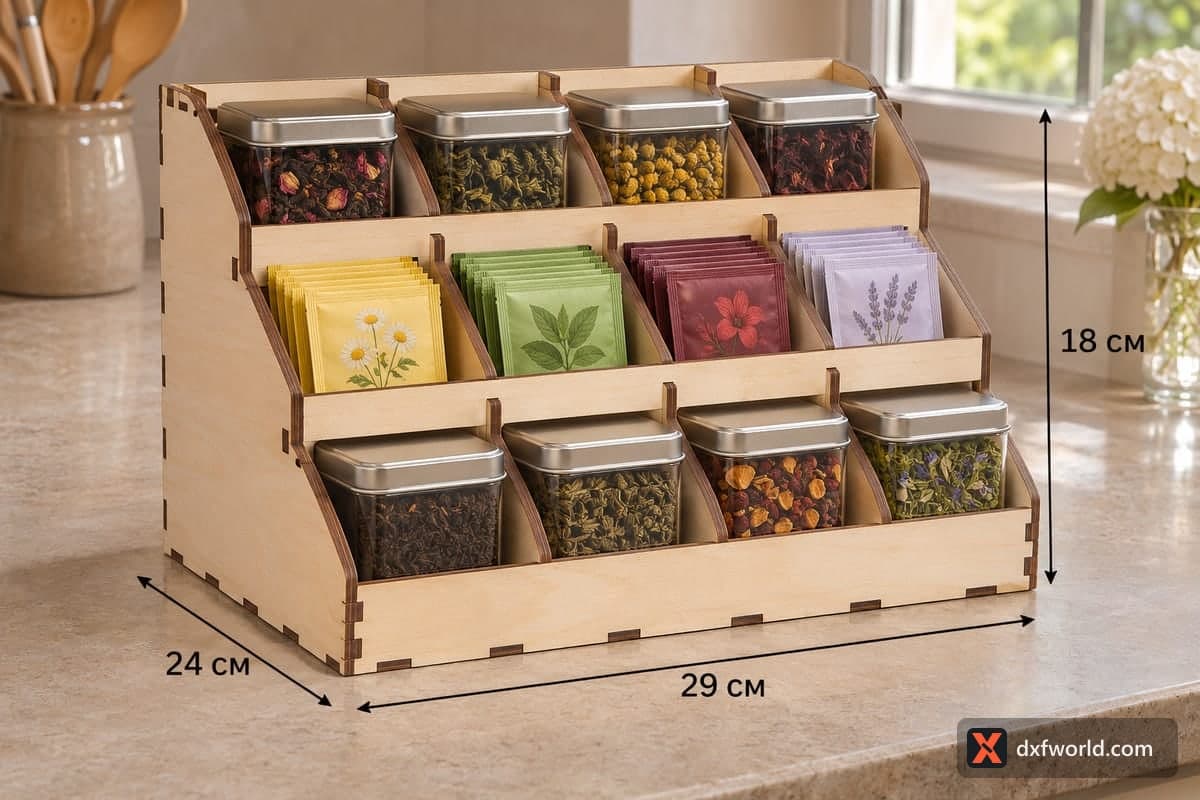
This is a free three-step tea stand laser cut file in SVG and DXF, with separate files for 3, 4, 5 and 6 mm plywood. It measures 290 × 240 × 180 mm (11.42 × 9.45 × 7.09 in) and is made of 18 pieces that join with tabs and slots, with small part numbers engraved on them to guide assembly. Low dividers split each of the three steps into four bays, giving 12 spots for tea canisters, tins or upright sachets.
- Formats
- SVG, DXF
- Outer size (W × D × H)
- 290 × 240 × 180 mm (11.42 × 9.45 × 7.09 in)
- Parts
- 18
- Material thickness
- 3, 4, 5 or 6 mm plywood (a file for each)
- Layout size (3 mm file)
- 1,180 × 328 mm
- Cut length
- 11.39 m
- Est. time, 10 W diode (3 mm)
- 37 min 58 s
- Est. time, 40 W CO2 (3 mm)
- 15 min 49 s
- Layers
- CUT only, no engraving
Free account required to download
How to make it
- 01Pick the SVG or DXF that matches your plywood thickness, then cut a single divider slot on scrap to check that a divider slides in snugly.
- 02Cut all 18 pieces, splitting the 1180 mm long layout over two or three sheets if your bed is smaller, and keep the engraved numbers facing inward.
- 03Fit the shelves, step boards, front board and brace between the two side panels, then press the nine dividers into the three steps.
- 04Sand, seal with lacquer or oil, and load canisters on the top and bottom steps with sachets in the middle row.
Twelve bays on three steps
The stand climbs toward the back in three steps, so the rear row sits higher than the front one and every label stays readable from the counter. Each step is divided into four bays by short dividers, twelve bays in total. In the photo the top and bottom steps carry square glass canisters with metal lids, filled with rosebuds, chamomile and green leaf, while the middle step holds tea bags standing upright and sorted by flavor. The dividers are only a little over 3 cm tall: enough to stop jars from drifting sideways, low enough to keep them on show.
Cutting the 18 pieces
Cutting time for the 3 mm file is about 37 min 58 s on a 10 W diode, about 15 min 49 s on a 40 W CO2 and about 7 min 36 s on a 100 W CO2. A diode gets through 3 mm plywood in one or two passes; for 5 or 6 mm you need a stronger tube or several passes. The 3 mm layout is 1180 × 328 mm, longer than most hobby beds, so move the pieces onto two or three smaller sheets. The nine dividers come in two sizes and look almost alike, which is where the engraved part numbers save time. Build the frame first: two side panels, the three shelves, the step boards, the front board and the brace, then slide the dividers into their slots. Dry tabs hold the frame together; a drop of wood glue at each joint makes it rigid for a busy counter.
Finishing and selling ideas
Sand the edges and seal the birch with clear lacquer or a food-safe oil so kettle splashes wipe off. Filled with a dozen sampler canisters, the stand makes a generous gift for a tea lover. Tea shops and cafes can set it beside the till to show loose blends sold by weight. At craft fairs, pair it with a set of matching coasters, or offer the shop name engraved on the front board as an add-on.
Questions about this file
What size tea canisters fit the bays?
Each step is split into four bays across 290 mm, so small square canisters or round tins up to roughly 6 cm wide sit one per bay. Measure your jars before cutting if they are wider.
Can I make the stand bigger for coffee bags or larger jars?
You can scale the drawing up, but the slots must stay the width of your plywood or the tabs will rattle. Scale the outline, then correct the slot widths back to your material thickness.
Do I need to glue the tiered stand?
The tabs hold it together without glue for light use. If it will carry heavy glass jars every day, glue the shelves and step boards to the sides.
Which thickness works best for a stand this tall?
4 or 5 mm plywood gives a stiffer stand under full glass jars, while 3 mm is lighter and cuts fastest on a diode laser.
Can it be cut from acrylic or MDF instead?
MDF of the same thickness works with the matching file. Acrylic cuts cleanly too, but it is brittle at the tabs, so assemble it slowly and use acrylic cement rather than wood glue.
Similar files