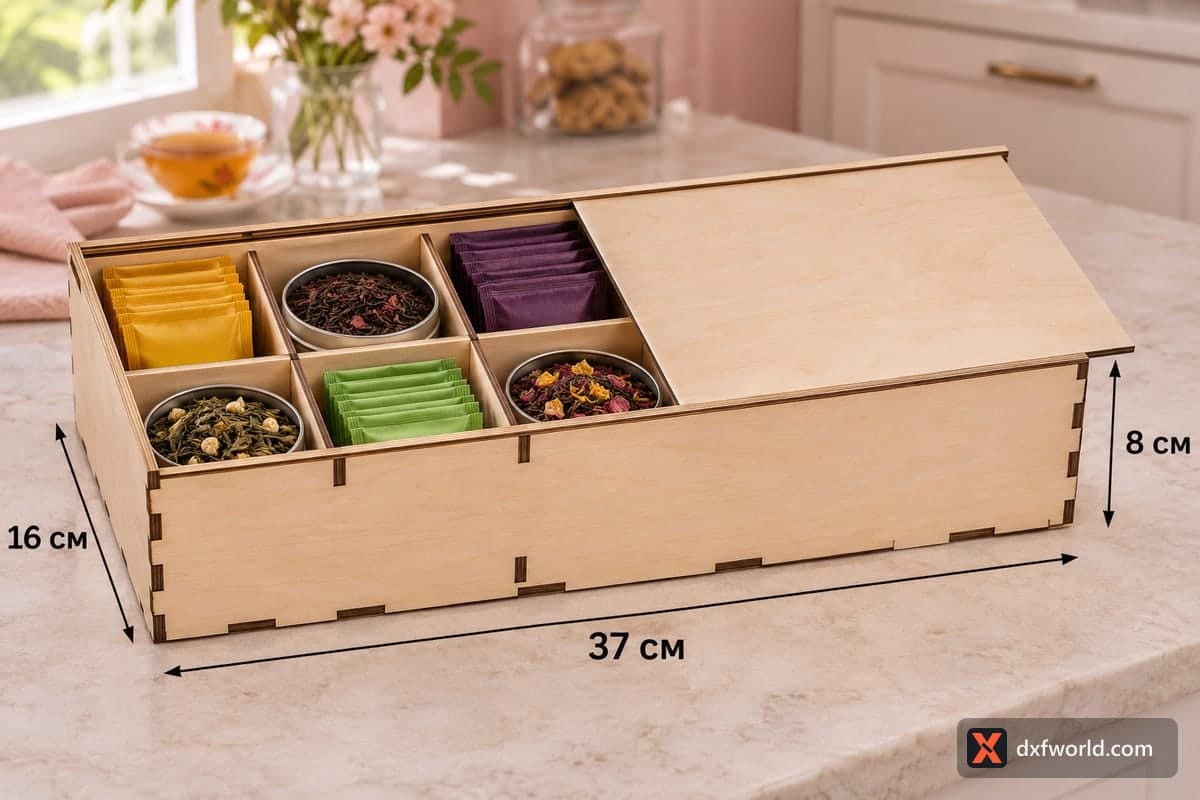
 Visualization
6 Compartment Sliding Tea Box SVG, Tea Sampler Gift Box Laser Cut File, Three Column Tea Bag Chest DXF
A free sliding lid tea box laser cut file in SVG and DXF, with separate versions for 3, 4, 5 and 6 mm plywood. The box is 370 × 160 × 80 mm (14.57 × 6.30 × 3.15 in), has six compartments in three columns and two rows, and is cut as 11 pieces that join with tabs and slots. The lid slides in along two rails on the side walls; there is no hinge and no lock.
- Formats
- SVG, DXF
- Outer size (W × D × H)
- 370 × 160 × 80 mm (14.57 × 6.30 × 3.15 in)
- Parts
- 11
- Material thickness
- 3, 4, 5 or 6 mm plywood (a file for each)
- Layout size (3 mm file)
- 1,454 × 332 mm
- Cut length
- 9.28 m
- Est. time, 10 W diode (3 mm)
- 30 min 56 s
- Est. time, 40 W CO2 (3 mm)
- 12 min 53 s
- Layers
- CUT only, no engraving
Free account required to download
How to make it
- 01Choose the file for your plywood thickness and cut one tab and slot pair on scrap to confirm the fit before the full run.
- 02Cut the 11 pieces: front, back, two sides, base, three dividers, two rails and the lid, spreading them over extra sheets on a small bed.
- 03Join the walls around the base, slot the long divider and the two short ones together inside, then fix the rails along the side walls.
- 04Slide the lid in to test it, ease any tight edge with sandpaper or wax, finish the box and fill the six sections.
Six sections under one lid
This long, low chest suits a drawer, a shelf or the back of the counter. Inside, a long divider runs the full length and two short ones cross it, making two rows of three sections, each roughly 12 cm wide. In the photo the back row holds yellow sachets, a tin of black tea with rose petals and a stack of purple envelopes; the front row has a tin of jasmine pearls, green tea bags and a tin of fruit and flower blend. The dividers stop below the rim, so the closed lid passes over them, and the front wall is a few millimetres lower than the back to let the lid slide in.
Making the lid run smoothly
The lid rides on two narrow rails fixed to the inside of the side walls. Fit the rails, then try the lid before any glue or finish goes on: it should glide with light pressure. If it sticks, sand the lid edges a little or rub them with paraffin or furniture wax. Keep lacquer thin on the rails and the lid edges, because a thick coat swells the fit.
For the 3 mm file, expect about 30 min 56 s on a 10 W diode, about 12 min 53 s on a 40 W CO2 and about 6 min 11 s on a 100 W CO2. The 3 mm sheet is 1454 × 332 mm, so on a smaller bed split the 11 pieces over two or three sheets. Thicker plywood of 5 or 6 mm needs a stronger laser or extra passes on a diode.
Gift and shop ideas
Fill it with six teas and give it as a tasting set for a birthday or a housewarming. The wide lid is a good spot for an engraved name or a botanical pattern, added in your own design software. Cafes can keep sachets dust-free in it behind the counter, and Etsy sellers can offer it empty or stocked with a sampler.
Questions about this file
What fits in each of the six tea sections?
Each section is about 12 cm wide and a little under 8 cm deep, which takes a stack of standard tea bags or a round tin of loose leaf tea lying flat.
Will the sliding lid fall out if I tip the box?
The lid slides freely along the rails and has no lock, so carry the box level or hold the lid when moving it.
Can I resize the sliding lid tea box?
Scaling is possible, but slot widths must stay equal to your plywood thickness and the lid must still match the rail gap, so check both after resizing.
Which plywood thickness suits a sliding lid box?
3 mm gives the lightest box and the easiest lid action; 4 mm feels sturdier for a box that is opened every day.
How do I protect it from steam near the kettle?
Seal the inside and outside with a water-based clear lacquer or hardwax oil, keeping the coat thin on the lid edges so it still slides.
Similar files