 Visualization
6 Compartment Hinged Tea Chest SVG, Two Row Tea Bag Storage Laser Cut File, Large Wooden Tea Box DXF
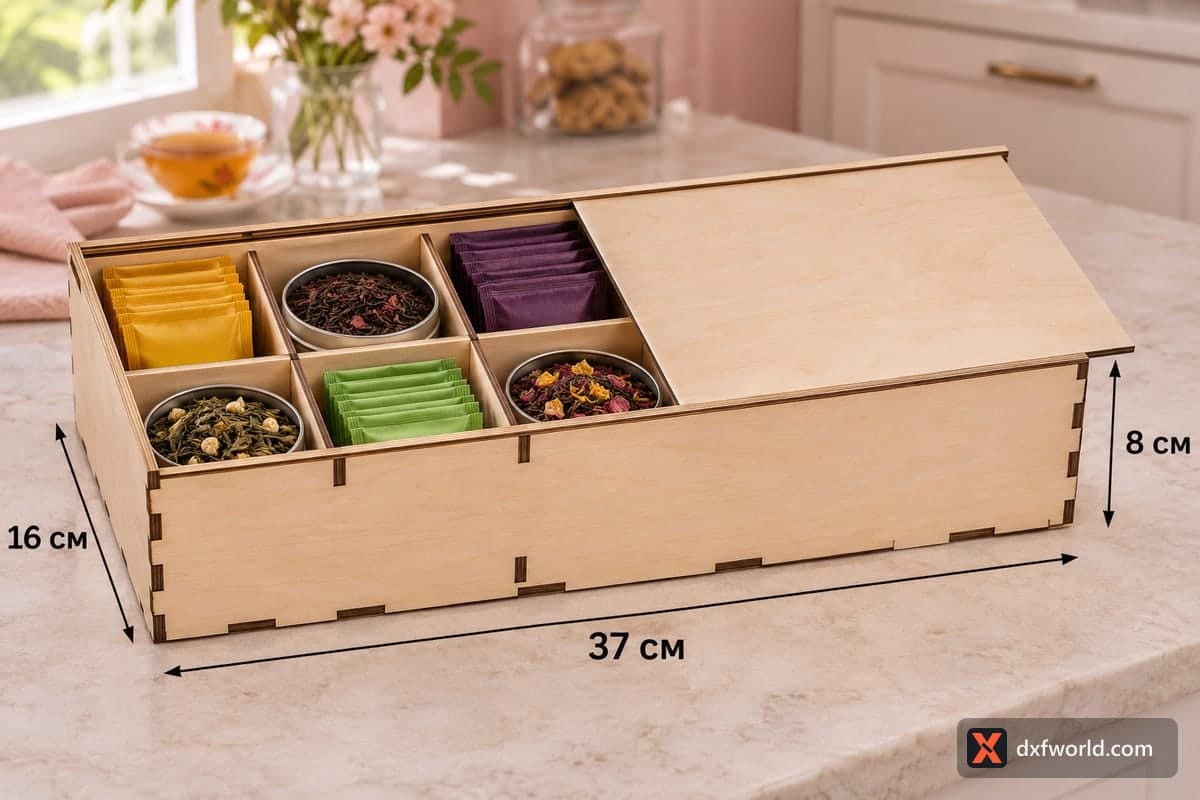
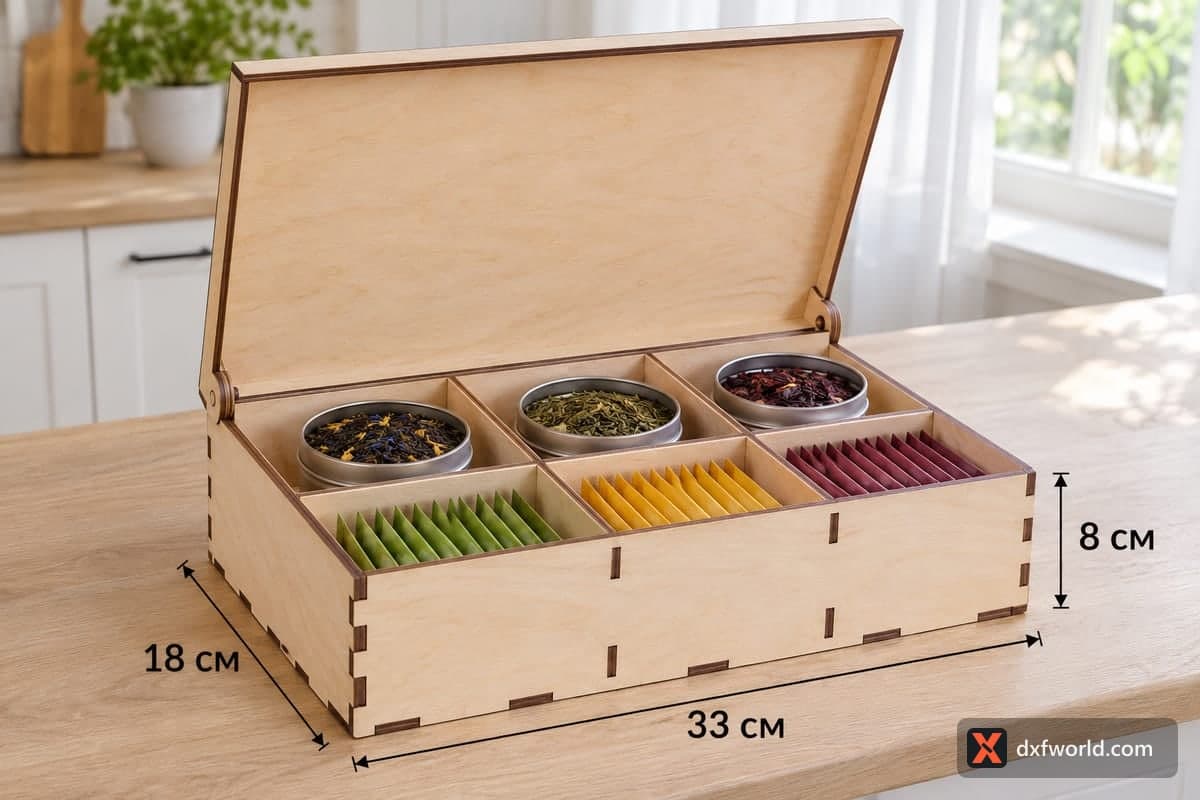
A free hinged tea chest laser cut file in SVG and DXF, with separate files for 3, 4, 5 and 6 mm plywood. It measures 330 × 180 × 80 mm (12.99 × 7.09 × 3.15 in), holds six compartments in two rows of three, and is cut as 9 pieces that fit together with tabs and slots. The lid pivots open at the back on pins cut into the plywood, so no metal hardware is needed.
- Formats
- SVG, DXF
- Outer size (W × D × H)
- 330 × 180 × 80 mm (12.99 × 7.09 × 3.15 in)
- Parts
- 9
- Material thickness
- 3, 4, 5 or 6 mm plywood (a file for each)
- Layout size (3 mm file)
- 1,040 × 457 mm
- Cut length
- 8.52 m
- Est. time, 10 W diode (3 mm)
- 28 min 24 s
- Est. time, 40 W CO2 (3 mm)
- 11 min 50 s
- Layers
- CUT only, no engraving
Free account required to download
How to make it
- 01Open the file for your plywood thickness and test-cut one slot and the lid pins on a scrap so you can feel the fit.
- 02Cut the 9 pieces: front, back, two sides with rounded backs, base, three dividers and the lid.
- 03Assemble the walls on the base, set the dividers in place, then fit the lid pins into the side panels and check that it swings freely.
- 04Sand the edges, seal the box, and fill the back row with tins and the front row with tea bags.
What sits inside
The chest is split into two rows of three equal compartments, each close to 10 cm wide and about 8 cm from front to back. The photo shows round tins of loose leaf in the back row (black tea with cornflower petals, a green leaf blend and dried hibiscus) and tea envelopes standing on edge in the front row, sorted green, yellow and berry red. Because the dividers are lower than the walls, the lid closes flat over everything and keeps dust and light off the tea.
The pivot lid and cutting
The two side panels rise slightly at the back with rounded tops, and the lid turns on pins cut into the plywood there, so it swings up without screws or bought hinges. Leave a hair of play: if the lid binds, sand the back edge until it turns freely before you add any finish.
On a 10 W diode the 3 mm file takes about 28 min 24 s; a 40 W CO2 needs about 11 min 50 s and a 100 W CO2 about 5 min 41 s. The 3 mm layout covers 1040 × 457 mm. That suits a large CO2 bed, but a compact diode machine will need the 9 pieces regrouped onto two or three sheets. A 10 W diode is comfortable with 3 mm in one or two passes; 5 and 6 mm sheets call for more power or repeated passes.
Gift and selling ideas
A filled chest with six favourite teas is a thoughtful present for a host, a teacher or a parent. The flat lid takes an engraved monogram, a wedding date or a tea leaf motif that you add to the design yourself. Sellers can list it in three finishes (natural, stained walnut, white-washed) and offer a personalised lid for a small extra charge. Finish the wood with clear lacquer or oil if it will live near the sink.
Questions about this file
Does the hinged tea chest need metal hinges?
No. The lid turns on pins cut into the plywood, so the whole chest is laser cut with nothing extra to buy.
How many tea bags fit in one compartment?
A compartment roughly 10 × 8 cm holds about 15 to 20 standard paper envelopes standing on edge, depending on the brand.
Can I scale the chest up for coffee pods?
Yes, but after scaling keep the slot and pin openings equal to your plywood thickness, otherwise the joints and the lid pivot will be loose.
Could I cut the hinged chest from MDF?
MDF cuts well and paints nicely, but the small lid pins are stronger in birch plywood, so use plywood if the lid will be opened often.
How can I personalise the lid?
Add a name, a date or a pattern as an engraving layer in your laser software before cutting; the file itself has cut lines only.
Similar files