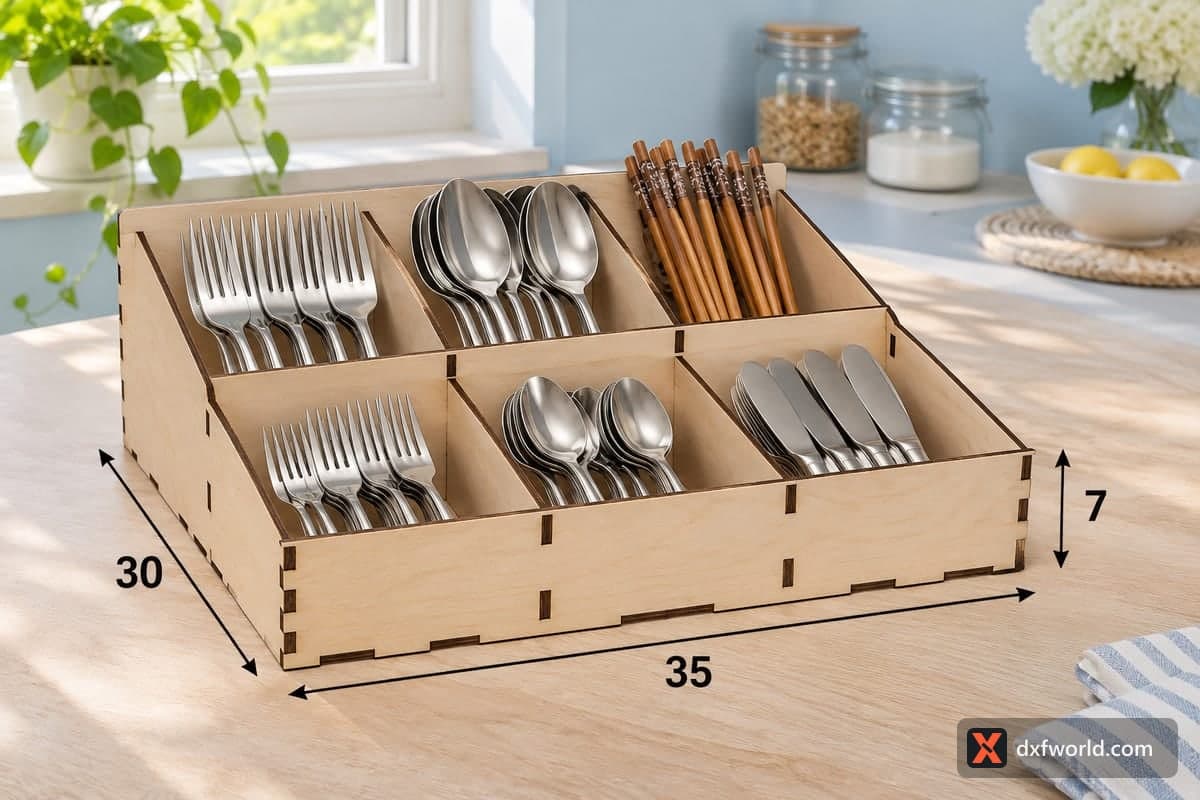
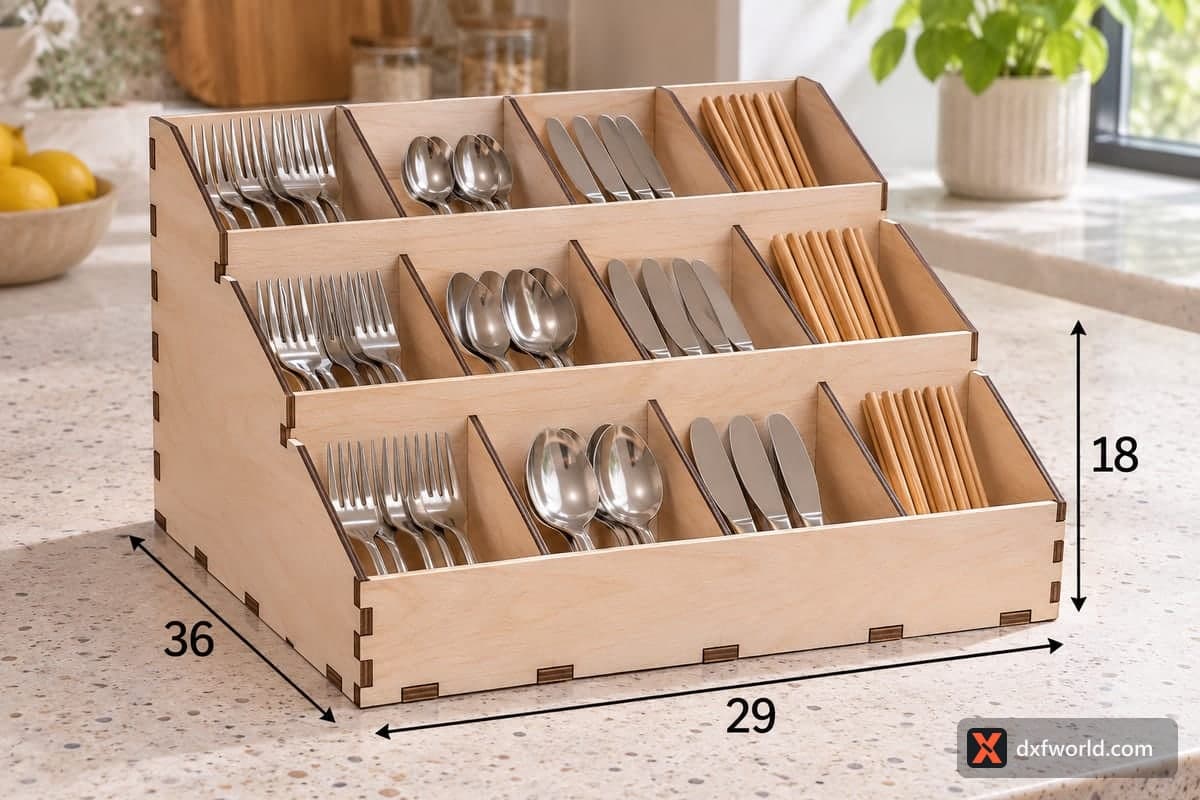
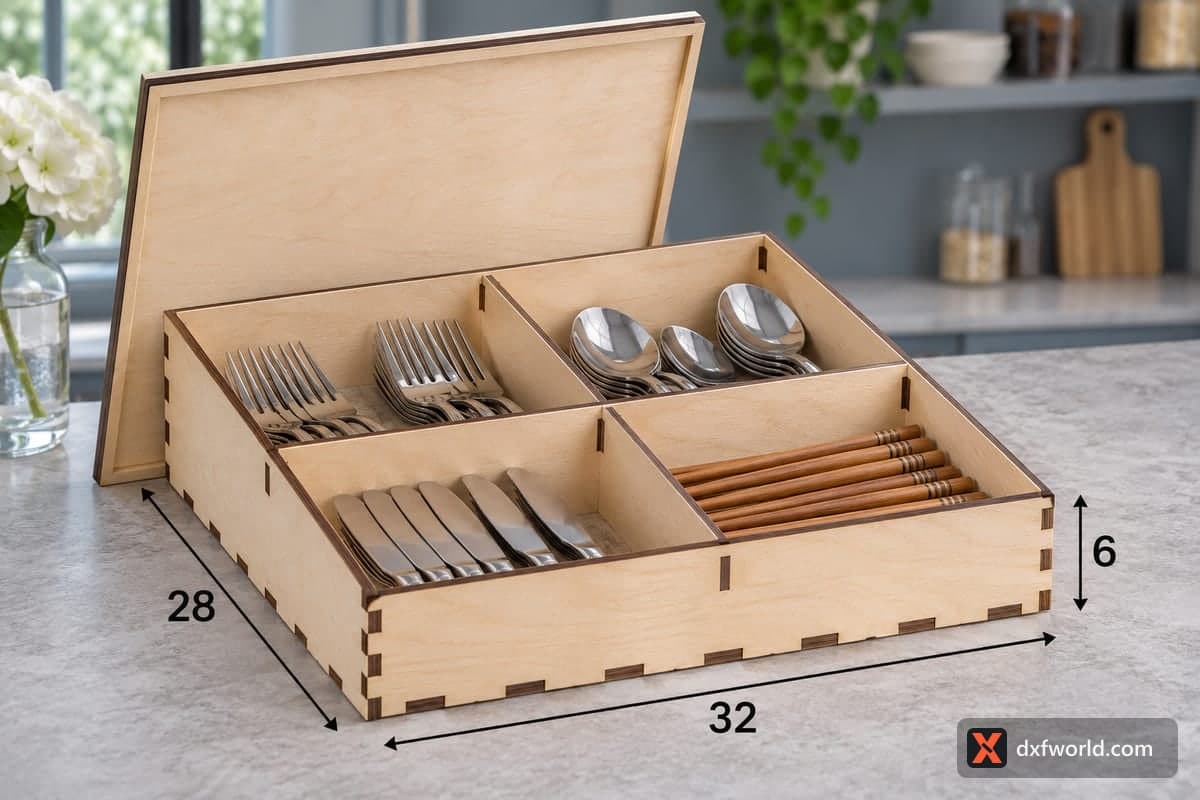
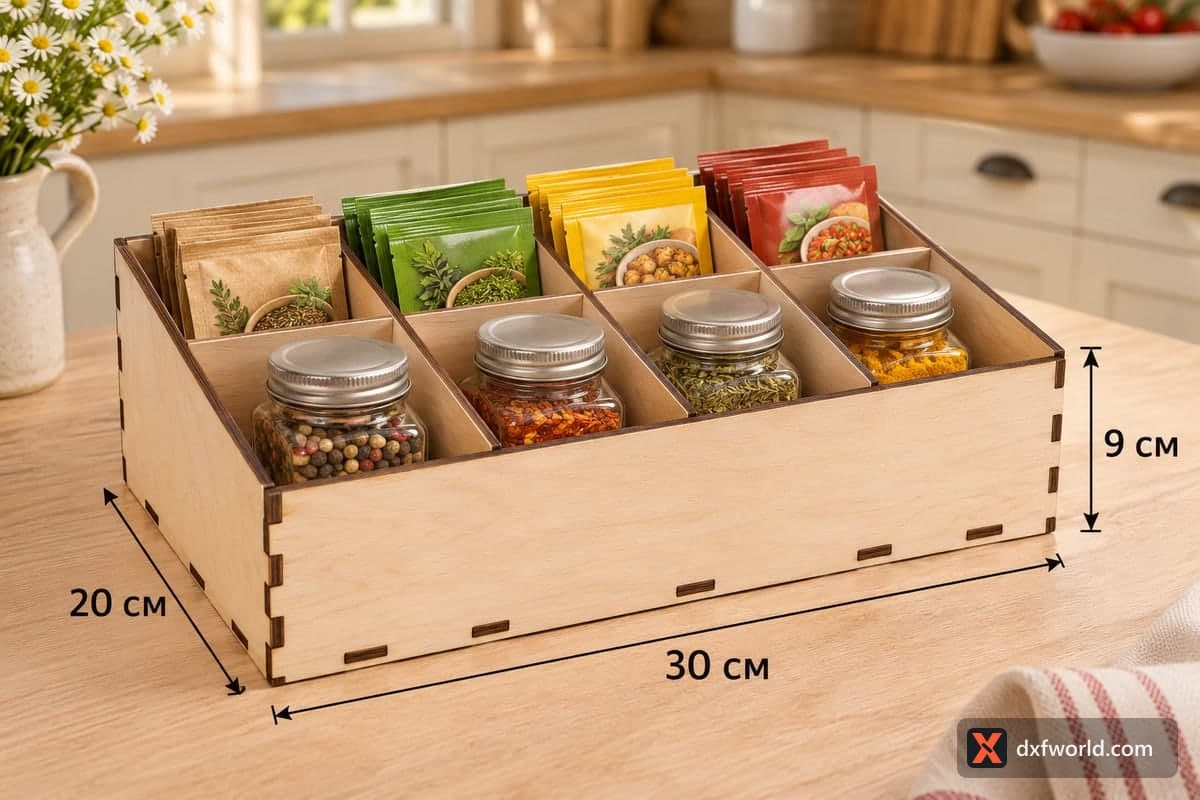
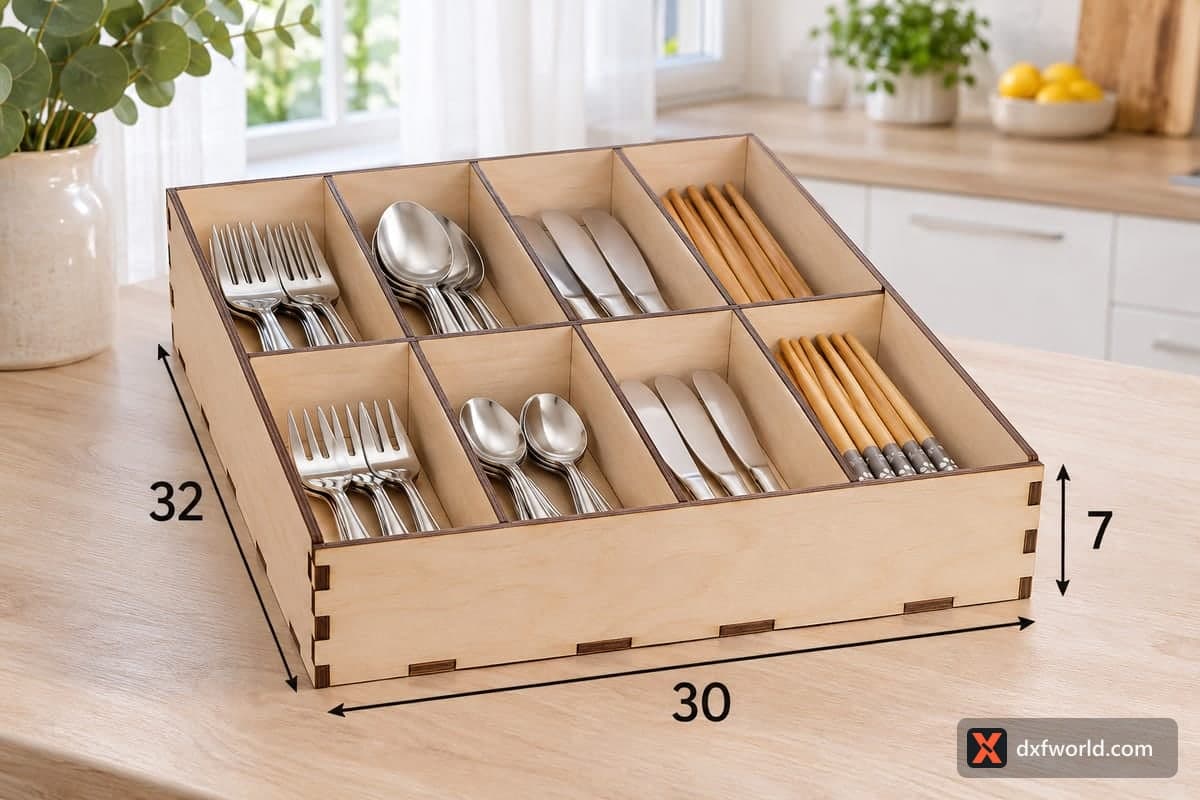
 Visualization
8 Compartment Cutlery Tray SVG, Two Row Silverware Drawer Organizer Laser Cut File, Large Flatware Insert DXF
A free laser cut file for an open cutlery drawer tray with eight compartments in two rows of four, 300 × 320 × 70 mm (11.81 × 12.60 × 2.76 in) outside, with straight full-height walls. The download holds SVG and DXF files for 3, 4, 5 and 6 mm plywood, and the 12 pieces lock together with tabs and slots.
- Formats
- SVG, DXF
- Outer size (W × D × H)
- 300 × 320 × 70 mm (11.81 × 12.60 × 2.76 in)
- Parts
- 12
- Material thickness
- 3, 4, 5 or 6 mm plywood (a file for each)
- Layout size (3 mm file)
- 1,271 × 476 mm
- Cut length
- 9.34 m
- Est. time, 10 W diode (3 mm)
- 31 min 07 s
- Est. time, 40 W CO2 (3 mm)
- 12 min 58 s
- Layers
- CUT only, no engraving
Free account required to download
How to make it
- 01Pick the SVG or DXF that matches your plywood (3, 4, 5 or 6 mm) and cut one slot on an offcut to check that a tab slides in firmly.
- 02Cut the 12 pieces, moving the base onto its own sheet if the 1271 mm layout is longer than your laser bed.
- 03Seat the long cross divider in the base, push the three back-row and three front-row dividers into their slots, then add the back, the two sides and the front.
- 04Sand the edges, seal the tray with food-safe oil, and sort forks, spoons, knives and chopsticks into the eight bays.
Two rows, eight bays
One cross divider runs the full 300 mm width and splits the tray into a front row and a back row. Three short dividers in each row then cut those rows into four bays apiece, each a little over 7 cm wide and roughly 15 cm deep. In the kitchen photo the back row holds dinner forks, tablespoons, table knives and a bundle of wooden chopsticks, and the front row repeats the pattern with dessert forks, teaspoons, butter knives and a second pair set. That mirrored layout works well for a family drawer: everyday pieces at the back, the smaller set within easy reach at the front. All walls are 70 mm tall, so long handles stay inside the tray when the drawer slides shut.
Cutting and fitting the pieces
The 3 mm layout is 1271 × 476 mm, longer than most hobby beds. Put the 300 × 320 mm base on one sheet and the walls plus the seven dividers on a second; nothing else needs to change. A 10 W diode needs about 31 min 07 s for the 3 mm file, a 40 W CO2 about 12 min 58 s and a 100 W CO2 about 6 min 13 s. For 5 or 6 mm stock plan on extra passes with a diode, or use a tube laser.
Measure your drawer before you cut: 300 mm wide and 320 mm deep fits most standard kitchen drawers with room to spare.
Finish and selling ideas
Sand the scorch off every edge, then wipe on food-safe oil or a clear lacquer so damp cutlery does not mark the birch. Tabs hold without glue, but a dab of wood glue on the base joints keeps the tray square for years.
- A housewarming gift with a new cutlery set already sorted inside
- A matched pair for kitchen and picnic basket, sold as a set at craft fairs
- An Etsy listing with the four back bays labelled by an engraving you add
Questions about this file
Which pieces of cutlery fit in the bays?
Each bay is about 7 cm wide and 15 cm deep, which suits dinner and dessert forks, spoons, table knives and chopsticks. Serving spoons and long ladles are too long for a single bay.
My drawer is narrower than 300 mm. Can I shrink the tray?
Change the outer size in your drawing program but keep every slot the width of your plywood. Shrinking the whole file proportionally also narrows the slots, and the tabs will no longer fit.
Is 3 mm plywood strong enough for a cutlery drawer?
Yes, 3 mm birch is stiff enough for a 70 mm tall tray with this many dividers. Choose 4 or 5 mm if the tray will be lifted out and carried to the table full of heavy steel.
How do I keep wet cutlery from staining the wood?
Let cutlery dry before it goes in, and coat the inside with two thin layers of food-safe oil or water-based lacquer. Reapply oil once a year if the bottom starts to look dry.
Can I cut it from MDF or acrylic instead?
Both work if you pick the file that matches the sheet thickness. MDF swells when it gets wet, so seal it well, and acrylic gives a clean, wipeable tray for a modern kitchen.
Similar files