 Visualization
Tiered Spice Rack SVG, 3 Step Spice Shelf Laser Cut File, Spice Pouch Display Stand DXF
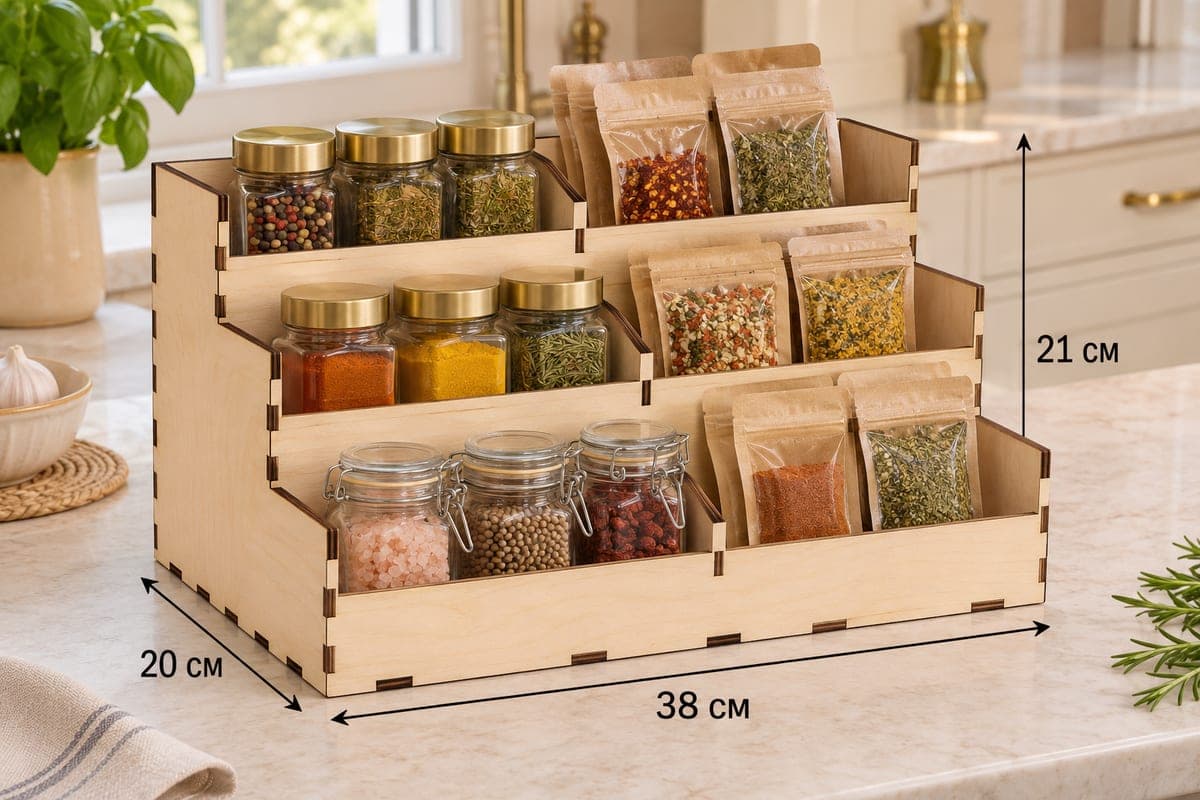
A free laser cut file for a three-step tiered spice rack in which every step is split by one divider into a jar side and a pouch side, six compartments in total. The download has SVG and DXF files for 3, 4, 5 and 6 mm plywood; the rack measures 380 × 200 × 210 mm (14.96 × 7.87 × 8.27 in), is built from 12 pieces joined with tabs and slots, and has small part numbers engraved on the pieces to help with assembly.
- Formats
- SVG, DXF
- Outer size (W × D × H)
- 380 × 200 × 210 mm (14.96 × 7.87 × 8.27 in)
- Parts
- 12
- Material thickness
- 3, 4, 5 or 6 mm plywood (a file for each)
- Layout size (3 mm file)
- 1,540 × 337 mm
- Cut length
- 10.66 m
- Est. time, 10 W diode (3 mm)
- 35 min 32 s
- Est. time, 40 W CO2 (3 mm)
- 14 min 48 s
- Layers
- CUT only, no engraving
Free account required to download
How to make it
- 01Choose the file for your plywood, then cut a test slot and check that a scrap of the same sheet slides in snugly.
- 02Cut the twelve numbered pieces, splitting the 1540 mm layout onto smaller sheets where your bed requires it.
- 03Slot the three shelves, two step boards and the brace into one side panel, add the front board, close with the second side and press in one divider per step.
- 04Sand the step edges, seal with clear lacquer, and put jars on one side of each step and pouches on the other.
Jars on the left, pouches on the right
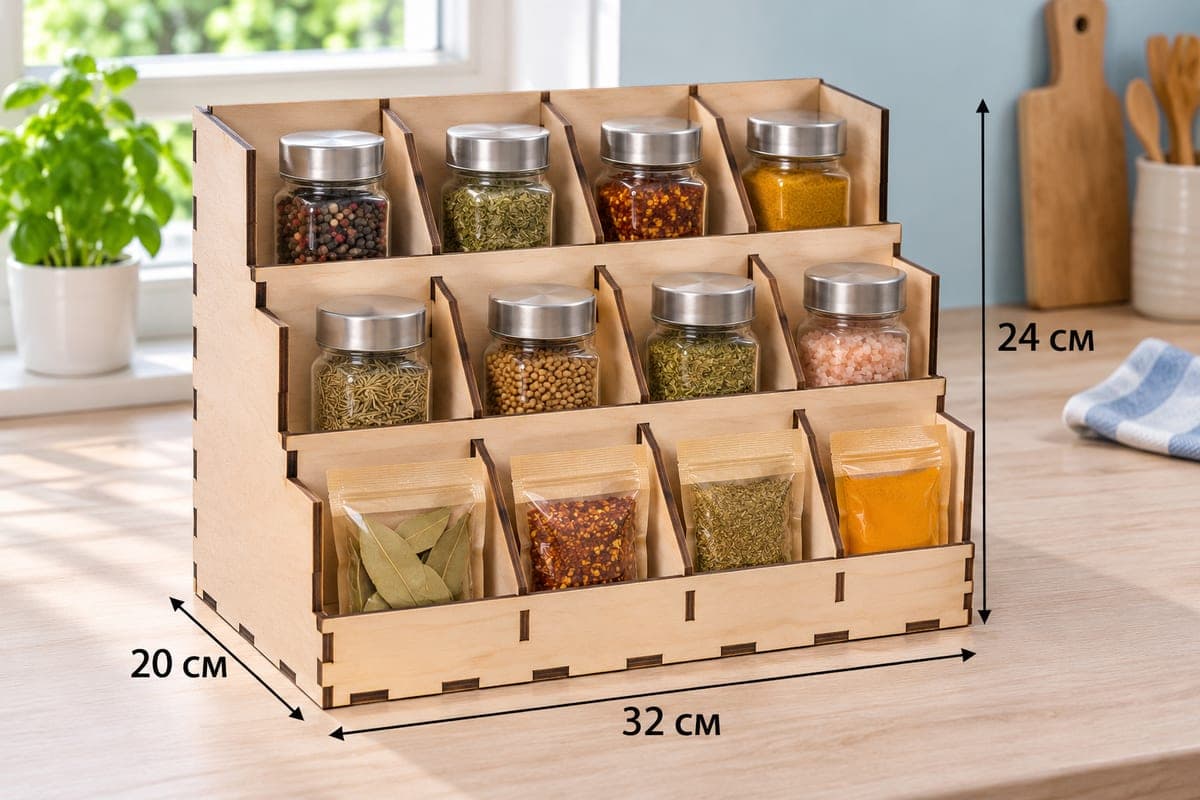
This stand climbs in three steps to a height of 210 mm across a 380 mm width. One divider on each step splits it into two bays, so you get six compartments arranged as two columns. In the photo the left column holds round jars: clip-top jars of salt, peppercorns and chili on the bottom step, gold-lidded jars of paprika and turmeric in the middle and peppercorn and herb jars at the top. The right column keeps kraft stand-up pouches upright, a handy home for refills bought in bulk.
The lowest shelf is 83.7 mm deep and the two upper shelves are 76.1 mm, enough for a standard jar with a little room behind it. A 63 mm front board stops anything from sliding off the bottom step.
Building the stand
There are two stepped sides, a front board, two step boards, three shelves, a brace across the back and three dividers. Every piece carries a small engraved number, which saves guessing between the shelves and step boards that look nearly alike. The 3 mm layout is 1540 × 337 mm, so most hobby lasers need it spread over two or three sheets; the 380 mm boards are the longest pieces.
For the 3 mm file the cut takes about 35 min 32 s on a 10 W diode, about 14 min 48 s on a 40 W CO2 and about 7 min 06 s on a 100 W CO2. Thicker 5 or 6 mm plywood makes a sturdier rack for heavy glass but needs a stronger laser or extra passes.
Where it earns its place
It suits an open shelf, a pantry or the back of a counter. Small spice shops can use it as a counter display with jars for sniffing on one side and packed pouches for sale on the other.
Questions about this file
Do spice pouches stay upright on the steps?
Yes, the divider on each step works as a bookend on one side and the side panel holds the other, so stand-up pouches lean on each other instead of falling over.
Why are there numbers on the rack pieces?
Small part numbers are engraved so you can match each shelf and step board to its place quickly. Apart from those numbers, the file holds cut lines only.
Which thickness is best for a rack this tall?
4 mm birch plywood is a good middle choice for a 210 mm stand full of glass jars. Use 3 mm for lighter loads and 5–6 mm if you want it extra rigid.
Can I add more dividers to a step?
You can draw extra slots in a vector editor, keeping each slot as wide as your plywood. The supplied file has one divider per step.
Will grease from cooking stain it?
Raw plywood absorbs oil, so give it two coats of water-based lacquer or hardwax oil before use. After that it wipes clean with a damp cloth.
Similar files