 Visualization
Tiered Flatware Rack SVG, Three Step Cutlery Display Stand Laser Cut File, Buffet Silverware Caddy DXF
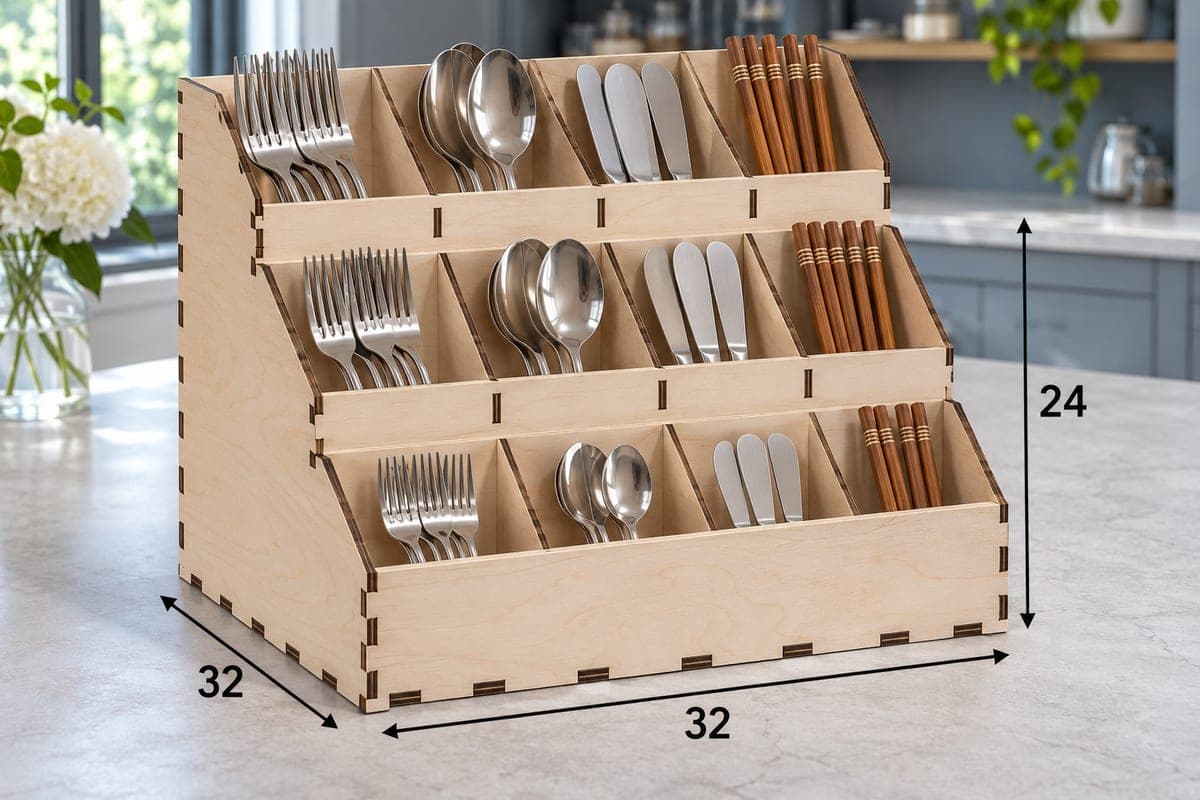
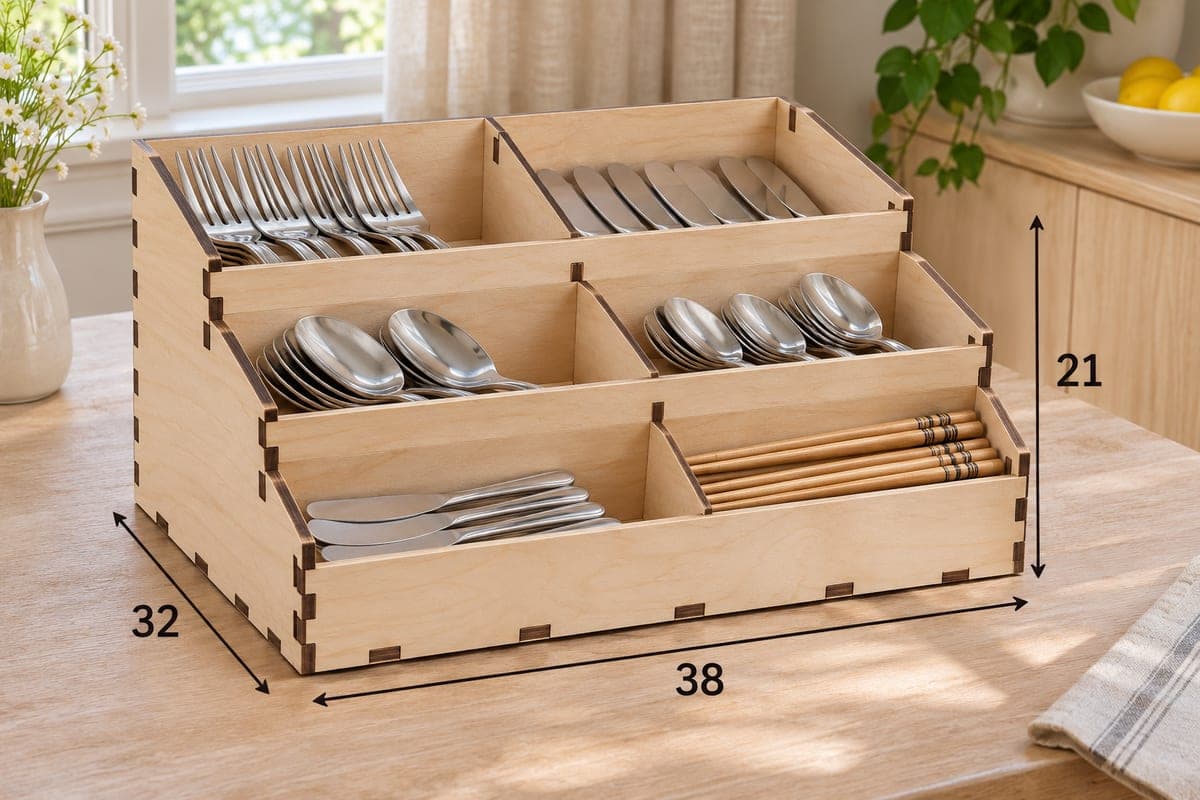
A tiered flatware rack with three steps rising to the back, each step split by one divider into two bins, six bins in total. It measures 380 × 320 × 210 mm (14.96 × 12.60 × 8.27 in), is made of 12 plywood pieces joined with tabs and slots and marked with small engraved part numbers, and is a free SVG and DXF download with separate files for 3, 4, 5 and 6 mm plywood.
- Formats
- SVG, DXF
- Outer size (W × D × H)
- 380 × 320 × 210 mm (14.96 × 12.60 × 8.27 in)
- Parts
- 12
- Material thickness
- 3, 4, 5 or 6 mm plywood (a file for each)
- Layout size (3 mm file)
- 1,540 × 379 mm
- Cut length
- 12.01 m
- Est. time, 10 W diode (3 mm)
- 40 min 03 s
- Est. time, 40 W CO2 (3 mm)
- 16 min 41 s
- Layers
- CUT only, no engraving
Free account required to download
How to make it
- 01Choose the file for your plywood and test-fit one shelf tab in a side panel slot before cutting the full set.
- 02Cut all 12 parts, leaving the engraved numbers on so you can tell the shelves and step boards apart.
- 03Join the two side panels with the three shelves, then add the front board, both step boards and the rear brace, and push the three dividers into place.
- 04Sand the shelf edges, seal with lacquer for wipe-clean use and fill the six bins from the top step down.
Six bins on three levels
Each tier sits higher and further back than the one in front, so every handle stays in view from the front. The photo shows dinner forks and butter knives on the top step, two groups of soup spoons in the middle and table knives beside a bundle of chopsticks at the bottom. On the lowest step the divider sits off-centre, giving one wide bin for knives and a narrow one that suits chopsticks or straws. Shelves are about 116 to 124 mm deep, which takes full-length cutlery lying flat with the handles facing you.
The stand is 210 mm tall at the back, so it belongs on a counter, a buffet table or an open shelf rather than inside a drawer. For a cafe or a self-service breakfast corner it keeps six kinds of cutlery apart in a footprint smaller than an A3 sheet.
Cutting the twelve parts
The 3 mm sheet is 1540 × 379 mm. The three shelves and the board pieces are all 380 mm long, so on a compact laser lay them out over two or three sheets. Cutting time for the 3 mm file is about 40 min 03 s with a 10 W diode, about 16 min 41 s with a 40 W CO2 and about 8 min 01 s with a 100 W CO2.
Every piece carries a small engraved number, which helps because the shelves and step boards look much alike. Fit both sides to the shelves first, then add the front board, the step boards and the brace at the back, and push the three dividers in last.
Where it earns its place
- Wedding and party buffets: set it next to the plates and guests serve themselves.
- Coffee shops and bakeries: engrave your logo on the side panels.
- Sell matching pairs for long tables or catering stands.
Questions about this file
Is this stand meant for a drawer?
No, at 210 mm tall it is made for a counter, buffet or shelf. For a drawer, pick one of the flat cutlery trays instead.
Why do the dividers sit in different places on each step?
They split each tier into two bins of different widths, so you can give the bulky pieces the wider bin and chopsticks or teaspoons the narrow one.
What are the numbers engraved on the pieces?
They are small part numbers that match the assembly order and make the similar shelves easy to sort. You can sand them off after assembly if you prefer clean faces.
Can I scale it for a smaller counter?
You can, but scale only the outline and keep every slot equal to your plywood thickness, or the tabs will be loose or will not fit.
How do I make it easy to clean at a busy buffet?
Two coats of water-based polyurethane let you wipe off spills and crumbs. Avoid soaking it, since plywood edges still take in water.
Similar files