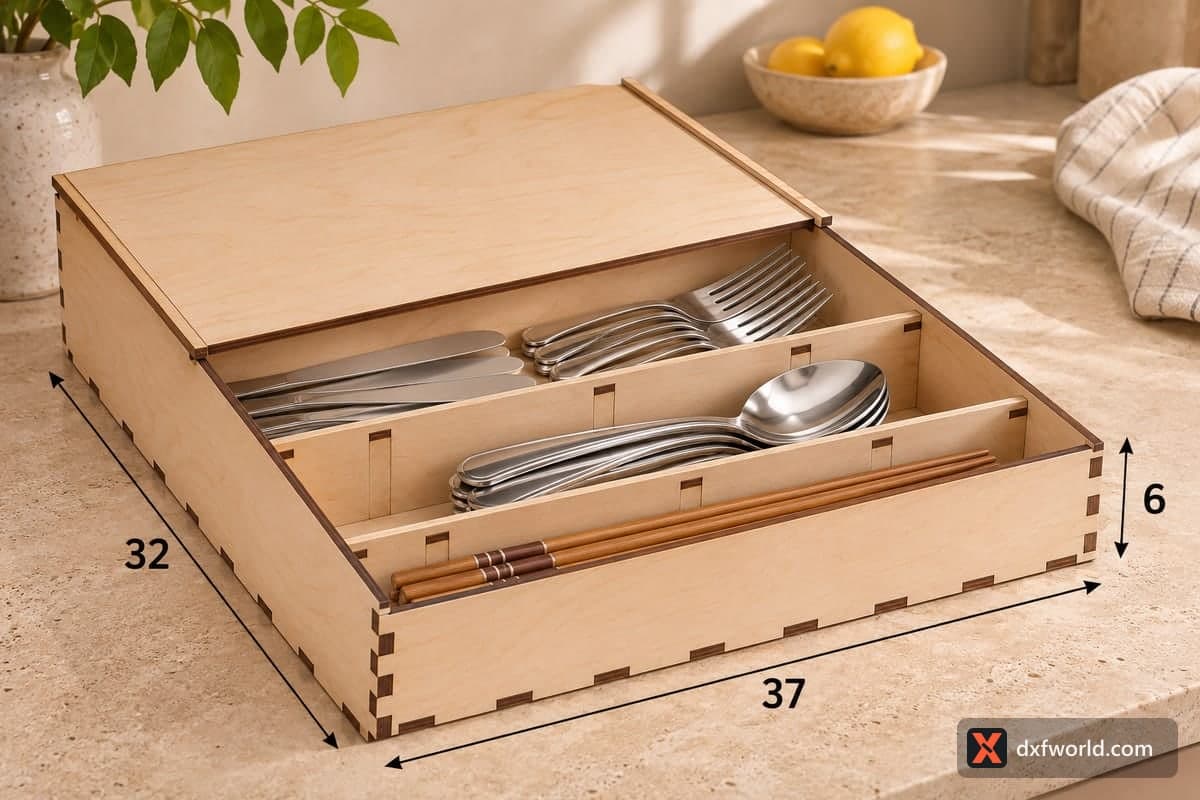
 Visualization
Three Lane Cutlery Box SVG, Sliding Lid Silverware Storage Laser Cut File, Covered Knife and Fork Box DXF
A free laser cut file for a wide cutlery box with a sliding lid, 370 × 320 × 60 mm (14.57 × 12.60 × 2.36 in) outside, split into three long lanes that run from side to side. The download contains SVG and DXF for 3, 4, 5 and 6 mm plywood; the 10 pieces join with tabs and slots, and the lid slides in on two rails with no hinge or lock.
- Formats
- SVG, DXF
- Outer size (W × D × H)
- 370 × 320 × 60 mm (14.57 × 12.60 × 2.36 in)
- Parts
- 10
- Material thickness
- 3, 4, 5 or 6 mm plywood (a file for each)
- Layout size (3 mm file)
- 1,435 × 716 mm
- Cut length
- 11.44 m
- Est. time, 10 W diode (3 mm)
- 38 min 08 s
- Est. time, 40 W CO2 (3 mm)
- 15 min 54 s
- Layers
- CUT only, no engraving
Free account required to download
How to make it
- 01Pick the file for your sheet thickness and test-cut one rail plus a strip of lid edge to confirm the lid will glide.
- 02Cut the ten pieces over three or four sheets; both the base and the lid need a work area of at least 370 × 320 mm.
- 03Join the base, back and two sides, add the lower front, slot in both long dividers, then glue the rails along the inside of the side walls.
- 04Sand the lid edges, rub wax on the rails, oil the box and lay knives, forks and spoons in their lanes before sliding the lid shut.
Three long lanes across the box
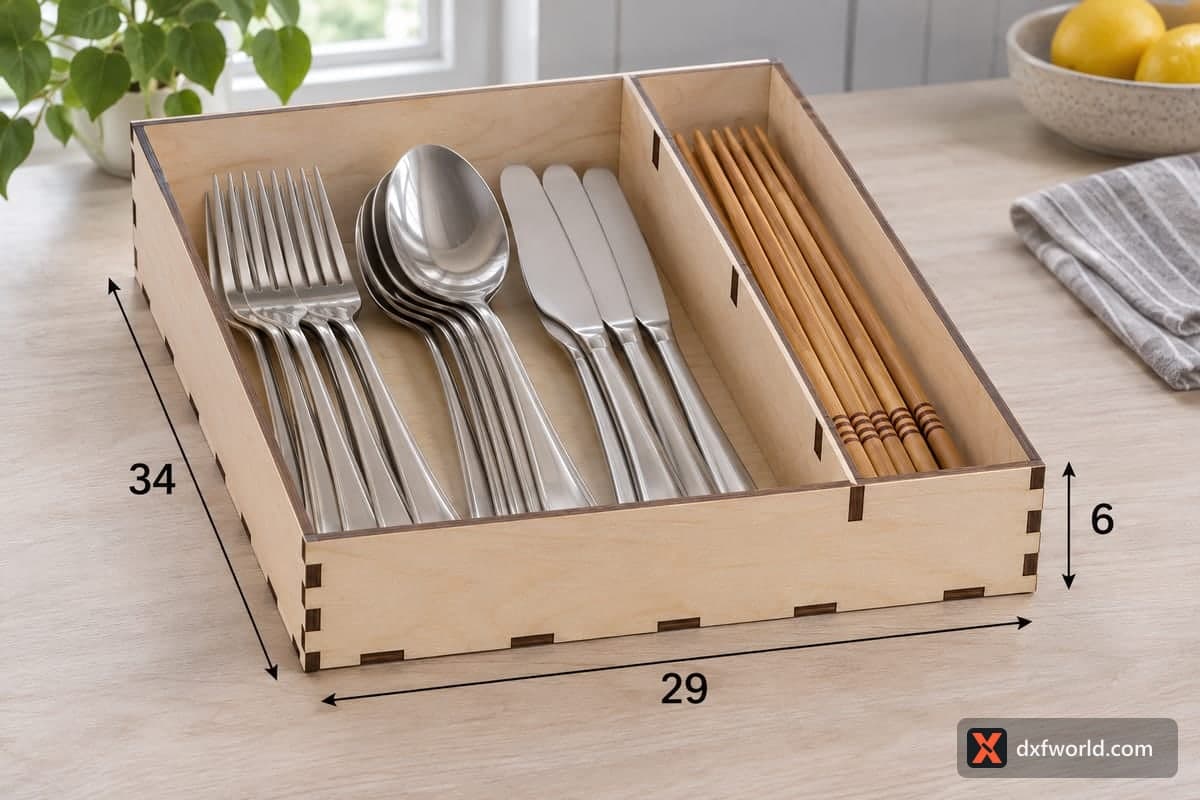
Two dividers, each 364 mm long, run across the full width and split the inside into three lanes roughly 10 cm deep and about 36 cm long. Because the lanes are so long, cutlery lies sideways in one straight line: dinner knives, salad servers, a cake slice or a ladle handle all fit without angling. In the photo the back lane holds table knives next to dinner forks, the middle lane a stack of tablespoons and the front lane a pair of wooden chopsticks.
The dividers are 43.5 mm tall, well under the 60 mm back wall. That gap gives the lid room to pass over them and lets you lift a fork out of the back lane without catching the front ones.
The lid and the cut
The lid is a 363.4 × 319.7 mm panel that runs along two 317 mm rails fixed inside the side walls. The front wall is 53.7 mm, a little lower than the back, so the lid slides out over it from the front.
Cutting the 3 mm file takes about 38 min 08 s on a 10 W diode, about 15 min 54 s on a 40 W CO2 and about 7 min 38 s on a 100 W CO2. The full layout is 1435 × 716 mm, so most people split it over three or four sheets. The base and the lid are each about 37 × 32 cm, which sets the minimum bed size. Pick a flat sheet for the lid; a bowed panel will jam on the rails.
Who buys a box like this
- Families who keep the good silver in a sideboard and want it dust free
- Caterers carrying serving spoons and tongs to events
- Couples, as a wedding gift with names engraved on the lid by the maker
Questions about this file
Do the lanes take serving spoons and salad servers?
Yes. Each lane is about 36 cm long, so most serving pieces lie flat end to end.
What is the gap above the 43.5 mm dividers for?
At 43.5 mm they leave clearance for the sliding lid and make it easy to lift pieces out of the back lane.
Can the lid be locked for travel?
The file has no lock. For a picnic or catering trip, wrap a leather strap or a wide elastic band around the closed box.
Is a 3 mm or 4 mm lid better at this width?
A 3 mm lid is light and slides easily but can bow at this width; 4 mm stays flatter. Use the file that matches the sheet you actually have.
How do I stop the cutlery from rattling?
Line each lane with a strip of felt or thin cork cut to size. It also protects plated silver from scratches.
Similar files