 Visualization
Cutlery Tray with Chopstick Lane SVG, Two Bay Kitchen Drawer Insert Laser Cut File, Simple Flatware Divider DXF
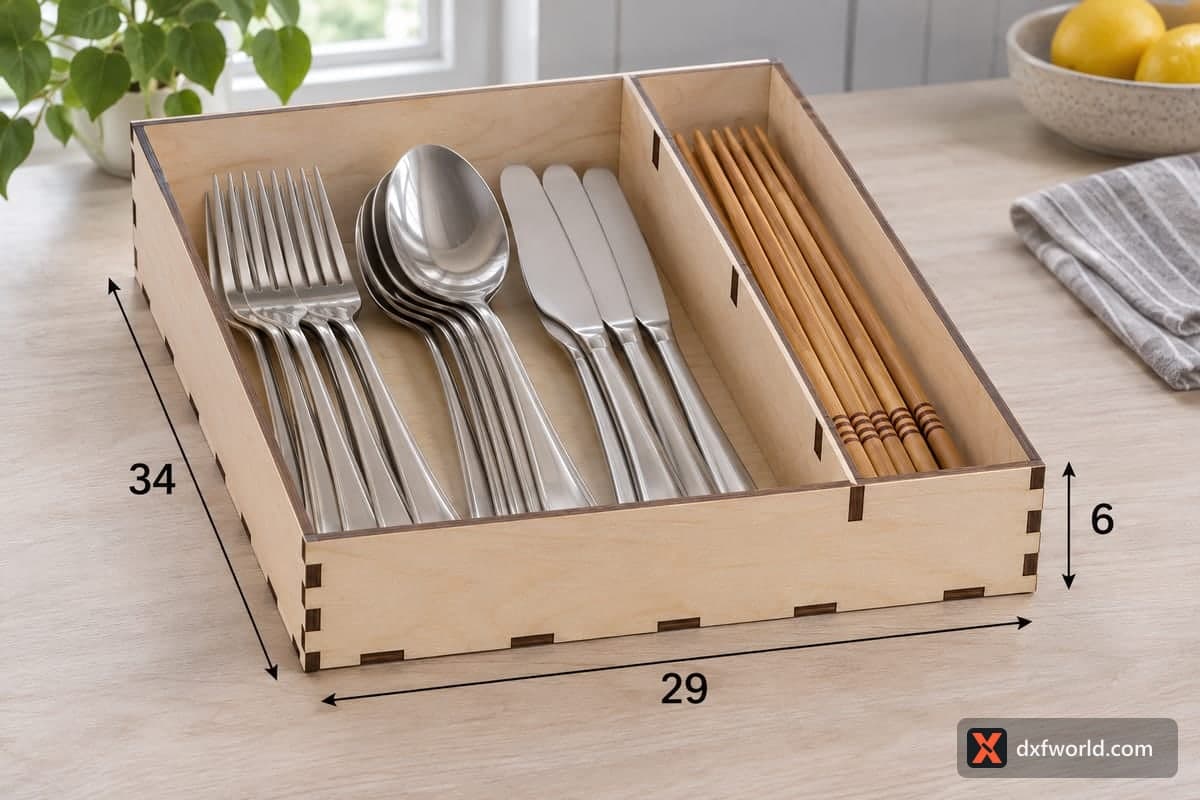
A free laser cut file for an open two-section cutlery tray, 290 × 340 × 60 mm (11.42 × 13.39 × 2.36 in) outside, with one wide bay and one narrow lane separated by a single full-length divider. The download has SVG and DXF for 3, 4, 5 and 6 mm plywood, and the 6 pieces slot together with tabs, which makes it one of the quickest trays to cut and build.
- Formats
- SVG, DXF
- Outer size (W × D × H)
- 290 × 340 × 60 mm (11.42 × 13.39 × 2.36 in)
- Parts
- 6
- Material thickness
- 3, 4, 5 or 6 mm plywood (a file for each)
- Layout size (3 mm file)
- 1,280 × 412 mm
- Cut length
- 6.53 m
- Est. time, 10 W diode (3 mm)
- 21 min 46 s
- Est. time, 40 W CO2 (3 mm)
- 9 min 04 s
- Layers
- CUT only, no engraving
Free account required to download
How to make it
- 01Choose the SVG or DXF for your plywood and test one divider slot on scrap before committing a full sheet.
- 02Cut the six parts; the 1280 × 412 mm layout splits neatly into two sheets on a mid-size bed.
- 03Fit the front, back and both sides into the base, then push the long divider into its off-centre slots.
- 04Round the top edges with fine sandpaper, oil the tray and set it in the drawer with the narrow lane against the wall.
One wide bay, one narrow lane
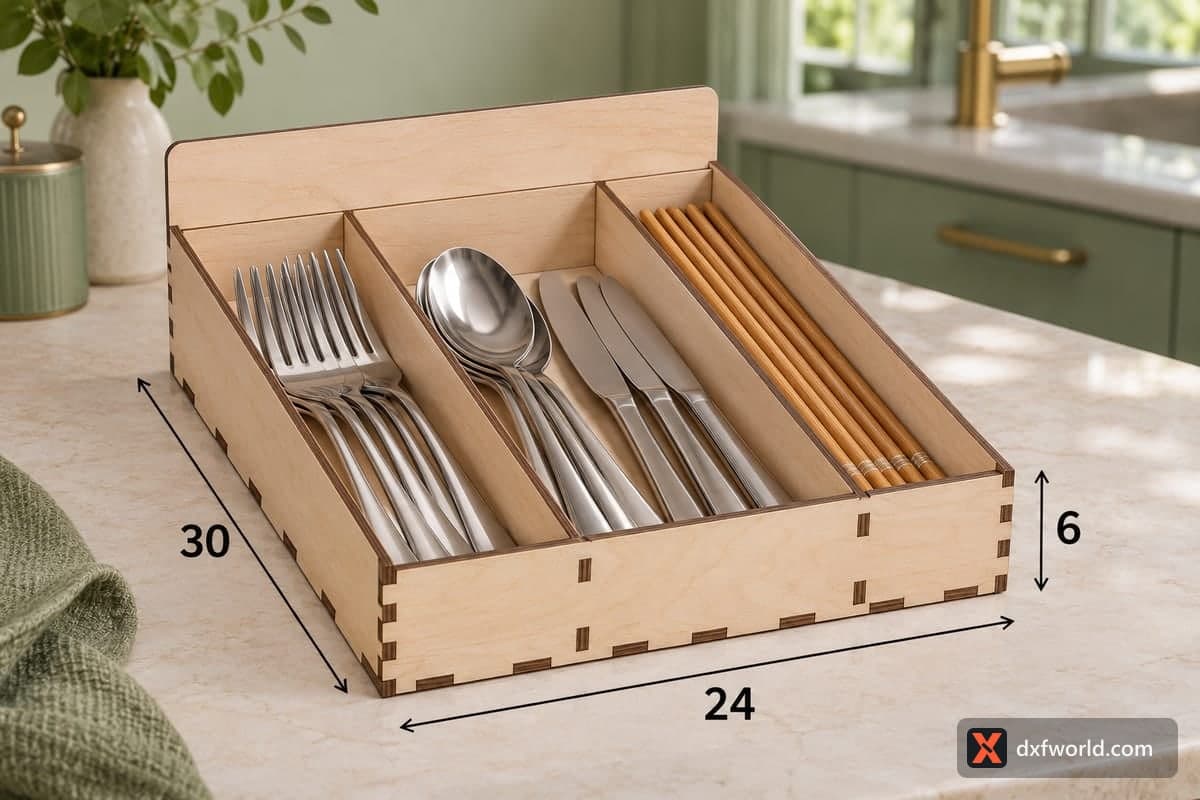
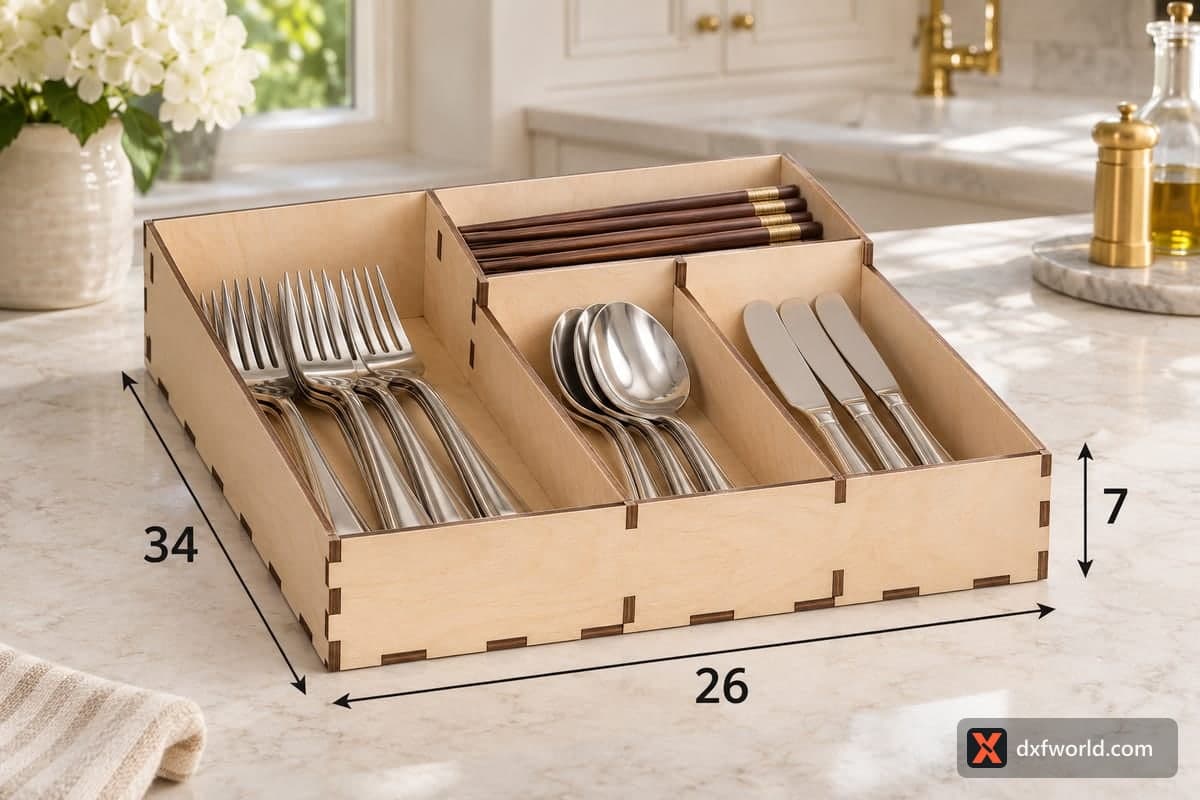
A single 340 mm divider runs from front to back, set off-centre: the main bay is roughly 19.5 cm wide and the side lane about 8.5 cm. Both use almost the whole 33 cm inside depth, so dinner knives, forks and long chopsticks lie flat with room to spare. In the photo forks, spoons and knives share the wide bay in three loose groups and a bundle of chopsticks fills the lane.
If you prefer every type in its own space, cut two extra strips from offcuts, about 55 mm tall and 33 cm long, and glue them to the base inside the wide bay. That turns the tray into four lanes without changing the file.
As a drawer insert it needs an inside floor of at least 290 × 340 mm and a drawer with more than 60 mm of clear height. Measure before cutting; a few millimetres too wide and it will not drop in.
Six parts, quick to build
The 3 mm file takes about 21 min 46 s on a 10 W diode, about 9 min 04 s on a 40 W CO2 and about 4 min 21 s on a 100 W CO2. The layout is 1280 × 412 mm; on a smaller bed, cut the front, back and divider on one sheet and the base and sides on another. With only six pieces it is a good first project for a new laser owner.
Selling and gift ideas
- A budget listing for buyers who just want a tidy drawer
- A sushi-lover gift: tray, a set of chopsticks and a pack of rests
- A pair of trays for a wide drawer, one for cutlery and one for utensils
Questions about this file
Is the divider in the middle?
No, it sits off-centre. You get a main bay of roughly 19.5 cm and a side lane of about 8.5 cm.
What fits in the narrow side lane?
Chopsticks, steak knives, teaspoons or a vegetable peeler. It is also handy for a few bag clips.
Can I add more compartments?
Yes, glue extra plywood strips from your offcuts inside the wide bay. Keep them a little lower than the walls so the tray still fits under the drawer above.
Can I cut it from MDF or acrylic?
MDF works with the matching file but should be sealed against moisture. Acrylic is fine too, though its slots do not give at all, so test the fit first.
Does it need glue?
The tabs hold the six parts firmly without it. A thin bead of wood glue along the base makes the tray rigid if you lift it out often.
Similar files