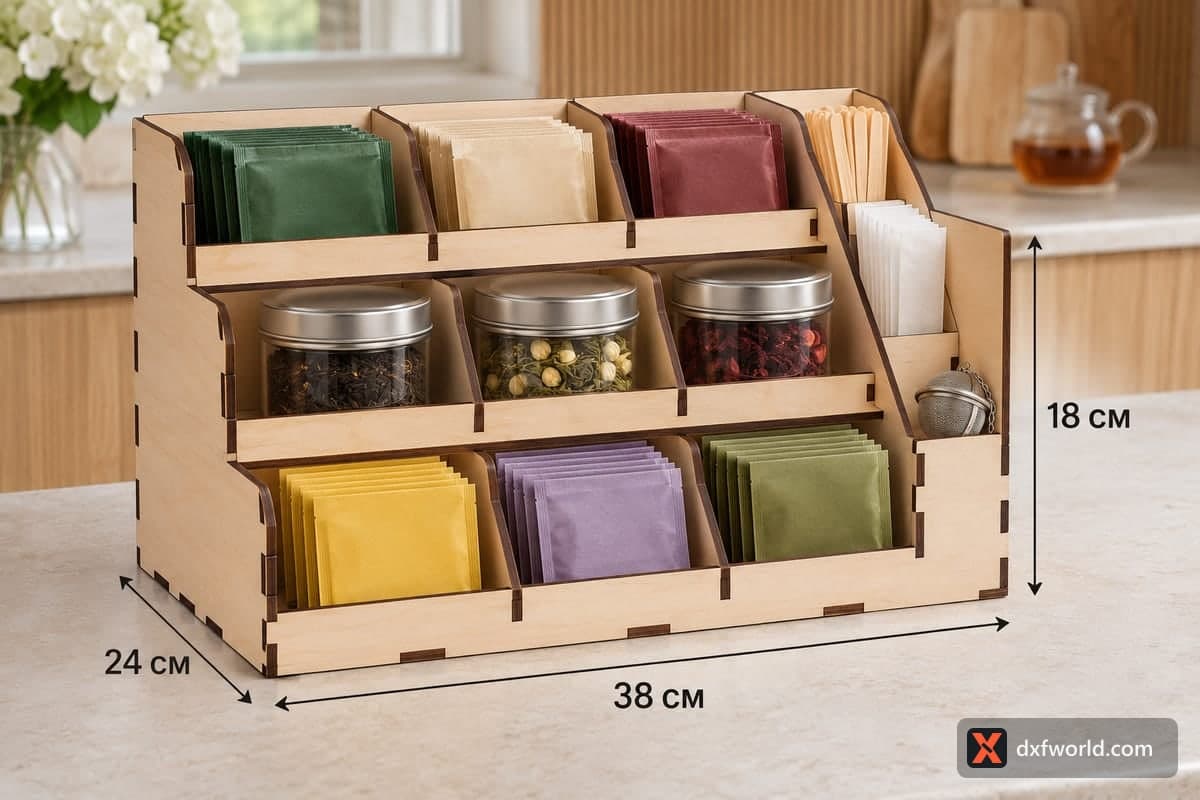
 Visualization
3x3 Tiered Tea Station SVG, Nine Bay Tea Bag and Jar Stand Laser Cut File, Stepped Tea Rack DXF
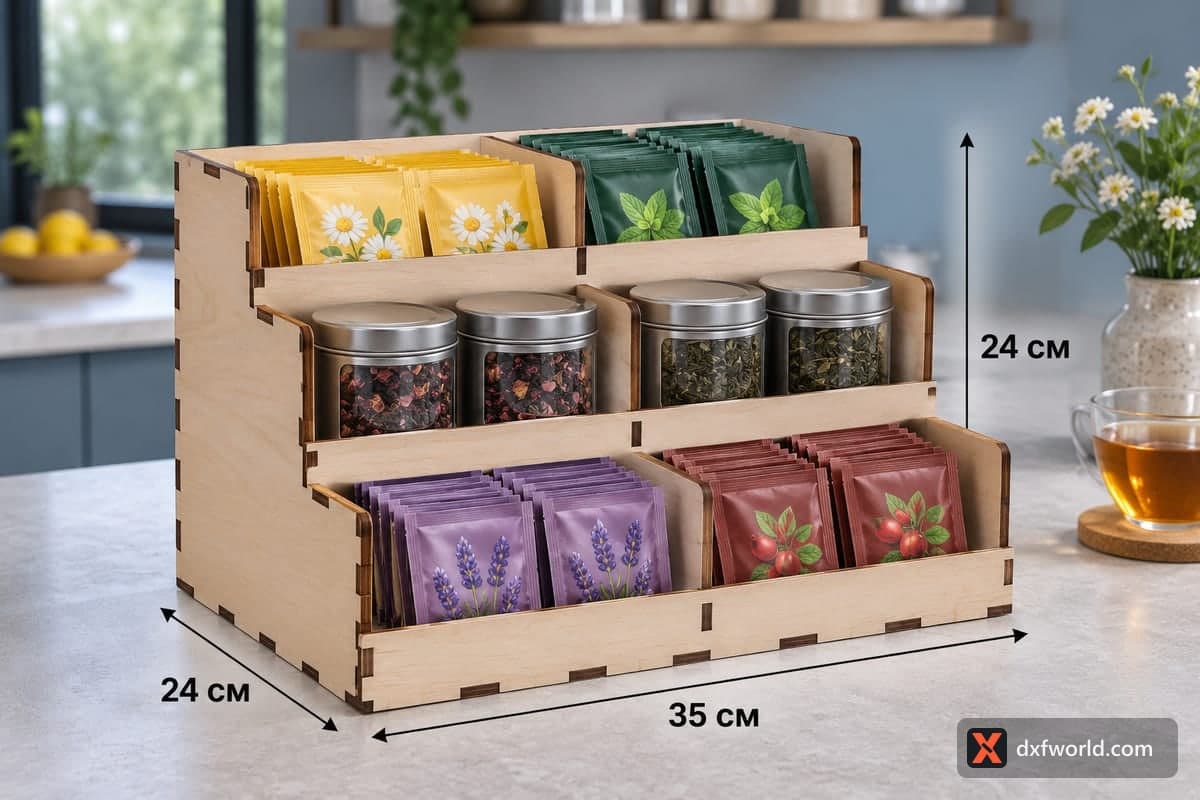
A free tiered tea station laser cut file in SVG and DXF, with separate versions for 3, 4, 5 and 6 mm plywood. It is 380 × 240 × 180 mm (14.96 × 9.45 × 7.09 in) and has three steps rising to the back, each split by two dividers into three bays, 9 in total. The stand is cut as 15 pieces that join with tabs and slots, and small part numbers are engraved on them to help with assembly.
- Formats
- SVG, DXF
- Outer size (W × D × H)
- 380 × 240 × 180 mm (14.96 × 9.45 × 7.09 in)
- Parts
- 15
- Material thickness
- 3, 4, 5 or 6 mm plywood (a file for each)
- Layout size (3 mm file)
- 1,540 × 328 mm
- Cut length
- 11.87 m
- Est. time, 10 W diode (3 mm)
- 39 min 34 s
- Est. time, 40 W CO2 (3 mm)
- 16 min 29 s
- Layers
- CUT only, no engraving
Free account required to download
How to make it
- 01Choose the file for your plywood and cut a test shelf tab to check it seats firmly in the side panel slot.
- 02Cut all 15 numbered parts, spreading the 1540 mm layout over three sheets on a mid-size bed.
- 03Join the shelves, step boards, front board and brace to one side panel, close with the second side, then fit two dividers on each step.
- 04Sand the step edges, apply lacquer, and stock the nine bays with tea bags at the top and bottom and jars in the middle.
Nine bays in a grid of steps
Each of the three steps is split by two dividers into three bays, giving a neat three-by-three grid. In the photo the top step holds dark green, kraft and red tea bags, the middle step three glass jars of loose black tea, jasmine pearls and fruit tea, and the bottom step yellow, purple and green sachets. At 180 mm tall and 380 mm wide it sits comfortably under wall cabinets. The side pocket with stirrers seen in the photo is not part of this file.
Parts and cut times
The 15 parts are two side panels, a front board, two step boards, three shelves, a back brace and six small dividers. Every part carries a small engraved number. For the 3 mm file a 10 W diode needs about 39 min 34 s, a 40 W CO2 about 16 min 29 s and a 100 W CO2 about 7 min 55 s. The layout is 1540 × 328 mm, so on a bed of 400 to 600 mm split it into three sheets, grouping the six dividers with the side panels. Plywood of 5 or 6 mm needs a CO2 laser or a strong diode with extra passes.
Lay one side panel down, push the shelves, step boards, front board and brace into it by number, add the second side, then slide two dividers onto each step. The joints are snug enough to work dry, but glue the shelves if the stand will hold glass jars.
For a cafe counter or a guest room
Nine bays make a full tea menu: a cafe can give each bay one tea and engrave the names along the step boards, and a guesthouse can set it beside the kettle in a breakfast room. As a gift, fill it with nine teas and wrap it whole. Finish with clear lacquer so spilled tea wipes off.
Questions about this file
How wide is each of the nine bays?
Each step is 380 mm long, so every bay is roughly 12 cm wide and about 9 cm deep: enough for a jar or a stack of tea bags.
Does the file include the stirrer pocket on the side?
No. The download is the three-step stand with nine bays; a side pocket would have to be designed separately.
What do the engraved numbers do?
They match each shelf, step board and divider to its slot, which saves time because several parts look almost the same.
Can the stand hold coffee pods instead?
Yes, each bay takes a row of capsules, sugar sticks or creamer cups, so it works as a coffee station too.
Which plywood thickness suits a busy cafe counter?
Use 5 or 6 mm plywood for a stand that is handled all day; those files have wider slots and need a laser that cuts that depth.
Similar files