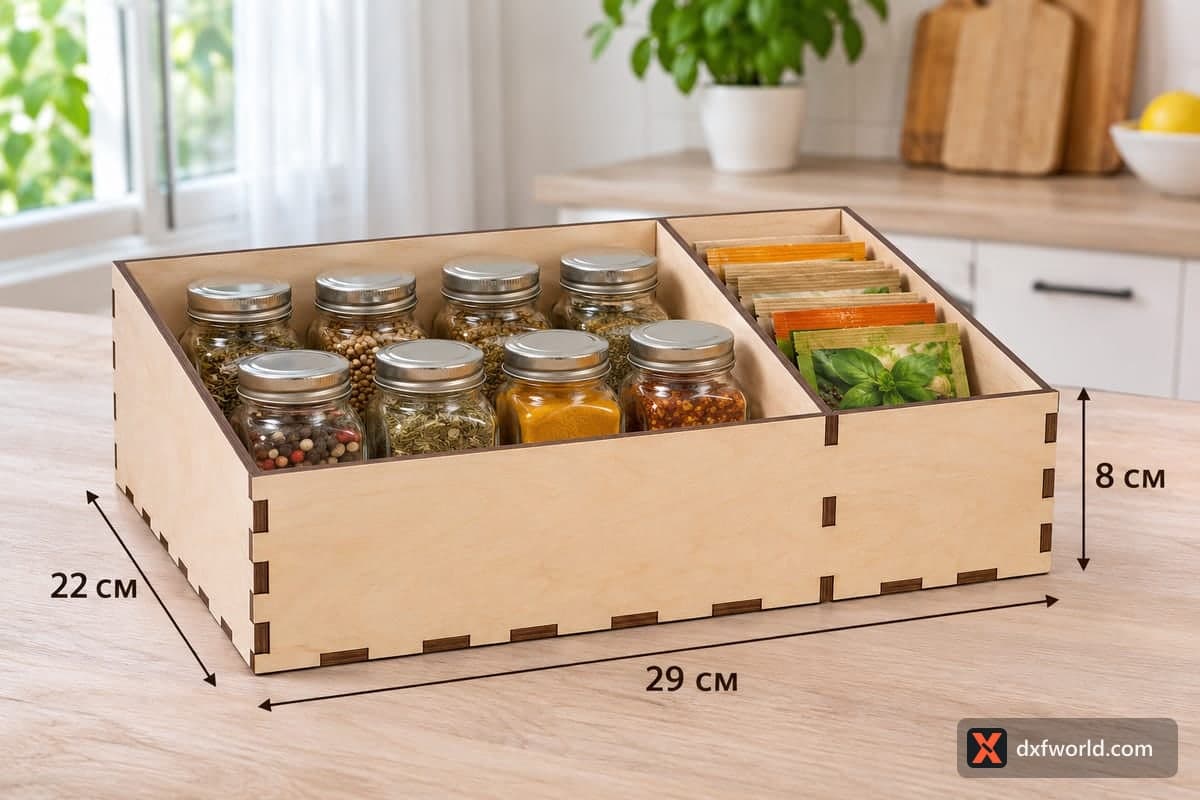
 Visualization
Two Bay Open Spice Box DXF, Square Edge Spice Jar Crate SVG, Seed Packet and Seasoning Sachet Bin Laser Cut File
A free laser cut file for an open, straight-walled spice box split by one front-to-back divider into two bays, one for jars and one for packets. It measures 290 × 220 × 80 mm (11.42 × 8.66 × 3.15 in), is cut from just 6 plywood pieces that join with tabs and slots, and includes SVG and DXF files for 3, 4, 5 and 6 mm plywood.
- Formats
- SVG, DXF
- Outer size (W × D × H)
- 290 × 220 × 80 mm (11.42 × 8.66 × 3.15 in)
- Parts
- 6
- Material thickness
- 3, 4, 5 or 6 mm plywood (a file for each)
- Layout size (3 mm file)
- 1,040 × 312 mm
- Cut length
- 5.56 m
- Est. time, 10 W diode (3 mm)
- 18 min 31 s
- Est. time, 40 W CO2 (3 mm)
- 7 min 43 s
- Layers
- CUT only, no engraving
Free account required to download
How to make it
- 01Select the folder for your plywood thickness and cut one tab with its slot from scrap to see whether it needs a kerf tweak.
- 02Cut the six pieces in one run if your bed fits 1040 mm, otherwise in two.
- 03Fit the four walls around the base, then slide the divider down into its slots from above.
- 04Break the sharp edges with sandpaper, oil the box, and fill one bay with jars and the other with packets.
Six pieces, two bays
This is the plainest box in the spice range: four walls, a base and one divider, all 80 mm tall. The divider runs the full 220 mm depth, so the box opens into two bays with no front row or back row to work around. All four walls are the same height, which gives it a neat crate look on an open shelf.
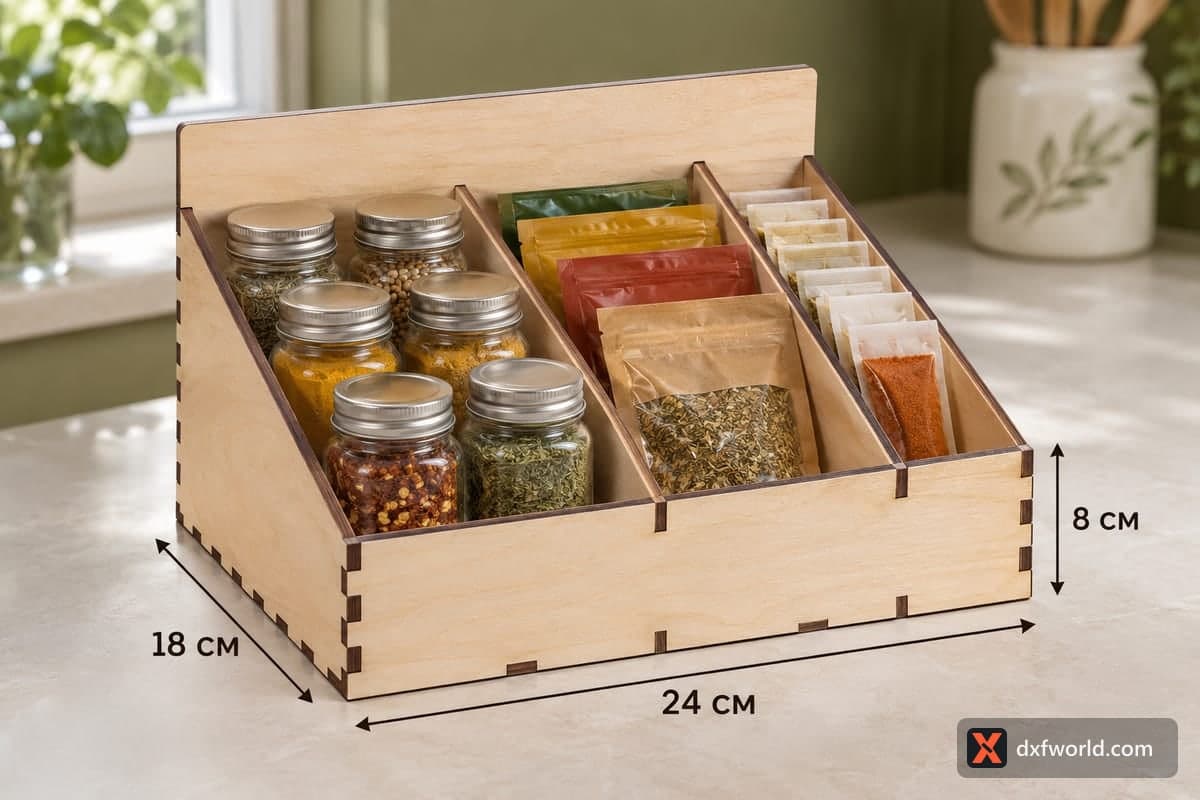
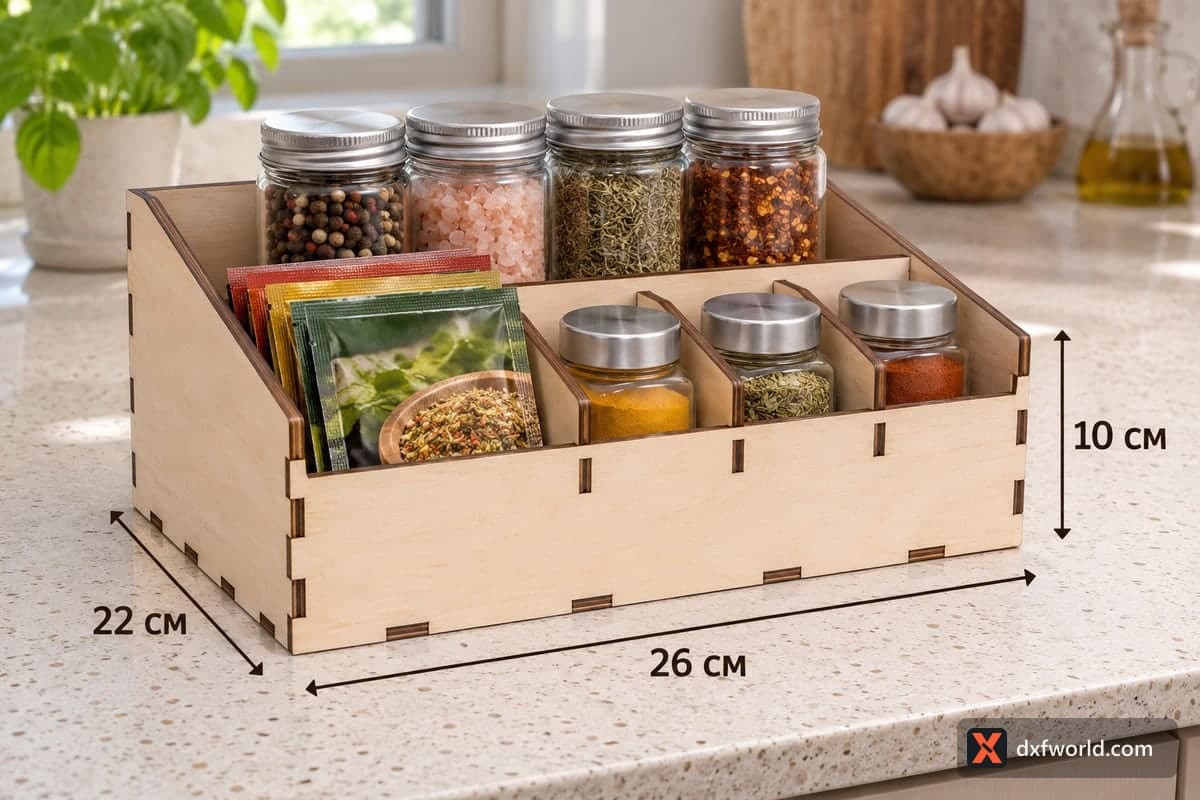
In the photo the larger left bay holds eight glass jars with silver lids in two rows of four, filled with peppercorns, coriander, herbs, turmeric and chili. The right bay is a slot for flat paper sachets and seed packets, standing on edge so you can flick through them like cards.
A good first project
With so few parts, it is a sensible file for someone new to tab-and-slot boxes. For the 3 mm file the cut takes about 18 min 31 s on a 10 W diode, about 7 min 43 s on a 40 W CO2 and about 3 min 42 s on a 100 W CO2. The 3 mm layout is 1040 × 312 mm; move the base onto its own sheet if your bed is smaller. A 10 W diode needs one or two passes for 3 mm and several for 5–6 mm.
To split the packet bay into a front and a back half, cut a strip 80 mm tall from the offcuts and glue it across. Glue is otherwise optional, because the joints hold dry.
Selling ideas
Gardeners buy it as a seed box, cooks as a spice box, so list it under both. It also works as the project in a beginner laser workshop, where each guest takes home their own box.
Questions about this file
How many spice jars fit?
The photo shows eight small jars in two rows of four in the bigger bay. Larger jars mean fewer per row.
Is it sturdy without glue?
Yes, for a box that stays on a shelf. Glue the four corners if it will be lifted by the walls with heavy jars inside.
Can I add a lid later?
The file has no lid. Cut a flat panel of 290 × 220 mm to rest on top, or choose one of the lidded spice boxes in this category.
Which plywood thickness suits this crate?
3 mm is enough for this size and keeps the cut short. Pick 4 mm if you like chunkier edges that look more like furniture.
Can I scale it to fit a cupboard?
Resize by editing panel lengths rather than scaling, so the slots stay matched to the plywood thickness.
Similar files