 Visualization
Sloped Napkin Caddy SVG, Three Row Table Caddy With Front Straw Slot Laser Cut File, Cutlery Slot DXF
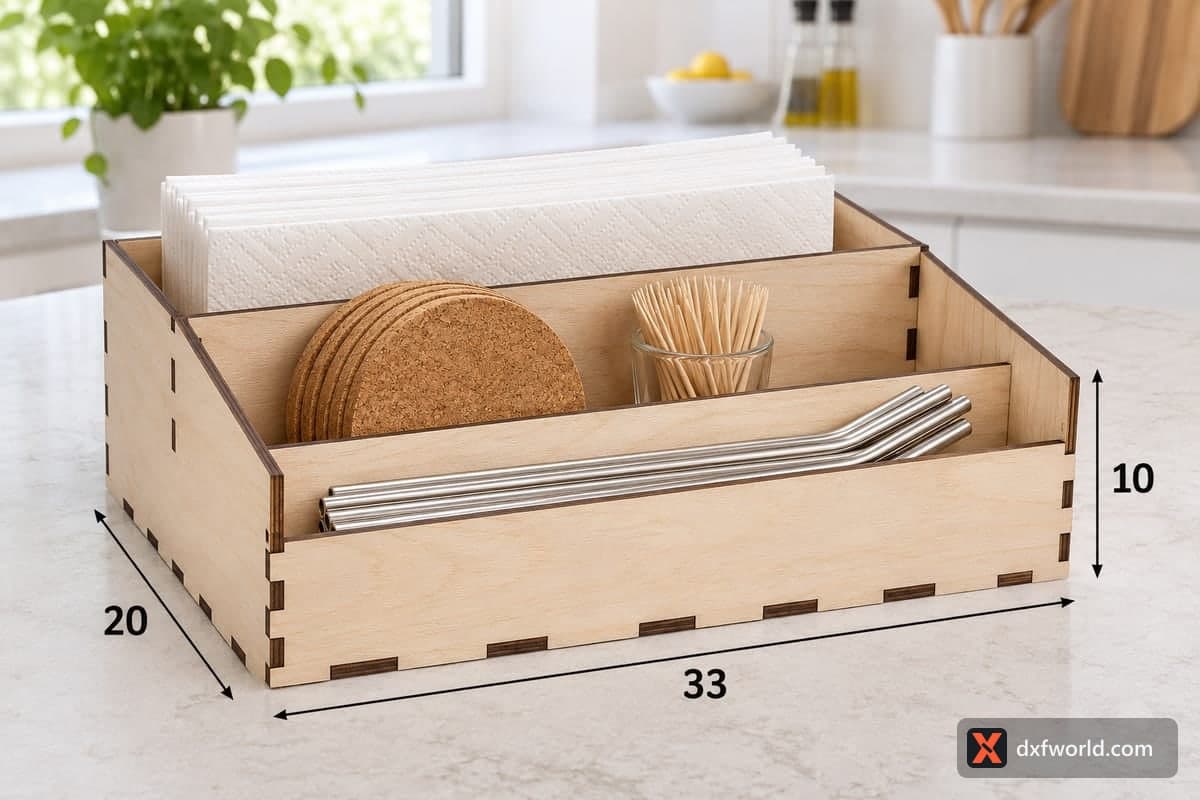
A free sloped napkin caddy with three rows: a full-width back pocket for upright napkins, a middle row split into two pockets, and a long front slot for straws or cutlery, four compartments in all. The download has SVG and DXF files for 3, 4, 5 and 6 mm plywood; it measures 330 × 200 × 100 mm (12.99 × 7.87 × 3.94 in), has a 60 mm front with sides sloping up to the back, and is cut as 8 pieces joined with tabs and slots.
- Formats
- SVG, DXF
- Outer size (W × D × H)
- 330 × 200 × 100 mm (12.99 × 7.87 × 3.94 in)
- Parts
- 8
- Material thickness
- 3, 4, 5 or 6 mm plywood (a file for each)
- Layout size (3 mm file)
- 1,091 × 312 mm
- Cut length
- 6.71 m
- Est. time, 10 W diode (3 mm)
- 22 min 22 s
- Est. time, 40 W CO2 (3 mm)
- 9 min 19 s
- Layers
- CUT only, no engraving
Free account required to download
How to make it
- 01Pick the SVG or DXF for your plywood and cut a scrap slot first to make sure the joints are snug, not forced.
- 02Cut the 8 pieces, using two smaller jobs if your bed cannot fit the 1091 mm layout.
- 03Assemble the back, sloped sides and base, then insert the taller cross divider, the lower one and the centre divider before adding the 60 mm front.
- 04Sand and oil the caddy, then stand napkins in the back, put coasters and toothpicks in the middle and lay straws along the front.
Three rows, four compartments
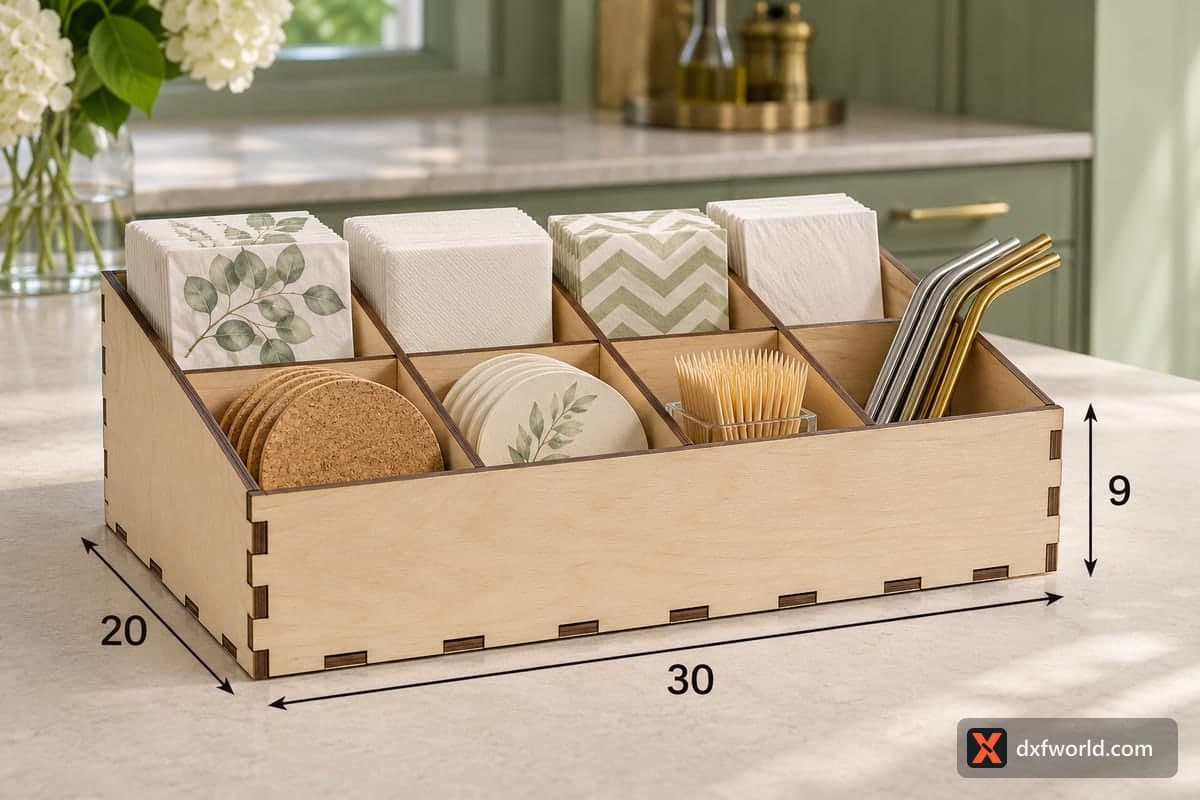
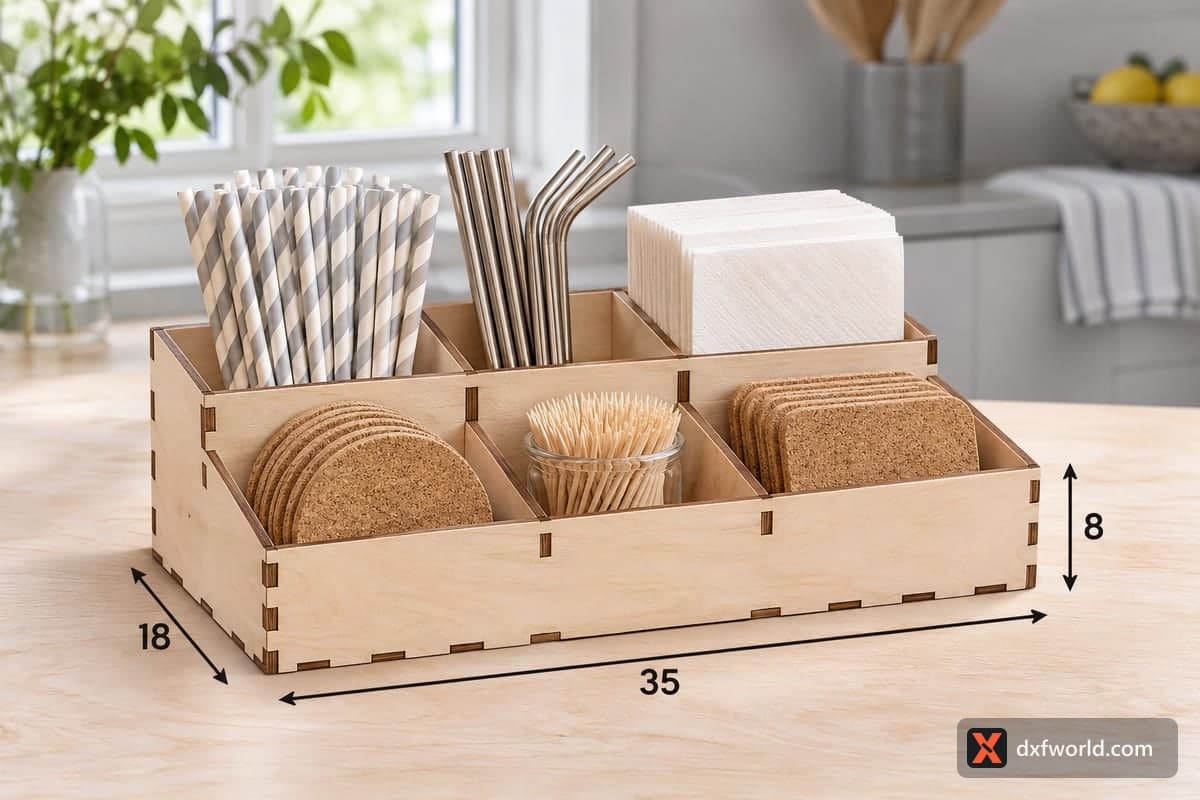
Two cross dividers run the full width and step down in height from back to front, following the sloped sides. The tallest row at the back is one open pocket, wide enough for a whole stack of paper napkins standing on edge. The middle row is split in the centre by one short divider, and in the photo it holds cork coasters on the left and a glass of toothpicks on the right. The lowest row behind the 60 mm front is a single long trough with metal drinking straws lying flat, and it would take forks, spoons or chopsticks just as well.
Cutting the parts
All 8 pieces fit on a 1091 × 312 mm layout. Estimated time for the 3 mm file is about 22 min 22 s on a 10 W diode, about 9 min 19 s on a 40 W CO2 and about 4 min 28 s on a 100 W CO2. A 10 W diode needs one or two passes through 3 mm plywood; thicker sheets mean several passes or a CO2 machine. If your bed is only 400 mm wide, split the job: base and back first, then the sides, front and dividers. Nothing is engraved, the file is cut lines only.
Putting it together
Fit the back and the two sloped sides to the base, slide in the taller back cross divider, then the lower front one, add the short centre divider and finish with the front wall. The joints are tight enough to stay together dry; add wood glue for a permanent build. Sand off scorch marks and seal with oil if the caddy will stand near the sink or the coffee machine.
Selling ideas: an everyday kitchen counter caddy for craft fairs, a barbecue table set with paper napkins and reusable straws, or a personalised gift with a surname engraved on the front.
Questions about this file
Why is the back row one big pocket?
It holds a full pack of paper napkins standing upright across the whole 330 mm width, so you do not have to split a stack between pockets.
Can the front slot hold cutlery?
Yes, the long front trough takes forks, spoons, chopsticks or straws lying flat, and the low front makes them easy to pick up.
Do I need to change anything when I scale it?
After scaling, set the slots back to the thickness of your sheet; a scaled slot is wider or narrower than the plywood and the joints will not hold.
What finish works next to a sink?
Seal every face, including the underside of the base, with water-based polyurethane or a hard-wax oil, and wipe off splashes instead of letting them sit.
Is 6 mm plywood a good idea here?
It makes a heavy, solid caddy but takes a few millimetres from each pocket and needs several passes on a diode. 3 or 4 mm suits most kitchens.
Similar files