 Visualization
8 Pocket Napkin Caddy SVG, Two Row Sloped Table Organizer Laser Cut File, Coaster and Toothpick Caddy DXF
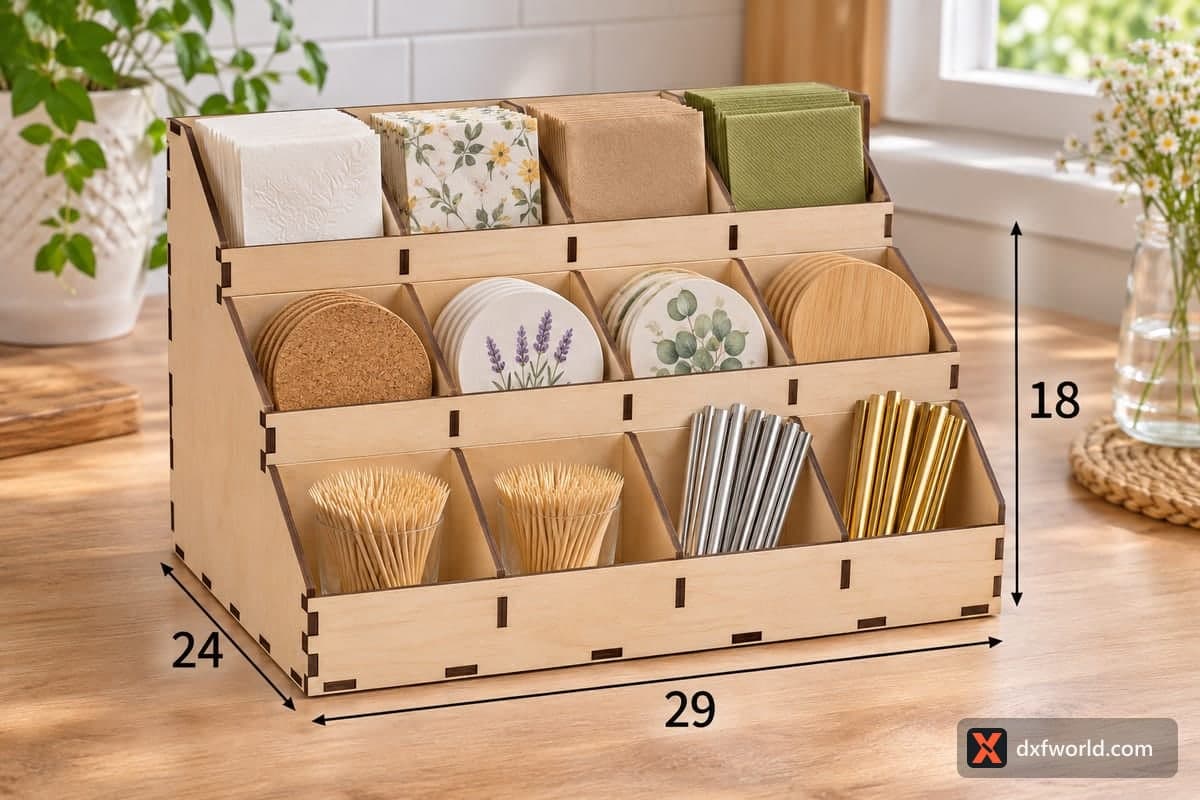
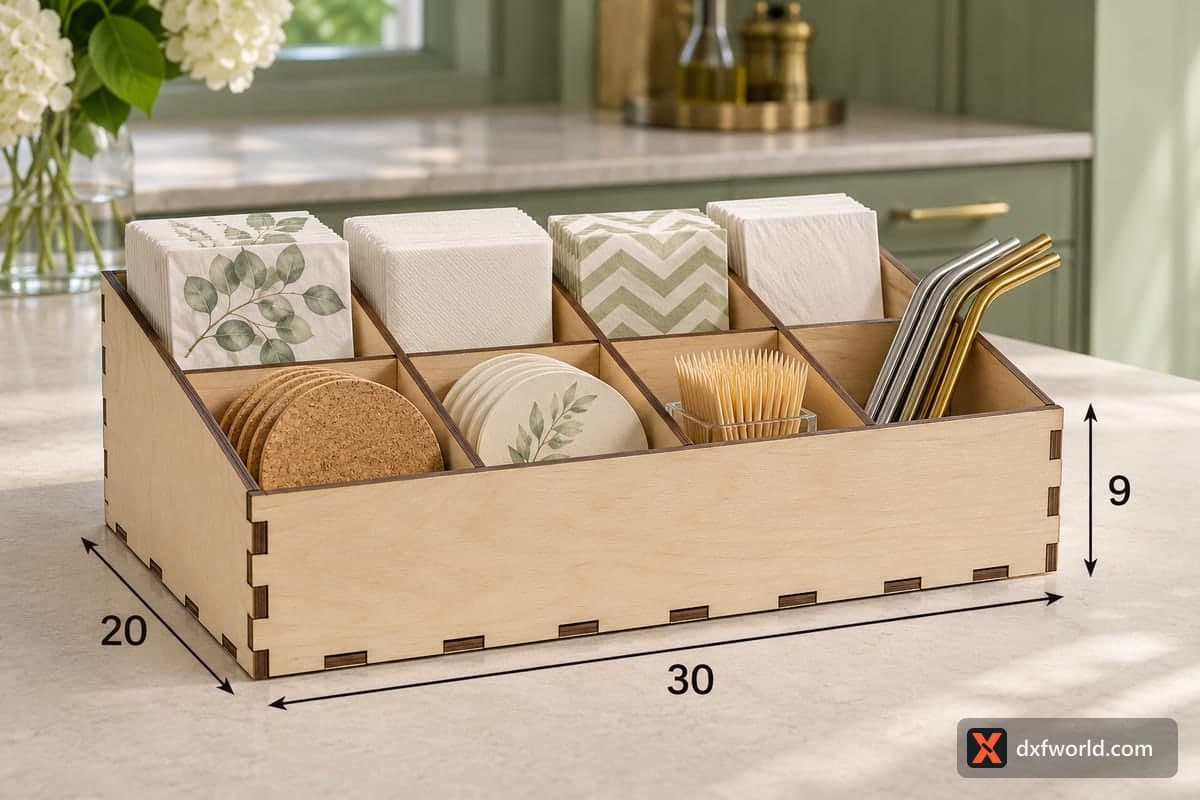
A free eight-pocket napkin and table caddy with two rows of four sections, a 54 mm front wall and sides that slope up to a 90 mm back, built to hold napkins, coasters, toothpicks and straws on a counter or dining table. The download has SVG and DXF files for 3, 4, 5 and 6 mm plywood; it measures 300 × 200 × 90 mm (11.81 × 7.87 × 3.54 in) and is cut as 12 pieces that join with tabs and slots.
- Formats
- SVG, DXF
- Outer size (W × D × H)
- 300 × 200 × 90 mm (11.81 × 7.87 × 3.54 in)
- Parts
- 12
- Material thickness
- 3, 4, 5 or 6 mm plywood (a file for each)
- Layout size (3 mm file)
- 1,134 × 396 mm
- Cut length
- 7.59 m
- Est. time, 10 W diode (3 mm)
- 25 min 18 s
- Est. time, 40 W CO2 (3 mm)
- 10 min 33 s
- Layers
- CUT only, no engraving
Free account required to download
How to make it
- 01Download the file for your plywood thickness and cut a single slot in an offcut to confirm the tabs press in snugly.
- 02Cut the 12 pieces, splitting the 1134 mm layout over two sheets if your bed is smaller.
- 03Fit the back and both sloped sides into the base, slide the long cross divider into place, add the six short dividers, then close the box with the low front wall.
- 04Sand away any scorch marks, apply lacquer or oil, and fill the back row with napkins and the front row with coasters, toothpicks and straws.
Two rows of four
A long cross divider runs the full 300 mm length and separates a tall back row from a lower front row, and three short dividers in each row make eight pockets in total. In the photo the back pockets hold four different napkin designs standing upright: a leaf print, plain white, a green chevron and a second white stack. The front row keeps cork coasters, round printed coasters, a small glass of toothpicks and a bundle of gold and steel drinking straws. The 54 mm front wall keeps the front pockets low, so you can grab a coaster without lifting the napkins behind it.
Cutting it on your machine
The 12 parts sit on a 1134 × 396 mm layout. That is longer than most diode and desktop CO2 beds, so move the base and the back onto one sheet and the sides, front and dividers onto a second. Estimated time for the 3 mm file is about 25 min 18 s on a 10 W diode, about 10 min 33 s on a 40 W CO2 and about 5 min 04 s on a 100 W CO2. A 10 W diode gets through 3 mm birch in one or two passes; 5 and 6 mm sheets need extra passes or a stronger tube. Only cut lines are in the file, nothing is engraved.
Gluing, sealing and selling
Tab-and-slot joints hold without glue, though a little wood glue along the base turns the caddy into a permanent piece. Sand the edges and seal with clear lacquer or oil, since napkin caddies live next to drinks and spills. Ideas: sell it to cafes as a napkin and condiment station, bundle it with a set of cork coasters as a housewarming gift, or offer a version with a family name engraved on the front.
Questions about this file
How wide is each of the eight pockets?
In the 3 mm version each pocket is a little over 70 mm wide, so napkins folded into narrow stacks stand upright and coasters stand on edge. For wider dinner napkins, scale the whole caddy up.
Can I make the caddy bigger for a restaurant?
Scale the drawing in your laser software, then reset every slot to the real thickness of your sheet. Scaling also widens the slots, and loose slots make the dividers wobble.
Can I cut this napkin caddy from MDF or acrylic instead?
3 mm MDF cuts cleanly with the 3 mm file but swells if it gets wet, so seal it well. Acrylic works too if you test one slot first and bond it with acrylic cement.
How do I protect it from coffee and water rings?
Two thin coats of water-based polyurethane or a hard-wax oil on every face, base included, keep spilled drinks from soaking into the plywood.
Which plywood thickness suits eight small pockets?
3 mm keeps the pockets roomiest and cuts fastest on a diode. 4 mm gives stiffer dividers if the caddy will be handled all day at a counter.
Similar files