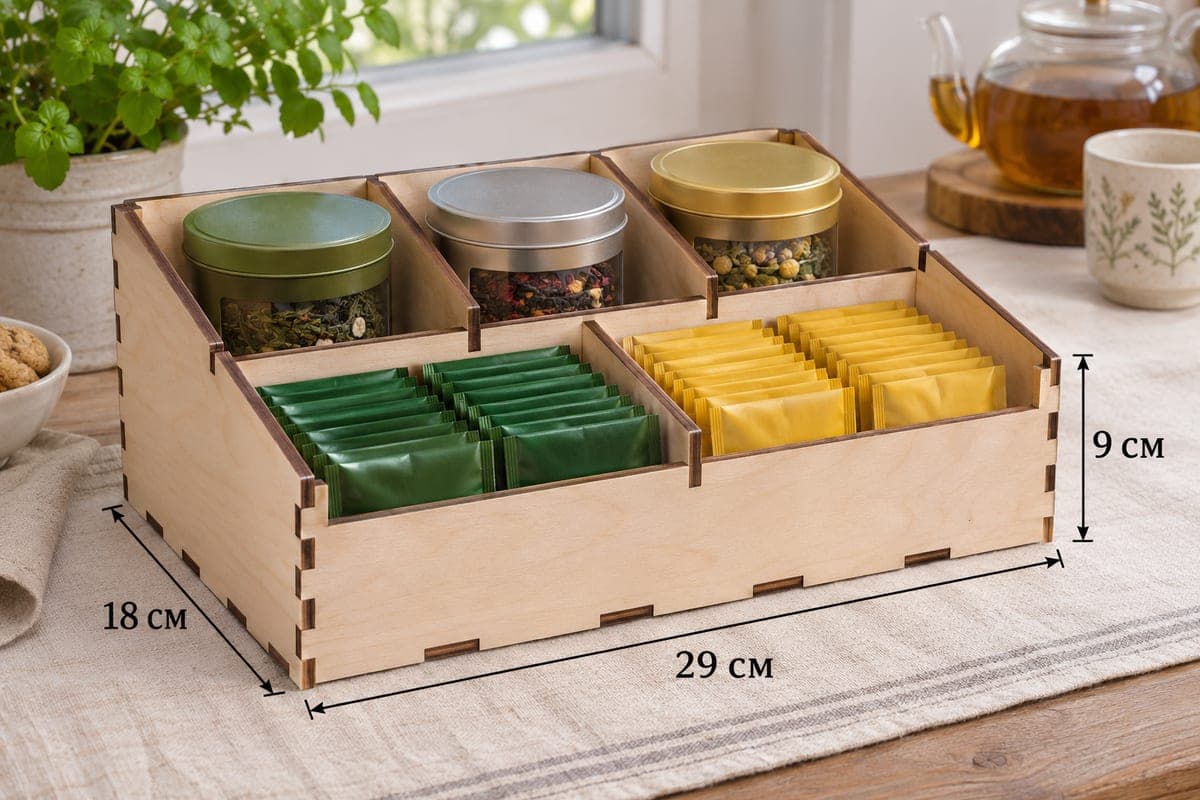
 Visualization
Tea Caddy SVG, Sloped Tea Tin Organizer Laser Cut File, Wooden Tea Bag Bin DXF, Tea Box Plans
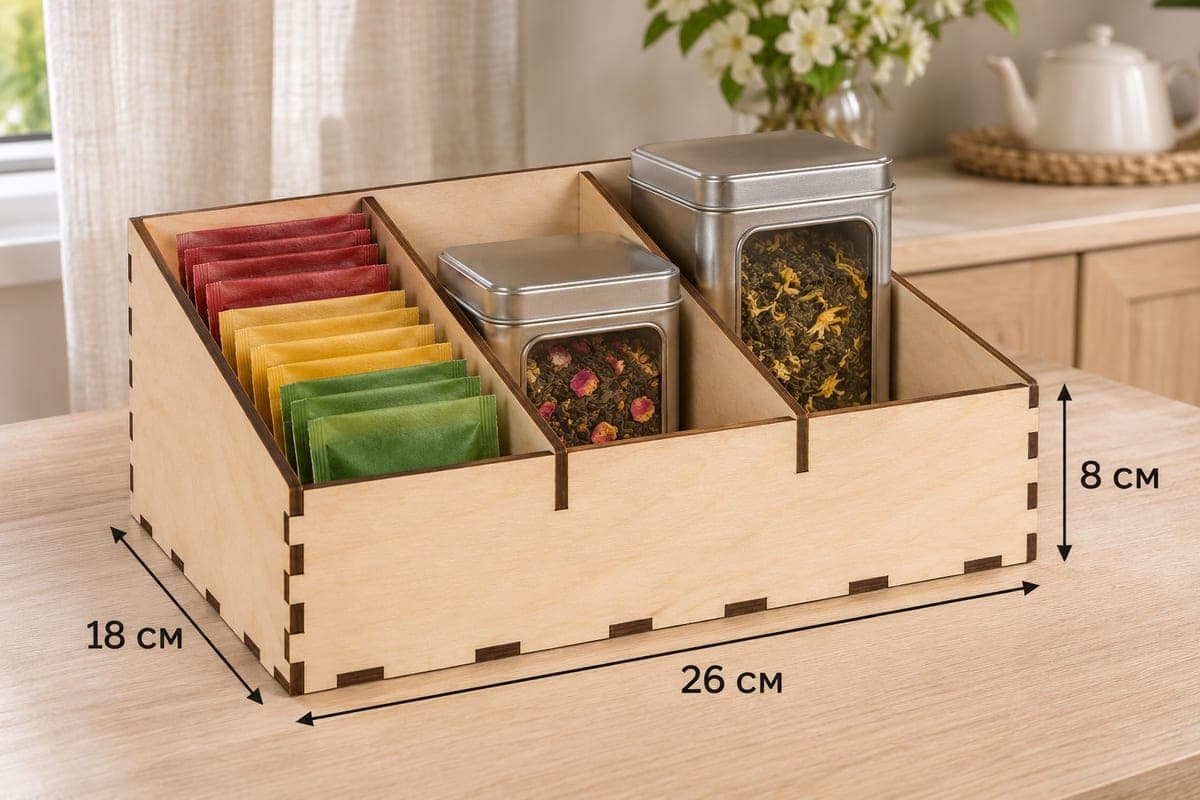
A free laser cut file for an open tea caddy with three cells along the back for tea tins and two wider, lower bins at the front for tea bags, five compartments in all. It measures 290 × 180 × 90 mm (11.42 × 7.09 × 3.54 in), the front wall is lower and the sides slope down to it, and the 9 plywood pieces join with tabs and slots. The SVG and DXF come in separate versions for 3, 4, 5 and 6 mm plywood.
- Formats
- SVG, DXF
- Outer size (W × D × H)
- 290 × 180 × 90 mm (11.42 × 7.09 × 3.54 in)
- Parts
- 9
- Material thickness
- 3, 4, 5 or 6 mm plywood (a file for each)
- Layout size (3 mm file)
- 960 × 282 mm
- Cut length
- 6.06 m
- Est. time, 10 W diode (3 mm)
- 20 min 11 s
- Est. time, 40 W CO2 (3 mm)
- 8 min 25 s
- Layers
- CUT only, no engraving
Free account required to download
How to make it
- 01Download the version for your plywood thickness and cut a single slot on scrap to confirm the tabs press in snugly.
- 02Cut the nine pieces from the 960 × 282 mm layout, moving the base to a second sheet if your bed is short.
- 03Fit the sloped sides to the base, add the back and the low front, then slot in the cross divider and the three short dividers.
- 04Sand and oil the caddy, set three tea tins in the back cells and fill the two front bins with tea bags.
Two rows for two kinds of tea
The back row is split into three cells, each roughly 90 mm deep, so round tins of loose leaf blends stand upright with their lids on top. In front of them a full-width cross divider marks off the low row, which is cut into just two wide bins. That leaves room for bigger stacks of bagged tea: in the photo one bin holds green tea envelopes and the other yellow ones, two deep rows each. The front wall is 54 mm tall against 90 mm at the back, and the side panels slope between them, so you see every tin and can pick a bag without lifting anything out.
Choosing plywood and cutting
Nine pieces make up the caddy: front, back, two sloped sides, base, the cross divider and three short dividers (one low one for the front row, two full-height ones for the back). On a 10 W diode laser the 3 mm file cuts in about 20 min 11 s; a 40 W CO2 needs about 8 min 25 s and a 100 W CO2 about 4 min 02 s for the 3 mm file. The 4, 5 and 6 mm versions have slots sized for those sheets, but a diode will need extra passes at 5 or 6 mm. All pieces sit on a 960 × 282 mm layout, so a small bed may need the base cut on its own sheet. Test one slot on scrap before the full run.
Finishing and gift ideas
Sand the sloped top edges of the sides, where hands touch most, then wipe on food-safe oil or a clear water-based lacquer. Glue is optional because the joints are snug, but a few drops along the base make the caddy stiff enough to carry when it is full. Fill it with three loose teas and two boxes of bags for a ready-made gift, add a name on the front wall with a light engraving pass, or sell caddies at a market in pairs with matching coasters.
Questions about this file
Which tins fit the three back cells?
Each back cell is about a third of the 290 mm length wide and roughly 90 mm deep, so medium round tea tins fit well. Measure your tins against those cells before cutting.
Why does the front row have only two bins?
Two wide bins hold long rows of tea bag envelopes, which suits people who keep a lot of one everyday tea. If you want three, add a divider and its slots to the front row in your editor.
Can I enlarge the caddy for bigger tins?
Yes, but stretch the panels rather than scaling the whole drawing, because every slot must stay as wide as your plywood. A uniform scale-up leaves the tabs loose.
Will it cope with splashes next to the kettle?
Bare plywood swells if water sits on it. Seal all faces with lacquer or a hard-wax oil and wipe spills promptly.
Is MDF a good alternative to plywood here?
MDF cuts cleanly from the same files when its thickness matches and takes paint well. It is heavier and less tolerant of damp than birch plywood, though.
Similar files