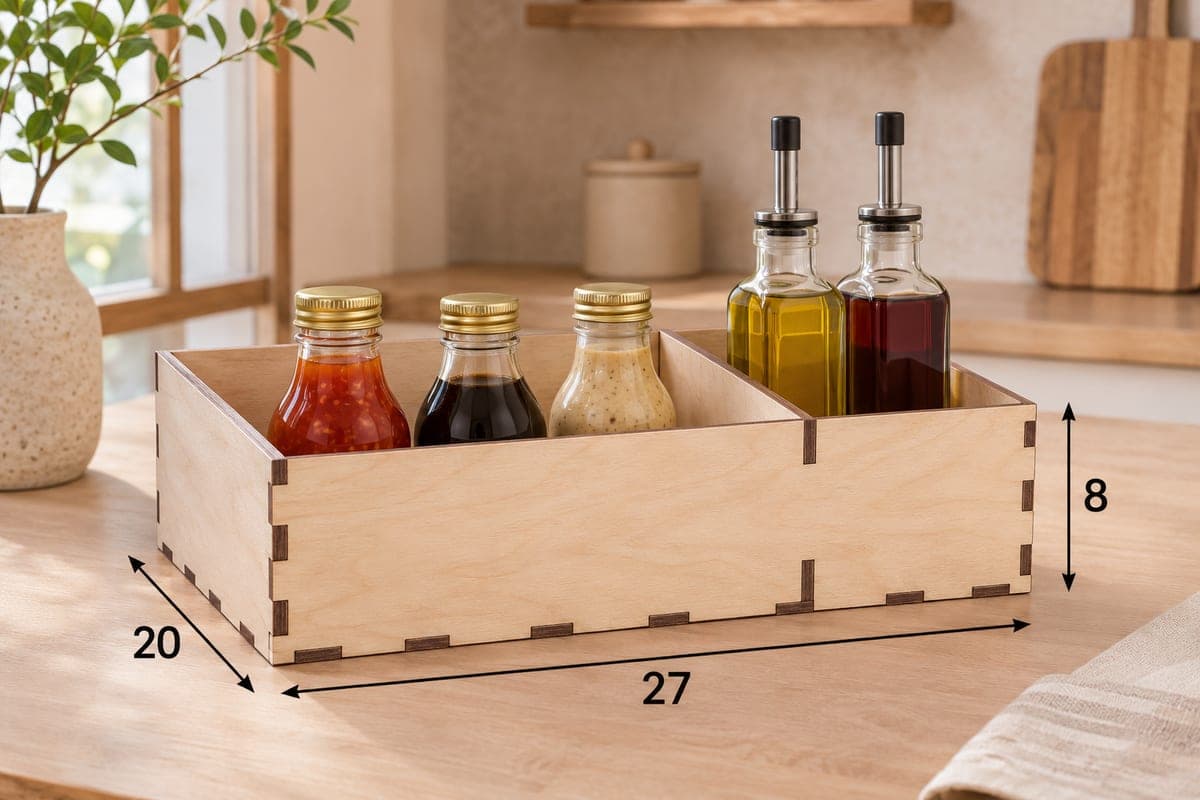
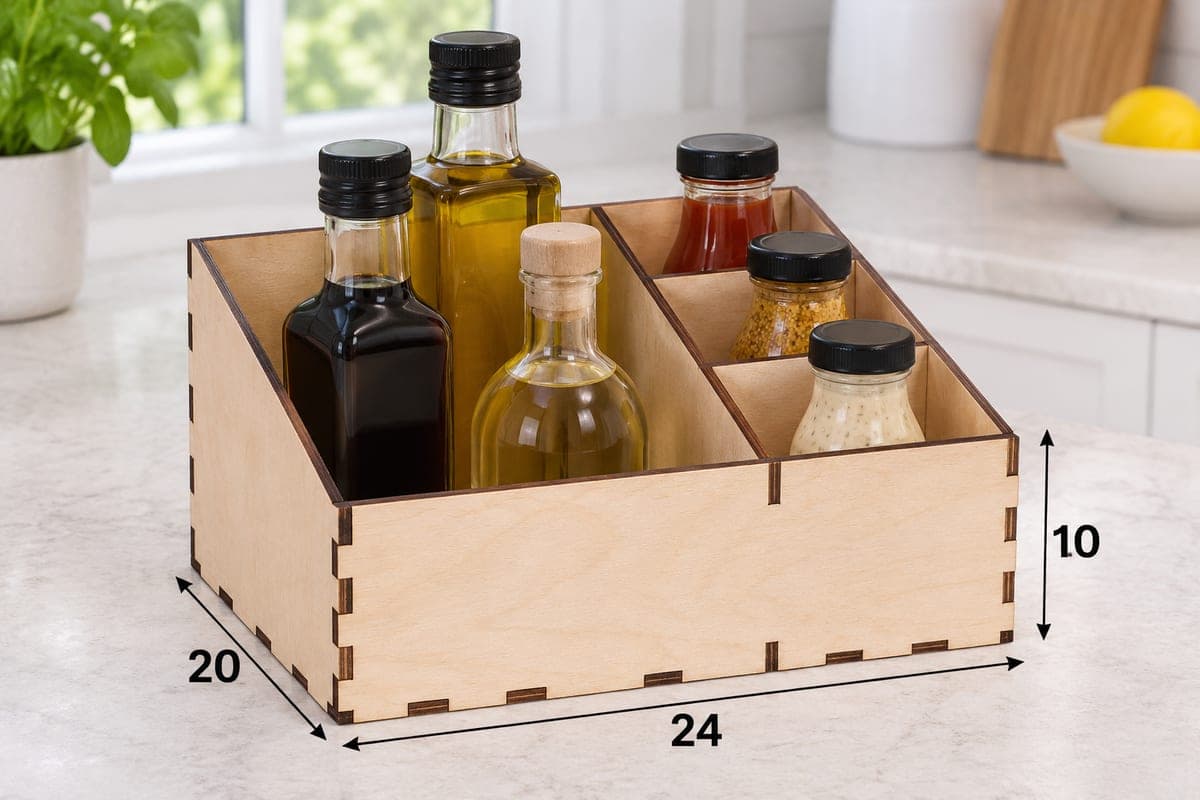
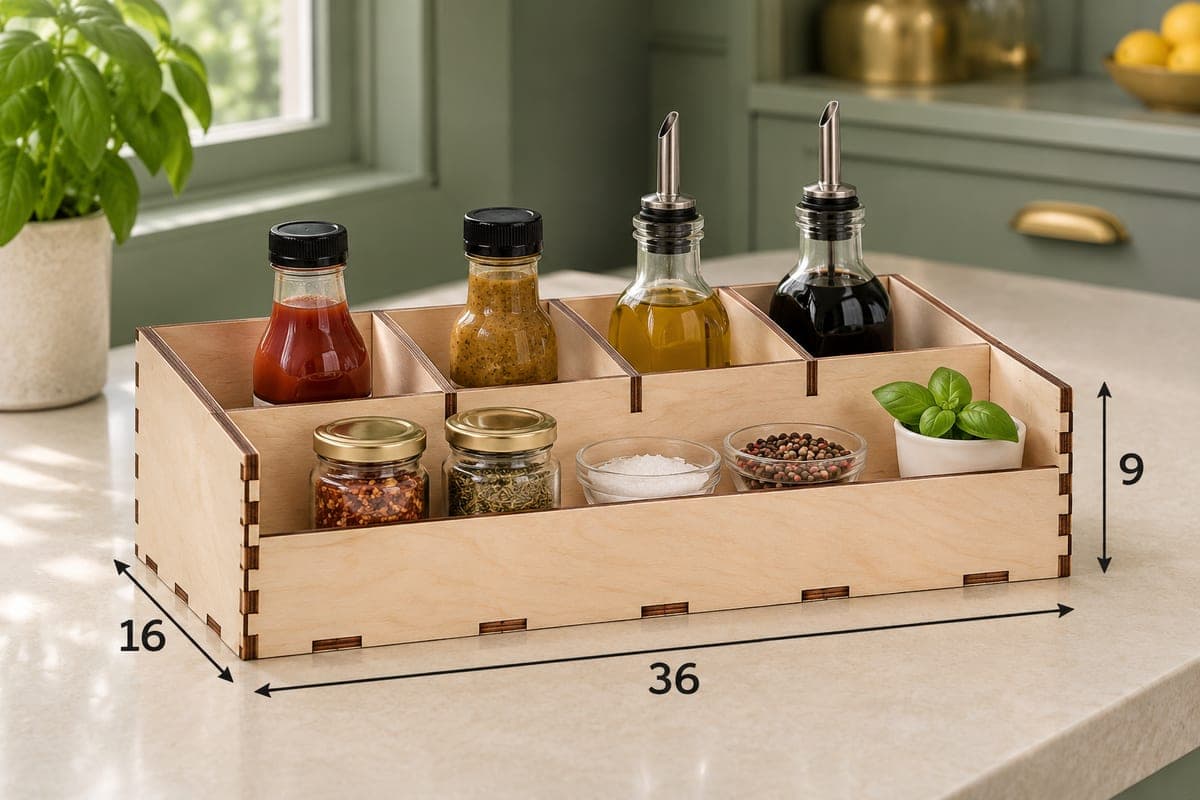
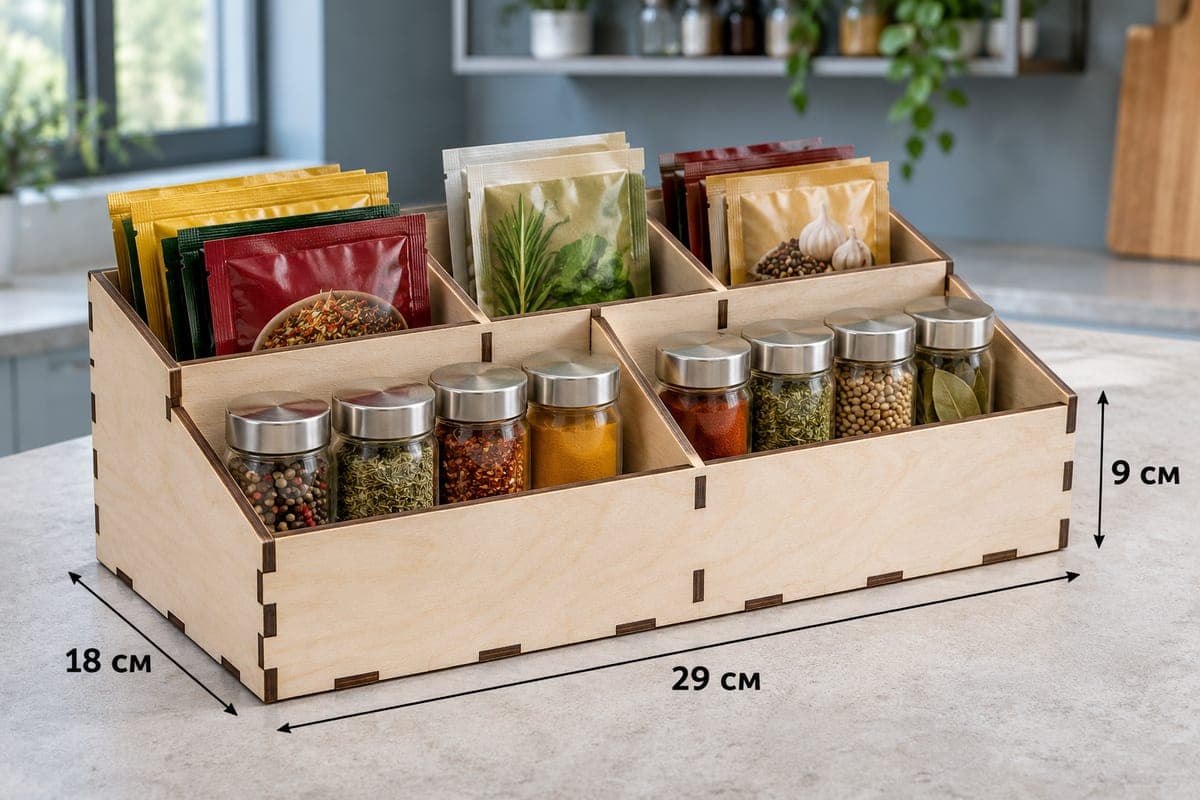
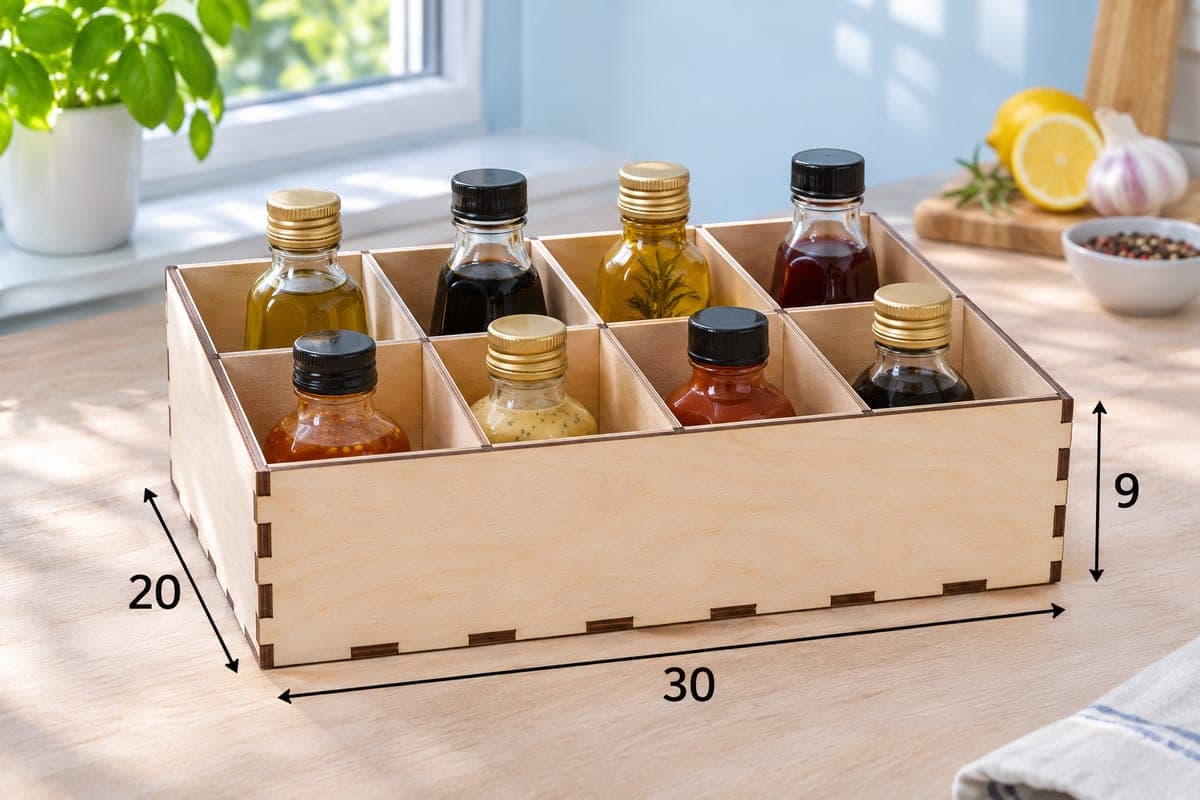
 Visualization
Sauce Bottle Organizer SVG, Sloped Condiment Caddy Laser Cut File, 8 Slot Wooden Dressing Bottle Holder DXF
A sloped caddy that gives eight small sauce and oil bottles a cell each, in two rows of four, with a low front so the labels and caps stay visible. The free download has SVG and DXF files for 3, 4, 5 and 6 mm plywood; it measures 300 × 200 × 90 mm (11.81 × 7.87 × 3.54 in), is cut from 12 pieces and assembles with tabs and slots.
- Formats
- SVG, DXF
- Outer size (W × D × H)
- 300 × 200 × 90 mm (11.81 × 7.87 × 3.54 in)
- Parts
- 12
- Material thickness
- 3, 4, 5 or 6 mm plywood (a file for each)
- Layout size (3 mm file)
- 1,134 × 396 mm
- Cut length
- 7.59 m
- Est. time, 10 W diode (3 mm)
- 25 min 18 s
- Est. time, 40 W CO2 (3 mm)
- 10 min 33 s
- Layers
- CUT only, no engraving
Free account required to download
How to make it
- 01Open the file for your plywood thickness and cut a single short divider first to confirm it slides into the cross divider.
- 02Cut all twelve pieces, moving the base and back to their own sheet if the 1134 mm layout is too long.
- 03Assemble the base, back, sloped sides and low front, then fit the cross divider and the six short dividers row by row.
- 04Sand the sloped edges smooth, apply a wipe-clean finish and place one bottle in each of the eight cells.
One bottle per cell
A long cross divider splits the caddy into two rows, and three short dividers in each row make four cells per row, eight in all. The back row stands at the full 90 mm. Toward the front the side walls slope down to a 54 mm front wall, and the front-row dividers are lower too (71.7 mm), so the bottles in front sit higher above the rim and are easy to grab. In the photo the back row carries olive oil, soy sauce, herb oil and a red vinegar, and the front row chili oil, a creamy dressing, hot sauce and balsamic, each bottle in its own cell so none of them rattle.
Laser settings and layout
Twelve pieces fit a 1134 × 396 mm layout, so on a smaller bed separate the base and back from the walls and the seven dividers. Cutting the 3 mm file takes about 25 min 18 s on a 10 W diode and about 5 min 04 s on a 100 W CO2. Thicker plywood works too, but a diode will need several slow passes through 5 or 6 mm.
Build it from the back: base, back wall, the two sloped sides, then the low front. Lay in the long cross divider and finish with the six short dividers, the three taller ones behind it and the three lower ones in front. A drop of glue per joint is optional.
Selling and gifting
Eight equal cells suit sampler sets: olive oils from one grove, a hot sauce flight, or homemade dressings for a holiday hamper. Cafes and pizzerias can use it on the pass for chili oil and dressings. Oil the wood or brush on a clear lacquer so greasy fingerprints wipe away.
Questions about this file
What size bottles fit in the cells?
Each cell is roughly 70 mm wide and 95 mm deep, which suits 100 to 250 ml round or square bottles like the ones in the photo.
Why are the front dividers shorter than the back ones?
The front wall drops to 54 mm, so the front-row dividers are cut to 71.7 mm to follow the slope while the back row keeps the full 90 mm.
Can I resize it for spice jars?
You can scale the drawing in your design software, but then reset every slot to the true thickness of your plywood, or the dividers will be loose or will not fit.
Is it waterproof enough for a restaurant pass?
Raw plywood is not. Two coats of polyurethane or a hard wax oil make it wipe-clean; avoid soaking it in a sink.
Can I engrave the bottle names on the cells?
There is no engraving in the download. Add small text to the front wall or the divider tops on an engrave layer if you want labelled cells.
Similar files