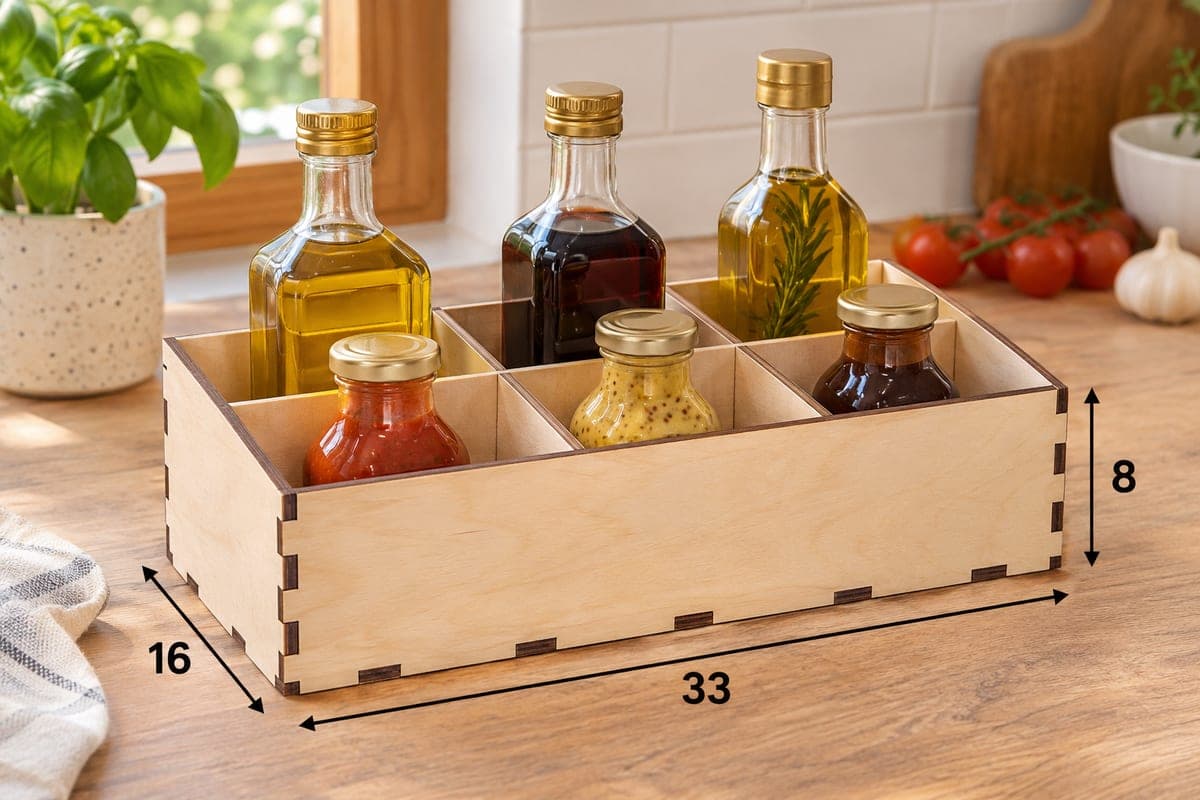
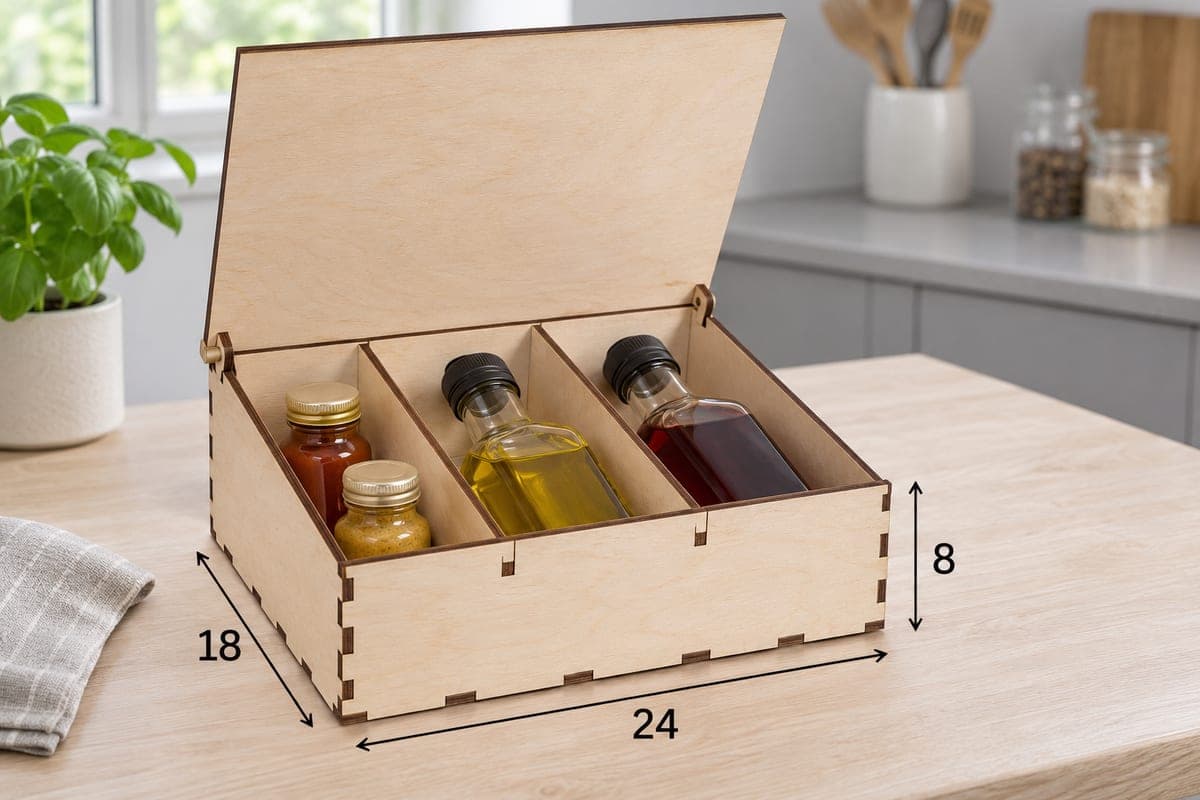
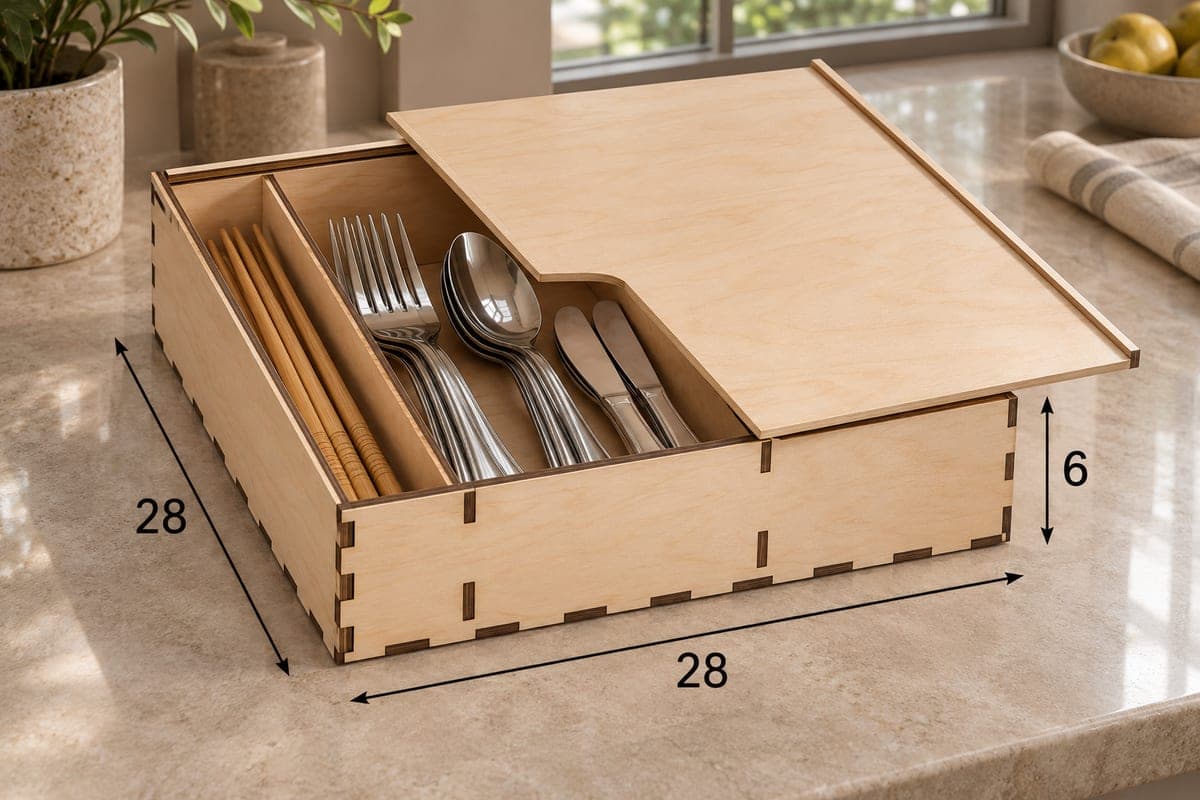
 Visualization
Sloped Condiment Caddy SVG, Oil Bottle and Spice Jar Holder Laser Cut File, Kitchen Island Organizer DXF
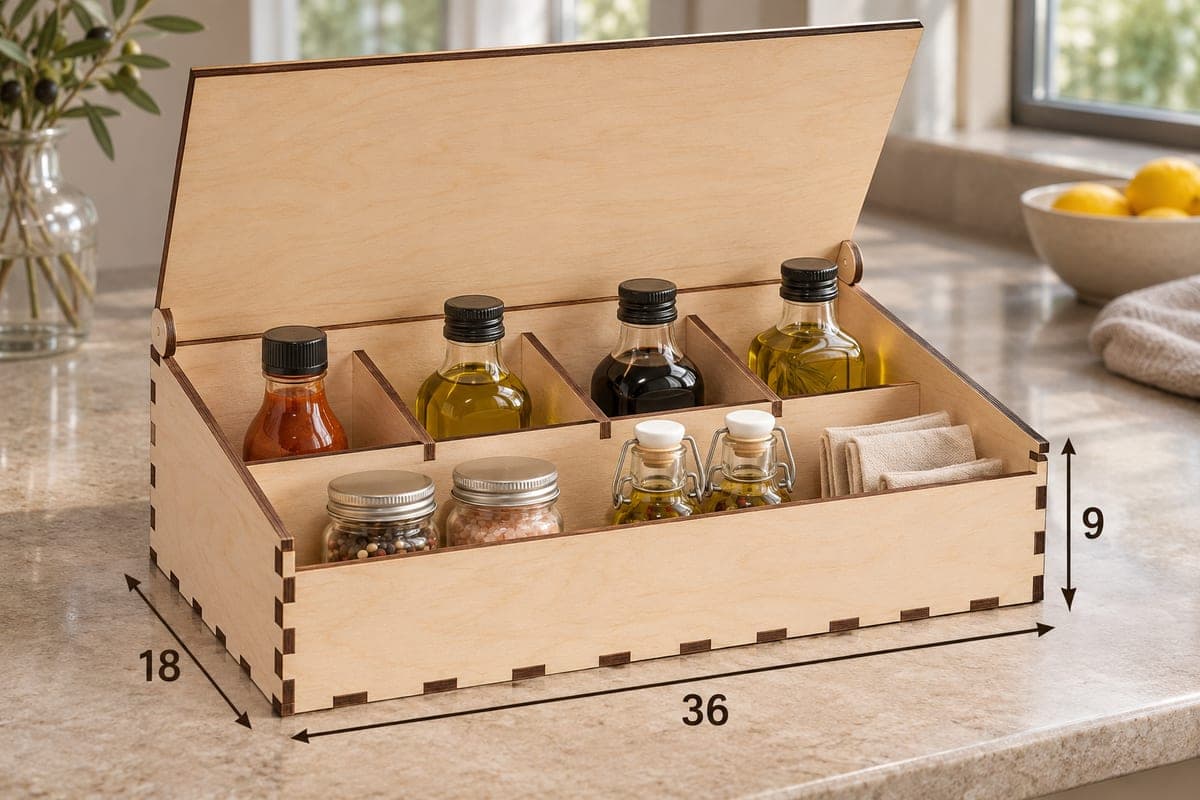
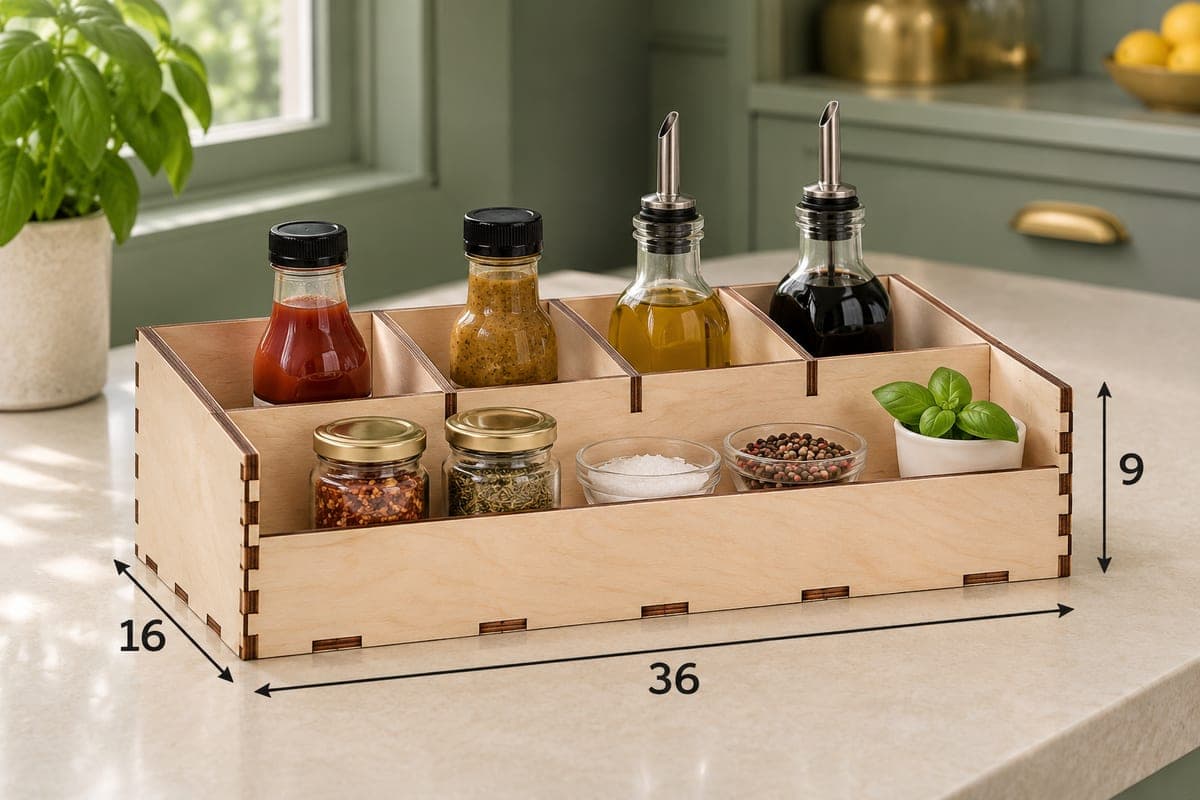
A sloped condiment caddy with four bottle bays along the back and one long open trough in front for jars and small bowls. The free download has SVG and DXF files for 3, 4, 5 and 6 mm plywood; it measures 360 × 160 × 90 mm (14.17 × 6.30 × 3.54 in), is cut from 9 pieces, and its sides slope from 90 mm at the back to a 50 mm front, all joined by tabs and slots.
- Formats
- SVG, DXF
- Outer size (W × D × H)
- 360 × 160 × 90 mm (14.17 × 6.30 × 3.54 in)
- Parts
- 9
- Material thickness
- 3, 4, 5 or 6 mm plywood (a file for each)
- Layout size (3 mm file)
- 1,424 × 262 mm
- Cut length
- 6.44 m
- Est. time, 10 W diode (3 mm)
- 21 min 28 s
- Est. time, 40 W CO2 (3 mm)
- 8 min 57 s
- Layers
- CUT only, no engraving
Free account required to download
How to make it
- 01Download the files for your plywood, cut the 50 mm front first and check its tabs against the base slots.
- 02Cut all nine pieces, moving them onto two or three sheets because the layout is 1424 mm long.
- 03Join base, back and the sloped sides, add the front, then fit the long cross divider and the three bay dividers behind it.
- 04Sand the sloped edges, seal with lacquer, and stand bottles in the back bays and jars in the front trough.
Bays behind, trough in front
This caddy splits its job in two. Along the back, three short dividers create four upright bays at the full 90 mm height for bottles that would tip over in an open tray: in the photo a ketchup bottle, a mustard bottle and two pourer bottles of oil and balsamic. In front of the 69.6 mm cross divider there is one long open trough with no dividers at all. That space takes whatever the day needs: jars of chilli flakes and dried herbs, small dishes of salt and peppercorns, even a little pot of basil.
The front wall is just 50 mm high, a little over half the back height, so you can reach into the trough from above without lifting the jars out.
Thickness and cutting
For a caddy that carries four full bottles, 4 mm plywood is a good middle choice. The 3 mm file cuts in about 21 min 28 s on a 10 W diode and about 4 min 18 s on a 100 W CO2. The layout is 1424 × 262 mm, a long thin strip, so on a typical 400 mm bed you will move parts onto two or three sheets. Expect several passes for 5 or 6 mm plywood on a diode.
Assemble the base with the back and sloped sides, add the front, then push the cross divider into place and finish with the three bay dividers. Glue is optional because the tabs lock everything in place, but a little wood glue on the base joints helps when the bottles are heavy.
Where it works
It suits a kitchen island, a barbecue station or a cafe counter where staff need sauces and a few toppings in one place. Seal it with clear lacquer so oil and sauce rings wipe away. Sell it in pairs at a craft fair, or fill it with oils and spice jars as a housewarming gift.
Questions about this file
Why is the front row one open space?
Jars, small bowls and shakers come in many sizes, so the trough has no dividers and takes any mix of them. The bottles behind get their own bays so they stay upright.
Can I add dividers to the trough?
Yes, cut extra strips the height of the 69.6 mm cross divider and glue them in place. There are no slots for them in the base, so glue is needed.
How do I make it shorter for a small counter?
Scaling the whole file shrinks the slots too, so they stop matching your plywood. Shorten the length in a vector editor and remove one bay instead.
Can it stand next to the sink or stove?
Yes, once sealed. Two coats of clear lacquer or a hard-wax oil keep splashes and grease from soaking in.
Could I cut this caddy from clear acrylic?
Clear 3 mm acrylic cuts well on a CO2 laser and looks smart on a cafe counter. Use the 3 mm file and glue the joints with acrylic cement, because acrylic has no give in tight slots.
Similar files