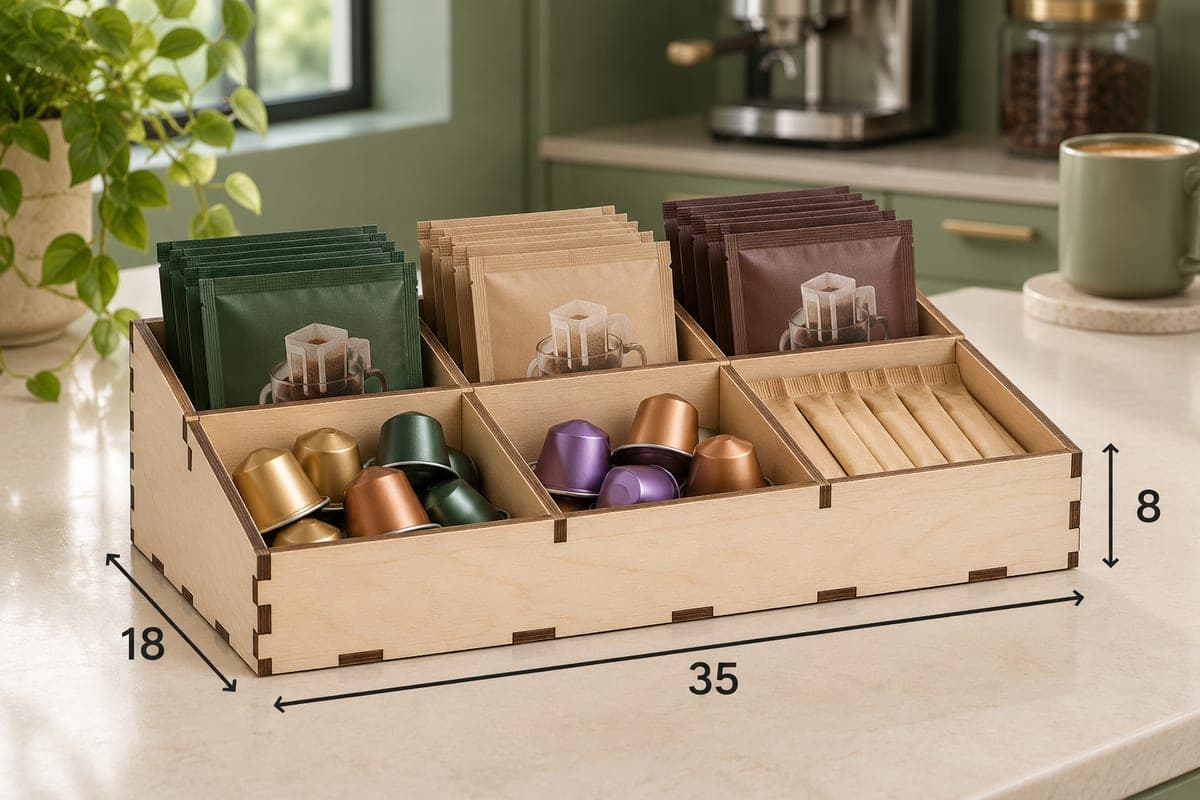
 Visualization
Coffee Bar Organizer SVG, Two Row Coffee Pod Caddy Laser Cut File, Drip Bag and Capsule Holder DXF
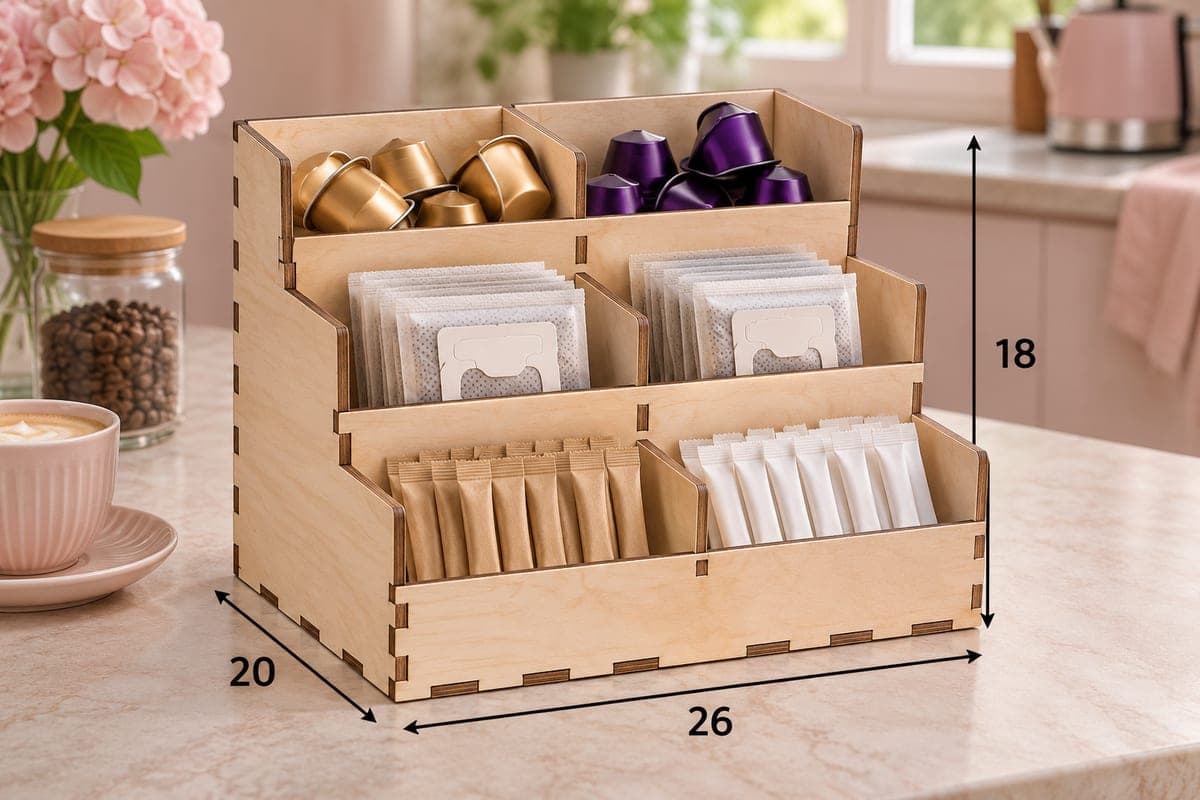
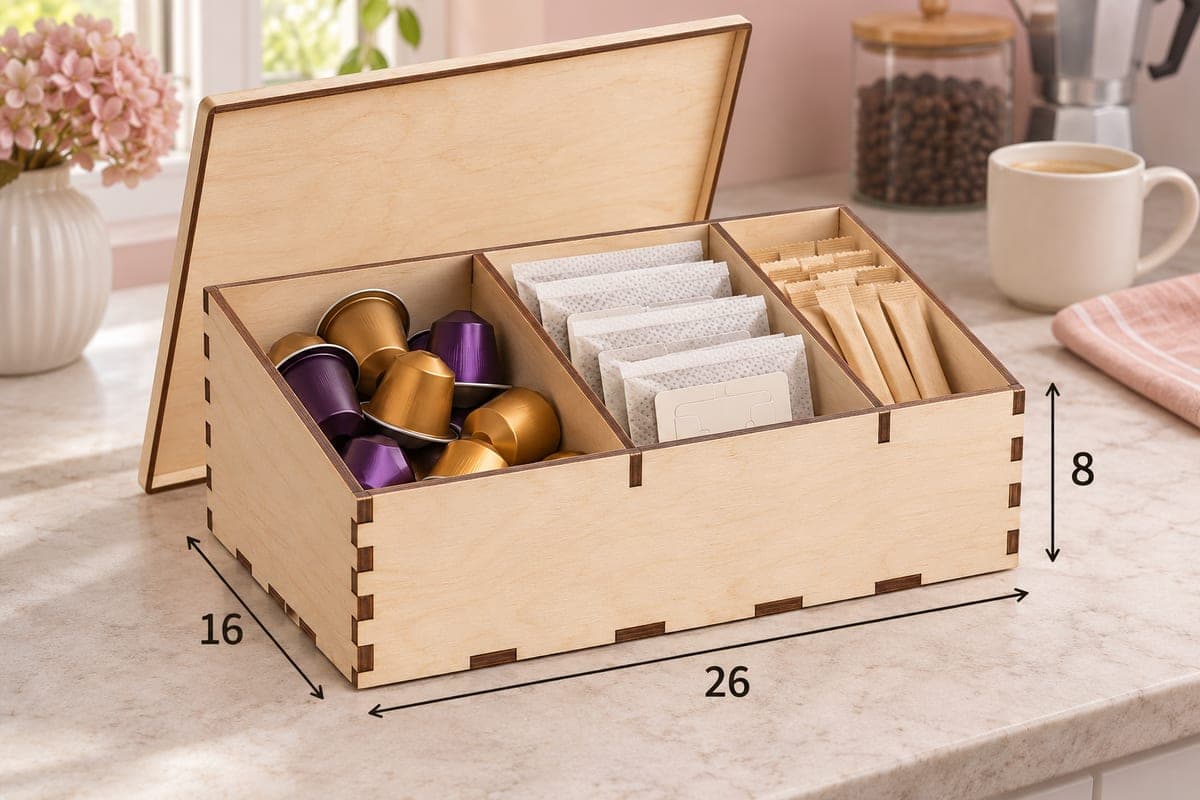
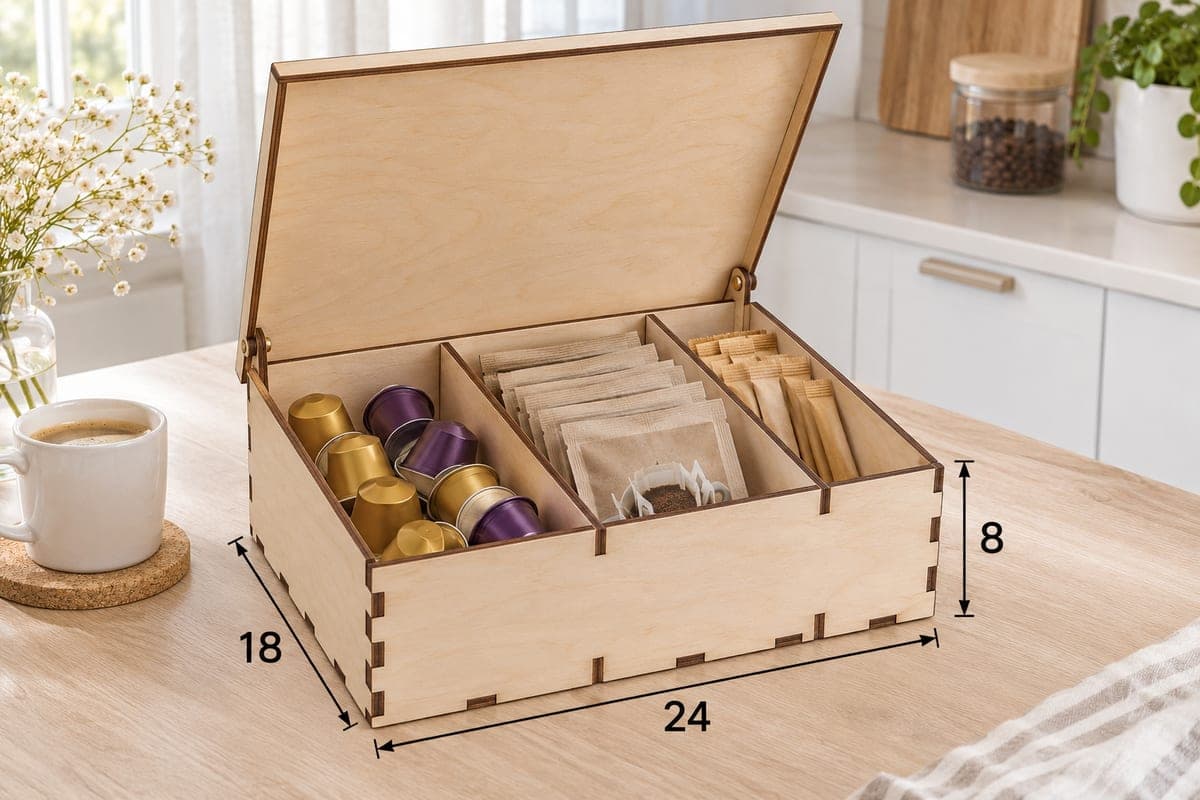
A free laser cut file for a long two-row coffee bar caddy with six sections: three tall ones at the back and three low ones at the front. The download has SVG and DXF files for 3, 4, 5 and 6 mm plywood, and the caddy measures 350 × 180 × 80 mm (13.78 × 7.09 × 3.15 in) with 10 pieces. The front wall is lower and the sides slope down to it, and the parts join with tabs and slots.
- Formats
- SVG, DXF
- Outer size (W × D × H)
- 350 × 180 × 80 mm (13.78 × 7.09 × 3.15 in)
- Parts
- 10
- Material thickness
- 3, 4, 5 or 6 mm plywood (a file for each)
- Layout size (3 mm file)
- 1,094 × 272 mm
- Cut length
- 6.79 m
- Est. time, 10 W diode (3 mm)
- 22 min 38 s
- Est. time, 40 W CO2 (3 mm)
- 9 min 26 s
- Layers
- CUT only, no engraving
Free account required to download
How to make it
- 01Choose the thickness folder that matches your plywood and test one short divider in a base slot before cutting everything.
- 02Cut the 10 parts across two or three sheets if your bed is shorter than the 1094 mm layout.
- 03Set the long cross divider into the base, add the two tall back dividers and the two low front ones, then fit the back, sloped sides and low front.
- 04Sand and seal the caddy, then fill the back row with sachets and the front row with pods and sticks.
Back row for sachets, front row for pods
This caddy uses its depth well. A long cross divider runs the whole 350 mm length and splits the box into two rows. The back row has full-height 80 mm dividers, so flat drip coffee sachets stand upright in three stacks, which the photo sorts by roast in green, kraft and dark brown packaging. The front row is much lower, with 48 mm dividers and a 44 mm front wall, and holds things you grab by the handful: two sections of espresso capsules and one of sugar sticks laid flat.
Because the front row is short, it never hides the sachets behind it. The sloped side panels follow the drop from the 80 mm back to the low front.
On the cutting bed
At 350 mm this is a long caddy, and the 3 mm layout is 1094 × 272 mm. On a diode or a compact CO2 that means two or three sheets; the long base and the cross divider are the pieces to plan around. Cutting time for the 3 mm file is about 22 min 38 s on a 10 W diode, about 9 min 26 s on a 40 W CO2 and about 4 min 32 s on a 100 W CO2.
Set the cross divider into the base first, then add the two tall back dividers and the two low front ones. The back, sides and front go on last. Glue is optional, but a dab in each wall corner keeps a long box from racking out of square.
Coffee bars and rentals
A caddy this size anchors a home coffee bar or a holiday rental welcome corner, because guests see every option at once. Sellers can offer it in a natural finish or stained to suit a kitchen, and a short three-lane tray in the same style turns it into a matching set.
Questions about this file
Why are the front sections lower?
The front row has 48 mm dividers and a 44 mm front wall, so it does not block the view of the tall back row. Pods and sticks are also easy to scoop out of a shallow section.
Do drip coffee bags fit in the back row?
Yes. The back sections are the full 80 mm tall, and standard drip sachets stand in them on edge, leaning back slightly as in the photo.
Could I cut it from acrylic for a café counter?
Acrylic works on a CO2 laser if you match the file to its measured thickness. Use acrylic cement instead of wood glue at the corners.
Can the caddy be scaled down for a smaller counter?
It can, but the slots shrink with it. After scaling, set each slot back to your sheet thickness so the dividers still fit.
Which thickness looks best at this length?
4 or 5 mm plywood keeps a 350 mm caddy rigid without looking bulky. 3 mm works as well if you glue the corners.
Similar files