 Visualization
Sliding Lid Box SVG, Six Compartment Napkin and Straw Storage Laser Cut File, Coaster Box DXF
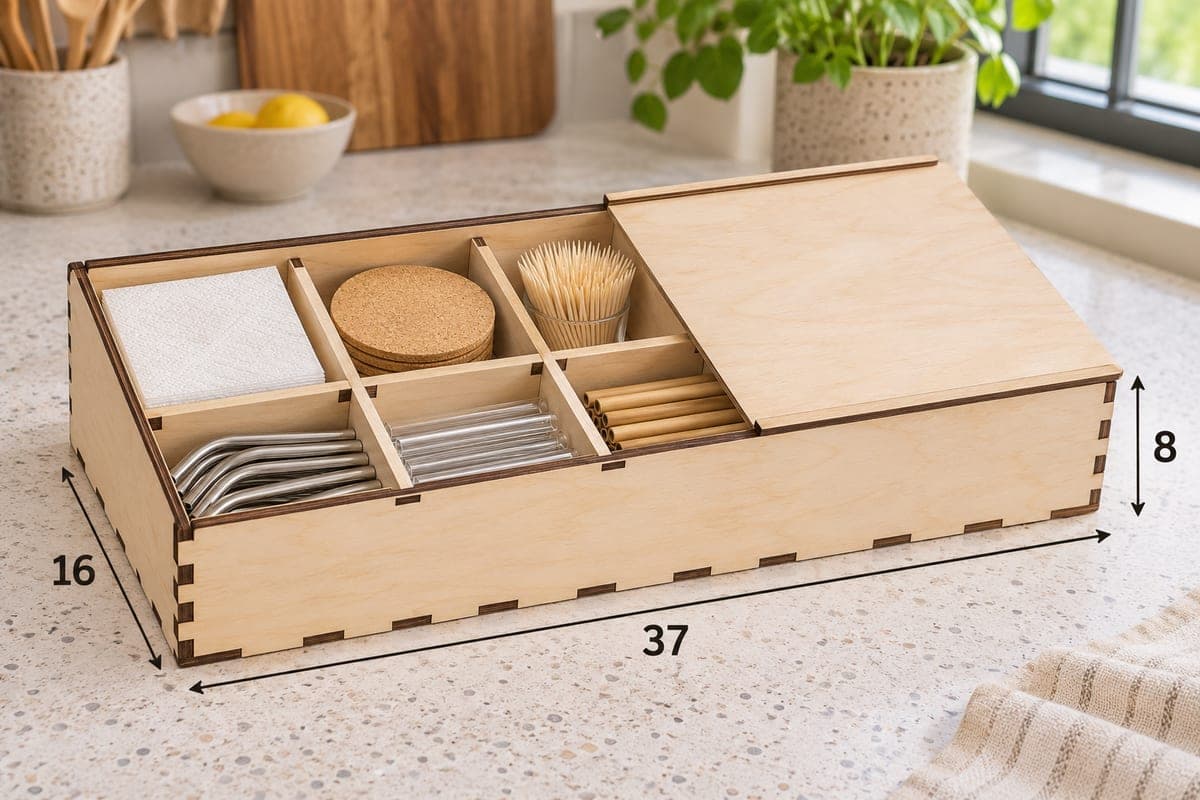
A free sliding lid box with six compartments in three columns and two rows, made to store paper napkins, coasters, reusable straws and toothpicks away from dust. The download includes SVG and DXF files for 3, 4, 5 and 6 mm plywood; the box is 370 × 160 × 80 mm (14.57 × 6.30 × 3.15 in) and is built from 11 pieces with tabs and slots, including two rails that carry the lid.
- Formats
- SVG, DXF
- Outer size (W × D × H)
- 370 × 160 × 80 mm (14.57 × 6.30 × 3.15 in)
- Parts
- 11
- Material thickness
- 3, 4, 5 or 6 mm plywood (a file for each)
- Layout size (3 mm file)
- 1,454 × 332 mm
- Cut length
- 9.35 m
- Est. time, 10 W diode (3 mm)
- 31 min 09 s
- Est. time, 40 W CO2 (3 mm)
- 12 min 59 s
- Layers
- CUT only, no engraving
Free account required to download
How to make it
- 01Choose the file for your plywood thickness and cut one rail and one wall slot on scrap to confirm the fit.
- 02Cut all 11 pieces, splitting the 1454 mm layout into a lid-and-base job and a walls-and-dividers job if needed.
- 03Assemble the walls on the base, slot in the three dividers, fit the two rails, and slide the lid in once any glue has set.
- 04Sand the lid edges until it moves freely, wax them, then load napkins, coasters, straws and toothpicks into the six cells.
Six cells under one lid
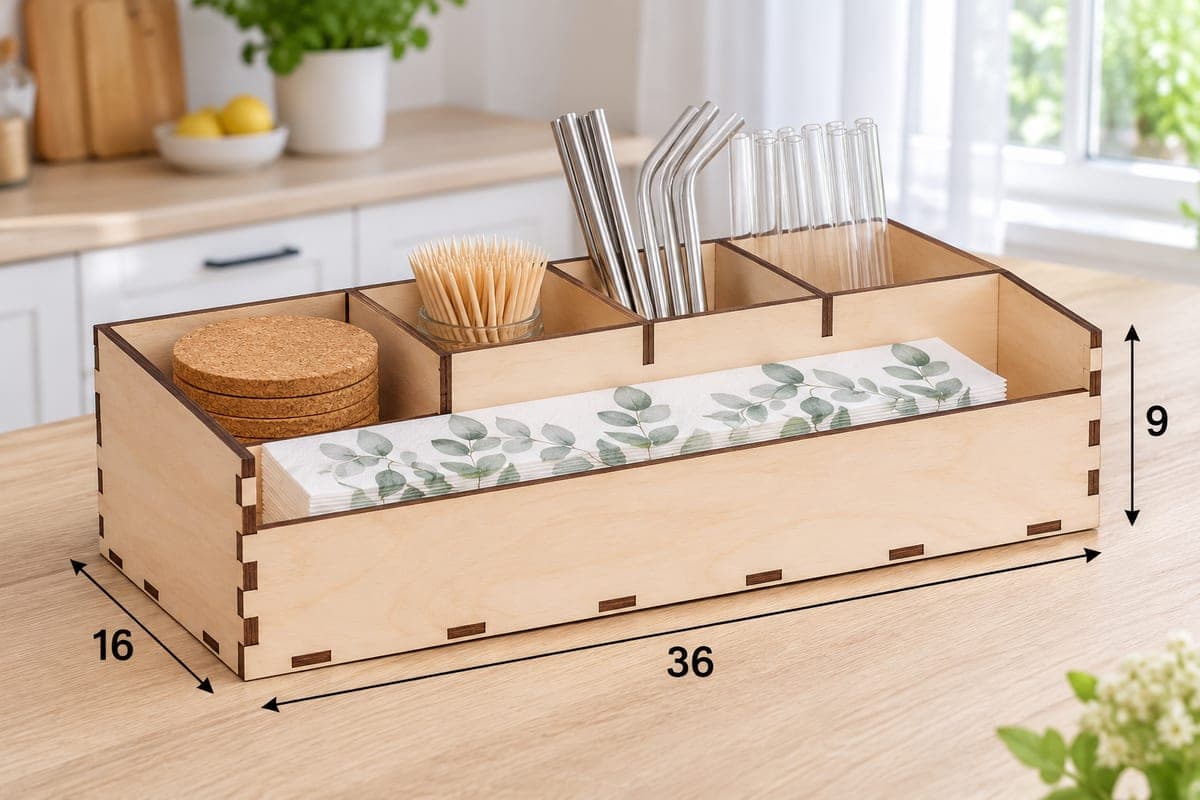
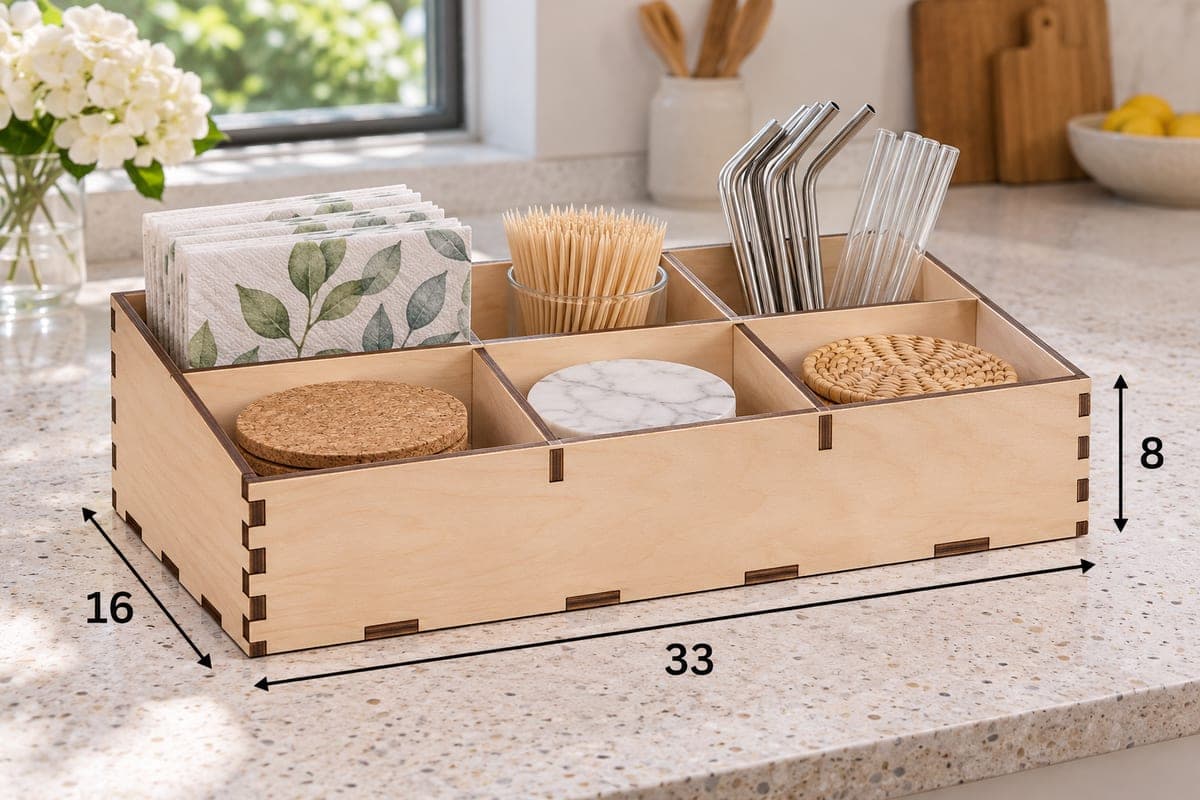
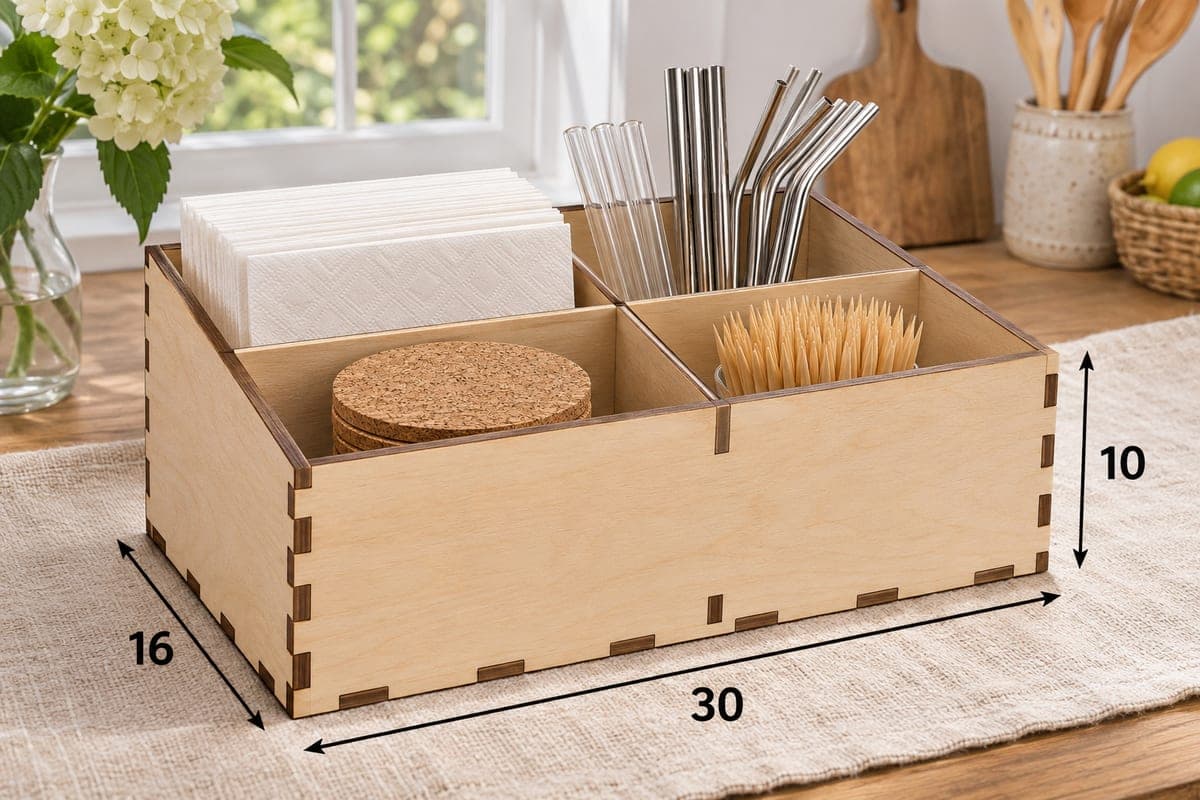
A long divider runs down the middle and two short ones cross it, making a grid of three columns by two rows. The photo fills the back row with a square of white napkins, round cork coasters and a glass of toothpicks, and the front row with bent steel straws, glass straws and bamboo straws. The flat lid slides in on two thin rails. There is no hinge and no lock, so you slide it partly open to reach one end of the box or pull it off completely while you set the table.
Cut time and plywood choice
For the 3 mm file the estimated time is about 31 min 09 s on a 10 W diode, about 12 min 59 s on a 40 W CO2 and about 6 min 14 s on a 100 W CO2. The 3 mm layout is 1454 × 332 mm; on a smaller bed, cut the lid and base as one job and the walls, dividers and rails as another. A 3 mm lid is the lightest to slide, while 5 or 6 mm plywood gives a heavier, chunkier box that a diode needs several passes to get through. Everything in the file is a cut line.
Assembly and finishing
Build the four walls around the base, then press in the long divider and the two short ones. Fit the two rails, let any glue dry, and only then try the lid. If it sticks, sand the lid edges rather than the rails, and rub a little wax along them so it glides.
The lid is a wide blank panel, which makes this box a good piece to personalise with a family name or a restaurant logo. Sell it as a matching set with napkin rings or coasters, or fill it with sugar sticks and stirrers for an office coffee corner.
Questions about this file
What can I store in the six cells?
Folded napkins, a stack of coasters, straws, toothpicks, sugar sachets or tea bags. Each cell is about a third of the 370 mm length wide.
Why does my lid feel tight?
Plywood often runs a little thicker than its label. Measure your sheet, choose the closest file, and sand the lid edges if it still binds.
Would a clear acrylic lid work on this napkin box?
Yes, as long as the acrylic is the same thickness as the plywood file you chose. A clear lid lets you see what is inside before you open it.
Is the box fine in a damp kitchen?
Seal every surface with water-based lacquer or hard-wax oil first. It copes well with kitchen air, but keep it away from the sink.
What happens to the rail gap if I scale the box?
Scaling changes the slots and the lid gap too, so they stop matching your sheet. Resize the outline only and keep slot widths at the plywood thickness.
Similar files