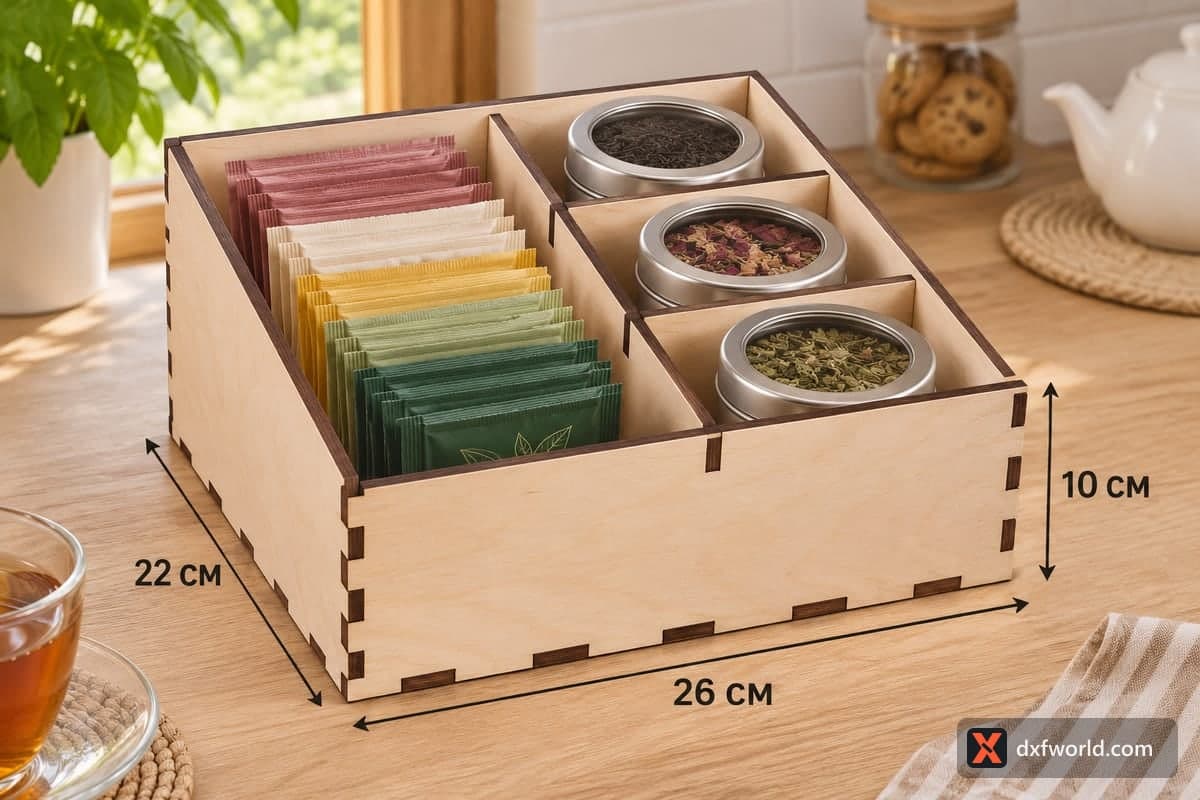
 Visualization
Open Tea Bag Box SVG, Simple Two Compartment Tea Holder Laser Cut File, Beginner Plywood Tea Box DXF
A free open tea bag box laser cut file in SVG and DXF, with separate versions for 3, 4, 5 and 6 mm plywood. It measures 260 × 220 × 100 mm (10.24 × 8.66 × 3.94 in), has two compartments split by one front-to-back divider, and is cut as just 6 pieces that join with tabs and slots. With straight walls and an open top, it is one of the quickest tea boxes to cut and assemble.
- Formats
- SVG, DXF
- Outer size (W × D × H)
- 260 × 220 × 100 mm (10.24 × 8.66 × 3.94 in)
- Parts
- 6
- Material thickness
- 3, 4, 5 or 6 mm plywood (a file for each)
- Layout size (3 mm file)
- 980 × 332 mm
- Cut length
- 5.61 m
- Est. time, 10 W diode (3 mm)
- 18 min 41 s
- Est. time, 40 W CO2 (3 mm)
- 7 min 47 s
- Layers
- CUT only, no engraving
Free account required to download
How to make it
- 01Pick the file for your plywood and cut one wall corner on scrap to see that the tabs close without gaps.
- 02Cut the six pieces: front, back, left and right walls, base and the divider.
- 03Fit the walls around the base one at a time, then press the divider into its slots.
- 04Sand the rim, add oil or lacquer, and file tea bags in the wide bay and tins in the slim one.
Simple layout
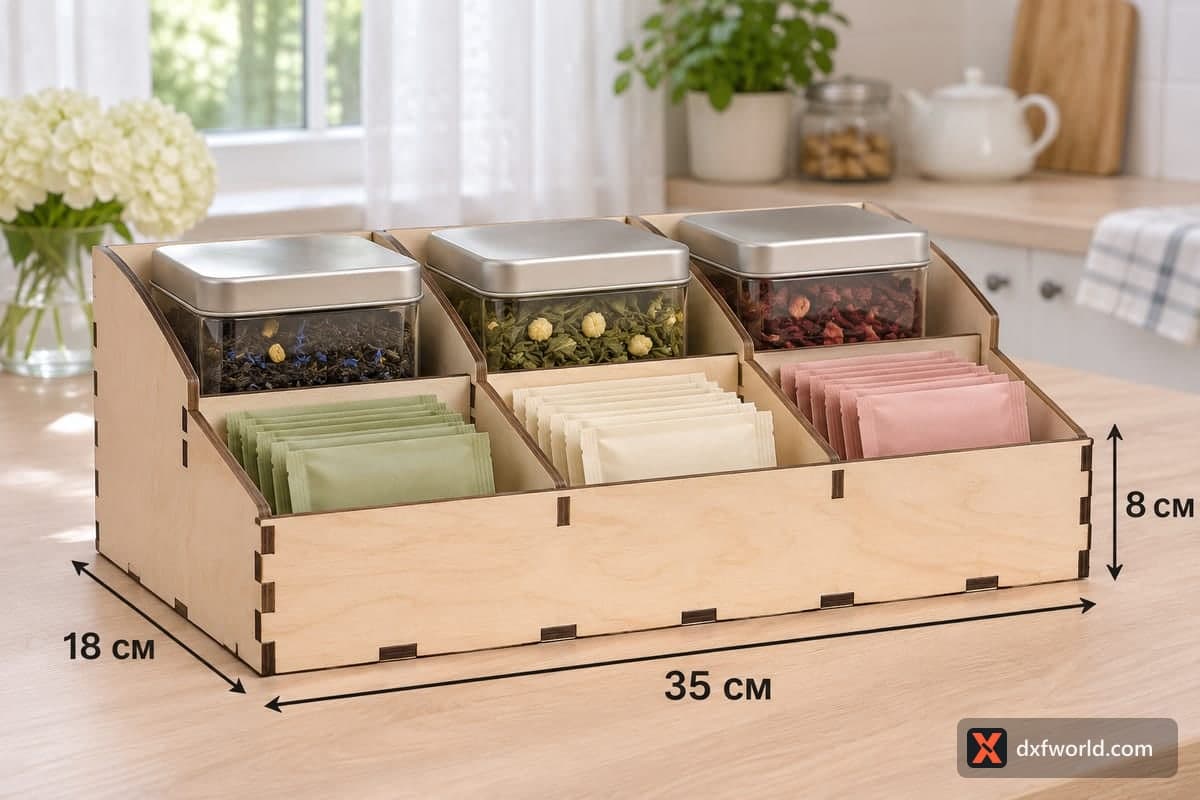
Four straight walls of equal height, a base and one divider: that is the whole box. The divider stands slightly lower than the walls and splits the floor into a wide bay and a slimmer one. In the photo the wide bay holds a long row of tea bags filed on edge, from pink and cream through yellow to dark green, and the slim bay holds three round tins of black tea, rose petals and dried herbs. The photo also shows two small cross strips between the tins; they are not part of the file, though offcut strips glued in place do the same job.
A good first project
Only six parts means few joints to line up, which makes this box a sensible first build for a new diode or CO2 owner. For the 3 mm file expect about 18 min 41 s on a 10 W diode, about 7 min 47 s on a 40 W CO2 and about 3 min 44 s on a 100 W CO2. The layout is 980 × 332 mm, so a small bed fits it in two or three sheets: base on one, walls and divider on the others. Choose 5 or 6 mm only if your laser cuts that depth cleanly.
Slot the four walls into the base, tap them home with a rubber mallet or the heel of your hand, and push the divider into its slots. Dry joints hold, but a thin line of wood glue in the corners makes the box rigid enough to carry full.
Sell it in batches
Because it cuts fast, this box is easy to make in numbers for a craft fair table, a cafe tea counter or a set of small thank-you gifts filled with a few tea bags. Engrave a short word or a leaf on the front wall if you like.
Questions about this file
Why is the tea bag bay wider than the other?
Tea bags are filed on edge in a long row, so they need width, while round tins line up front to back in the narrower bay.
Can I add a lid to this box?
This file is an open box without a lid. If you want one, look at the sliding lid and hinged tea boxes in the same category.
Is 3 mm plywood strong enough for this open box?
Yes, for tea bags and a few tins 3 mm is plenty; choose 4 or 5 mm only if you want a heavier box with thicker edges.
Can I cut the tea bag box from MDF?
MDF works with the file matching its thickness, but it soaks up moisture, so seal it well if it will stand near a kettle.
How do I resize the box for a different drawer?
Change the outer size in your design software while keeping every slot at your sheet thickness, then cut a test corner before the full run.
Similar files