 Visualization
Tea Storage Box SVG, Four Section Tea Bag Organizer Laser Cut File, Open Wooden Tea Tray DXF
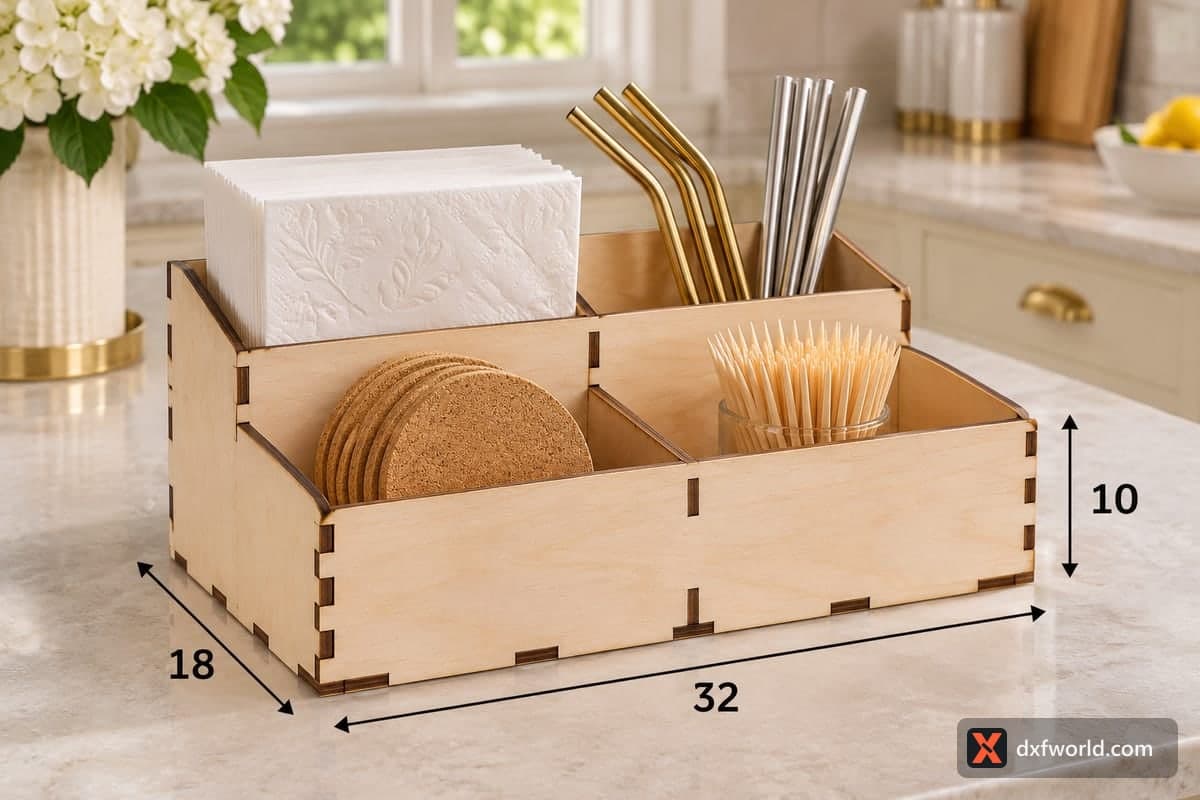
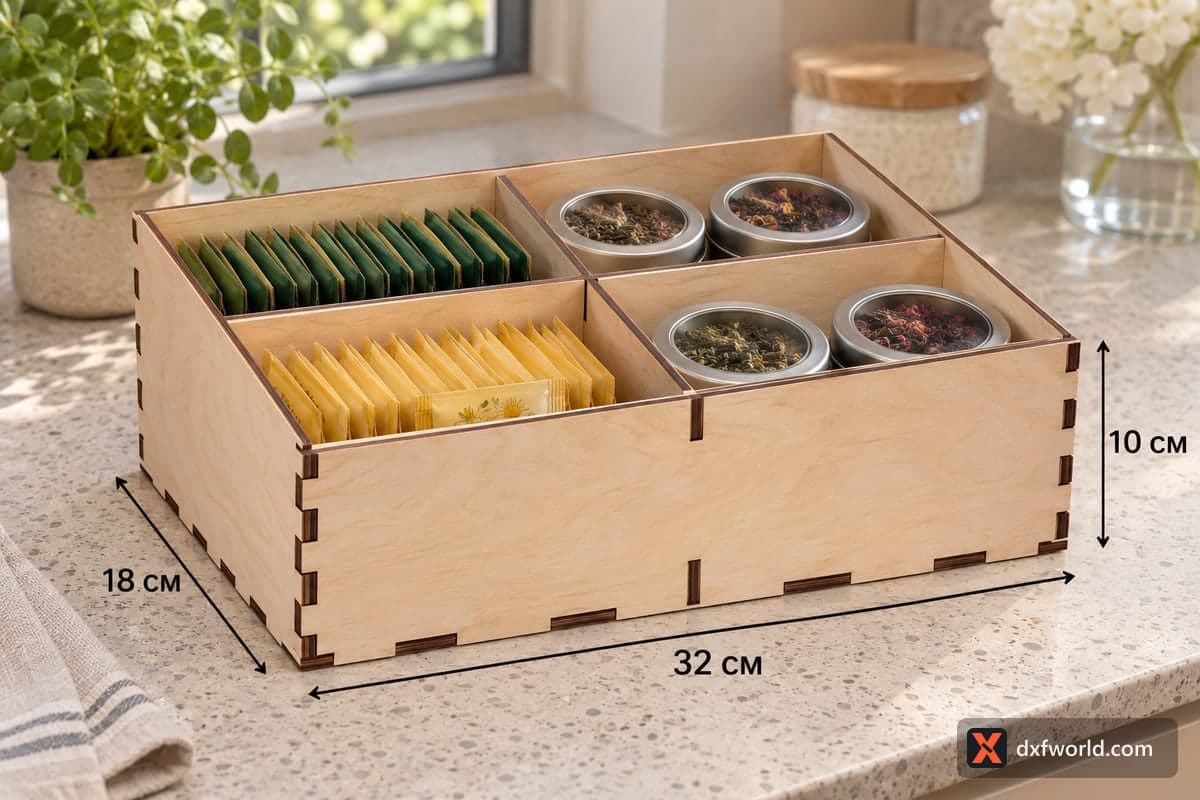
An open tea storage box with straight walls and a grid of two dividers that slot together into 4 equal compartments for tea bags and small tins. The free download has SVG and DXF files for 3, 4, 5 and 6 mm plywood; the box measures 320 × 180 × 100 mm (12.60 × 7.09 × 3.94 in), is made of 7 pieces and assembles with tabs and slots.
- Formats
- SVG, DXF
- Outer size (W × D × H)
- 320 × 180 × 100 mm (12.60 × 7.09 × 3.94 in)
- Parts
- 7
- Material thickness
- 3, 4, 5 or 6 mm plywood (a file for each)
- Layout size (3 mm file)
- 1,020 × 292 mm
- Cut length
- 7.29 m
- Est. time, 10 W diode (3 mm)
- 24 min 17 s
- Est. time, 40 W CO2 (3 mm)
- 10 min 07 s
- Layers
- CUT only, no engraving
Free account required to download
How to make it
- 01Download the SVG or DXF for your plywood thickness and do a quick test cut of one half-slot to see how the dividers mate.
- 02Cut the 7 pieces, splitting the 1020 mm layout into two or three jobs if your bed is small.
- 03Fit the base between front and back, add both ends, then lock the long and short divider together and lower them in.
- 04Sand the joints, oil the box and sort tea bags and tins into the four sections.
What goes in the four sections
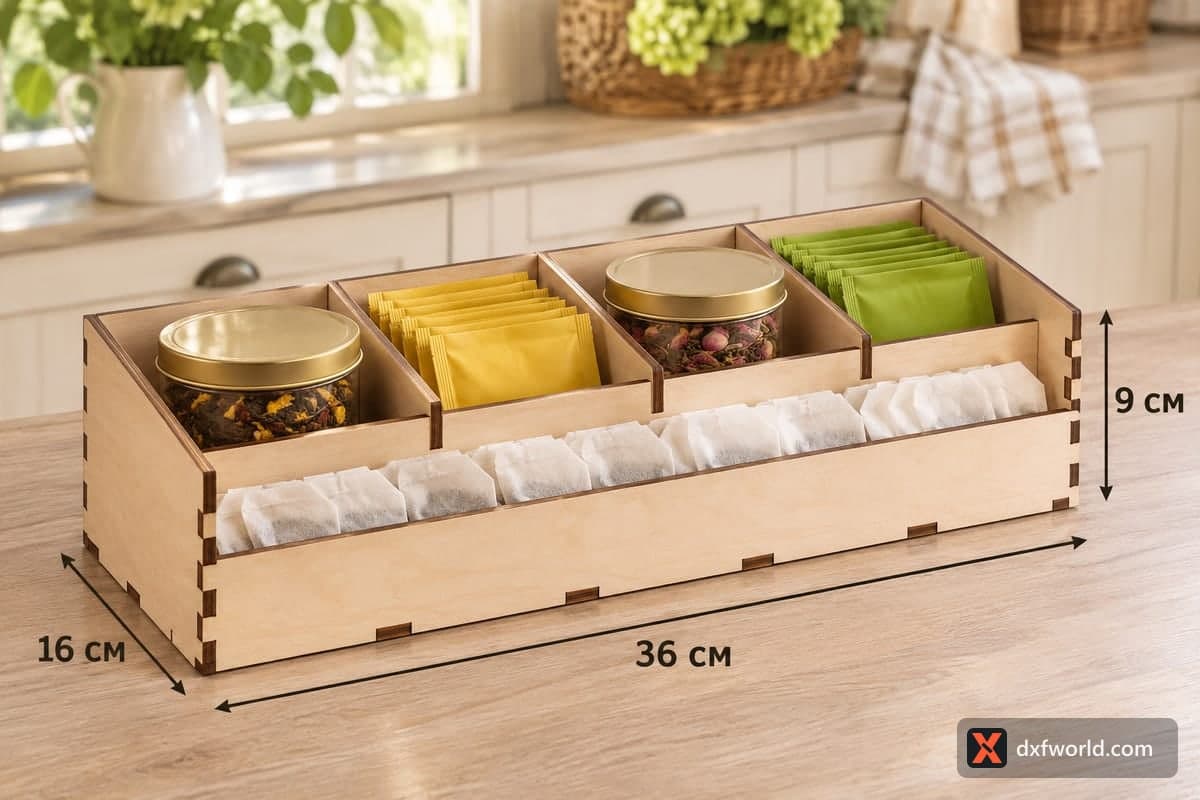
This is the simplest box in the tea range: four walls, a base and two dividers that cross in the middle. Each section is roughly 16 × 9 cm inside, deep enough for wrapped bags standing upright and wide enough for two small round tins side by side. The photo shows green sachets and yellow sachets on the left and four tins of loose leaf, rose and herbal blends on the right. The dividers are cut to about 90 mm, a little under the 100 mm walls, so your fingers slip over them easily.
With no lid it sits open on the counter or slides into a deep drawer, where it keeps the tea sorted by type.
Seven pieces, one evening
The pieces are the front, back, two ends, the base, one long divider and one short divider. The layout is 1020 × 292 mm, so a 600 mm bed can take it in two jobs and a 300 mm wide diode bed in three. For the 3 mm file, cutting takes about 24 min 17 s with a 10 W diode, about 10 min 07 s with a 40 W CO2, or about 4 min 51 s with a 100 W CO2. In 5 or 6 mm stock a diode needs more passes, so a CO2 is the easier route there.
Slide the base into the front and back, close the ends, then cross the dividers through their half-slots and drop the pair into the box. The joints hold without glue, though a thin line of wood glue on the base makes it sturdier for lifting full.
Finishing and gift ideas
Lightly sand the finger joints and rub in a food-safe oil. Sell a few in matching sizes as a set for a coffee and tea corner, fill one with four favourite blends for a birthday, or offer it to a B&B for the breakfast tray.
Questions about this file
How big is each section?
Each of the four sections is about 16 cm wide and 9 cm deep inside, with 90 mm high dividers.
Can I make a six-section version?
The file has one long and one short divider; you could draw an extra short divider yourself, matching the slot width to your plywood.
What happens if I scale the file?
The outer size changes, but slots scale too, so reset them to your material thickness or the joints will not fit.
Would MDF work for this tea box?
MDF cuts cleanly and is fine for a dry cupboard, but plywood copes better with kitchen humidity.
Does it need glue?
No, the tabs hold it together; glue only if you want the box to stay square when carried full of tins.
Similar files