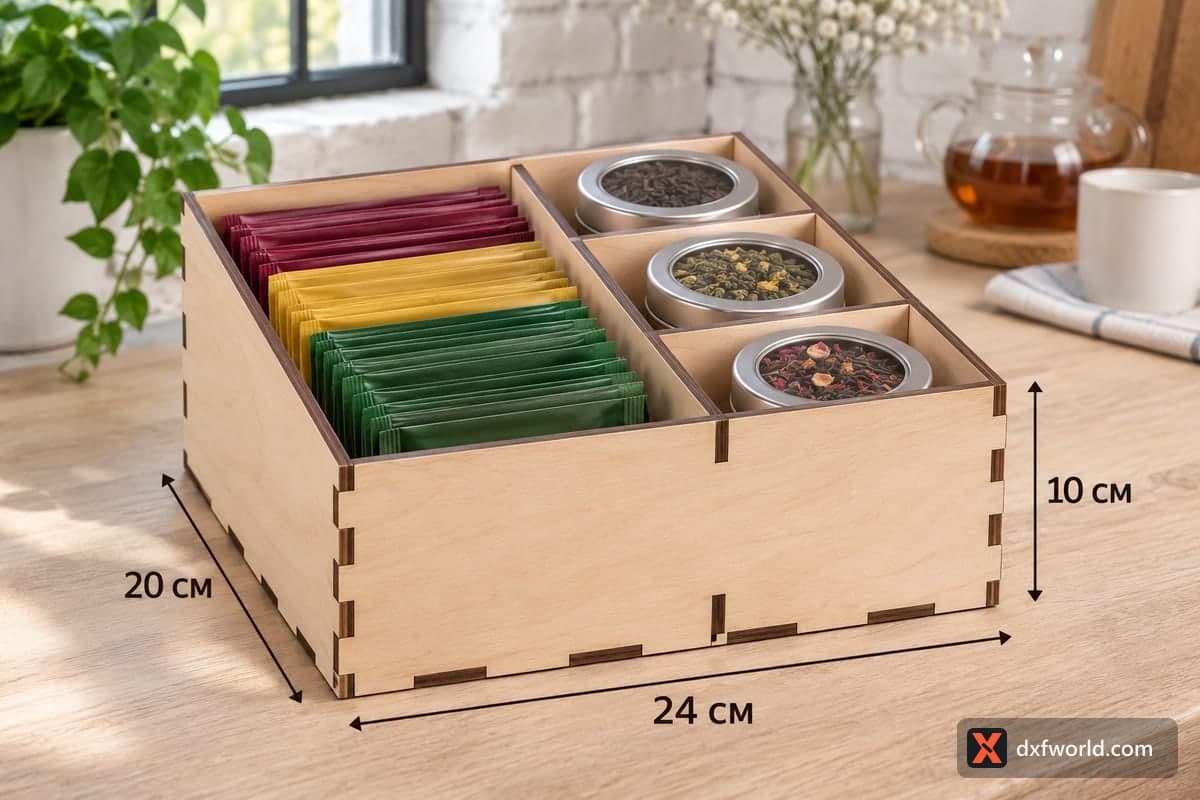
 Visualization
Tea Bag Caddy SVG, Compact Tea Organizer Laser Cut File, Wooden Tea Tin and Bag Box DXF
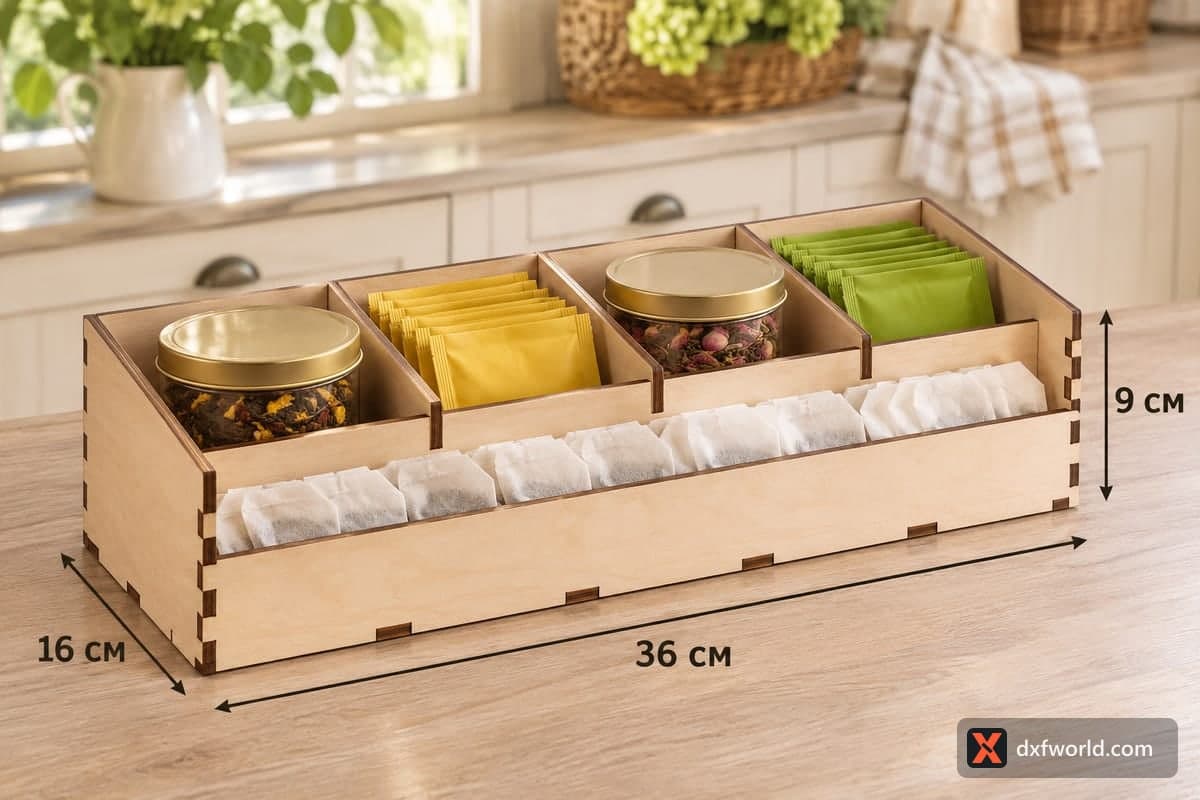
A compact open tea caddy with a low front and sloped sides: one wide bay for rows of tea bags on the left and a column of three small bays for tins on the right, 4 compartments in total. The free download has SVG and DXF files for 3, 4, 5 and 6 mm plywood; the caddy measures 240 × 200 × 100 mm (9.45 × 7.87 × 3.94 in) and is cut as 8 pieces that slot together with tabs.
- Formats
- SVG, DXF
- Outer size (W × D × H)
- 240 × 200 × 100 mm (9.45 × 7.87 × 3.94 in)
- Parts
- 8
- Material thickness
- 3, 4, 5 or 6 mm plywood (a file for each)
- Layout size (3 mm file)
- 900 × 312 mm
- Cut length
- 5.19 m
- Est. time, 10 W diode (3 mm)
- 17 min 19 s
- Est. time, 40 W CO2 (3 mm)
- 7 min 13 s
- Layers
- CUT only, no engraving
Free account required to download
How to make it
- 01Choose the file made for your plywood thickness and cut one cross divider first to check that it fits the long divider's slot.
- 02Cut the 8 pieces from the 900 × 312 mm layout, in one or two jobs depending on your bed.
- 03Join base, back and sloped sides, add the 65 mm front, then insert the long divider and the two cross dividers with the lower one at the front.
- 04Sand all edges, oil or lacquer the caddy, then stand tea bags on the left and tins in the three right-hand bays.
One big bay and a column of three
A full-depth divider splits this small caddy into two halves. The left half is one open bay that runs from front to back, where wrapped tea bags stand in rows by flavour; in the photo there are red, yellow and green sachets one behind the other. The right half is cut into three small bays by two short cross dividers, each just right for one round tin of loose leaf. The front wall is 65 mm high and the sides slope up to the 100 mm back, so the back rows are as easy to reach as the front ones.
At 24 × 20 cm it takes up less counter space than a chopping board, which makes it a good fit next to a kettle or on a narrow shelf.
Cutting notes
The 8 pieces are a front, back, two sloped sides, base, one long divider and two short cross dividers of slightly different heights. The layout is only 900 × 312 mm, so many diode lasers can cut it in two passes of the bed. For the 3 mm file it takes about 17 min 19 s on a 10 W diode, about 7 min 13 s on a 40 W CO2 and about 3 min 28 s on a 100 W CO2. Diode owners should cut 5 and 6 mm sheets slowly or in several passes.
Assembly and care
Set the base into the back and sides, then add the front. Push the long divider in, then fit the two cross dividers into the right half, the lower one at the front. The slots grip without glue; add a little if the caddy will be carried around. Sand, then seal with oil or lacquer so splashes from the kettle wipe off.
Small and quick to cut, it suits a market table at a low price, a secret-Santa gift with three loose teas, or a set of matching caddies for a holiday rental kitchen.
Questions about this file
How many tins does it hold?
Three small round tins, one in each right-hand bay; each bay is about 9 cm wide and 6 cm deep.
How many tea bags fit in the large bay?
The left bay is about 14 cm wide and nearly 20 cm deep, enough for three or four rows of wrapped bags.
Why is one tin divider shorter than the other?
They follow the sloped sides, so the front one is lower and the back one taller, which keeps every bay easy to see.
Can I cut it in acrylic for a cafe?
Use the 3 mm file with acrylic and test the slot fit, since acrylic has no give; clear acrylic looks good on a counter.
Can I enlarge it for coffee pods?
You can scale it up, as long as you set the slot width back to your plywood thickness afterwards.
Similar files